Vinland
Vinland is the name given by Norse explorers to a coastal region of North America visited around the year 1000 AD, nearly five centuries before the voyages of Christopher Columbus and John Cabot. The area, whose name likely means "Land of Wine," represents the earliest known European exploration of the continent. Its significance to Canada is cemented by the 1960 archaeological discovery at L'Anse aux Meadows in Newfoundland, the only authenticated Norse site in North America, which provides physical evidence of this pre-Columbian contact. The story of Vinland, preserved in Icelandic sagas, forms a foundational chapter in the early history of Atlantic Canada and continues to be a subject of public fascination and scholarly research.
Etymology and the Debate Over the Name
The etymology of the Old Norse name Vinland is centred on the interpretation of the root 'vin-'. The dominant and historically consistent explanation is that it derives from 'vín', the Old Norse word for wine. This is supported by the earliest written record outside the sagas, Adam of Bremen's 'Descriptio insularum Aquilonis' from about 1075, which states the land was called Winland because grapevines grew there producing wine. The 13th century Icelandic sagas, the Saga of Erik the Red and the Saga of the Greenlanders, repeatedly mention the discovery of 'vínber' or wineberries, a term scholars like Birgitta Wallace confirm refers specifically to grapes, not other berries. Kirsten Seaver has noted the alternative 'pastureland' interpretation has been thoroughly discarded, leaving the long-vowelled 'vin' for wine as the incontrovertible meaning.
An alternative theory was introduced by Sven Söderberg in 1898, proposing the name came from 'vin' with a short vowel, meaning meadow or pasture. Haugen argued the 'vin' element had changed its meaning from pasture to farm long before the Viking Age, and such names are absent from places colonized in that period. The archaeological discovery of butternut shells at L'Anse aux Meadows provides indirect support for the wine land theory. Butternuts and wild grapes (Vitis riparia) share a similar northern limit in the St. Lawrence River region and New Brunswick, indicating the Norse travelled far enough south to encounter grapes, making the name's origin a practical observation.
The Saga of the Greenlanders: A Detailed Narrative
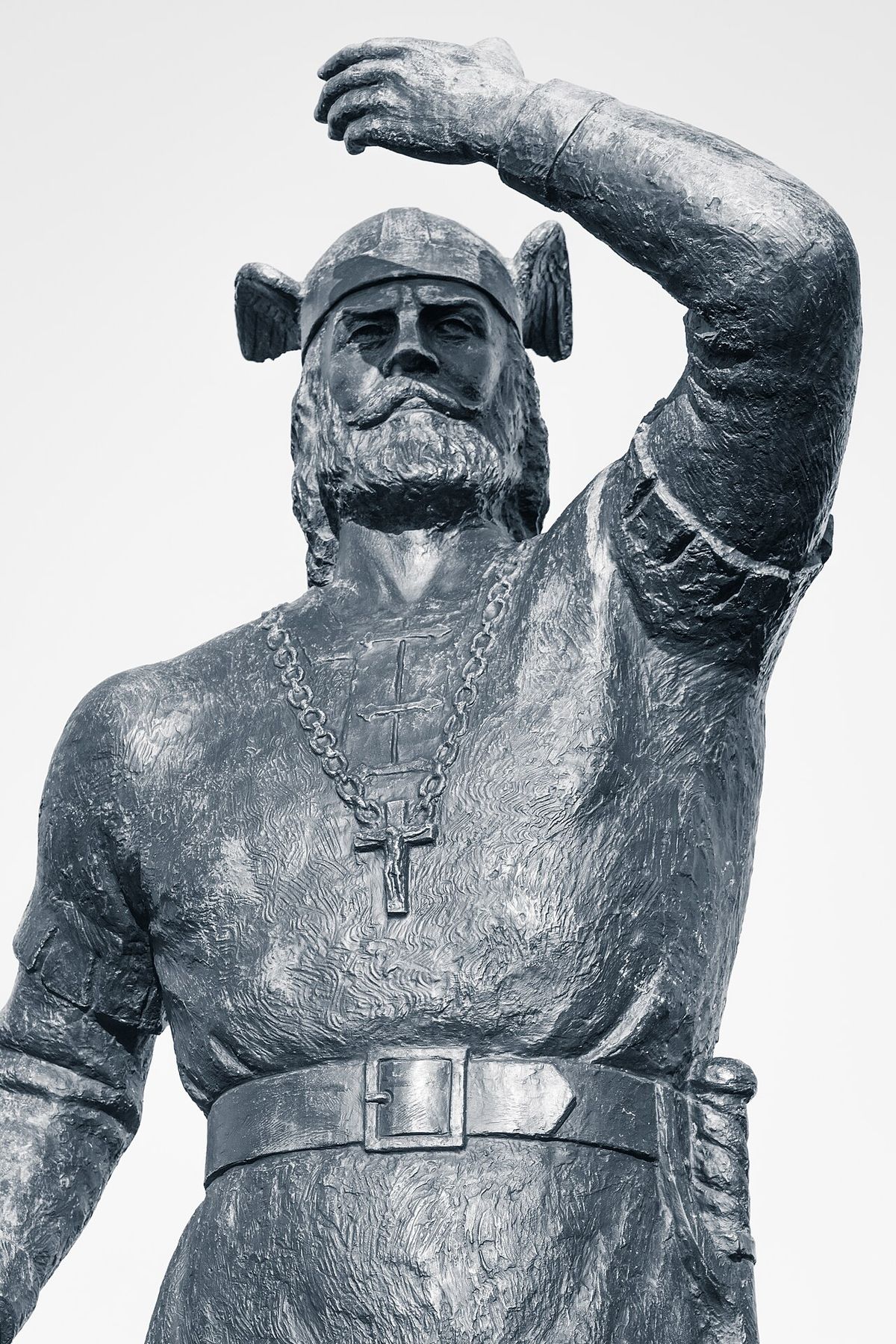
The Saga of the Greenlanders provides one of the two major narrative accounts of the Vinland voyages. It begins with Bjarni Herjólfsson who, around 986 AD, was sailing from Iceland to Greenland to visit his father when he was blown off course. He sighted new lands with flat stones, forests, and a mountainous area but did not land. Upon reaching Greenland, he was later criticized for not exploring these lands. His story inspired Leif Erikson, who purchased Bjarni's ship and organized an expedition with a crew of 35. Leif retraced the route in reverse, first landing at a place of flat stones he named Helluland, then a forested land named Markland. Sailing onward, they found a land with grapes and mild winters where they built a base, Leifsbudir (Leif's Booths).
Subsequent expeditions followed Leif's. His brother Thorvald led a crew of 30 and used Leifsbudir as a base for three winters. During explorations, they had a fatal encounter with Indigenous people, the Skrælings, and Thorvald died from an arrow wound. Another brother, Thorstein, attempted to retrieve Thorvald's body but failed. The most substantial expedition was led by the Icelander Thorfinn Karlsefni, who brought livestock and a crew of 60. He married Gudrid, widow of one of Thorstein's crew. At Vinland, Gudrid gave birth to a son, Snorri, the first European known to be born in North America. After initial trade with Skrælings, conflict arose, leading the Norse to retreat to a defensive position. They returned to Greenland after further explorations. A final, violent expedition was led by Freydís, daughter of Erik the Red, who orchestrated the murder of her Icelandic partners.
The Saga of Erik the Red: An Alternate Version
The Saga of Erik the Red presents a more consolidated but differing account. Here, Leif Erikson discovers the new land accidentally on a return voyage from Norway after being commissioned by King Olaf Tryggvason to spread Christianity in Greenland. He finds grapes, wheat, and timber. The saga then focuses on a large, well equipped expedition led by Thorfinn Karlsefni, with a company of 140 or 160 people including his partner Snorri Thorbrandsson, Bjarni Grimolfsson, Thorhall Gamlason, and Leif's siblings Thorvald and Freydís. They sailed past Helluland and Markland, rounded a headland called Kjalarnes (Keel Point), passed the long Furðustrandir (Wonderstrands), and established a main camp at Straumfjörð.
From Straumfjörð, the party split. Thorhall Gamlason took nine men north to seek Vinland but was lost at sea. Karlsefni, Snorri, and others sailed south with over 40 men to a place called Hóp, a sheltered lagoon accessible by river at high tide. They found abundant grapes and wheat and spent a mild winter there. Trade with Skrælings occurred, but conflict erupted when the Norse bull frightened the locals. During an attack, the pregnant Freydís scared the attackers away by brandishing a sword. The group returned to Straumfjörð. Later, Karlsefni and Thorvald Eriksson explored south of Kjalarnes, where Thorvald was killed by an arrow shot by a one footed creature. The expedition ultimately ended after disagreements, and on the return to Greenland, Bjarni Grimolfsson's ship was destroyed by marine worms in the 'Sea of Worms', with only those in the ship's worm proofed boat surviving.
Archaeology at L'Anse aux Meadows: Uncovering the Base Camp
The discovery of L'Anse aux Meadows in 1960 by Norwegian explorer Helge Ingstad and archaeologist Anne Stine Ingstad transformed Vinland from saga legend to historical fact. The architectural style, with long fireplaces and earthen benches, is identical to Norse structures in Iceland and Greenland from the late 10th or early 11th century. The site was not a farming settlement but a strategic base for exploration and ship repair, likely occupied for a relatively short period, perhaps a decade or less, by crews numbering in the dozens. Key artefacts confirm Norse identity and activity. These include a bronze ring headed pin of Norse design, a soapstone spindle whorl, a small stone lamp, and abundant iron slag from a smithy where bog iron was processed. The presence of a smithy indicates self sufficiency in tool and nail production for boat repair. Woodworking debris, particularly from deciduous trees not native to Newfoundland, points to repair operations. The most significant environmental finds were butternut shells and a piece of burl wood from a butternut tree. Since butternuts do not grow north of New Brunswick, this is definitive proof that the Norse explored the Gulf of Saint Lawrence region extensively, likely collecting resources from more southern areas and bringing them back to their Newfoundland base. This evidence strongly supports the identification of L'Anse aux Meadows with the saga location Straumfjörð.
Medieval European Knowledge and Cartography
Knowledge of Vinland entered medieval European scholarship primarily through Adam of Bremen, who wrote his account around 1075 based on information from King Svend Estridson of Denmark. Adam described Winland as an island rich in vines, situating it in the northern Atlantic. This reference shows that news of the Norse discoveries reached continental courts. In the early 14th century, the Italian friar Galvano Fiamma mentioned the Norse region of Markland in his 'Cronica universalis', making him likely the first southern European to write about this part of the New World. However, geographical understanding was often vague and confused.
An English geography encyclopedia, the 'Geographica Universalis' compiled at Malmesbury Abbey, and the widely circulated 'Polychronicon' by Ranulf Higden, both referenced a place called Wintland. The Malmesbury monk incorrectly placed it in the ocean east of Norway, while Higden placed it west of Denmark. Copies of the 'Polychronicon' often included a world map where Wintland appeared as an island in the Atlantic near Iceland, but far closer to Scandinavia than in reality. The earliest known map specifically of Vinland was drawn by the Icelandic schoolmaster Sigurd Stefansson around 1570. His sketch shows a large peninsula labelled 'Vinland' with prominent bays, which historians have attempted to match to locations from Chesapeake Bay to Cape Cod, though its precise correlation remains speculative. These documents illustrate how specific Norse geographical knowledge became diluted into semi mythical cartography over the centuries.
Scope and Limits of Norse Exploration
The Norse exploration of Vinland was a deliberate but limited enterprise focused on resource acquisition. L'Anse aux Meadows served as a gateway settlement, a winter camp and repair station for voyages into the Gulf of Saint Lawrence. The primary resources sought were timber, especially for shipbuilding and construction in treeless Greenland, and other valuable goods like furs, grapes, and butternuts. The settlement pattern was seasonal and transient, not aimed at establishing permanent agricultural communities. The Norse brought livestock, as mentioned in the sagas, but there is no archaeological evidence of stables or manure layers at L'Anse aux Meadows to suggest long term husbandry.
Relations with Indigenous peoples, referred to uniformly as Skrælings in the sagas, were a defining factor. Initial encounters involved cautious trade, with the Norse exchanging cloth and dairy products for furs. However, cultural misunderstandings and fear, often triggered by the Norse livestock, led to violence. The sagas recount several skirmishes where the Norse, despite superior weapons, were overwhelmed by numbers and chose strategic retreat. These conflicts, combined with the vast distance from Greenlandic support networks, made sustained occupation risky and ultimately unsustainable. The Norse withdrew not because the land was inhospitable, but because the cost of defending a small, remote outpost against potential hostilities outweighed the benefits of its resources.
Vinland's Place in Modern Canadian Heritage
L'Anse aux Meadows National Historic Site, managed by Parks Canada, is the principal venue where the Vinland story is presented to the public. Guided tours explain the site's history and significance, connecting the physical landscape to the saga narratives. Specialized programming brings the Viking Age to life, such as evening saga storytelling sessions inside the sod buildings where visitors hear heroic and tragic tales from the Icelandic texts. The site actively participates in national heritage initiatives. During Historic Places Days in July 2026, L'Anse aux Meadows was open by donation, encouraging public visitation. Specific events are scheduled annually, such as a guided exploration titled 'The Saga of Vinland' offered in October 2026. These efforts ensure the site remains an engaging educational resource. The story also reaches wider audiences through digital media, including podcasts like 'Canadian History Ehx' which produce episodes exploring Norse history at L'Anse aux Meadows. This multi faceted approach solidifies Vinland not merely as an archaeological curiosity, but as an integral part of Canada's historical identity, representing the first known point of contact between European and Indigenous civilizations on North American soil.
Questions about Vinland
What is Vinland and where was it located?
Vinland was a region of coastal North America explored by Norse Vikings around the year 1000 AD. While its exact boundaries are unknown, archaeological evidence confirms a Norse base at L'Anse aux Meadows in northern Newfoundland. The discovery of butternuts there, which do not grow in Newfoundland, indicates the Norse explored much farther south, likely into the Gulf of Saint Lawrence and areas like New Brunswick, where wild grapes also grew. Thus, Vinland is best understood as a region explored from a Newfoundland base, not a single, fixed settlement.
Who discovered Vinland?
According to the Icelandic sagas, the first European to sight the North American mainland was Bjarni Herjólfsson, who was blown off course while sailing to Greenland around 986 AD. However, the first deliberate exploration and landing is credited to Leif Erikson, son of Erik the Red, around 1000 AD. Leif retraced Bjarni's route in reverse, landed, and named the area Vinland after finding what the sagas describe as grapes. The archaeological site at L'Anse aux Meadows provides physical proof of this Norse presence.
Is there archaeological proof of Vikings in Canada?
Yes, definitive archaeological proof was uncovered at L'Anse aux Meadows in Newfoundland. Discovered in 1960 by Helge Ingstad and Anne Stine Ingstad, the site contains the remains of eight Norse buildings from around 1000 AD, including dwellings and a forge. Artefacts like a bronze pin, a stone lamp, and evidence of iron working confirm the site's identity. Crucially, finds of butternut shells, which come from trees that grow much farther south, prove the Norse explored beyond Newfoundland. L'Anse aux Meadows is a UNESCO World Heritage Site and a National Historic Site.
Why did the Vikings leave Vinland?
The Norse did not establish a permanent colony in Vinland. Their presence lasted only a few decades based on seasonal expeditions from Greenland. The sagas suggest that rising tensions and violent conflicts with the Indigenous inhabitants, referred to as Skrælings, were a major factor in the decision to abandon the venture. Furthermore, the small number of Norse explorers, likely numbering in the dozens or low hundreds, were far from their support bases in Greenland and Iceland. The challenges of sustaining a settlement in the face of potential conflict and logistical hurdles ultimately made continued occupation impractical.
What does the name Vinland mean?
The prevailing interpretation is that Vinland means "Land of Wine" or "Wine Land." This is based on the Old Norse word 'vín' (wine) and is supported by medieval chronicler Adam of Bremen and the Icelandic sagas, which state the land was named for its wild grapes ('vínber'). An alternative theory suggesting the name derives from 'vin' meaning pasture has been largely discarded by scholars. The discovery of butternut evidence at L'Anse aux Meadows, which implies travel to regions where wild grapes grow, lends further weight to the wine land etymology.
Can I visit the Viking site in Canada?
Yes, the archaeological site of L'Anse aux Meadows National Historic Site in Newfoundland and Labrador is open to the public. Managed by Parks Canada, it features the original archaeological remains and reconstructed Norse buildings. Visitors can take guided tours, see artefacts, and participate in special programs like saga storytelling sessions. The site is typically open from early June to early October, with specific hours and events updated annually. For example, in 2026 the site hosted events for Historic Places Days and scheduled guided explorations of the Vinland saga in October.
Sources: Wikipedia and current public reporting, checked by the Nosy Mag desk. Last updated 2026-10-18.