Leif Erikson
Leif Erikson, also known as Leif the Lucky, was an 11th-century Norse explorer from Greenland. He is widely regarded as the first European to have reached the shores of continental North America, nearly five hundred years before the voyages of Christopher Columbus. According to medieval Icelandic sagas, he established a Norse settlement at a place he named Vinland, a region now associated with coastal Canada. His story holds particular significance for Canada as the archaeological site of L'Anse aux Meadows in Newfoundland provides tangible evidence of Norse presence in North America around the year 1000 CE. The exploration initiated by Erikson represents a brief but definitive chapter in the early history of transatlantic contact.
Early life and family in the Norse world
Leif Erikson was born around the 970s, most likely in Iceland, though his exact birthplace is not recorded in the sagas. He was the son of the famed explorer Erik the Red and his wife Thjodhild. His paternal grandfather, Thorvald Ásvaldsson, had been banished from Norway for manslaughter, forcing the family into exile in Iceland, which had been colonized by Norsemen in the preceding century. Erik then sailed west, discovering a massive landmass he shrewdly named Greenland to attract settlers. He returned to Iceland to gather colonists, including his family, and established the first permanent Norse settlement in Greenland in 986. Leif grew up on the family estate, Brattahlíð, in the Eastern Settlement of Greenland, a remote outpost on the edge of the known world. He had two brothers, Thorstein and Thorvald, and a sister, Freydís. A thrall named Tyrker, who was specially trusted by Erik, acted as a foster father to Leif during his childhood, a relationship Leif later acknowledged. This upbringing in a family of explorers, in a society defined by exile, settlement, and maritime skill, fundamentally shaped his character and future ambitions.
Conflicting saga accounts of the Vinland voyage
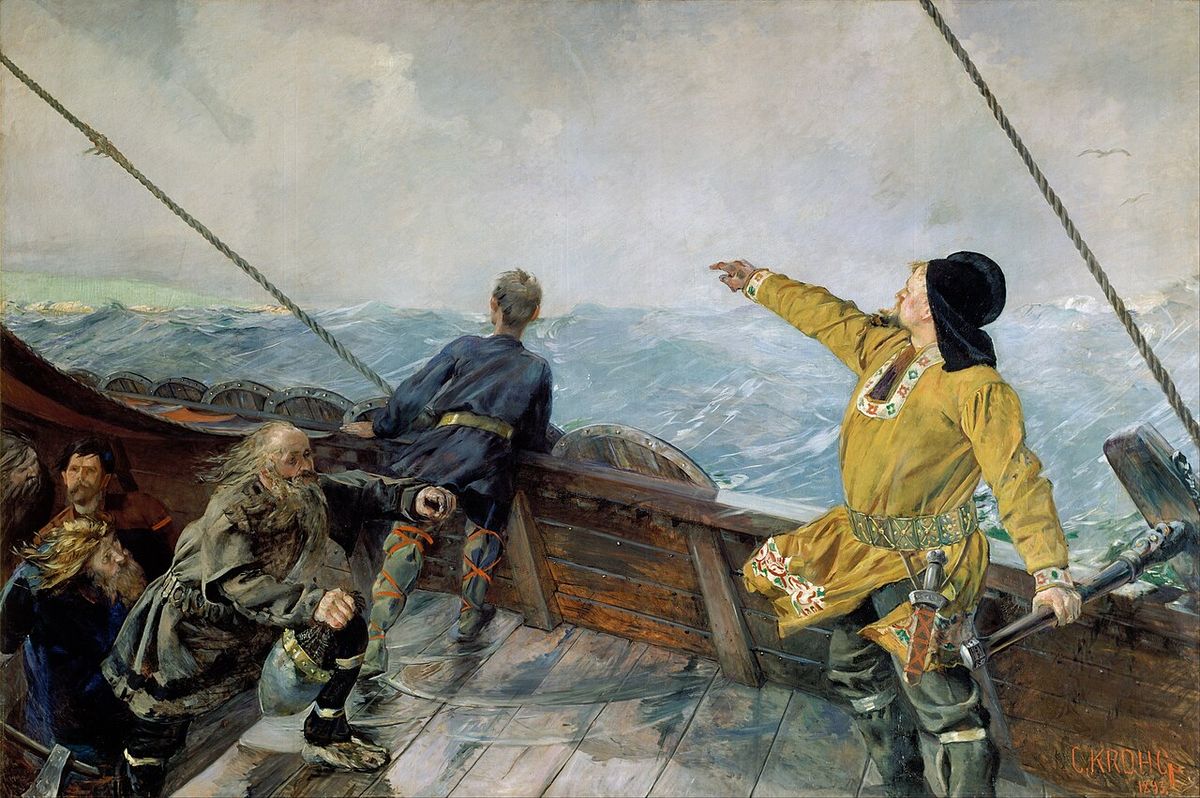
The primary accounts of Leif Erikson's voyage come from two Icelandic sagas written around 1200, the Saga of Erik the Red and the Saga of the Greenlanders. These sagas are works of literature based on oral tradition, and scholars debate their factual accuracy, as they offer detailed but sometimes conflicting narratives. According to the Saga of the Greenlanders, Leif was not the first European to sight North America. Bjarni saw unknown forested and rocky coasts but did not land, deciding they were not Greenland. About fifteen years later, Leif approached Bjarni, purchased his ship, gathered a crew of thirty-five men, and set out to explore these lands. His father Erik was meant to join but withdrew after a fall from his horse, which was seen as a bad omen. Leif retraced Bjarni's route in reverse, first landing on a barren, rocky shore he named Helluland, or Flat Rock Land, often identified with Baffin Island. Sailing further south, he found a forested coast he called Markland, or Forest Land, thought to be part of Labrador. After two more days at sea, they found a verdant area with a mild climate, abundant salmon, and, crucially, wild grapes discovered by Tyrker. Leif named this land Vinland, meaning Wineland. They built a small settlement there called Leifsbudir, or Leif's Booths, and wintered over before returning to Greenland with a cargo of grapes and timber. On the return voyage, he rescued shipwrecked sailors, which earned him his enduring nickname, Leif the Lucky.
The Saga of Erik the Red presents a more streamlined and theologically focused version. It states Leif discovered Vinland after being blown off course while returning from Norway to Greenland. In this account, he had been at the court of King Olaf Tryggvason, converted to Christianity, and was commissioned to bring the new faith to Greenland. The storm drove him to an unknown shore where his crew found wild grapes, self sown wheat, and maple trees. After loading samples, they sailed to Greenland, rescuing shipwrecked sailors en route. This saga makes no mention of Bjarni Herjólfsson, Helluland, or Markland, and credits Leif with the initial discovery. Despite the differences, both sagas agree that Leif led the first Norse expedition to land and explore parts of North America, that he established a base, and that he never returned to Vinland after his initial voyage, though he encouraged others to do so.
Archeological evidence and the site of L'Anse aux Meadows
For centuries, the Vinland sagas were considered legendary, but archaeological work in the 1960s provided compelling physical evidence that transformed historical understanding. Norwegian explorer Helge Ingstad and his wife, archaeologist Anne Stine Ingstad, identified a Norse site at L'Anse aux Meadows on the northern tip of Newfoundland after consulting the sagas and following logical landing points. Excavations revealed the foundations of eight turf walled buildings, including three dwellings, a forge, a carpentry workshop, and four sheds, identical in style and construction to structures found in Iceland and Greenland from the Norse era. The presence of a forge with iron slag and a carpentry workshop with wood debris indicates it was a base for ship repair and maintenance, not a large farming settlement. Carbon dating placed the occupation between 990 and 1050 CE, and more precise tree ring analysis of wood from the site, cut with metal tools, dates activity to the exact year 1021. This confirms Norse presence in North America exactly around the time of Leif Erikson and his successors.
Most scholars agree L'Anse aux Meadows was a Norse base, likely used for overwintering, ship repair, and as a waypoint for expeditions further south into richer regions. It is widely considered to be the site of Leifsbudir described in the sagas. The settlement was not a large colony but rather a gateway to a wider region the Norse called Vinland. Archaeological evidence suggests Vinland may have been the areas around the Gulf of Saint Lawrence, and L'Anse aux Meadows served as a staging post for voyages there. The Saga of Erik the Red mentions two other settlements in Vinland, Straumfjǫrðr and Hóp, located farther south, which aligns with the interpretation of L'Anse aux Meadows as a central hub. The discovery demonstrated conclusively that Norsemen had reached North America about 500 years before Christopher Columbus, a fact now enshrined in history.
Personal life, conversion, and chieftaincy
Leif Erikson is described in the sagas as a strong, wise, and striking man. As a young man, he travelled to Norway, likely to serve as a retainer at the court of King Olaf Tryggvason. On the journey, his ship was driven to the Hebrides, where he was forced to stay for much of a summer. There he fell in love with a noblewoman named Thorgunna, who later gave birth to their son, Thorgils. Leif refused to take her to Greenland without her family's permission, so she remained behind. Thorgils was later sent to Greenland but was not well liked. At King Olaf's court, Leif converted to Christianity. He was then tasked with bringing the new religion back to Greenland, with some saga versions stating he brought a priest and clerics with him. His father Erik reacted coldly to the suggestion he abandon his pagan religion, while his mother Thjodhild became a Christian and built a church called Thjóðhild's Church at Brattahlíð.
After his return from Vinland and the subsequent death of his father shortly after 1000 CE, Leif became the paramount chieftain of the Greenland settlement. He is last mentioned alive in 1018 in the Saga of St. Olaf. According to The Saga of the Sworn Brothers, by 1025 the chieftaincy of Eiríksfjǫrðr had passed to his son Thorkell. Leif likely died in Greenland sometime between these dates. Nothing is mentioned about his death in the sagas, and nothing further is known about his family beyond the succession of Thorkell. His other known son, Thorgils, did not succeed him, indicating Thorkell was likely from a different and more legitimate union.
Norse encounters with Indigenous peoples
While Leif Erikson's own expedition reportedly had no contact with the Indigenous inhabitants of North America, later Norse explorers did, with significant consequences. The Norse referred to the Indigenous peoples they met as skrælingi, an archaic term often translated as wretches. According to the Saga of Erik the Red, the first encounter was made during a colonizing expedition led by Thorfinn Karlsefni, which also included Leif's brother Thorvald. At first this group traded furs for milk and red cloth with the natives at a place called Hóp, but weeks later the new Norse settlement was attacked and Karlsefni decided to abandon it. The Norse retreated to their other settlement at Straumfjǫrðr. Later, Thorvald was killed by an arrow shot by a one legged native during a skirmish. He is famously known for pulling the arrow out and reciting, This is a rich country we have found, there is plenty of fat around my entrails, before he died. On their return to Greenland, Karlsefni's crew captured two native boys, taking them to Greenland where they were taught Norse and baptized.
According to the Saga of the Greenlanders, Leif's brother Thorvald made first contact with the natives. The encounter happened while Thorvald and his crew were exploring the coast, likely in the Markland area, and found nine natives asleep under boats. They attacked the natives, killing eight of them, while one escaped. Shortly after, in an apparent reprisal, Thorvald was killed by a native's arrow. Later, Thorfinn Karlsefni led a group to colonize Vinland and encountered natives, who they initially traded with, but relations soured when a native was killed attempting to steal weapons from the Norse. In retaliation, the natives attacked with catapults, and Karlsefni decided to abandon the colony. These encounters, marked by cultural misunderstanding, curiosity, and sudden violence, contributed to the Norse decision not to establish permanent settlements in Vinland. Despite this, sporadic voyages from Greenland to areas like Markland for timber and other resources likely continued for centuries, as suggested by casual references in later documents.
Legacy in medieval Europe and historical knowledge
Leif's successful expedition in Vinland encouraged other Norsemen from Greenland and Iceland to make the journey, and the Norse became the first Europeans to colonize the area, however briefly. Knowledge of the Vinland journeys spread around medieval Europe, although to what extent is unclear. The medieval chronicler Adam of Bremen directly mentions Vinland around 1075 based upon reports from the Danes. Ari the Wise also mentions it in the Book of Icelanders around 1122. The casual tone of these references may suggest their discovery was not seen as particularly significant by contemporaries in Europe, or that it was assumed to be public knowledge in the Norse world. It has been suggested that the knowledge of Vinland might have been maintained in European seaports in the 15th century, and that Christopher Columbus, who claimed in a letter to have visited Iceland in 1477, could have heard stories of lands to the west. The Norse exploration left no permanent settlements but opened a temporary window of transatlantic contact.
Modern commemoration and cultural impact
Leif Erikson's legacy has been celebrated, particularly in North America by communities of Nordic descent. In the United States, Leif Erikson Day is observed annually on October 9, following a congressional authorization in 1964. Each US president issues a proclamation for the day, as was done in 2026. The date was chosen not for a specific event in Leif's life but because it marks the anniversary of the arrival of the first organized party of Norwegian immigrants aboard the ship Restaurationen in New York Harbor in 1825. In Canada, communities with Scandinavian heritage also hold events. For example, a Leif Erikson Day Festival was scheduled for October 4, 2026, at the Scandinavian Community Centre in Burnaby, British Columbia, featuring a Greenland themed buffet dinner and cultural activities. Statues honouring Leif have been erected in many cities, including Boston in 1887, Chicago in 1901, Seattle, and Reykjavík in 1930, the latter a gift from the United States to Iceland.
The Leif Erikson Awards, established in 2015 by The Exploration Museum in Húsavík, Iceland, are given annually for achievements in exploration and in the study of the history of exploration. His story has also permeated popular culture through various media. He is the main character in the 1928 film The Viking and the Netflix series Vikings Valhalla, played by Sam Corlett. He appears in Henry Treece's juvenile novel Vinland the Good, the manga Vinland Saga, and as a Great Admiral in the video game Civilization VI. These commemorations ensure his name remains recognized as a pioneering figure in transatlantic exploration, symbolizing the Norse chapter in North American history.
Historiography and scholarly debates
Leif Erikson is almost certainly a historical figure, and the archaeological proof at L'Anse aux Meadows solidifies his claim as the first known European to reach continental America. However, many details of his life remain subjects of scholarly debate due to the nature of the source material. The sagas are literary works compiled centuries after the events they describe, blending history with legend, family lore, and sometimes Christian moralizing. Elements such as the specific, dramatic roles of his sister Freydís or his foster father Tyrker may be fictional embellishments. Similarly, the story of his commission as a Christian missionary to Greenland may have been added by later writers like Gunnlaugr Leifsson to serve religious narratives and connect the exploration to the royal Norwegian court. The two main sagas also disagree on fundamental points like the discoverer, the route, and the role of Christianity.
Scholars treat these accounts with caution, cross referencing them with the scant contemporary references and the hard evidence from archaeology. The only known strictly historical mentions of Vinland from near Leif's time are the brief notes by Adam of Bremen and Ari the Wise. Despite these uncertainties, the core of the story, a Norse voyage of exploration and temporary settlement in North America led by Leif Erikson, is supported by both documentary tradition and unequivocal archaeological evidence. This makes him a foundational, if partially shrouded, figure in the pre Columbian history of the Americas, and his story continues to be refined as historical and archaeological research progresses.
Questions about Leif Erikson
Did Leif Erikson discover Canada?
Leif Erikson is credited as the first European to reach continental North America, which includes parts of modern day Canada. According to the sagas, he explored regions he named Helluland, Markland, and Vinland, which scholars associate with Baffin Island, Labrador, and Newfoundland. The archaeological site of L'Anse aux Meadows in Newfoundland confirms Norse presence around the year 1000 CE, providing tangible evidence of his or similar Norse voyages to Canadian shores. While he did not discover Canada in the modern sense of a unified country, his expedition represents the first documented European exploration of its eastern coastline.
What is Vinland and where exactly was it located?
Vinland was the name given by Leif Erikson to a region in North America, noted for its wild grapes and fertile land. It is generally understood to be a coastal area in eastern Canada. While the exact boundaries are unknown, most researchers believe Vinland encompassed areas around the Gulf of Saint Lawrence, with the Norse base at L'Anse aux Meadows in Newfoundland serving as a northern gateway. The sagas describe Vinland as a wider region containing multiple settlements, including Straumfjǫrðr and Hóp, which were located farther south. Vinland was not a single point but a territory explored and briefly utilized by the Norse for its resources.
Is there definitive proof that Leif Erikson landed in North America?
Yes, there is definitive archaeological proof that Norse explorers, consistent with the sagas of Leif Erikson, reached North America. The settlement at L'Anse aux Meadows in Newfoundland, discovered in the 1960s, contains the remains of Norse buildings from around the year 1000 CE. Artifacts like a bronze ringed pin, a stone lamp, and iron nails match those from Norse sites in Greenland and Iceland. Crucially, tree ring analysis has dated wood from the site, cut with metal tools, to the year 1021. While no artifact bears Leif's name, the site's date, location, and nature align perfectly with the saga accounts of the Vinland exploration he led.
How is Leif Erikson Day celebrated in Canada?
In Canada, Leif Erikson Day is often marked by local events in communities with Scandinavian heritage, organized by cultural centres. For instance, a Leif Erikson Day Festival was scheduled for October 4, 2026, at the Scandinavian Community Centre in Burnaby, British Columbia. The event featured a theme of Greenland Past and Present and included cultural activities, a Greenlandic buffet dinner by reservation, and educational components. These celebrations honour Norse exploration history and the cultural contributions of Scandinavian immigrants to Canada. They are typically community focused rather than nationwide statutory holidays.
What was the nature of Norse interactions with Indigenous peoples in Vinland?
The sagas indicate that Leif Erikson's own expedition did not encounter Indigenous peoples. However, later Norse expeditions did make contact, with interactions ranging from trade to conflict. Initial encounters involved trading furs for Norse goods like milk and cloth. These relations frequently deteriorated into violence due to mutual suspicion, cultural clashes, and incidents like the Norse killing natives or natives attempting to steal weapons. The Norse found themselves outnumbered and vulnerable to attack, which is cited as a primary reason they abandoned their attempts to establish permanent colonies in Vinland. These were the first recorded encounters between Europeans and Indigenous peoples in North America.
When did Leif Erikson die and who succeeded him?
Leif Erikson died sometime between 1018 and 1025 in Greenland. The sagas do not record the exact circumstances or cause of his death. He is last mentioned alive in 1018, and by 1025 the chieftaincy of Eiríksfjǫrðr in Greenland had passed to his son Thorkell. Beyond this succession, little is known about his family's later history. His other known son, Thorgils, born to Thorgunna in the Hebrides, did not succeed him and was reportedly not popular in Greenland. Leif's death marked the end of the era of the initial Vinland exploration, though Greenlanders continued occasional voyages to North American shores for resources.
Sources: Wikipedia and current public reporting, checked by the Nosy Mag desk. Last updated 2026-10-18.