Tanks of Canada
Tanks of Canada refer to the armoured fighting vehicles developed, produced, and operated by the Canadian Army, primarily under the Royal Canadian Armoured Corps. The nation's tank history began in earnest during the Second World War, evolving from early training vehicles to significant domestic production of the Valentine, Ram, and Grizzly tanks. In the modern era, Canada has operated foreign-designed main battle tanks like the Leopard while also developing indigenous wheeled armoured vehicles such as the Cougar and Coyote. Today, the fleet of Leopard 2 main battle tanks is a key component of Canadian land power, with ongoing modernization and future replacement plans forming a part of national defence strategy.
Early History and Second World War Production
Canada's first tank units were established late in the First World War, with the 1st Canadian Tank Battalion still training in Mark V tanks in the United Kingdom when the armistice was signed in November 1918. The modern Canadian Armoured Corps was formally created on 13 August 1940, at a time when the nation possessed almost no modern armoured vehicles. Initial training was conducted using 219 obsolete American M1917 tanks, acquired at scrap value due to US isolationist laws. The urgent need to equip Canadian forces after the fall of France led to the decision to establish a domestic tank manufacturing industry. This industrial effort was centred on major railway and locomotive workshops, which were the only facilities with the necessary heavy engineering capacity at the time.
The first major production tank was the Valentine infantry tank, built under contract by Canadian Pacific Railway's Angus Shops in Montreal. A total of 1,940 Valentines were produced in Canada, with the majority of the 1,400 tanks built for Canada itself being supplied to the Soviet Union under Lend-Lease arrangements. The Valentine was adapted to use a GMC diesel engine, an improvement that was later adopted by British manufacturers. While the Valentine provided crucial initial production experience, Canada required a cruiser tank for its newly formed armoured divisions, leading to the development of an indigenous design.
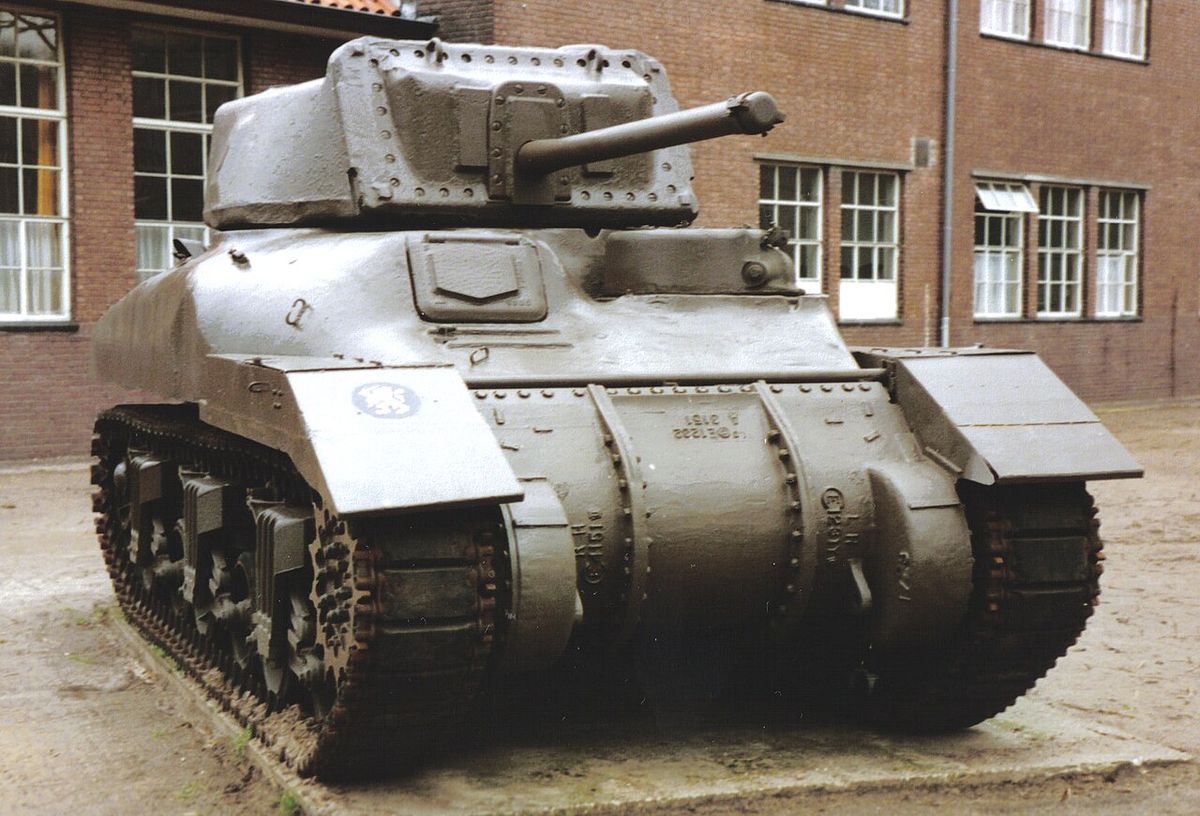
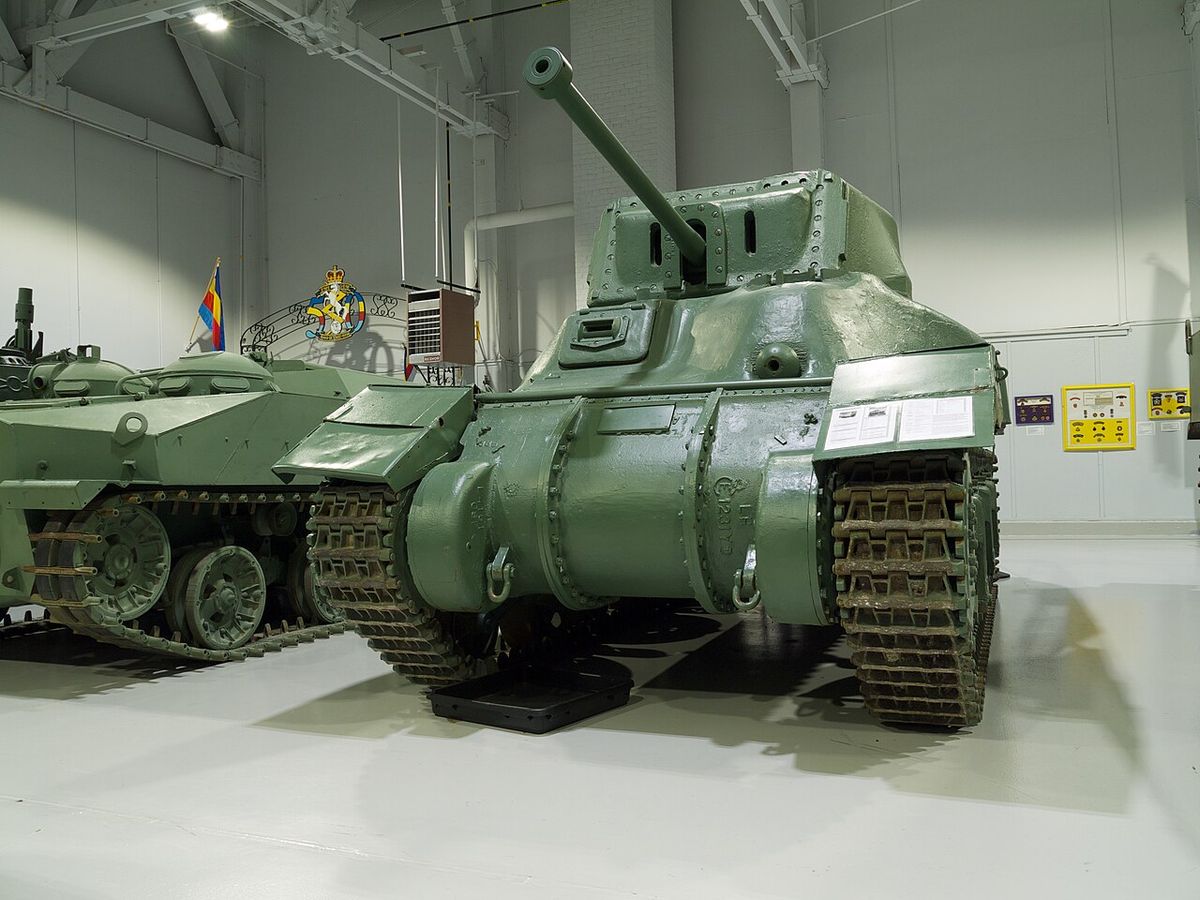
The Ram cruiser tank became Canada's signature armoured vehicle of the Second World War. Developed by the Montreal Locomotive Works, it was based on the chassis and running gear of the American M3 Lee medium tank. Production ran from 1941 to 1943. Although the Ram itself did not see combat as a gun tank with Canadian divisions, which standardized on the Sherman, it was invaluable for training armoured crews in Canada and Britain prior to the invasions of Italy and Normandy. The Ram chassis proved highly adaptable, serving as the basis for several important specialized vehicles.
- Ram Kangaroo: Turretless armoured personnel carrier capable of carrying 11 troops.
- Badger: Flamethrower tank conversion used in Northwest Europe.
- Sexton: Self-propelled gun armed with a QF 25-pounder.
- Ram OP/Command: Mobile observation post for artillery officers.
- Ram ARV: Armoured recovery vehicle in Mk I and Mk II variants.
Following the Ram, Canada shifted production to the Grizzly I cruiser tank, the Canadian-built version of the M4 Sherman. The Grizzly incorporated Canadian-specific components like 17-tooth drive sprockets and CDP tracks, which did not require scarce rubber. Production began in August 1943 but was halted as ample US Sherman production made Canadian manufacture redundant. Montreal Locomotive Works then focused on building the Sexton self-propelled gun, which used the Grizzly chassis, for Commonwealth forces. A small batch of Grizzly tanks was fitted with an Ordnance QF 17-pounder for training.
Post-War and Cold War Armoured Vehicles
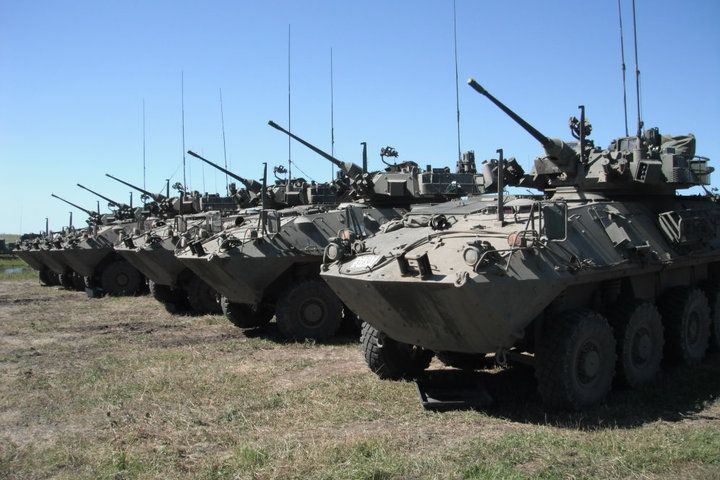
After the Second World War, Canada did not pursue domestic main battle tank production, instead acquiring foreign designs from American, British, and later German manufacturers. This changed in the late 1970s with the fielding of the first Canadian-built armoured fighting vehicle since the war, though it was not a main battle tank. The Cougar Armoured Vehicle General Purpose was a wheeled direct Fire Support Vehicle. Manufactured by GM Diesel Division in London, Ontario, the Cougar was based on a Swiss MOWAG Piranha hull fitted with a British Scorpion tank turret armed with a 76 mm gun. It entered service with regular and reserve armoured regiments in the late 1970s.
The Cougar and the broader AVGP family were conceived as air-transportable vehicles for rapid deployment. They were used by the Canadian Air Sea Transportable Brigade for exercises in Norway and by the 1st Canadian Division in NATO's Central Army Group. Their light armour made them unsuitable for direct combat against main battle tanks, so their operational use shifted to stability operations in places like Bosnia and Somalia in the 1990s. Domestically, they were used to train tank crews who would later operate the heavier Leopard C1 tanks. The experience and industrial base developed through the Cougar and AVGP program proved foundational for Canada's subsequent success in wheeled armoured vehicles.
This evolution led directly to the Light Armoured Vehicle series. The Coyote Armoured Reconnaissance Vehicle, an eight-wheeled Canadian upgrade of the LAV-25, entered Canadian service in 1996 with 203 vehicles. The Coyote's success, alongside the globally deployed LAV III, cemented Canada's reputation as a leader in wheeled armoured vehicle design and manufacture. These vehicles represented the mature product of the expertise gained from the earlier AVGP project.
The Main Battle Tank Era and Strategic Debates
For heavy armoured forces, Canada has relied on the German-designed Leopard tank since the Cold War. The army initially operated the Leopard 1, but combat experience in Afghanistan prompted a major shift. During intense conventional fighting in the Panjwayi district in September 2006, the limitations of lighter vehicles became starkly apparent. Canada urgently deployed a squadron of Leopard 1 tanks to Kandahar and arranged to borrow modern Leopard 2A6M tanks from Germany. This experience led to the 2007 decision to abandon a previous plan to replace tanks with the wheeled M1128 Mobile Gun System and instead purchase used Leopard 2 tanks from the Netherlands.
This reversal ended a prolonged strategic debate within the Canadian Army about the necessity of main battle tanks. The ACV was envisioned as a wheeled vehicle that could replace both the AVGP Cougar and the Leopard 1 tank, moving the army toward a medium-weight, wheeled force. Operational research and wargaming, however, raised serious concerns. Analyses concluded that a wheeled ACV, even with improved armour and a through-the-barrel missile system, would lack the survivability and mobility to manoeuvre against a modern enemy equipped with tanks. It would be relegated to ambush tactics and was deemed a potential death trap if forced into a tank role.
The research also highlighted a critical secondary capability that would be lost with the elimination of tanks: armoured engineering support. Tank-based vehicles like bridgelayers, mine-clearing ploughs, and armoured engineer vehicles were essential for breaching obstacles under fire. The study recommended against procuring any envisioned LAV-based engineer vehicles, judging them inferior to the existing Leopard-based platforms. The experience in Afghanistan validated these concerns, firmly re-establishing the main battle tank as an indispensable component of combined arms warfare for the Canadian Army.
Current Fleet and Modernization Plans
The Canadian Armed Forces currently operate a fleet of 103 Leopard 2 main battle tanks across several variants, including the 2A4, 2A4M, 2A6M, and the engineering and recovery vehicles based on the chassis. These tanks are scheduled to remain in service until 2035. To maintain their operational viability, a major modernization program is underway under the Heavy Direct Fire Modernization project. This work focuses on upgrading the tanks' optic and fire-control systems to keep them effective on the modern battlefield. A key part of this effort is a near-term $76 million conversion of Leopard 2A6M tanks to the updated 2A6M C2 CAN configuration.
Concurrent with these upgrades, the army is implementing a strategic consolidation of its entire Leopard 2 fleet. The tanks are being centralized in Edmonton, Alberta, to improve overall effectiveness and fleet management. This move, linked to a Long Term Support Contract with KNDS Deutschland GmbH, aims to create a critical mass of operational vehicles for training and potential deployments. A Regional Maintenance Centre is being established near Edmonton under a public-private partnership, allowing military technicians to focus on operational tasks while the contractor handles deeper maintenance and inspections. The consolidation is designed to ensure Canada can provide a meaningful tank capability for NATO commitments and national defence until a replacement is fielded.
Looking to the future, the Canadian Army is accelerating plans to acquire new armoured fighting vehicles and select a successor to the Leopard 2. In early 2026, defence officials announced an accelerated timeline to acquire 250 tracked armoured fighting vehicles, moving the target service date from 2035 to between 2029 and 2031. These vehicles, offering STANAG Level 6 blast protection, are intended to form the backbone of Medium Cavalry brigades within a new Maneuver Division. Potential contenders for the AFV purchase come from Germany, South Korea, and Sweden. Alongside this, the project to select a new main battle tank is advancing, with a selection target of 2030 and deployment of the first new tanks slated for 2037.
Museums and Public Heritage
Canada's tank heritage is preserved and displayed by several major institutions, most notably the Canadian War Museum in Ottawa and the Canadian Tank Museum in Ontario. The Canadian War Museum's collection features nearly 200 military vehicles, with a significant number in operational or fully restored condition. Its LeBreton Gallery is a primary display space for this collection. A dedicated team of staff and skilled volunteers work in the museum's restoration shop, bringing historic vehicles from various eras back to running order using original plans and period-correct parts. This work ensures these important artifacts remain accessible for education and demonstration.
The museum hosts major public events that bring this history to life. War Machines Weekend, typically held in early August, is a major annual spectacle where vehicles are driven on a demonstration track. The 2026 event was held from August 7 to 9. Activities include live vehicle demonstrations, battle reenactments, and opportunities for the public to speak with drivers and volunteers. The museum also creates digital engagement tools, such as a detailed 3D model of the Grizzly tank that can be projected via smartphone. Another key institution is the Canadian Tank Museum, which hosts its own signature event, Aquino Tank Weekend. Scheduled for June 12-14 in 2026, this is billed as Canada's largest military vehicle display show, featuring vehicle demonstrations and reenactments.
These institutions preserve unique artifacts, such as the sole surviving Canadian-built Grizzly Mk I tank. The museum also holds a restored Cameron Highlanders of Ottawa Universal Carrier. Beyond static displays, the operational vehicles at events like War Machines Weekend provide a tangible link to the past. Many current and former military members volunteer at these museums. They share their firsthand knowledge with visitors about the history of Canadian armoured vehicles.
International Contributions and Aid
Canada's tank fleet has also been a tool of international policy and alliance solidarity. In the context of the Russo-Ukrainian War, Canada announced on 24 February 2023 that it would provide Ukraine with eight Leopard 2 main battle tanks and one Leopard 2-based Armoured Recovery Vehicle. This contribution was part of a broader Western effort to bolster Ukraine's defensive capabilities with modern heavy armour. The donation of operational tanks from the Canadian Army's inventory demonstrated a commitment to supporting a fellow democracy under invasion and fulfilled a specific request from Ukraine and its allies for main battle tank capabilities.
This action followed a long tradition of Canada supplying armoured vehicles to allies, most notably during the Second World War when the majority of Canadian-built Valentine tanks were sent to the Soviet Union. In the modern era, Canada's provision of Leopard 2 tanks required careful logistical planning and likely involved the training of Ukrainian personnel on the complex systems. The decision to donate this high-end capability reflected a strategic assessment of both Ukraine's needs and Canada's ability to contribute meaningfully while maintaining its own training and operational requirements. Such contributions reinforce Canada's role within the NATO alliance and its support for the rules-based international order.
Future Trajectory and Strategic Context
The future of Canada's armoured forces is being shaped by a significant increase in defence spending and a clear strategic vision outlined in documents like "Our North, Strong and Free." This policy calls for nearly $53 billion in new defence investments over 20 years. In October 2025, Prime Minister Mark Carney announced a further $46 million increase aimed at raising Canada's defence spending to 2% of GDP, with an ultimate goal of meeting a NATO spending threshold of 3.5% of GDP on direct military expenditure by 2035. This financial commitment supports the ambitious modernization plans for the army's armoured corps.
The accelerated acquisition of 250 tracked AFVs and the project to replace the Leopard 2 are central to this rebuild. The new AFVs are specifically intended for operations in the Arctic and other off-road conditions, where their tracked mobility will allow them to operate alongside main battle tanks. The force design is evolving toward a Maneuver Division structure that integrates heavy and medium forces. As officials stated in early 2026, the army is actively building its future armoured capability rather than just planning for it.
Questions about Tanks of Canada
What was the first tank built in Canada?
The first major tank produced in Canada was the Valentine infantry tank during the Second World War. Built by Canadian Pacific Railway's Angus Shops in Montreal, Canadian production totalled 1,940 vehicles. The Canadian version was adapted to use a GMC diesel engine, an improvement later adopted by British manufacturers. While many were built for Canada, most of the 1,400 Valentines destined for Canadian forces were actually supplied to the Soviet Union under Lend-Lease.
What is Canada's current main battle tank?
Canada's current main battle tank is the German-designed Leopard 2. The Canadian Armed Forces operate a fleet of 103 Leopard 2 tanks across several variants, including the 2A4, 2A4M, and 2A6M. These tanks were acquired after combat experience in Afghanistan in 2006 demonstrated the urgent need for modern heavy armour. The fleet is scheduled to remain in service until 2035 and is currently undergoing a modernization program to update its optics and fire-control systems.
Is Canada planning to get new tanks?
Yes, Canada has plans to both modernize its current tanks and acquire a new main battle tank. The existing Leopard 2 fleet is being upgraded to extend its service life to 2035. A separate project is underway to select a successor tank, with a target selection date of 2030 and the first new vehicles slated for deployment by 2037. This is part of a broader armoured vehicle modernization that also includes the accelerated purchase of 250 new tracked armoured fighting vehicles between 2029 and 2031.
Did Canada donate tanks to Ukraine?
Yes, Canada donated Leopard 2 tanks to Ukraine. On 24 February 2023, Canada announced it would provide Ukraine with eight Leopard 2 main battle tanks. Canada also provided a Leopard 2-based Armoured Recovery Vehicle. This contribution was part of an international effort to support Ukraine's defence against the Russian invasion.
Where can I see historic Canadian tanks?
Historic Canadian tanks are displayed at museums such as the Canadian War Museum in Ottawa and the Canadian Tank Museum in Ontario. The Canadian War Museum has a collection of nearly 200 vehicles and hosts the annual War Machines Weekend in August, featuring live demonstrations. The Canadian Tank Museum hosts Aquino Tank Weekend in June, which is billed as Canada's largest military vehicle display show. Both museums have skilled volunteers who restore and maintain the vehicles in operational condition.
What was the Ram tank used for?
The Ram was a Canadian-designed cruiser tank produced during the Second World War. It was based on the chassis of the US M3 Lee tank. Although it did not see combat as a gun tank with Canadian divisions, it was used for essential tactical training. The Ram was also produced in numerous variants, including the Kangaroo Armoured Personnel Carrier and the Badger flamethrower tank. The Ram Kangaroo could carry 11 troops and the Badger was used in Northwest Europe.
Sources and further reading
- Tanks of Canada (Wikipedia)
- Canada unveils plans to upgrade tanks and armored fighting ... (thewatch-journal.com)
- The Canadian Tank Museum (tankmuseum.ca)
- Tank Centralization: A bridge to the Army's future armoured ... (canadianarmytoday.com)
Checked by the Nosy Mag desk. Last updated 2026-11-01.