History of the Royal Canadian Air Force
The Royal Canadian Air Force (RCAF) is the air and space force of Canada, a component of the Canadian Armed Forces and Department of National Defence. Its formal history began on 1 April 1924, when the Canadian Air Force was granted the royal title by King George V, establishing a permanent military aviation service. Over the past century, the RCAF has evolved from a small organization focused largely on civil support into a modern force responsible for defending North American airspace, contributing to international security, and providing critical domestic aid. Its legacy is marked by service in global conflicts, peacetime operations, and an ongoing commitment to technological advancement.
Early Experiments and the First World War
The story of Canadian military aviation begins with early civilian experiments. The first powered, heavier-than-air flight in Canada occurred on 23 February 1909 when J.A.D. McCurdy piloted Alexander Graham Bell's Silver Dart in Baddeck, Nova Scotia. McCurdy and his partner F.W. Baldwin had formed the Canadian Aerodrome Company and hoped to sell aircraft to the military. Demonstrations for the Department of Militia and Defence at Camp Petawawa in August 1909 ended with crashes, and the militia department showed no further interest. The outbreak of the First World War in 1914 forced the government to reconsider. Minister of Militia Sam Hughes authorized the creation of the Canadian Aviation Corps (CAC) on 16 September 1914, a unit of two officers and a mechanic with $5000 to buy an aircraft. It purchased a single Burgess-Dunne biplane, which was shipped to England but never flew, and the CAC was defunct by May 1915. Over 20,000 Canadians volunteered to serve with British flying services like the Royal Flying Corps and Royal Naval Air Service. The Royal Flying Corps opened training airfields in Canada in 1917 and the government helped finance an aircraft factory, Canadian Aeroplanes, in Toronto. Celebrated aces from this period include William Barker, Billy Bishop, the first Canadian aviator awarded the Victoria Cross, Raymond Collishaw, Roy Brown, Donald MacLaren, Frederick McCall, and Wilfrid May. In the war's final months, the Canadian government authorized a Canadian Air Force (CAF) in Europe on 19 September 1918 to control two bomber and fighter squadrons under Lieutenant-Colonel Billy Bishop, but this force was disbanded in February 1920 without flying any operations. The British Air Ministry had formed the two squadrons, which eventually became No 1 Wing, CAF.
The Interwar Years and Permanent Establishment
In the postwar period, the Canadian government established the Air Board in 1919 to manage civil aviation and air defence, partly to meet obligations under the International Convention for Air Navigation. The Board operated over 100 surplus aircraft gifted by Britain and established six air stations for civil operations at Jericho Beach, Morley, Ottawa, Dartmouth, Victoria Beach and Roberval between 1920 and 1921. It also ran a part-time air militia, again called the Canadian Air Force, for refresher training at Camp Borden from July 1920 to March 1922. A major reorganization in 1922 merged the Air Board into the new Department of National Defence, with the CAF becoming responsible for all flying operations in Canada by January 1923, and the six Air Board stations were declared CAF stations. Formal application for a royal title was made on 5 January 1923, and on 15 February 1923, King George V granted the name Royal Canadian Air Force, which was officially recognized on 1 April 1924. The new RCAF was organized into a small permanent force and a planned Non-Permanent Active Air Force (NPAAF), though the NPAAF was not activated until 1932. The RCAF's early work was overwhelmingly civil in nature. Its diverse tasks included forest fire patrols, anti-smuggling flights to curb rum-running during American Prohibition, which accounted for almost half of its civil flying in 1932, mercy missions, and aerial surveying. A significant operation was the 1927-28 Hudson Strait Expedition to study ice conditions for potential shipping to Churchill, Manitoba. Budget cuts during the Great Depression in the early 1930s, especially the 'Big Cut' of 1932, forced a reduction in these activities and spurred the actual formation of the NPAAF. By the late 1930s, as global tensions rose, the RCAF began to reorient towards its military role, acquiring new aircraft like the Armstrong-Whitworth Atlas and building new air stations. Ten auxiliary squadrons were formed between 1932 and 1938, and regional commands were implemented, though the force remained limited with obsolete aircraft and little operational experience.
The Second World War: Training, Defence and Global Combat
The RCAF entered the Second World War in September 1939 fielding eight of its eleven permanent squadrons, with 15 squadrons available by October. It started with only 29 front-line fighter and bomber aircraft among twenty types in service. Its growth and contribution to the Allied victory were monumental, organized around three key spheres: training, home defence, and overseas operations. The British Commonwealth Air Training Plan (BCATP), agreed upon by Canada, the UK, Australia and New Zealand in 1939, was administered by the Canadian government and commanded by the RCAF. This massive undertaking trained over 130,000 aircrew at schools across Canada, which included initial training schools, elementary and service flying training schools, bombing and gunnery schools, navigation schools, and operational training units. For home defence, Western Air Command and Eastern Air Command protected Canada's coasts from German U-boats and the potential Japanese threat, growing to 37 squadrons and even assisting in the defence of Alaska during the Aleutian Islands Campaign. Overseas, forty-eight RCAF squadrons served in multiple theatres including Britain, northwest Europe, North Africa, and Southeast Asia. RCAF squadrons participated in most combat roles, including fighter, night fighter, intruder, reconnaissance, anti-shipping, anti-submarine, strategic bombing, and transport. They played parts in the Battle of Britain, the Battle of the Atlantic, and provided close support during the Battle of Normandy. A major formation was No. 6 Group, RCAF, within RAF Bomber Command, established in January 1943 under Air Vice-Marshal G.E. Brookes by consolidating Canadian bomber squadrons. Initially flying from bases in the fog-prone Vale of York with older aircraft like the Wellington and Halifax, the group suffered heavy losses. Under new commander Air Vice-Marshal C.M. McEwen from 29 February 1944, navigational and ground crew training improved significantly. After a pause for operations in support of D-Day, the group returned to bombing Germany in October 1944. The strategic bombing campaign was one of the costliest for Canada, with 9,980 Canadians killed in bombing raids over Europe between 1940 and 1945. By war's end, the RCAF had reached a peak strength of 215,000 in January 1944 and was the fourth-largest Allied air force, with approximately 13,000 personnel killed on operations or as prisoners of war and another 4,000 dying during training or from other causes. The RCAF also had squadrons in Egypt, Italy, Sicily, Malta, Ceylon, India, and Burma.
Postwar Evolution, Unification and Restoration
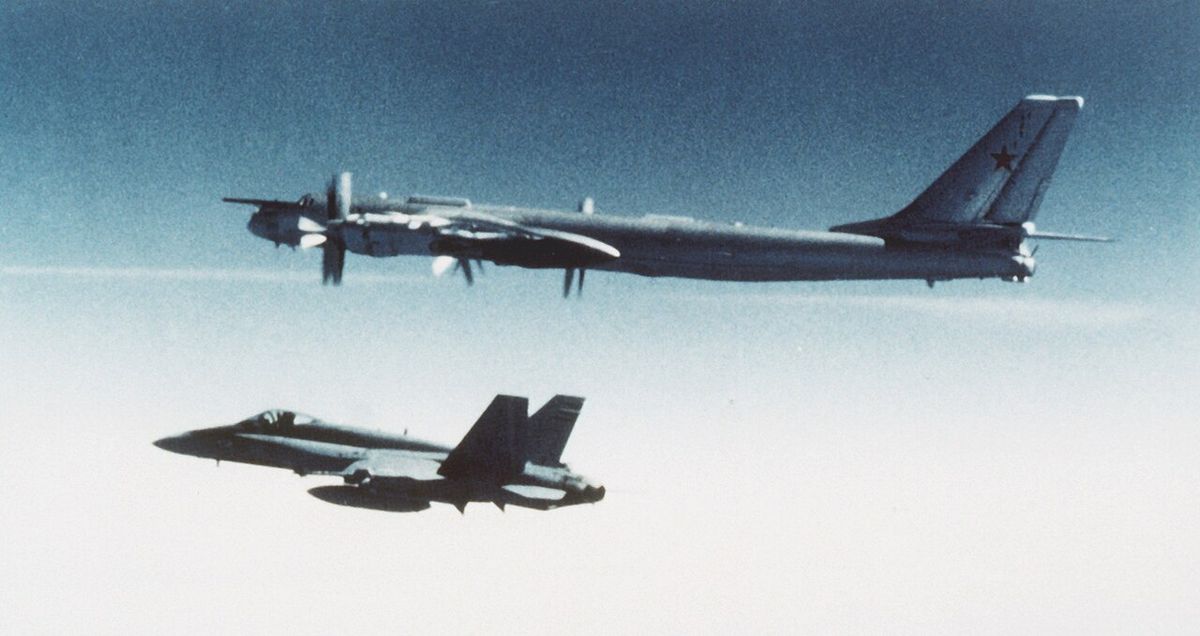
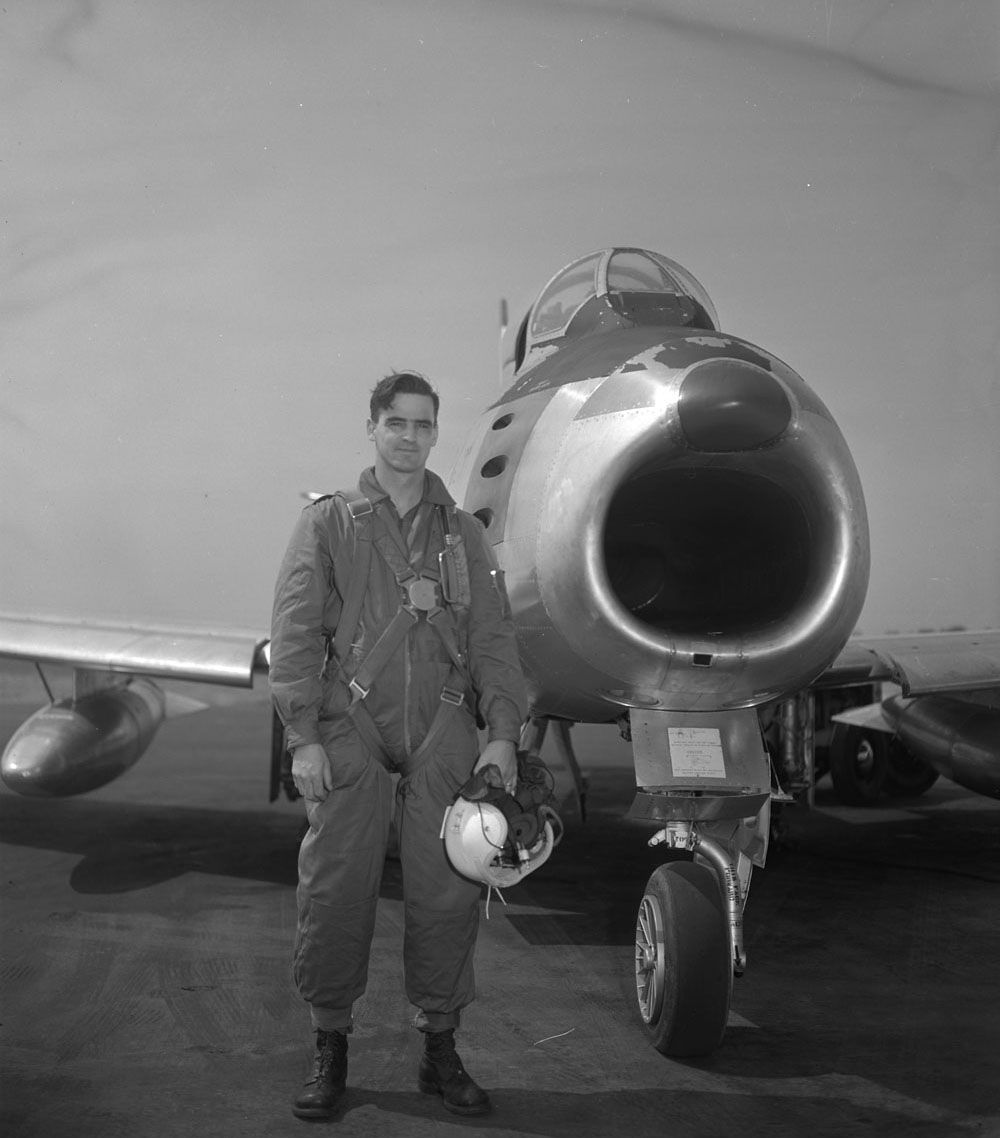
Following the Second World War, the BCATP was discontinued and the RCAF was rapidly downsized from 215,000 to a proposed peacetime strength of 16,000. The RCAF maintained a significant presence in Europe throughout the Cold War as part of Canada's NATO commitments, forming No. 1 Air Division with four wings at bases in Marville, France. Grostenquin, France. Zweibrücken, West Germany. And Baden-Soellingen, West Germany. The RCAF participated in the Korean War, with twenty-two fighter pilots flying on exchange duty with the United States Air Force, and several, including Squadron Leader Joseph A.O. Levesque and Flight Lieutenant E. A. Glover, scored air-to-air victories. In a major restructuring of the Canadian Armed Forces, the RCAF ceased to exist as an independent service on 1 February 1968, unified into the Canadian Forces. The air element was known as Canadian Forces Air Command (AIRCOM) from 1975 until 16 August 2011, when the historic name Royal Canadian Air Force was restored. The modern RCAF's core missions include defending Canadian and North American airspace in partnership with the United States through NORAD, which was formed on 1 August 1957, conducting search and rescue, supporting domestic disaster relief, and contributing to international peace and security operations. The RCAF operated early warning radar lines like the Pinetree Line, Mid-Canada Line, and DEW Line during the Cold War.
Key Figures and Personnel Legacy
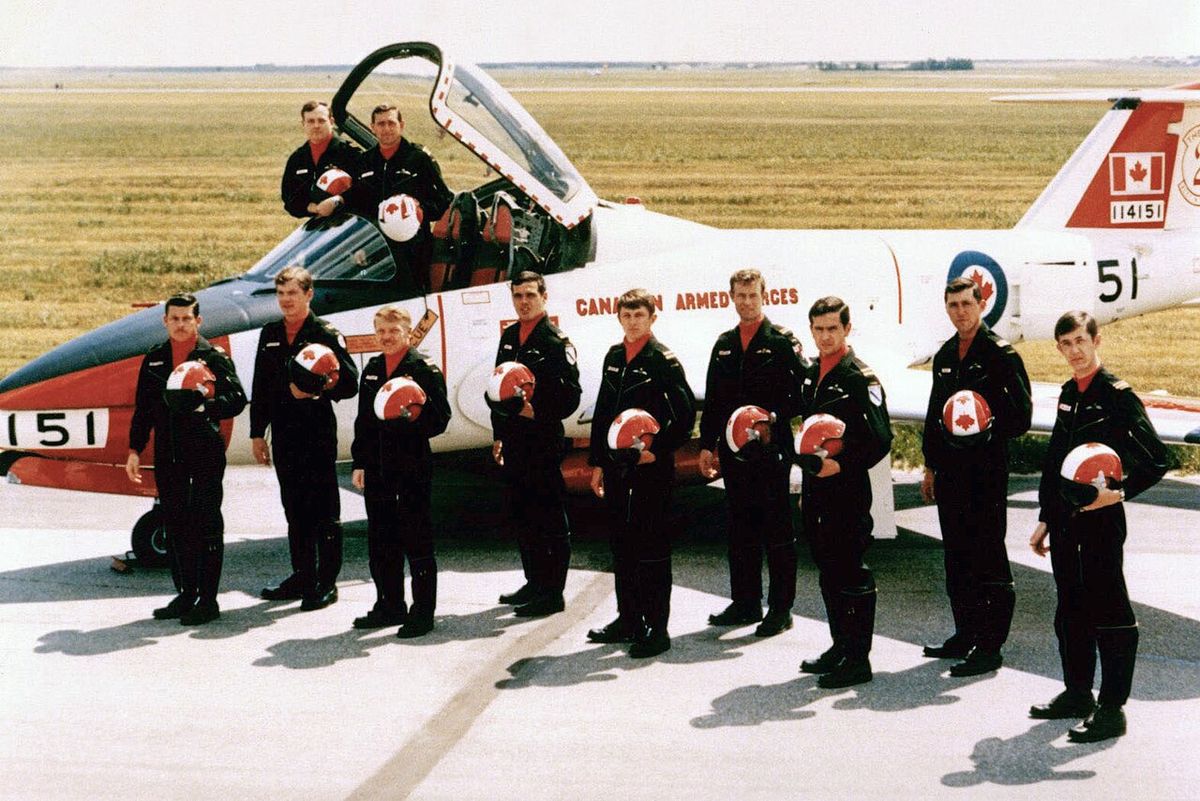
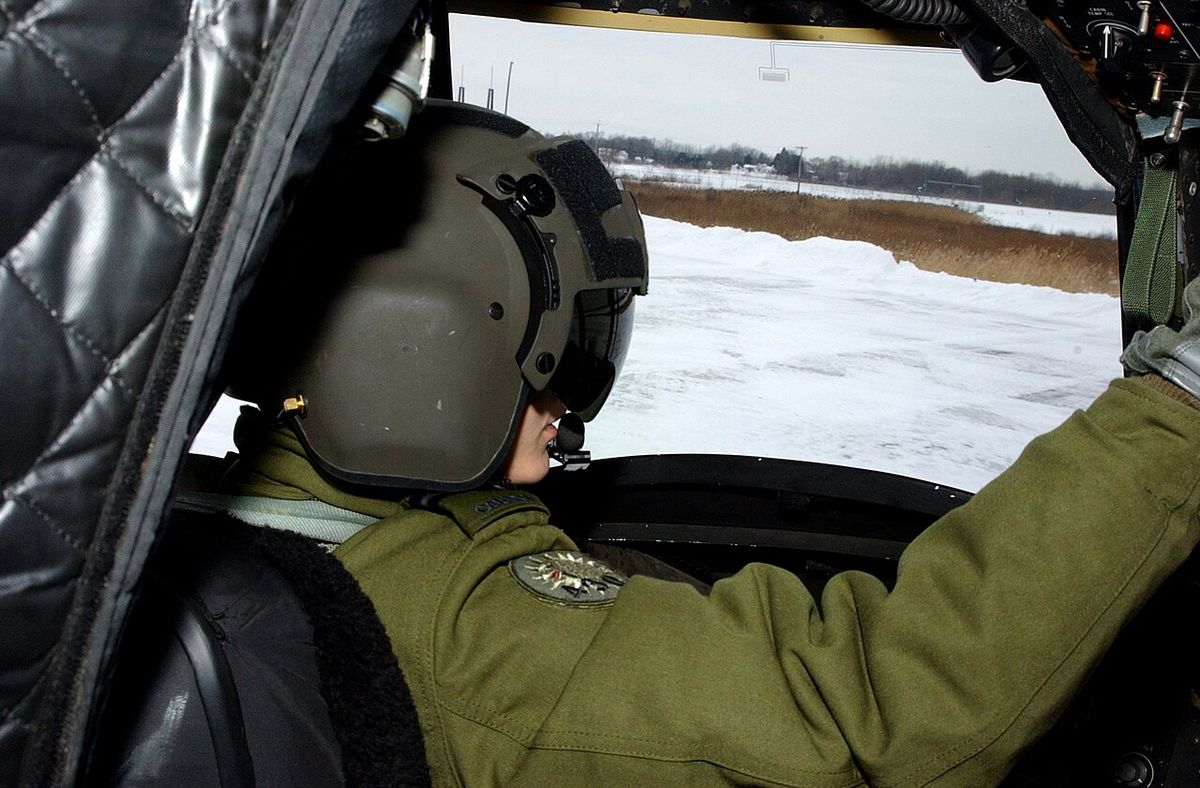
The history of the RCAF is shaped by the skill and sacrifice of its personnel. Notable individuals from the First World War include aces like William 'Billy' Bishop, the leading ace of the British Empire, and William Barker and Raymond Collishaw. Second World War high-scoring pilots included George Beurling, Don Laubman, James 'Stocky' Edwards and Robert Fumerton. The force has also been defined by skilled peacetime operators and leaders. In the postwar era, leaders like Lieutenant-General (Ret) George MacDonald were instrumental in founding events like Air Force Day on the Hill. The RCAF was the first Western country to allow women to be fighter pilots in 1988. Women were accepted as military pilots in 1980. The Canadian Women's Auxiliary Air Force was formed in 1941, later renamed the Royal Canadian Air Force Women's Division in 1942. Today, the RCAF comprises personnel in many different occupations, offering careers for pilots, aerospace technicians, and other trades. The force has had notable aerobatic teams including the Golden Hawks, the Snowbirds, and earlier teams like the Blue Devils and Fireballs.
Public Engagement, Commemoration and Association
The RCAF maintains a strong connection with the Canadian public through events, museums, and associations. A key annual event is Air Force Day on the Hill, first held in 2007 and organized by the Royal Canadian Air Force Association (RCAFA) and the Department of National Defence. It takes place on Parliament Hill in Ottawa to honour RCAF personnel. The event was pioneered under the leadership of Lieutenant-General (Ret) George MacDonald, then Honorary National President of the RCAFA. The RCAFA itself is a national organization established to preserve the achievements of Canada's air forces. Public displays of capability are common, such as the RCAF CF-18 Tactical Demonstration team, which performs at airshows across the country. Historical education is provided by institutions like the National Air Force Museum of Canada in Trenton, Ontario. The association collaborates with partners like the Air Cadet League of Canada and the Royal Canadian Legion. The RCAF also has a tartan, designed in 1942 and based on the Anderson tartan, used on pipe band kilts and regalia.
Notable Operations and Civil Contributions
Beyond major wars, the RCAF has undertaken significant operations that highlight its diverse utility to Canada. In its early decades, civil government air operations were paramount, managed under the Civil Government Air Operations Branch after 1927, though still staffed and equipped by the RCAF. These critical activities demonstrate the RCAF's evolution from a bush-pilot-style service to a technologically advanced force. The force's early identity was often that of 'bush pilots in uniform', performing tasks vital to Canada's geographic and economic development before shifting focus to military preparedness in the late 1930s. These tasks included experimental work developing equipment for harsh Canadian winters. The RCAF's first helicopters, Sikorsky H-5s, were delivered in March 1947 for training and search and rescue.
- The Hudson Strait Expedition (1927-28) to study ice navigation for Hudson Bay shipping.
- Anti-smuggling patrols along the Nova Scotia coast during American Prohibition, which accounted for nearly half of its civil flying in 1932 as it worked with the Royal Canadian Mounted Police.
- Pioneering aerial photography and surveying across Canada, with routine Arctic operations by 1930 using aircraft like the Fairchild 71 and Vickers Vedette.
- Expediting international mail delivery by meeting transatlantic steamers in the Strait of Belle Isle in 1932.
- Forestry protection, aerial forest spraying, and law enforcement support as part of its regular civil duties from 1924 to 1935.
- Providing critical airlift, mercy flights, and search and rescue capabilities during domestic natural disasters.
- Maintaining a continuous alert for NORAD, defending North American airspace alongside the United States.
- Contributing to international peacekeeping, NATO operations like Operation Impact in Iraq in 2014, and United Nations missions around the world.
- In 2011, RCAF CF-18s, CC-177 Globemasters, and CP-140 Auroras were deployed as part of Operation Mobile during the Libyan uprising.
Organizational Structure and Training Legacy
The RCAF's organizational journey reflects its changing priorities and scale. From 1924, it was structured as a small permanent force with a non-permanent auxiliary component. During the Second World War, its Home War Establishment was divided into Western and Eastern Air Commands for coastal defence, while overseas squadrons operated under RAF groups, notably No. 6 Group. The BCATP represented a distinct, Canada-wide training structure with dozens of specialized schools including wireless schools, flight engineers' schools, and radio direction finding schools. Today, the RCAF is organized under 1 Canadian Air Division and 2 Canadian Air Division, the latter responsible for training and doctrine, into wings and squadrons across Canada and deployed internationally. Its training legacy remains deep. The BCATP's network of airfields and schools transformed Canadian aviation and left a permanent infrastructure. Modern training continues to produce highly skilled pilots and aircrew. The RCAF also trained aircrew from other NATO countries under the NATO Air Training Plan until 1958. Postings for personnel can be to bases across Canada or to international locations. The rank structure changed after unification in 1968 to use army-style ranks, with the exception of the rank of 'aviator'. The original RCAF used a rank structure similar to the Royal Air Force.
Questions about History of the Royal Canadian Air Force
When was the Royal Canadian Air Force officially founded?
The Royal Canadian Air Force was officially founded on 1 April 1924. This date marks when the Canadian government formally recognized the royal title granted by King George V to the existing Canadian Air Force. The title itself was granted on 15 February 1923. The RCAF's origins trace back to earlier organizations like the part-time Canadian Air Force formed in 1920 and the short-lived Canadian Aviation Corps of 1914. The CAF in Europe was authorized in September 1918 but disbanded in 1920.
What was the British Commonwealth Air Training Plan?
The British Commonwealth Air Training Plan (BCATP) was a massive wartime training program established in 1939 by Canada, the United Kingdom, Australia and New Zealand. Administered by the Canadian government and commanded by the RCAF, it trained aircrew for Allied service during the Second World War. Training facilities were spread across Canada and included schools for flying, navigation, bombing, gunnery, and wireless operations. The BCATP graduated over 130,000 aircrew. It was discontinued in the spring of 1945.
How large was the RCAF during the Second World War?
The RCAF experienced enormous growth during the Second World War, becoming the fourth-largest Allied air force. It reached its peak strength of 215,000 personnel of all ranks in January 1944. At the war's outset in 1939, it had only about 4,000 personnel and 195 mostly obsolete aircraft. The human cost was significant, with roughly 13,000 RCAF members killed on operations or as prisoners of war, and another 4,000 deaths during training or from other causes. Forty-eight RCAF squadrons served overseas.
What is Air Force Day on the Hill?
Air Force Day on the Hill is an annual event held on Parliament Hill in Ottawa to honour and recognize the service of Royal Canadian Air Force personnel. First held in 2007, it is organized by the RCAF Association and the Department of National Defence. The event brings together parliamentarians, aerospace industry leaders, and RCAF members. It was initiated under the leadership of retired Lieutenant-General George MacDonald. The RCAF Association is a national organization that advocates for a strong air force.
What are the main roles of the modern Royal Canadian Air Force?
The modern Royal Canadian Air Force has primary roles in air and space defence, domestic and continental operations, and international engagements. It defends Canadian and North American airspace in partnership with the United States through NORAD. It provides critical domestic services such as search and rescue and disaster relief. It contributes to international peace and security through operations with NATO and the United Nations. The RCAF operates a diverse fleet including CF-18 Hornets, CP-140 Auroras, CC-130 Hercules, and CH-149 Cormorants.
What happened to the RCAF in 1968?
The Royal Canadian Air Force ceased to exist as an independent service on 1 February 1968 due to the unification of Canada's armed services into the Canadian Forces. The air element was later organized as Canadian Forces Air Command (AIRCOM) in 1975. The historic name Royal Canadian Air Force was restored on 16 August 2011 to better reflect Canada's military heritage and align with other Commonwealth countries. During unification, six commands were formed including Mobile Command and Air Defence Command.
Sources and further reading
- History of the Royal Canadian Air Force (Wikipedia)
- Air Force Day on the Hill (rcafassociation.ca)
- Canada's Air Force in War and Peace (warmuseum.ca)
- The Royal Canadian Air Force (forces.ca)
Checked by the Nosy Mag desk. Last updated 2026-11-02.