Snowbirds
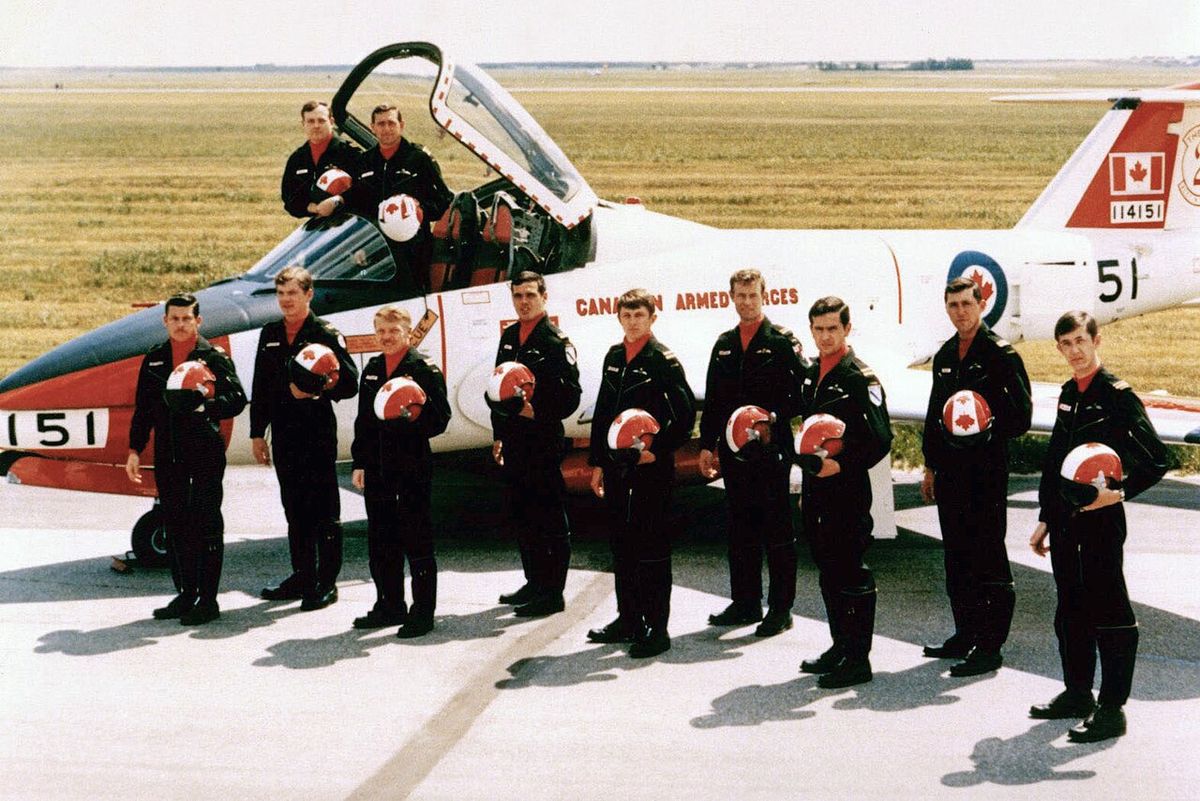
The Snowbirds, officially known as 431 Air Demonstration Squadron, are the military aerobatics flight demonstration team of the Canadian Forces and its air command, the Royal Canadian Air Force. Based at 15 Wing Moose Jaw in Saskatchewan, the team performs precision flying routines across North America. The squadron flies the CT-114 Tutor jet, an aircraft that will be retired after the 2026 season. The Snowbirds will then enter a hiatus until transitioning to a new aircraft, the CT-157 Siskin II, in the early 2030s.
Squadron History and Lineage
The Snowbirds' lineage traces back to the Second World War with the original 431 (Iroquois) Squadron, Royal Canadian Air Force. That squadron formed on 11 November 1942 at RAF Burn in England, operating Wellington bombers under RAF Bomber Command. It later moved to RAF Tholthorpe and then RAF Croft, converting to Halifax and Lancaster heavy bombers, flying missions over Europe until disbanding at RCAF Station Dartmouth, Nova Scotia on 5 September 1945. The squadron earned numerous battle honours for campaigns including the English Channel and North Sea, Fortress Europe, France and Germany, and the Ruhr. The squadron was reformed as a fighter unit at RCAF Station Bagotville on 18 January 1954, flying Canadair Sabres and performing at air shows before disbanding on 1 October 1954.
The direct predecessor to the modern Snowbirds emerged in 1969 at Canadian Forces Base Moose Jaw. Colonel O.B. Philp, the base commander and former leader of the Golden Centennaires aerobatic team, envisioned using leftover CT-114 Tutor jets for a new formation team. Starting with informal practice, instructors from 2 Canadian Forces Flying Training School began performing flypasts in 1970. By 1971, this group, known informally as the "Tutor Whites," was performing with up to seven aircraft. A naming contest at Bushell Park Elementary School on the base resulted in the official name "Snowbirds," adopted on 25 June 1971. The team was formally authorized as the Canadian Forces Air Demonstration Team on 15 January 1975, and was permanently established by reactivating 431 Squadron as 431 Air Demonstration Squadron on 1 April 1978.
Operations and Show Routine
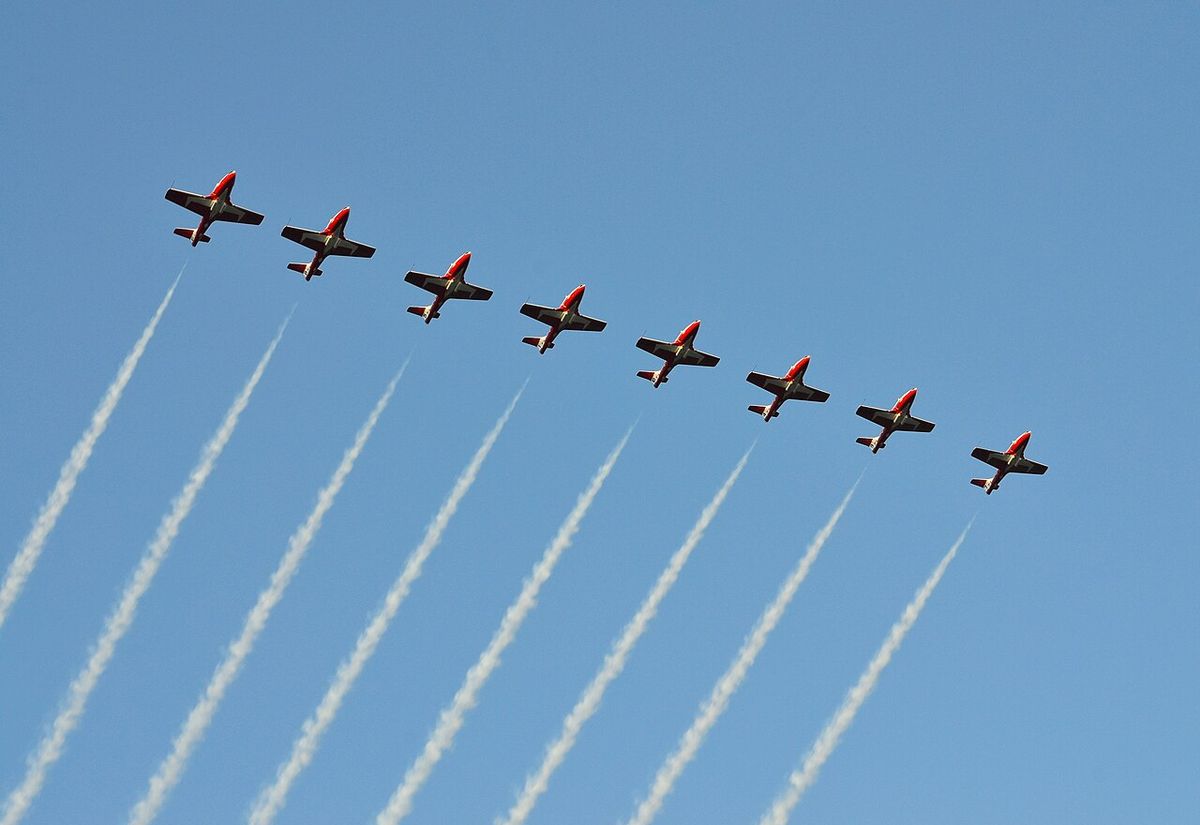
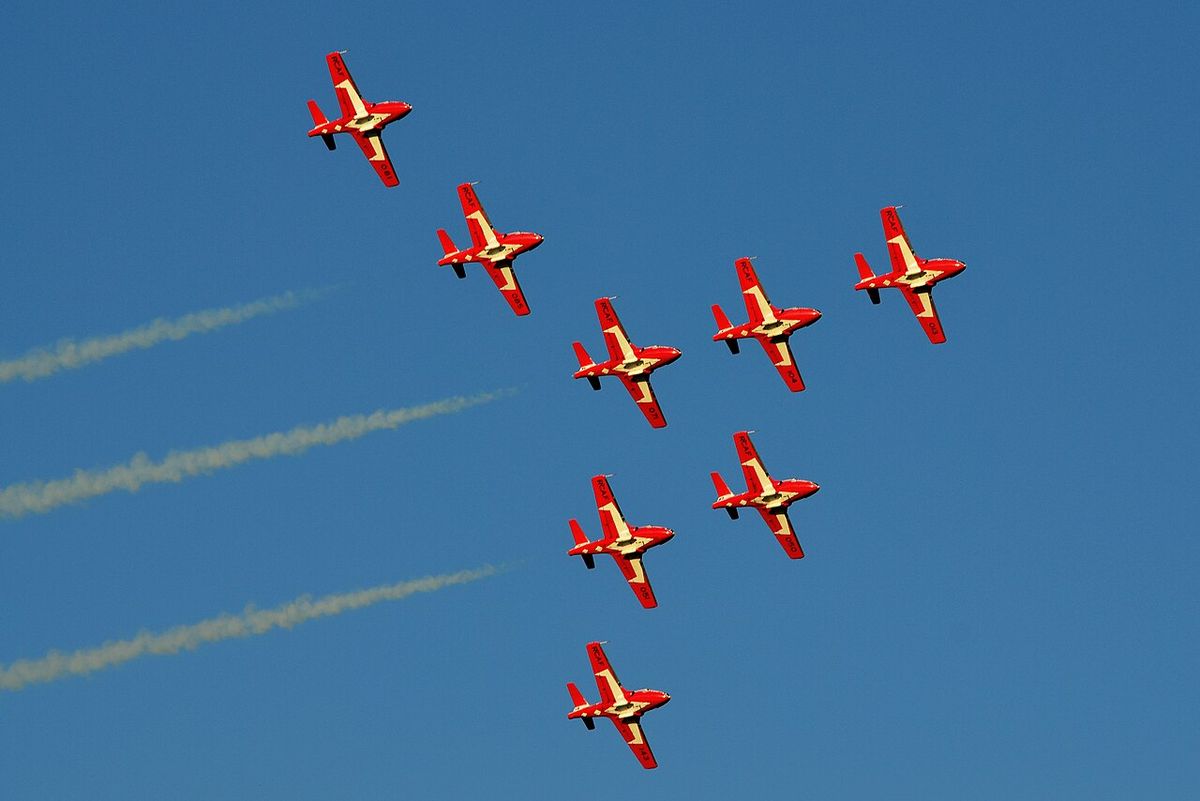
The Snowbirds' aerobatic routine is meticulously planned and rehearsed each season. The team designs three types of shows: a high show for ideal weather, a low show, and a flat show for conditions with cloud restrictions. A non-aerobatic flypast is also part of their repertoire. All manoeuvres are drawn from a Standard Manoeuvre Manual and must receive safety approval from the Canadian Forces, Transport Canada, and, for performances in the United States, the Federal Aviation Administration. Signature elements passed down through seasons include the Canada burst, heart formation, downward bomb burst, solo head-on crosses, and their nine-abreast formation. Training occurs over several months, culminating in specialized practice at CFB Comox and a final "acceptance show" at Moose Jaw for approving officials.
The show team consists of nine performing aircraft flown by pilots who typically serve a maximum of three-year postings, with one-third of the pilots replaced annually to maintain continuity. The Snowbirds were the first aerobatic team in the world to incorporate music into their performances, with live commentary often provided by the pilots of the two spare aircraft. They fly at speeds ranging from 100 to 320 knots, with aircraft separation as close as 1.8 metres in tight formations. Following crashes in 2019 and 2020, new restrictions were implemented for the 2021 season onwards, including rules on altitude, speed, and minimum runway lengths to enhance safety. The team is entirely self-sufficient, travelling with an 18-wheeler mobile support unit to carry parts and equipment across the continent. The Snowbirds are the only major military aerobatics team that operates without a support aircraft.
Aircraft and the Replacement Program
The Snowbirds have flown the Canadair CT-114 Tutor jet since the team's inception. Developed in the 1950s and first accepted by the RCAF in 1963, the aircraft is notable for its age, exceeding 55 years of service. A 2003 Department of National Defence study recommended beginning replacement immediately, citing escalating technical, safety, and financial risks due to metal fatigue, outdated ejection seats, and antiquated avionics. Subsequent reviews extended the aircraft's service life through upgrade programs, but concerns about safety and obsolescence persisted. In 2024, the defence minister stated the Tutor had "aged out" and was "well past its utility," directing the RCAF to search for a replacement.
The Snowbird Aircraft Replacement Project, which initially aimed to procure new jets between 2026 and 2035 at an estimated cost of $500 million to $1.5 billion, was discontinued. Instead, a Tutor Life Extension Program was implemented by L3Harris to keep the jets flying until 2030 with modernized avionics and upgraded escape systems. However, on 19 May 2026, Defence Minister David McGuinty announced the Tutors would be retired after the 2026 flying season. The Snowbirds will be grounded during a hiatus until the transition to the new aircraft, the turbo-prop CT-157 Siskin II (a variant of the Pilatus PC-21), is completed, with the team expected to be ready with the new platform by 2030 or later.
Notable Performances and Milestones
The Snowbirds have marked numerous significant firsts and milestone performances throughout their history. Their inaugural show under the Snowbirds name was held at their home base, CFB Moose Jaw, on 11 July 1971. The team's first foreign performance took place later that year on 27 November at Williams Air Force Base in Arizona. A 1974 show in Inuvik, Northwest Territories, was historic as the first aerobatic team performance conducted at midnight under the Arctic summer sun. The Snowbirds' 1000th official air show was performed at CFB Edmonton on 20 May 1990. Their role as national ambassadors was highlighted at major events like the opening ceremonies of the 1988 Calgary Winter Olympics, where they used coloured smoke representing the Olympic rings for the first time.
- 11 July 1971: First performance as the "Snowbirds" at CFB Moose Jaw.
- 27 November 1971: First performance in a foreign country (United States).
- 13 May 1972: First public show featuring opposing solos, in Yellowknife.
- 1974: First midnight aerobatic show, performed in Inuvik, NWT.
- 28 April 1978: First official show as 431 Air Demonstration Squadron, at Royal Roads Military College, Victoria, BC.
- February 1988: Used coloured smoke for the first time at the Calgary Olympics.
- 20 May 1990: 1000th official air show at CFB Edmonton.
- October 1993: First performance outside North America, at Zapopan Military Air Base near Guadalajara, Mexico.
Accidents and Safety Record
The high-risk nature of military aerobatics has resulted in several tragic accidents throughout the Snowbirds' history, resulting in the deaths of nine personnel. The first fatality occurred on 10 June 1972 when Captain Lloyd Waterer died in a wingtip collision during an opposing solo manoeuvre at the Trenton Air Show. Other notable accidents include the death of Captain Gordon de Jong in Grande Prairie in 1978 due to a stabilizer failure, and a midair collision in Toronto in 1989 that killed Captain Shane Antaya. Training exercises have also proven dangerous, with fatalities in 1998, 2004, 2007, and 2008. The most recent fatal crash occurred on 17 May 2020 in Kamloops, British Columbia, during the "Operation Inspiration" tour, claiming the life of public affairs officer Captain Jennifer Casey and seriously injuring pilot Captain Richard MacDougall. A subsequent flight safety investigation concluded the ejections occurred outside the safe envelope for the system. The Royal Canadian Air Force acknowledges the inherent risks of formation flying and honours those lost in the performance of their duty.
Honours, Recognition, and Public Role
Beyond their demonstration role, the Snowbirds serve as aerial ambassadors for the Canadian Armed Forces, fulfilling significant public relations and recruiting functions. Their recognitions include the 1994 Belt of Orion Award for Excellence from Canada's Aviation Hall of Fame and the 1999 Golden Hawks Award from the Air Force Association of Canada for outstanding performance in military aviation. In 2002, they were named ambassadors for the Ch.i.l.d. Foundation. The team's cultural impact is evidenced by commemorative stamps issued by Canada Post in 1982 and 2006, the latter marking their 35th anniversary alongside a $5 silver coin from the Royal Canadian Mint. The squadron was presented with its squadron colour on 16 October 1999 for 25 years of service. Civilian Lois Boyle, a senior administrative assistant at CFB Moose Jaw instrumental in the team's early development, was honoured with the title 'Mother of the Snowbirds' and was commemorated with a flyover at her funeral in 2012.
The 2026 Season and Future
The 2026 season represents a significant milestone and a turning point for the Snowbirds. It is the team's 55th anniversary season and will be the final year of operations for the CT-114 Tutor. The tour schedule runs from 24 May to 11 October 2026, with 25 confirmed appearances across six provinces. Notable scheduled performances include a show at White Rock, British Columbia, on 12 August and a featured role at Airshow Atlantic in Saint John, New Brunswick, on 29 and 30 August. Following the season's conclusion, the team will be grounded as it enters a hiatus. The transition to the new CT-157 Siskin II aircraft will require extensive pilot training and operational integration, with the goal of returning the Snowbirds to the skies by the early 2030s. This period marks the end of a long era for the Tutor and the beginning of a new chapter for Canada's aerial demonstration team.
| Selected 2026 Performance Dates | Location | Province |
|---|---|---|
| 24 May 2026 | Season Opener | Saskatchewan |
| 12 August 2026 | Wings Over White Rock | British Columbia |
| 29-30 August 2026 | Airshow Atlantic | New Brunswick |
| 11 October 2026 | Season Finale | Saskatchewan |
Questions about Snowbirds
What aircraft do the Snowbirds fly?
The Snowbirds fly the Canadair CT-114 Tutor, a Canadian-built jet trainer first accepted by the RCAF in 1963. The team operates eleven of these aircraft, with nine used in the aerobatic formation and two kept as spares. An additional 13 units are maintained in storage. Due to the aircraft's advanced age, which exceeds 55 years, the Tutors will be retired after the 2026 show season. The Snowbirds are scheduled to transition to a new aircraft, the CT-157 Siskin II, a turbo-prop trainer, in the early 2030s following a hiatus.
Where are the Snowbirds based?
The Snowbirds are based at 15 Wing Moose Jaw near Moose Jaw, Saskatchewan. This is the home station for 431 Air Demonstration Squadron. The team is composed of approximately 80 Canadian Forces personnel who work with the squadron full-time. About 24 personnel are in the show team that travels during the show season.
How many pilots have died flying with the Snowbirds?
Since the team's first show in 1971, seven Snowbird pilots and two other personnel have died in accidents. The first pilot fatality was Captain Lloyd Waterer in 1972. Other fatal incidents occurred in 1978, 1989, 1998, 2004, 2007, and 2008. The most recent tragedy was in May 2020, when public affairs officer Captain Jennifer Casey was killed in a crash in Kamloops, British Columbia. The Royal Canadian Air Force acknowledges the inherent risks of formation flying and honours those lost in the performance of their duty.
What is the purpose of the Snowbirds?
The Snowbirds' official purpose is to demonstrate the skill, professionalism, and teamwork of Canadian Forces personnel. The team also provides a public relations and recruiting role. They serve as an aerial ambassador for the Canadian Armed Forces. The Snowbirds are the military aerobatics flight demonstration team of the Canadian Forces and its air command, the Royal Canadian Air Force.
When will the Snowbirds get new planes?
The Snowbirds will retire their current CT-114 Tutors after the 2026 flying season. Following this, the team will be grounded during a transition period. The Department of National Defence plans to replace the Tutors with the CT-157 Siskin II aircraft. The transition process, including pilot training and operational integration, is expected to be complete by 2030 or later, at which point the Snowbirds will resume flying demonstrations with their new platform.
What was the Snowbirds' role during the COVID-19 pandemic?
In 2020, the Snowbirds undertook a cross-country tour named "Operation Inspiration. The mission was to salute Canadians and boost morale during the challenging period of the COVID-19 pandemic. The tour involved flypasts over various communities. Tragically, during this tour on 17 May 2020, one of the Snowbirds' Tutor jets crashed in Kamloops, British Columbia, resulting in the death of Captain Jennifer Casey and serious injuries to the pilot, Captain Richard MacDougall. The final report of the Directorate of Flight Safety concluded that both occupants' ejection sequences were outside of the ejection envelope.
Sources and further reading
- Snowbirds (Wikipedia)
- Canadian Forces Snowbirds (cias.org)
- Snowbirds set to soar at YSJ (ysjsaintjohn.ca)
Checked by the Nosy Mag desk. Last updated 2026-10-29.