William Osgoode
William Osgoode (March 1754, 17 January 1824) was the first Chief Justice of Upper Canada, a foundational legal figure in early Ontario. Educated at Oxford and called to the English bar, he was appointed in 1791 and played a central role in adapting English law to the needs of the new colony. His work included drafting the Judicature Act of 1794, which established the province's court system, and serving on the Executive Council. Though his judicial tenure was relatively brief, his name endures prominently in Canadian legal institutions, most notably Osgoode Hall and Osgoode Hall Law School.
Early Life and Education in England
William Osgoode was born in London, England in March 1754, the only son of William Osgood, a successful hosier from Leeds. His father was a Methodist and a friend of the evangelist John Wesley, who preached his funeral sermon in December 1767. The younger Osgoode received a classical education at the Methodist school in Kingswood, near Bath, an institution founded by Wesley. He matriculated at Christ Church, Oxford in 1768, graduating with a Bachelor of Arts in 1772 and a Master of Arts in 1777. He entered Lincoln's Inn in 1773 and was called to the English bar on 11 November 1779. In that same year, he published Remarks on the law of descent, a critique of Sir William Blackstone's Commentaries, which helped establish his reputation as a legal thinker. He developed a practice as a draftsman in the courts of equity rather than as a common-law barrister. Family traditions suggesting he was an intimate of William Pitt or a natural son of George II are without historical foundation. He also spent a year in France before his call to the bar.
Appointment and Judicial Work in Upper Canada
Osgoode was appointed the first Chief Justice of Upper Canada on 31 December 1791. He arrived in Quebec in June 1792 and travelled to Upper Canada with Lieutenant Governor John Graves Simcoe, with whom he developed a strong working relationship. Osgoode lived with the Simcoe family in Newark (now Niagara-on-the-Lake) for much of that year. His primary task was to adapt English law for the new colony, and he sought advice primarily from English lawyers. His most significant legislative contribution was the Judicature Act of 1794, which established a system of district courts and a superior provincial court, laying the foundation for common law practice in Upper Canada. He also served on Simcoe's Executive Council and as Speaker of the Legislative Council. During his term, legislation was introduced in 1793 to abolish the importation of enslaved people into the province, though it exempted existing enslaved persons and their trade. Osgoode shared a vision with merchant Richard Cartwright of an Upper Canada settled by United Empire Loyalists as a bulwark against the United States. He also allowed justices of the peace to perform marriages when Anglican priests were not available.
Tenure as Chief Justice of Lower Canada and Political Conflicts
In 1794, Osgoode was appointed Chief Justice of Lower Canada. His time in Quebec was marked by significant political conflicts. He first clashed with Governor Robert Prescott over attempts to sort out the complex issue of land grants in the region. When Prescott was recalled, Osgoode came into further conflict with his successor, Lieutenant Governor Robert Shore Milnes. In his judicial role, he took a firm personal stance against slavery, systematically freeing enslaved individuals who were brought before him in trials, despite the absence of legislation prohibiting the practice in the colony. This action, combined with the Legislative Assembly's refusal to address the issue, contributed to enslaved people deserting their masters without legal repercussions. Osgoode also held strong views on the establishment of the Church of England, regretting with Bishop Jacob Mountain that it had no legal claim to tithes in Lower Canada. He expressed aristocratic views, including a qualified sympathy for duelling under a code of restraint. He was surprised during the 1792 election in Montreal to find women could vote. He maintained private correspondence with British under-secretary John King, offering partisan commentary on his colleagues.
Return to England, Later Work, and Death
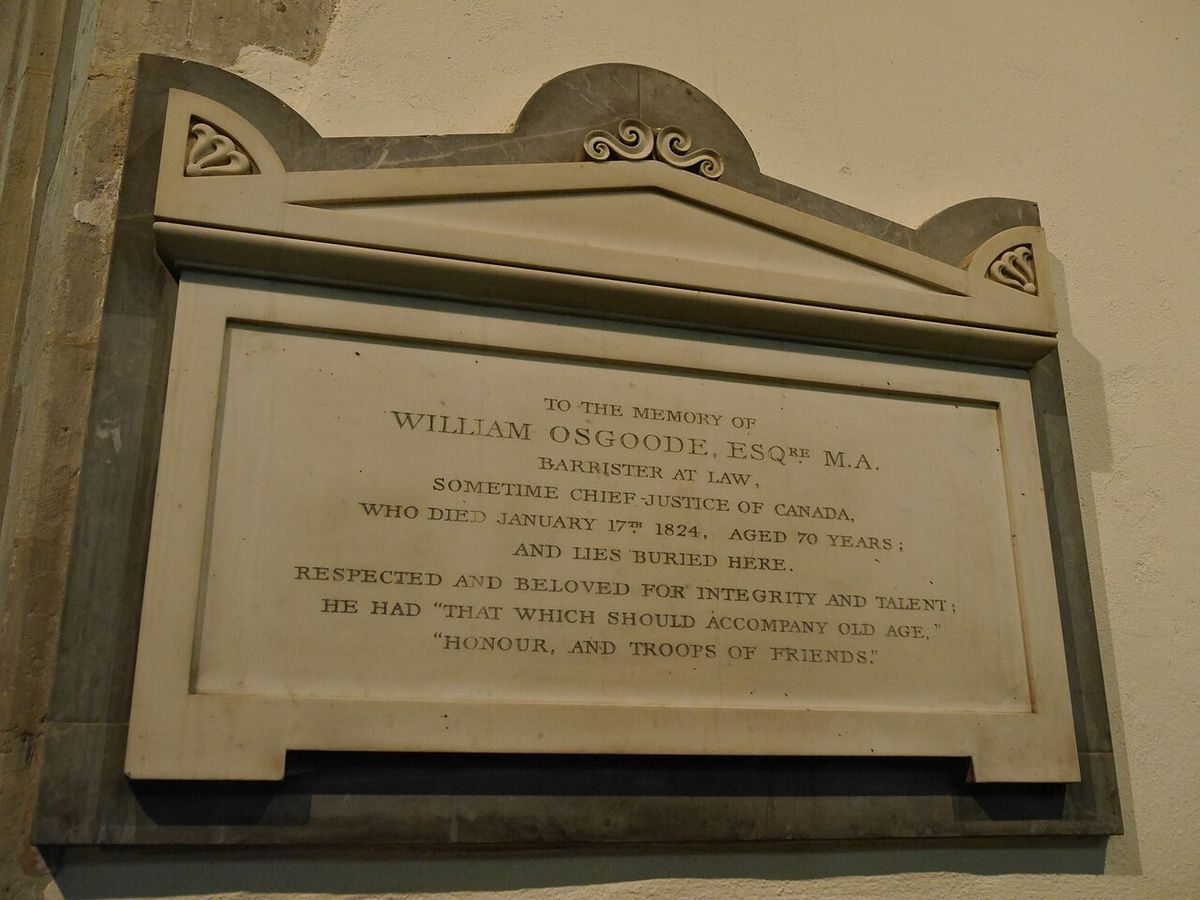
Osgoode resigned his post in Lower Canada in 1801 and returned to London. There, he lived the rest of his life as a country gentleman. He continued to engage with legal reform, becoming a member of the Royal Commission on the Courts of Law. His work on this commission contributed to efforts that eventually led to the Uniformity of Process Act in 1832, a significant piece of English procedural law reform. He remained unmarried and maintained a private life. William Osgoode died in London on 17 January 1824. He was buried at St. Mary's Church in Harrow-on-the-Hill. His legacy in England was less pronounced than in Canada, where his name would become permanently attached to major legal institutions. His will left his estate to his nephew, the Reverend William Osgood.
Physical Legacy: Osgoode Hall and the Law School
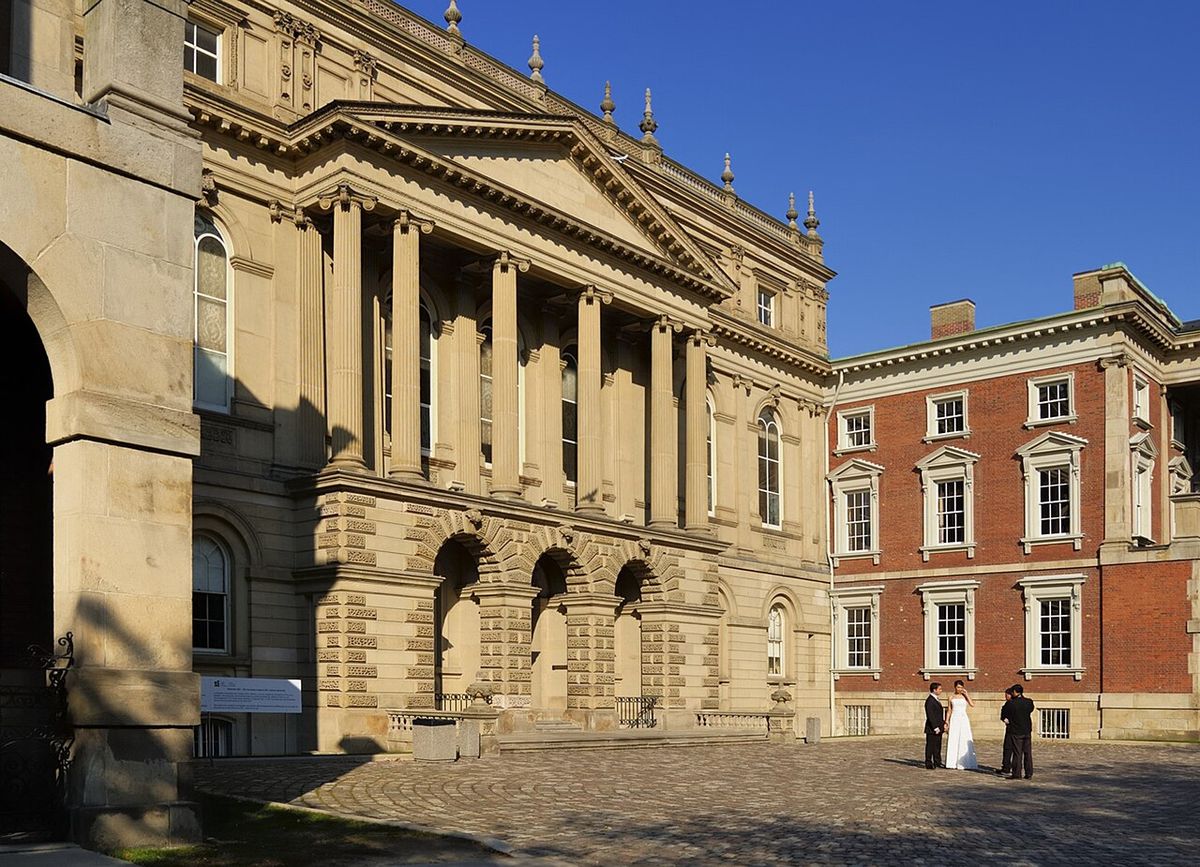
The most enduring physical legacy of William Osgoode is Osgoode Hall in Toronto. The Law Society of Upper Canada (now the Law Society of Ontario) was formed in 1797 and established its headquarters at the corner of University Avenue and Queen Street. The original building was completed in 1832 and named in Osgoode's honour as the province's first chief justice. The complex houses the Ontario Court of Appeal, the Law Society of Ontario, and judicial offices. Inside, a memorial plaque acknowledges Osgoode, and plaques from the Historic Sites and Monuments Board of Canada and the Ontario Heritage Foundation recognize the site. The building also provided the original home for legal education. The Law Society made Osgoode Hall Law School a permanent institution in 1889. In 1969, the law school was transferred to York University. The Osgoode Hall complex, the law school at York, and an adjacent Toronto subway station all carry his name. The former Osgoode Township in Ontario also bears his name.
- Osgoode Hall: Construction began 1829, completed 1832. Named for William Osgoode.
- Original Purpose: Headquarters of the Law Society of Upper Canada and home to courts.
- Osgoode Hall Law School: Founded permanently in 1889 by the Law Society.
- Transfer to York University: Occurred in 1969.
- Memorials: Plaque inside Osgoode Hall. Historic Sites and Monuments Board plaque. Ontario Heritage Foundation sign.
The Osgoode Society for Canadian Legal History
Established in 1979, the Osgoode Society for Canadian Legal History is a scholarly organization that perpetuates the study of law in Canada. The Society publishes books on a diverse range of topics in Canadian legal history and creates and preserves an oral history archive. As of 2026, the Society has published more than 125 books and recorded more than 715 oral histories from various members of the legal profession, making it the world's largest oral history programme dedicated to legal history. All of its work is supported by The Law Foundation of Ontario. The Society's activities include book launches and events for members throughout the year. Its oral history archive includes interviews with prominent figures such as former Ontario Attorney General and Chief Justice Roy McMurtry, former federal cabinet minister Allan Rock, Canada's first Black MP Lincoln Alexander, and celebrated lawyer John Robinette. The Society also sponsors the Time Immemorial podcast series exploring episodes of Canadian legal history. The Society's publications include works on constitutional history, biographies of judges, and studies of legal practice.
Character, Legal Philosophy, and Historical Assessment
Historical assessments describe Osgoode as a man of good manners, kindliness, and tranquil temperament, who was popular among the colonial elite in Upper Canada. He was well-liked by figures such as Richard Cartwright and maintained a long correspondence with Elizabeth Simcoe. His legal philosophy was conservative, aristocratic, and firmly aligned with upholding Crown authority. Historian Douglas Hay notes Osgoode made his reputation as an effective instrument of state power, at the expense of judicial impartiality, and was committed to upholding aristocratic, monarchical, and anti-democratic government. He viewed courts as instruments to protect the monarch. He harboured a deep, unqualified mistrust of American influence. While he did not leave a substantial body of judicial rulings, his legacy lies in his legislative drafting and the foundational court system he helped create. His pragmatic adaptations of English law, though designed for a colonial elite, provided an early administrative structure for what would become Ontario. His personal interventions against slavery in Lower Canada, while not based on legislation, were a notable feature of his time on the bench. He is also noted for his good looks and his role as a mediator among officials in Lower Canada.
Publications and Scholarly Influence
Osgoode's scholarly influence began early with his 1779 publication, Remarks on the law of descent. This work was a critique of Sir William Blackstone's influential Commentaries on the laws of England, demonstrating Osgoode's engagement with the leading legal theories of his day and his capacity for independent legal thought. This publication likely contributed to his professional reputation and may have aided his appointment to the Canadian bench. Beyond this, his primary written legacy consists of the statutes he drafted, most importantly the Judicature Act of 1794. His work is now studied primarily through the publications of the Osgoode Society for Canadian Legal History, which as of 2026 has released over 125 books on topics ranging from constitutional history to professional legal practice. The Society's oral history programme, with over 715 interviews, further preserves the context and evolution of the Canadian legal profession that Osgoode helped to initiate. No other major publications by Osgoode are known beyond his early legal treatise.
Questions about William Osgoode
Who was William Osgoode?
William Osgoode was the first Chief Justice of Upper Canada, appointed in 1791. Born in London in 1754 and educated at Oxford, he was a barrister before coming to Canada. He served as Chief Justice in both Upper and Lower Canada and was responsible for drafting key early legislation, including the Judicature Act of 1794 which established the province's court system. He returned to England in 1801 and died there in 1824.
What is Osgoode Hall named after?
Osgoode Hall is named after William Osgoode. The building, completed in 1832 in Toronto, was constructed as the headquarters for the Law Society of Upper Canada. It was named in his honour as the province's first chief justice. Today, the building houses the Ontario Court of Appeal and the Law Society of Ontario, and its name is shared by the law school originally founded within its walls.
What did William Osgoode do about slavery in Canada?
As Chief Justice of Lower Canada, William Osgoode personally refused to recognize the legality of slavery. He systematically ordered the freedom of enslaved people who were brought before him in court, despite there being no legislation at the time that outlawed slavery in the colony. His actions, alongside the legislature's inaction, allowed enslaved individuals to leave their masters without legal penalty. In Upper Canada, he was part of the council that passed legislation in 1793 to abolish the importation of enslaved people, though it did not free those already enslaved.
What is the Osgoode Society for Canadian Legal History?
The Osgoode Society for Canadian Legal History is an organization founded in 1979 that promotes the study and preservation of Canada's legal past. It publishes books on a wide array of legal history topics and maintains the world's largest oral history programme dedicated to legal history. As of 2026, the Society has published more than 125 books and recorded over 715 oral history interviews. It is supported by The Law Foundation of Ontario and is named after William Osgoode.
Where did William Osgoode go to law school?
William Osgoode did not attend a law school in the modern sense. Osgoode entered Lincoln's Inn in 1773 and was called to the English bar in 1779. His academic education was at Christ Church, Oxford, where he earned BA and MA degrees. The law school named after him, Osgoode Hall Law School, was founded long after his death, in 1889.
How long was William Osgoode in Canada?
William Osgoode's time in Canada lasted approximately nine years. He arrived in 1792 to take up his post as Chief Justice of Upper Canada. In 1794, he moved to Lower Canada (Quebec) to become its Chief Justice. He resigned from this position and returned to England in 1801, where he lived for the remainder of his life.
Sources and further reading
- William Osgoode (Wikipedia)
- William Osgoode (thecanadianencyclopedia.ca)
- OSGOODE, WILLIAM, Dictionary of Canadian Biography (biographi.ca)
- Who is Osgoode of Osgoode Hall Law School? - L. Anders ... (alternativecampustour.info.yorku.ca)
- Welcome to the Osgoode Society for Canadian Legal History (osgoodesociety.ca)
Checked by the Nosy Mag desk. Last updated 2026-10-27.