North Warning System
The North Warning System (NWS) is a joint United States and Canadian early-warning radar system for the atmospheric air defence of North America. Spanning over 4,800 kilometres across Canada's Arctic coastline from the Yukon to Labrador, it provides surveillance of airspace against potential incursions from across the polar region. The system, which replaced the older Distant Early Warning (DEW) Line in the late 1980s and early 1990s, is a key component of North American Aerospace Defense Command (NORAD) operations. Its 47 remote radar sites in Canada automatically feed data to control centres, forming an essential tripwire for continental security.
System Description and Components
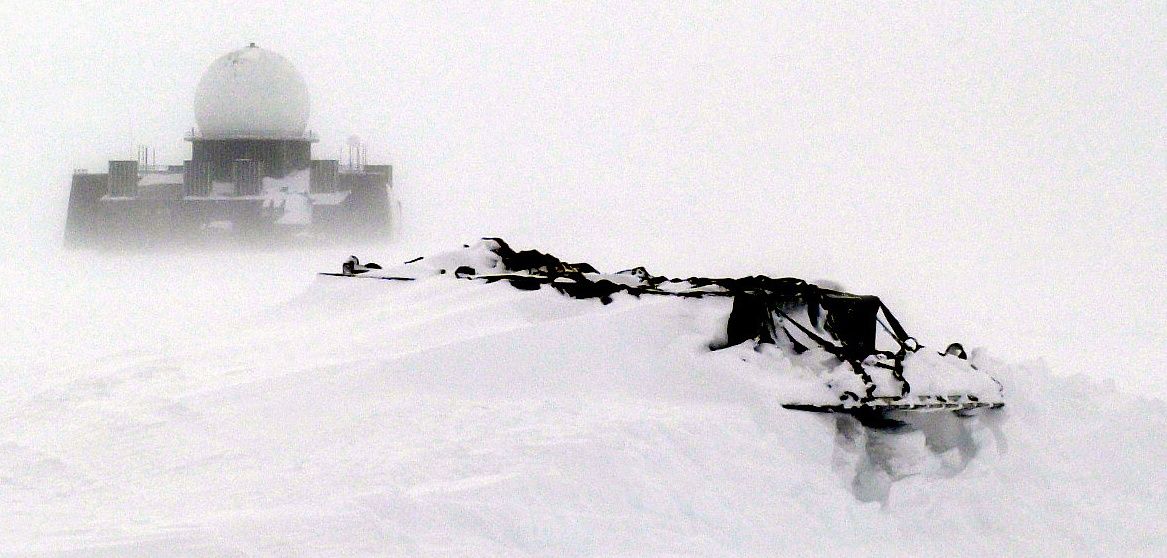
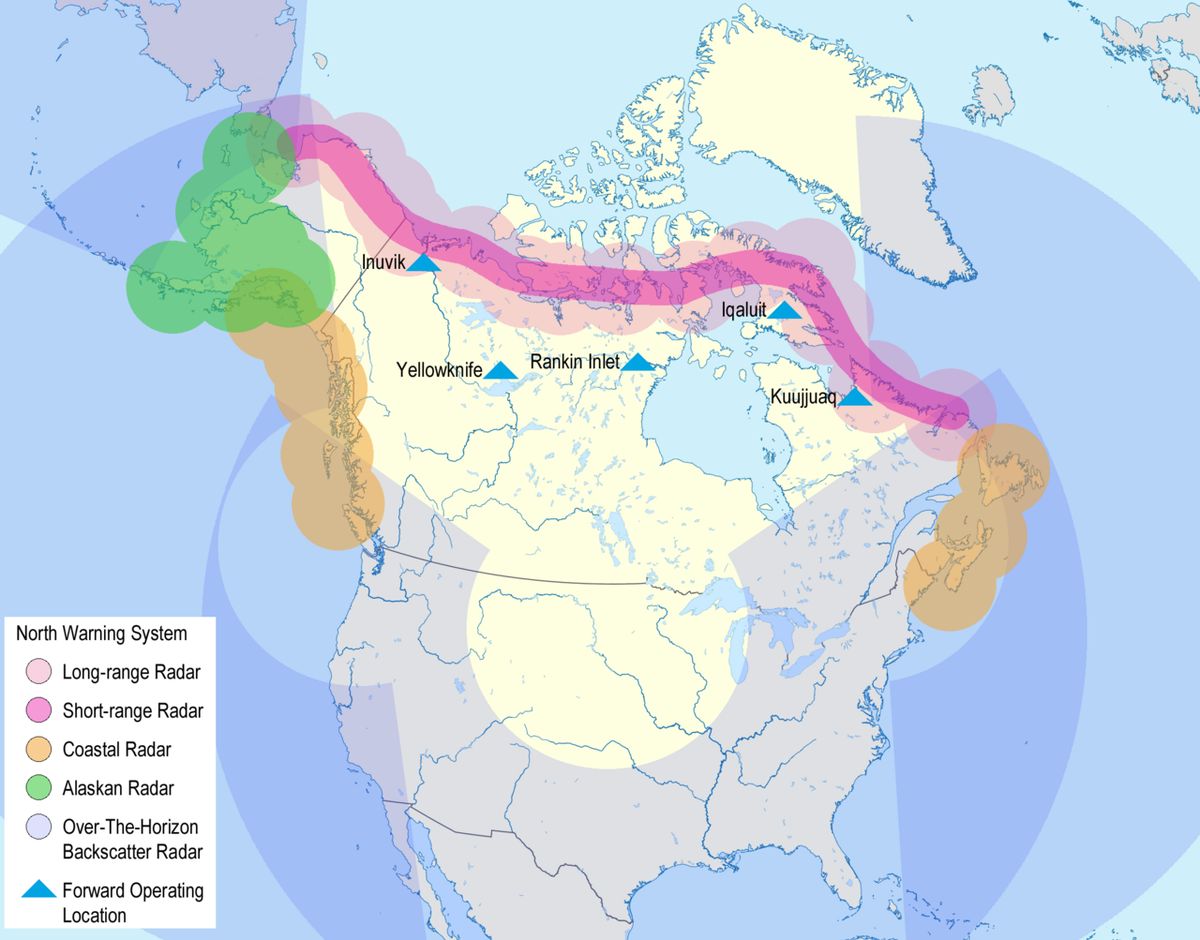
The North Warning System is a network of minimally attended radar stations designed to detect aircraft and cruise missiles. It consists of two primary types of radar: the long-range AN/FPS-117 and the short-range AN/FPS-124. In Canada, there are 11 long-range sites and 36 short-range sites, for a total of 47 locations. The system overall consists of 13 long-range sites and 36 short-range sites. These sites form a surveillance corridor 4,800 kilometres long and 320 kilometres wide, creating a defensive tripwire across the top of the continent. The radar chain is concentrated along the Arctic coasts of the Yukon, Northwest Territories, Nunavut, and Labrador, monitoring the most likely northern approaches to North America.
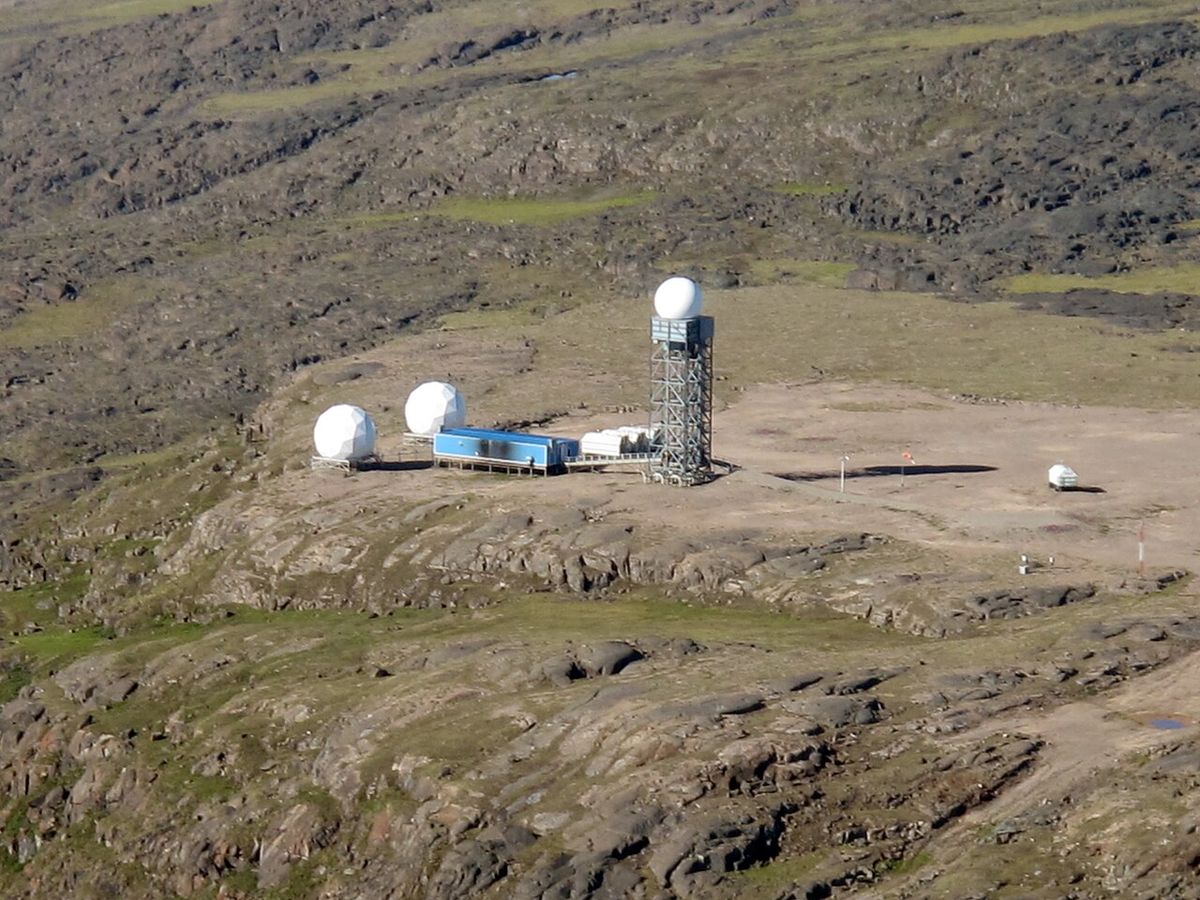
Each long-range site features accommodation buildings, radar towers protected by radomes, independent power generation and fuel systems, satellite communication terminals, automated weather stations, and UHF and VHF ground-air-ground radio equipment. Short-range sites are more austere, typically consisting of a single AN/FPS-124 radar, satellite terminals, power generation, and a small emergency shelter capable of housing six people. Some short-range stations lack weather stations and UHF tactical radios. All sites operate unattended, powered by diesel generators, and are connected via a satellite communications network that relays data south. The physical infrastructure at Canadian sites is owned or leased by the Government of Canada, while the radars and tactical radios are owned by the United States Air Force.
The information gathered by the remote radars is transmitted automatically to Regional Operations Control Centres (ROCCs). The Canada East and Canada West ROCCs are located at 22 Wing/CFB North Bay in Ontario. These centres remotely monitor and control the Canadian sites on a 24/7 basis. The Alaska ROCC at Joint Base Elmendorf-Richardson controls the stations located in that state. Data from all ROCCs is then forwarded to the NORAD Combat Operations Centre at Peterson Space Force Base in Colorado Springs, Colorado, for integrated air defence picture compilation.
Historical Development from the DEW Line
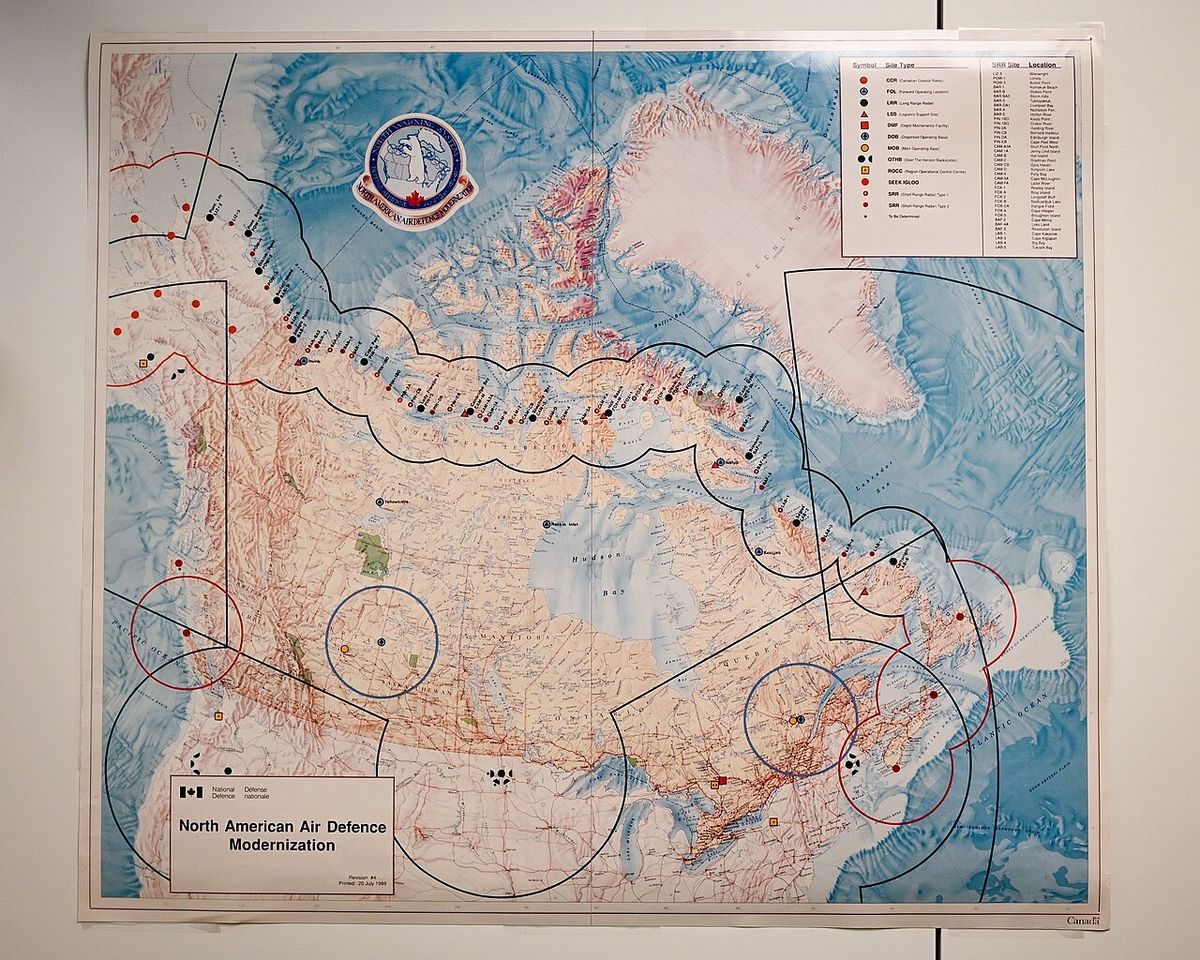
The North Warning System originated from the need to modernize the aging Distant Early Warning (DEW) Line, which was constructed in the late 1950s. By the 1980s, the DEW Line's technology was becoming obsolete. The project to replace it was formally launched on 18 March 1985, when Prime Minister Brian Mulroney and President Ronald Reagan signed the North American Air Defence Modernization agreement at the Shamrock Summit in Quebec City. This agreement set the stage for the DEW Line's upgrade and transition into the new system. The project was driven by both defence needs and a continuing Canadian imperative to contribute credibly to continental defence.
The NWS began limited operation in 1988 with the commissioning of three newly constructed east coast sites: BAF-3 on Brevoort Island, Nunavut, and LAB-2 at Saglek and LAB-6 at Cartwright in Labrador. Throughout the late 1980s and early 1990s, new NWS long-range radars replaced selected former DEW Line sites. DEW Line sites that were not transitioned to the new system were closed. The official activation of the North Warning System and the concurrent inactivation of the DEW Line took place on 15 July 1993. This marked the completion of a major binational infrastructure project.
The transition also initiated a significant environmental remediation project. DEW Line sites had used materials and practices acceptable by the standards of their time but which left contamination. Beginning in 1989, the Canadian Department of National Defence investigated site conditions, starting cleanup work at two locations in 1996. The project aimed to remove surplus infrastructure, treat chemically contaminated soils, and stabilize landfills to protect the Arctic food chain. The remediation of 21 former DEW Line sites was scheduled for completion in 2013, and DND announced the project was finished in March 2014.
Operation, Maintenance and Northern Partnerships
The day-to-day operation and maintenance of the NWS in Canada has been conducted by private contractors, with a strong emphasis on northern benefits and Inuit partnership. In 1987, Frontec Logistics Corp (an ATCO company) became the first Canadian contractor awarded the management and operation contract. To deepen northern involvement, Frontec partnered with the Pan Arctic Inuit Logistics Corporation (PAIL) in 1994 to form the Nasittuq Corporation, initially a 50-50 joint venture. Nasittuq was awarded the NWS operations and maintenance contract in 2001, holding it until 2014. During this period, Nasittuq was responsible for the entire system, including 47 helipads, gravel runways, over 118 buildings, and 311 bulk fuel storage tanks.
Nasittuq's work involved comprehensive maintenance, logistics, environmental systems management, and project management across the Arctic. The company maintained exceptional system performance, consistently exceeding the 96% operational availability target and frequently achieving over 99% annually. Its workforce model emphasized northern employment, with a reported 250 full-time employees, 20% of whom were Inuit, and a part-time workforce that was 35% Inuit. The partnership included training and senior technical development programs to encourage Inuit participation as employees and suppliers, with Inuit representatives serving on the Nasittuq board.
In April 2022, Nasittuq, now an Inuit majority-owned company, again assumed responsibility for NWS operations and maintenance under a new contract. This contract includes a commitment to provide Inuit Benefits starting at 50.37%, with a 1% increase every two years. It also involves a $2.5 million training and development program and the implementation of sustainability initiatives to reduce greenhouse gas emissions and fuel consumption. Support for the remote sites is coordinated through five logistics support sites across the North: Inuvik, Cambridge Bay, Hall Beach, Iqaluit, and Goose Bay. Overall systems engineering and project management support for the NWS is supplied by the United States Air Force's Air Force Materiel Command from Hill Air Force Base in Utah.
- 1987: Frontec Logistics Corp awarded the first NWS operations contract.
- 1994: Formation of the Nasittuq Corporation joint venture between Frontec and PAIL.
- 2001: Nasittuq awarded the NWS operations and maintenance contract.
- 2001 to 2014: Nasittuq's first contract period, maintaining over 99% system availability.
- April 2022: Nasittuq begins a new NWS operations and maintenance contract.
Governance and Binational Structure
The North Warning System is a foundational element of the North American Aerospace Defense Command (NORAD), the binational command responsible for aerospace warning and control. The system is jointly funded by the Canadian and United States governments, reflecting its shared importance to continental defence. Strategic oversight and operational control reside with NORAD, which integrates NWS data with information from other sensors like AWACS aircraft and coastal radars. This integrated picture is essential for providing early warning of any airborne threat approaching from the north. The binational North Warning System Office (NWSO), located in Ottawa, Ontario, provides program management and coordination for this complex partnership.
The North Warning System Office (NWSO) in Ottawa is staffed by both Canadian and American military and civilian personnel. The Royal Canadian Air Force has operational responsibility for the Canadian sites, but they are physically staffed by civilian contractors. Logistical and maintenance support for the NWS is supplied by the Air Force Materiel Command of the United States Air Force, located at Hill Air Force Base in Utah. The system provides surveillance of airspace from potential incursions or attacks from across North America's polar region.
Planned Modernization and Replacement
The North Warning System is acknowledged to be approaching the end of its functional and technological life. Canada's 2017 defence policy explicitly stated the system was nearing its life expectancy and that bilateral efforts were underway to develop a successor. Planning for a new system, often referred to as the Northern Approaches Surveillance system (NASS), is a major undertaking expected to extend over at least a decade. Current estimates suggest delivery and installation will continue into the mid-2030s or beyond, indicating a lengthy and complex procurement and construction phase.
The cost of replacing the NWS is projected to be many billions of dollars, significantly exceeding the original multi-billion dollar investment. The procurement timeline, as outlined in policy documents, envisioned research and analysis completed by 2020, system approval in 2021, a request for proposals by 2023, and a final contract award in 2024. While real-world progress may differ, these milestones highlight the scale and long-term nature of the modernization project. This renewal will be one of the most substantial joint Canada-US defence infrastructure projects of the coming decades.
Strategic Importance and Canadian Context
The North Warning System serves a vital strategic role as the primary peacetime surveillance network for North America's northern flank. Its core function is to provide early warning of any airborne threat, such as bombers or cruise missiles, traversing the Arctic towards the continent's populated centres. This early detection is crucial for NORAD to execute its warning and control missions, allowing time for the scrambling of interceptor aircraft and the implementation of other defensive measures. In this sense, the NWS acts as a critical tripwire across the continent.
For Canada, the system represents a sovereign capability operated on its own territory as part of a binational framework. It allows Canada to meet its NORAD commitments and exercise control over surveillance activities within its Arctic regions. The system also generates significant northern benefits, including employment, training, and business opportunities for Inuit and northern communities through contracting and partnership models like that with Nasittuq Corporation. These socio-economic aspects are an integral part of the system's footprint in the North.
The NWS also exists within a broader historical and geopolitical context. It succeeded the DEW Line, which was built in response to the Soviet bomber threat during the Cold War. While the specific threat has evolved, the fundamental requirement for Arctic awareness persists. The planned modernization of the system reflects renewed strategic competition and recognition of the Arctic's growing accessibility. The NWS, therefore, remains a key instrument for both continental defence and the assertion of Canadian sovereignty in its northern territories.
Questions about North Warning System
What is the North Warning System and what does it do?
The North Warning System is a joint United States and Canadian network of early-warning radars stretching across the Arctic from Alaska to Labrador. Its primary function is to detect aircraft and cruise missiles entering North American airspace from the north, providing early warning to NORAD for continental air defence. The system consists of 47 remote, minimally attended radar sites in Canada that automatically relay surveillance data to control centres in North Bay, Ontario, and Colorado Springs, USA. It replaced the older Distant Early Warning Line and became fully operational on 15 July 1993.
Who operates and maintains the North Warning System?
The system is operated under the North American Aerospace Defense Command (NORAD). Day-to-day operation and maintenance of the Canadian sites are performed by civilian contractors. From 2001 to 2014 and again starting in April 2022, this contract has been held by Nasittuq Corporation, an Inuit majority-owned company. Nasittuq manages logistics, maintenance, and technical support for all 47 sites, employing a significant number of Inuit and northern residents. The Royal Canadian Air Force has operational responsibility, while overall program management is handled by the binational North Warning System Office in Ottawa.
How many radar sites are there and where are they located?
There are a total of 47 North Warning System radar sites located along Canada's Arctic coastline. This includes 11 long-range AN/FPS-117 radar sites and 36 short-range AN/FPS-124 radar sites. They are spread across the territories of Yukon, Northwest Territories, Nunavut, and the province of Labrador. The sites are extremely remote, powered by diesel generators, and connected via satellite. Support is coordinated through five main logistics sites in Inuvik, Cambridge Bay, Hall Beach, Iqaluit, and Goose Bay.
When was the North Warning System built and what did it replace?
The North Warning System was built to replace the aging Distant Early Warning (DEW) Line from the 1950s. The project was formally agreed upon by Canada and the United States on 18 March 1985. The first new sites began limited operation in 1988, and the system officially replaced the DEW Line on 15 July 1993. Many new NWS radars were constructed at former DEW Line locations, while other DEW sites were closed and subsequently underwent environmental cleanup, a project declared complete by Canada's Department of National Defence in March 2014.
Is the North Warning System being replaced?
Yes, Canada and the United States are planning a replacement for the aging North Warning System. Referred to as the Northern Approaches Surveillance system (NASS) in planning documents, the new system is expected to take at least a decade to deploy. Current estimates suggest completion is anticipated for the mid-2030s or beyond. The replacement is driven by the system's technological obsolescence and the need for enhanced domain awareness in the face of new threats and increased Arctic activity. The project is expected to cost many billions of dollars.
What is Nasittuq Corporation's role with the North Warning System?
Nasittuq Corporation is an Inuit majority-owned company that holds the contract for the operation and maintenance of the North Warning System in Canada. It first held this role from 2001 to 2014 and resumed it in April 2022. Nasittuq is responsible for the system's performance, logistics, environmental management, and project services. The company's contract includes specific Inuit benefit targets starting at 50.37% and a $2.5 million training and development program for northern employees.
Sources and further reading
- North Warning System (Wikipedia)
- NORTH WARNING SYSTEM (nasittuq.com)
- Operating the North Warning System (frontec.atco.com)
- CBO | North Warning System (canadianbaseoperators.com)
- Replacing the North Warning System: Strategic competition ... (thesimonsfoundation.ca)
Checked by the Nosy Mag desk. Last updated 2026-10-26.