Tommy Prince
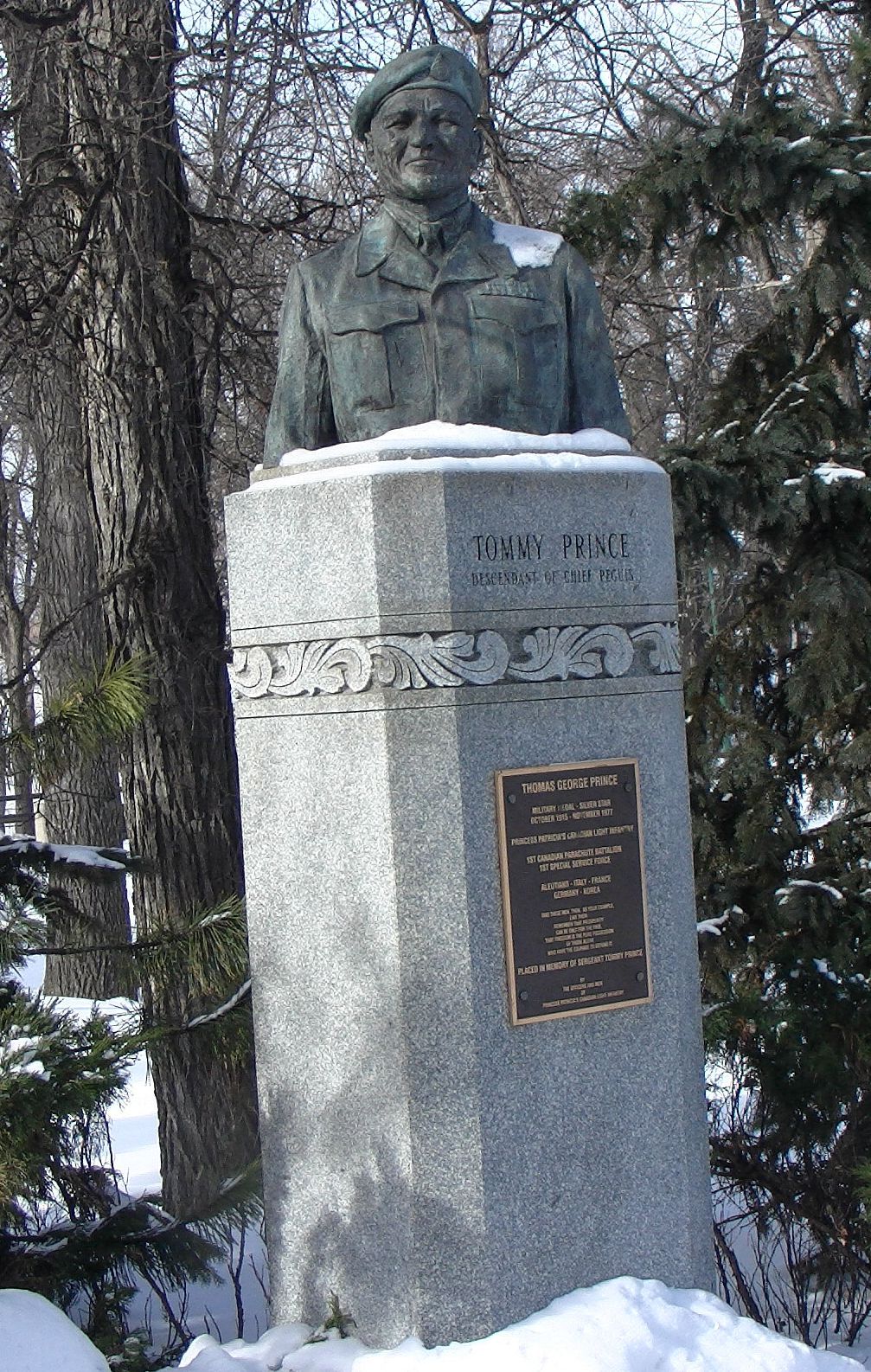
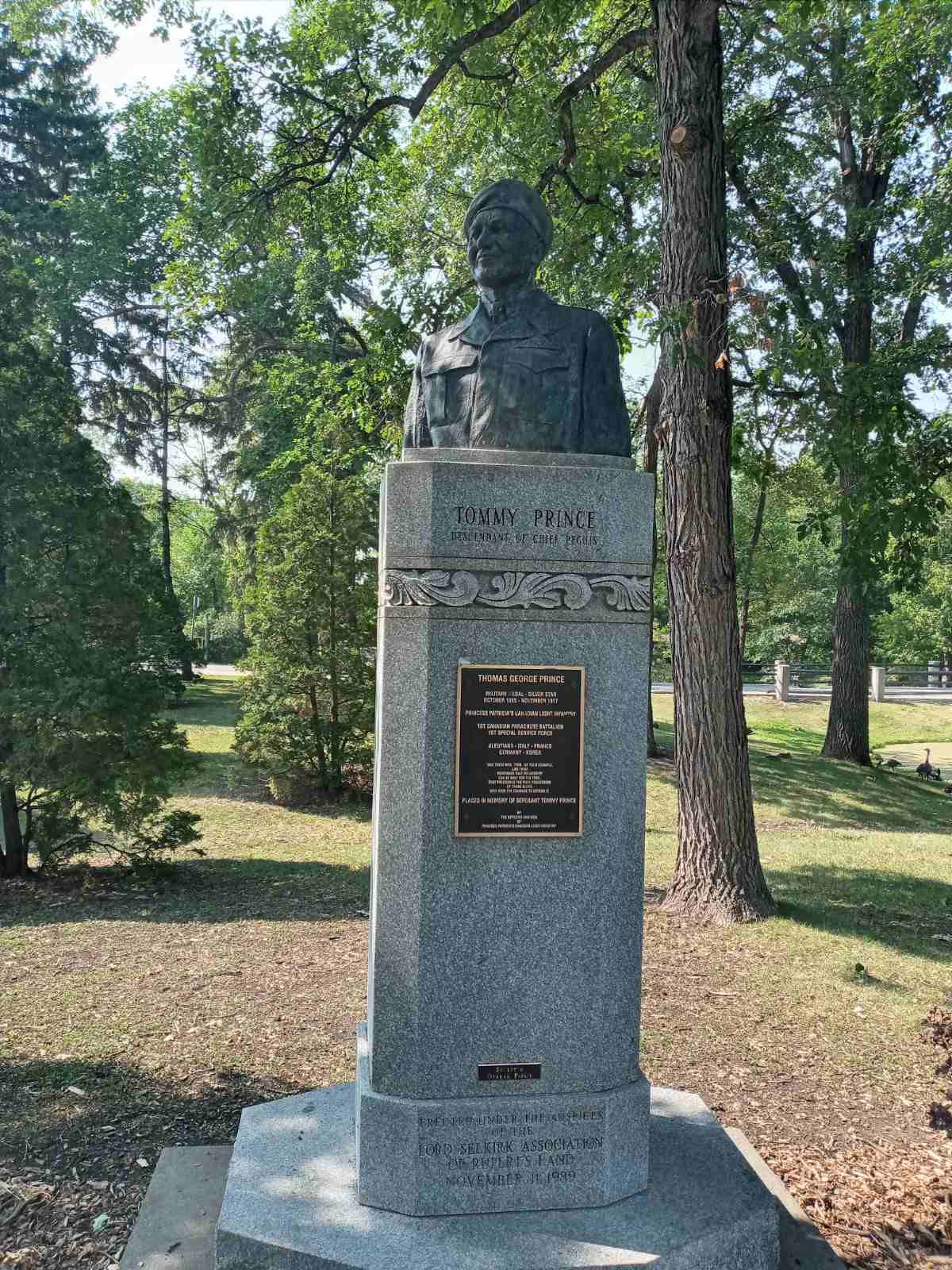
Sergeant Thomas George "Tommy" Prince, MM, was a decorated Anishinaabe war hero from the Brokenhead Ojibway Nation in Manitoba. He is recognized as Canada's most decorated First Nations soldier, having earned 11 medals for valour across the Second World War and the Korean War. Prince served with elite units, most notably the joint American-Canadian First Special Service Force, known as the Devil's Brigade, where his extraordinary skills as a reconnaissance scout were instrumental in key Allied victories. Beyond his military service, Prince became a prominent advocate for Indigenous rights, dedicating his life to fighting for equality and the honour of his people.
Early Life and Family Heritage
Thomas George Prince was born on October 25, 1915, in Petersfield, Manitoba, one of eleven children of Henry and Arabella Prince. In 1921, the family moved to the Brokenhead Ojibway Nation reserve near Scanterbury, Manitoba. His father, Henry, was a chief of the Peguis First Nation, a community with a deep history of leadership and military alliance with the Crown. Prince was a great-grandson of the renowned Saulteaux Chief Peguis, who led his people from Sault Ste. Marie to the Red River region in the 1790s and later signed the Selkirk Treaty in 1817. His grandfather, Chief Henry Prince (Mis-koo-kenew), was a principal negotiator and signatory of Treaty 1 at Lower Fort Garry in 1871. Prince attended the Elkhorn Residential School in Manitoba, where he completed Grade 8 and studied agricultural science. Aspiring to become a lawyer, he was forced to leave school at age sixteen due to family financial hardship during the Great Depression, taking up manual labour jobs such as tree felling.
Warrior Traditions and Formative Skills
Prince's upbringing was steeped in a family tradition of military service and Ojibwe warrior culture. Ojibwe warrior traditions emphasized stealth, patience, and individual skill, qualities Prince developed from a young age. Growing up near Lake Winnipeg, he spent much of his childhood hunting and travelling through forests and wetlands, honing exceptional abilities in tracking, stealth, and wilderness survival. His father taught him marksmanship, and Prince later recalled being able to place five bullets through a target the size of a playing card from about 100 metres away. These early experiences directly shaped the fieldcraft and silent approach techniques that would define his legendary wartime reconnaissance work. Some of his actions behind enemy lines were later compared to the traditional practice of counting coup, where a warrior demonstrated bravery by approaching an enemy without causing harm to shake their morale.
Enlistment and Early World War II Service
When the Second World War began, thousands of First Nations men volunteered for service, with historians estimating over 3,000 Status First Nations men served from a population of fewer than 100,000. Prince had previously joined the Royal Canadian Army Cadets as a teenager, where he developed an interest in military life. He attempted to enlist in the Canadian Army several times but faced rejections, a common barrier for Indigenous applicants at the time. He persisted and was finally accepted in June 1940, a critical moment following the Fall of France. He was immediately sent overseas to Britain, where he served with the Royal Canadian Engineers as a sapper, trained in tasks like building bridges and placing explosives. Much of this early service involved construction and maintenance work, which Prince found frustrating, later remarking he had not enlisted simply to drink tea in England. He was promoted to lance corporal in February 1941 and participated in army athletics like running and boxing, building the endurance that would later serve him in commando training.
Joining the Elite First Special Service Force
In July 1942, Prince volunteered for the 2nd Canadian Parachute Battalion, a designation that disguised recruitment for a secret sabotage unit targeting German heavy water plants in Norway. He reported to the parachute training school at RAF Ringway in the UK, where the selection was extremely strict. Of one hundred volunteers, only nine were chosen to continue. In September 1942, he returned to North America and travelled to Fort Benning, Georgia, before moving to a remote training camp near Helena, Montana, with train windows blacked out. There, he joined the newly formed First Special Service Force, a joint American-Canadian commando unit of 1,800 men commanded by American Lieutenant Colonel Robert T. Frederick. Prince was selected for his physical ability and fieldcraft, qualities deemed essential for the unit's demanding missions. The Force underwent an intensive training program that included demolition, stealth reconnaissance, hand-to-hand combat, amphibious operations, mountain warfare, rock climbing, and skiing, as well as instruction on operating captured German weapons.
Combat in Italy and the Battle for Monte Majo
The First Special Service Force was deployed to Italy in late 1943 after its original mission to Norway was cancelled and a brief deployment to the Aleutian Islands saw no action. Allied forces were struggling to break the German Winter Line, a chain of fortified mountain positions blocking the advance to Rome. The Force established a base near Santa Maria and began conducting reconnaissance patrols into German-held territory. Prince, wearing Ojibwe moccasins for silence, quickly gained a reputation as a supremely capable scout, often crossing enemy lines at night to observe positions. His commanding officer, Lieutenant Colonel Tom Gilday, began assigning him the most demanding reconnaissance and combat missions. The critical objective of Monte Majo, a heavily defended peak, was assigned to the Force for early January 1944. Desperate for a strategy, Gilday assigned Prince to lead a patrol to silently eliminate the enemy gun emplacements on the lower and middle slopes blocking the intended assault route.
On the night of January 7, 1944, Captain Mark Radcliffe observed Prince move like a shadow as he led his patrol out. Prince left his men in a supporting position and single-handedly approached the successive German artillery and machine-gun bunkers. He dispatched all the gunners in these positions with complete silence, without triggering any alarms. He returned before dawn to report the route clear, allowing the Force's assault to proceed at 05:30. The attacking company ascended to the summit without firing a shot, passing the now-silent bunkers, with Radcliffe noting Prince had done a beautiful job. The Force then used captured German machine guns to repel fierce counter-attacks over several days. This victory at Monte Majo cost the Force dearly, reducing its strength from 1,800 to about 400 men. The unit received the Battle Honour "Mount Majo," but Prince's classified, solo contribution did not result in an individual medal at the time due to operational security concerns.
Further Exploits and High Decorations
Prince continued to demonstrate extraordinary bravery and ingenuity. In February 1944, near Littoria, he conducted a 24-hour solo watch from an abandoned farmhouse 200 metres from German lines, connected by 1,400 metres of telephone wire. When shelling severed the line, Prince donned civilian clothing, grabbed a hoe, and walked out among the German soldiers pretending to be a farmer weeding his crops. He inched along the line, pretended to tie his shoelaces, and repaired the connection, allowing him to continue reporting enemy artillery positions which led to the destruction of four German posts. For this act of courage and utter disregard for personal safety, he was awarded the Military Medal. Later, during the campaign in Southern France in September 1944, Prince and a private scouted deep behind enemy lines near L'Escarène, locating the encampment of an enemy reserve battalion. Prince then walked 70 kilometres across rugged mountainous terrain to report the intelligence and led the brigade back to attack, successfully wiping out the enemy bivouac. For this, he was recommended for and received the American Silver Star. In a notable ceremony, King George VI decorated Prince at Buckingham Palace on February 12, 1945, presenting him with the Military Medal. He later received the Silver Star from Brigadier General E. F. Koenig on April 24, 1945.
Korean War Service and Military Honours
In August 1950, Prince re-enlisted in the Canadian Army to serve in the Korean War. He joined the 2nd Battalion, Princess Patricia's Canadian Light Infantry, the first Canadian infantry battalion deployed to Korea. He served as a sergeant and second in command of a rifle platoon. In late March 1951, he selected, trained and led an eight-man night snatch patrol that captured two heavy machine guns from a Chinese position without firing a shot. His battalion was awarded the United States Presidential Unit Citation for its role in the Battle of Kapyong in April 1951. Prince volunteered for a second tour in March 1952 with the 3rd Battalion PPCLI. In November 1952, he was wounded by shrapnel in the legs during the Second Battle of the Hook but continued fighting and helped retake the outpost. He was honourably discharged on October 28, 1953. His full list of decorations is as follows.
- Military Medal (MM)
- Silver Star (United States)
- 1939 to 1945 Star
- Italy Star
- France and Germany Star
- Defence Medal
- Canadian Volunteer Service Medal with overseas clasp
- War Medal 1939 to 1945
- Korea Medal
- United Nations Service Medal (Korea)
- Canadian Volunteer Service Medal for Korea (awarded posthumously)
Post-War Activism and Advocacy
Returning to a Canada that still denied Indigenous people the federal vote and equal veterans' benefits, Prince dedicated himself to political activism. In 1946, he was elected vice-president of the Manitoba Indian Association, now the Assembly of Manitoba Chiefs. Later that year he was selected to chair the national First Nations delegation appearing before a joint parliamentary committee reviewing the Indian Act. He lobbied the federal government in Ottawa, advocating fiercely for the abolition of the Indian Act. His position was based on respect for the traditional Crown treaties as the sole and proper basis of First Nations rights, a stance considered radical at the time but later vindicated by Supreme Court of Canada rulings. He stated that all his life he had wanted to do something to help his people recover their good name and to show they were as good as any white man. His advocacy work aimed at securing increased educational and economic opportunities for Indigenous peoples across the country, fighting the systemic discrimination he and others faced despite their service.
Later Life, Commemoration, and Legacy
Prince's later years were marked by hardship as he struggled with poverty, painful arthritis in his knees, and the challenges of transitioning to civilian life. He was effectively denied access to many veteran benefits programs because First Nations members were forbidden entrance to Royal Canadian Legion branches where applications were processed. He demonstrated ongoing courage in peacetime, such as saving a man from drowning in the Red River in Winnipeg in June 1955. In his final years, he lived in a Salvation Army shelter in Winnipeg. Tommy Prince died on November 25, 1977, at the age of 62 in Winnipeg's Deer Lodge Centre. His funeral was a provincial state funeral, a significant public event attended by over 500 people including Manitoba's Lieutenant Governor Francis Laurence Jobin, and consuls from the United States, France, and Italy. Members of the Princess Patricia's Canadian Light Infantry served as his pallbearers, providing full military honours. His legacy has been widely commemorated through numerous schools, streets, a Canadian naval vessel, and a postage stamp issued in 2022. He was designated a Person of National Historic Significance in 2019.
Questions about Tommy Prince
What was Tommy Prince's most famous wartime exploit?
One of his most famous exploits occurred in February 1944 near Littoria, Italy. While conducting a solo observation from an abandoned farmhouse 200 metres from German lines, his communication wire was cut by shelling. Prince disguised himself as a local farmer, walked out in full view of German soldiers, and pretended to tie his shoe while reconnecting the wire. He continued directing artillery fire that destroyed four enemy positions, an act for which he received the Military Medal.
What did Tommy Prince do after the wars?
After his military service, Tommy Prince became a prominent advocate for Indigenous rights in Canada. In 1946, he was elected vice-president of the Manitoba Indian Association and chaired the national First Nations delegation to a parliamentary committee reviewing the Indian Act. He lobbied for the abolition of the Indian Act and proposed respect for the traditional Crown treaties as the basis of First Nations rights. Prince's position, considered radical at the time, has since been supported by Supreme Court of Canada rulings and is now accepted as government policy.
How is Tommy Prince remembered today?
Tommy Prince is remembered as Canada's most decorated First Nations war hero and a courageous advocate for his people. His legacy is honoured through many institutions including Sergeant Tommy Prince Street in Winnipeg and Sergeant Tommy Prince School in Scanterbury. He was also featured in a Historica Canada Heritage Minute and was the subject of a Canada Post stamp in 2022. He has been described as perhaps Canada's greatest soldier for his unique and strategically important military deeds.
How many medals did Tommy Prince earn?
Tommy Prince earned a total of 11 medals for his service in the Second World War and the Korean War. Among his most distinguished awards were the Canadian Military Medal and the American Silver Star. He was one of only three Canadians to receive both of these honours during World War II. His other decorations included various campaign stars and service medals from both conflicts.
What Indigenous nation was Tommy Prince from?
Tommy Prince was from the Brokenhead Ojibwe Nation near Scanterbury, Manitoba. He was a great-grandson of the Saulteaux leader Chief Peguis, who signed the Selkirk Treaty in 1817. Prince's grandfather, Chief Henry Prince, was a principal negotiator and signatory of Treaty 1 in 1871. His father, Henry George Prince, was a chief of the Saulteaux Peguis First Nation.
Did Tommy Prince serve in the Korean War?
Yes, Tommy Prince served two tours of duty in the Korean War. He re-enlisted in August 1950 and served with the 2nd Battalion, Princess Patricia's Canadian Light Infantry. During his service, he participated in Operations Rugged and Dauntless, the Battle of Kapyong, and the Second Battle of the Hook where he was wounded. He was honourably discharged from service in October 1953.
Sources and further reading
- Tommy Prince (Wikipedia)
- Tommy Prince (veterans.gc.ca)
- Tommy Prince (legionmagazine.com)
Checked by the Nosy Mag desk. Last updated 2026-10-25.