St. Lawrence Iroquoians
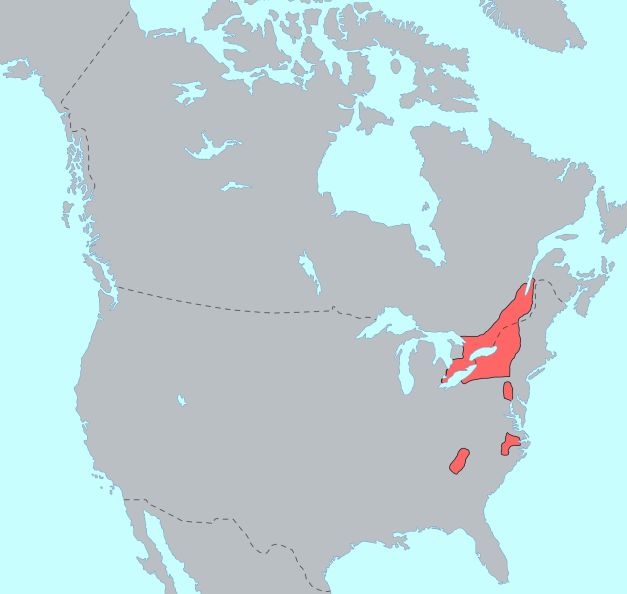
The St. Lawrence Iroquoians were an Iroquoian Indigenous people who existed until about the late 16th century. They concentrated along the shores of the St. Lawrence River in present-day Quebec and Ontario, Canada, and in the American states of New York and northernmost Vermont. They spoke the Laurentian language, a branch of the Iroquoian family. They lived in fortified villages and practised maize agriculture. Their disappearance from the river valley by the time Samuel de Champlain arrived in 1608 remains a significant historical mystery, with theories pointing to warfare, disease, and dispersal.
Identity and Historical Debate
For centuries, the identity of the Indigenous peoples encountered by Jacques Cartier along the St. Lawrence River was a subject of intense scholarly debate. Early theories, developed in the 18th and 19th centuries, often proposed that the inhabitants of villages like Stadacona and Hochelaga were ancestors or direct relations of historically known groups like the Wendat (Huron) or Mohawk. This Huron-Mohawk option was based on early French reports and vocabulary lists but lacked rigorous archaeological support. Another theory, the Mohawk Identity Option, suggested that Mohawk, Onondaga, or Oneida peoples had temporarily migrated into the St. Lawrence Valley before relocating to their historic territories in New York.
Canadian archaeologist James F. Pendergast noted in 1998 that this attribution has not been supported by the archaeological record from Ontario, Quebec, and New York State. Since the 1950s, a multidisciplinary consensus has emerged among anthropologists, archaeologists, and linguists. They concluded, based on definitive linguistic and archaeological studies, that the St. Lawrence Iroquoians were a wholly indigenous and discrete people distinct from both the Haudenosaunee Confederacy and the Wendat. The current convention is to designate them St. Lawrence Iroquoians, while acknowledging that ongoing research indicates they were not a single political entity but likely consisted of several discrete groups or nations sharing cultural and linguistic traits. Pendergast argued that the determination of identity for the St. Lawrence Iroquoians is crucial. He stated that understanding relations between Europeans and Iroquoians during the contact era hinges largely upon correctly identifying the people of Stadacona and Hochelaga. While anthropologists and topical academics have mostly reached consensus on this theory, some historians have continued to publish other theories and ignore the archaeological evidence that discredited the older theories.

Culture, Villages, and Subsistence
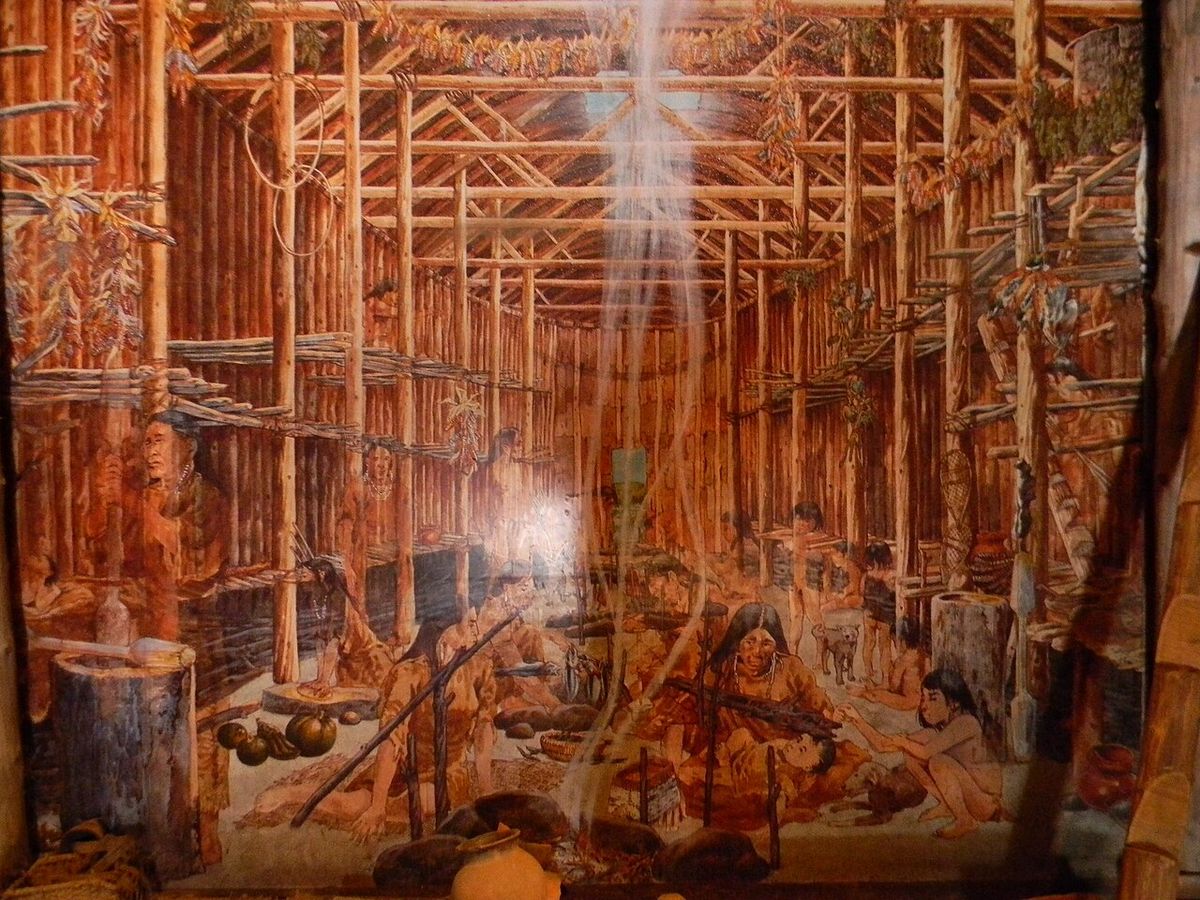
The St. Lawrence Iroquoians were sedentary horticulturalists who lived in villages strategically located on slopes and terraces a few kilometres from the river, often near a stream or swamp. By the end of the 15th century, these settlements were encircled by earthworks and wooden palisades, indicating a need for defence. Villages typically covered 2 to 3.25 hectares. Inside the palisades, people lived in longhouses, the characteristic dwelling of Iroquoian peoples. These structures ranged from 18 to 41 metres in length and housed several families related through the maternal line.
The frame was made of bent poles tied with hemp rope and covered with large slabs of cedar, fir, or elm bark. Their economy was mixed, drawing subsistence from growing maize, beans, squash, sunflowers, and tobacco, complemented by hunting, fishing, and gathering. At its peak around 1500 CE, horticulture provided a major portion of their diet. Women were primarily responsible for agricultural work and activities like making clothing, baskets, and pottery.
Men manufactured tools from bone and stone, crafted wooden utensils and fishing nets, and hunted. Villages were occupied for about 10 to 20 years until longhouses deteriorated, soil fertility declined, or local game was depleted, prompting relocation to a new site nearby. Archaeological evidence has established distinct subculture areas by roughly 1300 CE. These population centres included Jefferson County, New York, with about 2,500 people, Grenville County, Ontario, with about 2,500 people, the Lake St. Francis basin west of Montreal, with about 1,000 people, and the Montreal and Quebec City areas, with 2,000 to 3,000 people.
There were also settlements in northernmost Vermont and neighbouring Ontario near Lake Champlain. The oldest known St. Lawrence Iroquoian village in Quebec is the Mcdonald Site. The largest site is Droulers-Tsiionhikwatha in Saint-Anicet, which likely sheltered 500 to 800 individuals. Jacques Cartier noted cultural differences between groups, describing the large maize fields and sedentary lifestyle at Hochelaga, while the Stadaconans were more migratory, relying heavily on marine resources from the lower St. Lawrence and Gulf.
Contact with Europeans
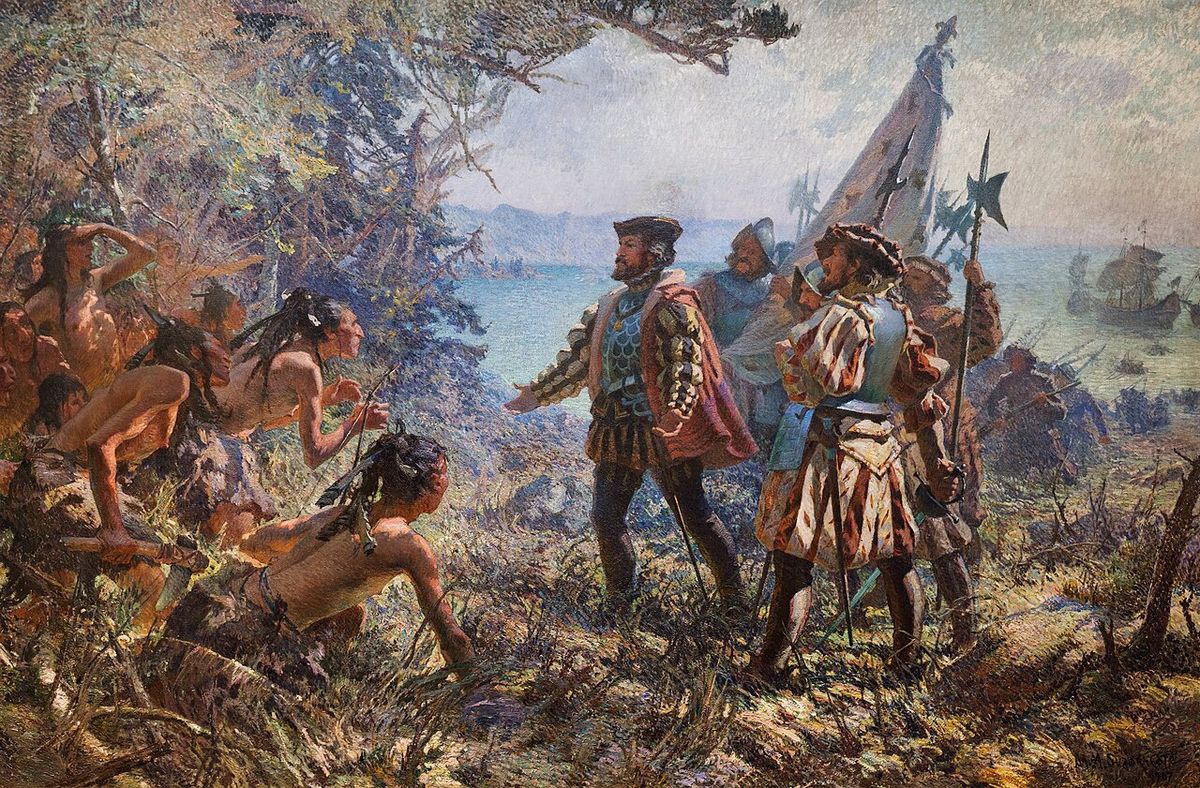
Breton, Basque, and English fishermen likely had early, undocumented contact with the St. Lawrence Iroquoians in the early 16th century. French navigator Thomas Aubert visited the area in 1508 and reportedly took seven captured Indigenous people back to France. The first definitive European contact was with Jacques Cartier. In July 1534, during his first voyage, Cartier met a group of over 200 Iroquoians camped on the north shore of Gaspé Bay. They had travelled more than 600 kilometres from their home at Stadacona to fish for mackerel.
Cartier noted they met the French very familiarly, suggesting possible prior trading contacts. During his second expedition in 1535 and 1536, Cartier visited several villages, including Stadacona, near present-day Quebec City, and Hochelaga, on the island of Montreal. He provided detailed descriptions of these settlements, their inhabitants, and their ways of life. Around this same period, Basque whalers began frequenting the area, with their presence peaking around 1570 to 1580. They held friendly commercial relations with the St. Lawrence Iroquoians and other Indigenous groups, referring to them as Canaleses, a term likely derived from the Iroquoian word kanata, meaning village or settlement. Basques and American natives of the Labrador-Saint Lawrence area developed a simplified language for mutual understanding. This language shows a strong Mi'kmaq imprint.
Disappearance and Theories of Demise
By the time Samuel de Champlain arrived and founded Quebec in 1608, the St. Lawrence Iroquoians and their villages had vanished from the valley. Champlain found no trace of the settlements Cartier described some 75 years earlier. The valley was then used by Algonquin and Mohawk nations as a hunting ground and route for war parties. The dispersal is believed to have occurred in the half-century between Cartier's visits and the arrival of his nephew, Jacques Noël, in 1583 or 1585. Historians and archaeologists have developed several interrelated theories to explain this disappearance.
The most strongly supported theory points to warfare with the neighbouring Haudenosaunee, particularly the Mohawk nation. Located in New York, the Mohawk sought to control access to European trade goods moving up the St. Lawrence River, which was then centred at Tadoussac in Innu territory. Anthropologist Bruce G. Trigger believed the political dynamics made it unlikely the Wendat would attack north into Haudenosaunee territory, pointing the cause toward conflict with the Haudenosaunee themselves. Other contributing factors likely included epidemics of Old World diseases introduced by European fishermen and traders, and crop failures exacerbated by the cooler temperatures of the Little Ice Age in the 16th century.
Archaeological and oral historical evidence suggests survivors may have been absorbed into other nations. Some St. Lawrence Iroquoians likely joined the Wendat to the west, either as refugees or captives adopted en masse. Others may have found refuge among Innu (Montagnais) allies in the Saguenay region or with Abenaki allies in Maine. The people of Hochelaga spoke to Cartier of enemies called Agojudas, while the Stadaconans were at war with the Toudamans, believed to be the Mi'kmaq. The University of Georgia's Dating Iroquoia project, conducted in collaboration with the Huron-Wendat nation, is applying enhanced radiocarbon dating and Bayesian modelling to archaeological samples to build a more precise chronology of this turbulent period.
Archaeology and Modern Research
Modern understanding of the St. Lawrence Iroquoians is largely constructed from archaeological evidence gathered since the 1950s, combined with the writings of Jacques Cartier, earlier histories, and Indigenous oral accounts. Key archaeological finds have established their distinct material culture. The study of ceramic pipes from Jefferson County, New York, dating back 500 years, suggests a territory of interaction and diplomatic visits that may have preceded the Haudenosaunee confederacy. Current research, like the Dating Iroquoia project led by archaeologist Jennifer Birch, focuses on re-examining previously excavated materials with improved techniques. The project uses advanced carbon-14 dating calibrated with Bayesian statistical modelling on items like carbonized corn, seeds, and wood charcoal. This approach has already reshaped historical timelines, such as re-dating the Huron-Wendat Jean-Baptiste Lainé site near Toronto to a later period. The project's second phase specifically investigates the fate of the St. Lawrence Iroquoians, moving beyond the concept of a simple disappearance to understand their scattering and assimilation into other nations. This research is conducted collaboratively with Indigenous communities, including the Huron-Wendat nation.
Legacy and Contemporary Significance
The legacy of the St. Lawrence Iroquoians is woven into the foundational history of Canada. The name of the country itself is widely accepted to be derived from the Iroquoian word kanata, meaning village or settlement. Cartier recorded that the people of Stadacona used this word, and he applied it to the region and the river. This origin reflects the deep Indigenous history of the land. Another legacy is the story of annedda, the white cedar infusion the Stadaconans used to cure Cartier's crew of scurvy.
When Champlain later asked for the same remedy, the Haudenosaunee he met did not know the word, a fact that shows the distinct identity of the St. Lawrence Iroquoians. In a modern context, the St. Lawrence River that was home to these peoples continues to be a focus of Indigenous advocacy and environmental protection. On April 19, 2023, the Assembly of First Nations Quebec-Labrador, representing 43 First Nations communities, passed a resolution recognizing the legal personhood of the St. Lawrence River. This resolution, presented at the United Nations, aims to build an alliance for the river's defence and propose a governance model determined by First Nations. This contemporary initiative connects directly to the historical stewardship of the river valley by its original inhabitants, including the St. Lawrence Iroquoians.
Population and Chronology
Estimates of the St. Lawrence Iroquoian population have varied significantly over time. The Pointe-à-Callière Museum once suggested a figure of 120,000 people in 25 nations occupying 230,000 square kilometres. Most contemporary scholars, however, consider this far too expansive based on archaeological evidence. The current scholarly consensus, supported by settlement size and distribution, places their total population between 8,000 and 10,000 people at their peak. Individual villages typically housed 150 to 250 people, though larger centres like Hochelaga may have had up to 1,000 inhabitants.
The Droulers-Tsiionhikwatha site is estimated to have sheltered 500 to 800 individuals. The chronology of their occupation and dispersal is continually refined by new research. Iroquoian culture associated with maize agriculture first appears in the archaeological record at the Princess Point site in Hamilton, Ontario, around 500 CE. It is detected in the Saguenay River region of Quebec by about 1000 CE. The distinct St. Lawrence Iroquoian culture flourished from approximately 1300 CE. Their disappearance from the St. Lawrence Valley occurred prior to 1580, with the period between Cartier's last visit and 1580 being the key window for their dispersal. The following table summarizes key population centres around 1300 CE as identified by archaeologists.
| Region | Estimated Population c. 1300 CE |
|---|---|
| Jefferson County, New York | 2,500 |
| Grenville County, Ontario | 2,500 |
| Lake St. Francis basin (west of Montreal) | 1,000 |
| Montreal and Quebec City areas | 2,000-3,000 |
Questions about St. Lawrence Iroquoians
What happened to the St. Lawrence Iroquoians?
The St. Lawrence Iroquoians disappeared from their river valley homeland sometime before 1580. Scholars believe a combination of factors caused their dispersal, with warfare being a primary driver. Conflict with the Haudenosaunee, particularly the Mohawk, who sought control of trade routes, is strongly supported by evidence. Other contributing factors likely included epidemics of European diseases and crop failures during the Little Ice Age. Survivors were likely absorbed into neighbouring nations such as the Wendat, the Innu, or the Haudenosaunee through adoption or as refugees.
What is the connection between the St. Lawrence Iroquoians and Canada's name?
The name Canada is widely accepted to originate from the St. Lawrence Iroquoian language. The word kanata means village or settlement. Jacques Cartier recorded that the people of Stadacona used this word, and he applied it to the region around their village and the St. Lawrence River. This origin story is a direct linguistic legacy of the St. Lawrence Iroquoians.
How did the St. Lawrence Iroquoians live?
They lived a sedentary, agricultural life in fortified villages containing multiple longhouses. Their diet was based primarily on maize, beans, and squash. Women managed horticulture and crafts like pottery, while men hunted, fished, and made tools. Villages were relocated every 10 to 20 years as soil fertility declined and longhouses deteriorated. They also engaged in trade, used tobacco, and produced distinctive pottery. Their society was matrilineal, organized around maternal clans.
Why is the St. Lawrence River's legal personhood relevant to this history?
On April 19, 2023, the Assembly of First Nations Quebec-Labrador passed a resolution recognizing the legal personhood of the St. Lawrence River. This modern initiative by First Nations leadership seeks to protect the river's ecosystem through a governance model they determine. It connects to the deep historical relationship Indigenous peoples have with the river as their homeland. The St. Lawrence Iroquoians, for instance, concentrated along the river's shores and drew their subsistence from fishing and other resources for centuries.
Who were the St. Lawrence Iroquoians?
The St. Lawrence Iroquoians were a distinct Iroquoian Indigenous people who existed until about the late 16th century. They concentrated along the shores of the St. Lawrence River in present day Quebec and Ontario, as well as in New York and northern Vermont. They spoke the Laurentian language and were culturally and politically distinct from the neighbouring Wendat and Haudenosaunee nations. Archaeological evidence indicates they lived in palisaded villages of longhouses and had a mixed economy based on maize agriculture, fishing, and hunting.
Sources and further reading
- St. Lawrence Iroquoians (Wikipedia)
- St. Lawrence Iroquoians (thecanadianencyclopedia.ca)
- The dispersion of the St. Lawrence Iroquoian, Parks Canada (parks.canada.ca)
- Uncovering the fate of the St. Lawrence Iroquoians (theglobeandmail.com)
Checked by the Nosy Mag desk. Last updated 2026-11-01.