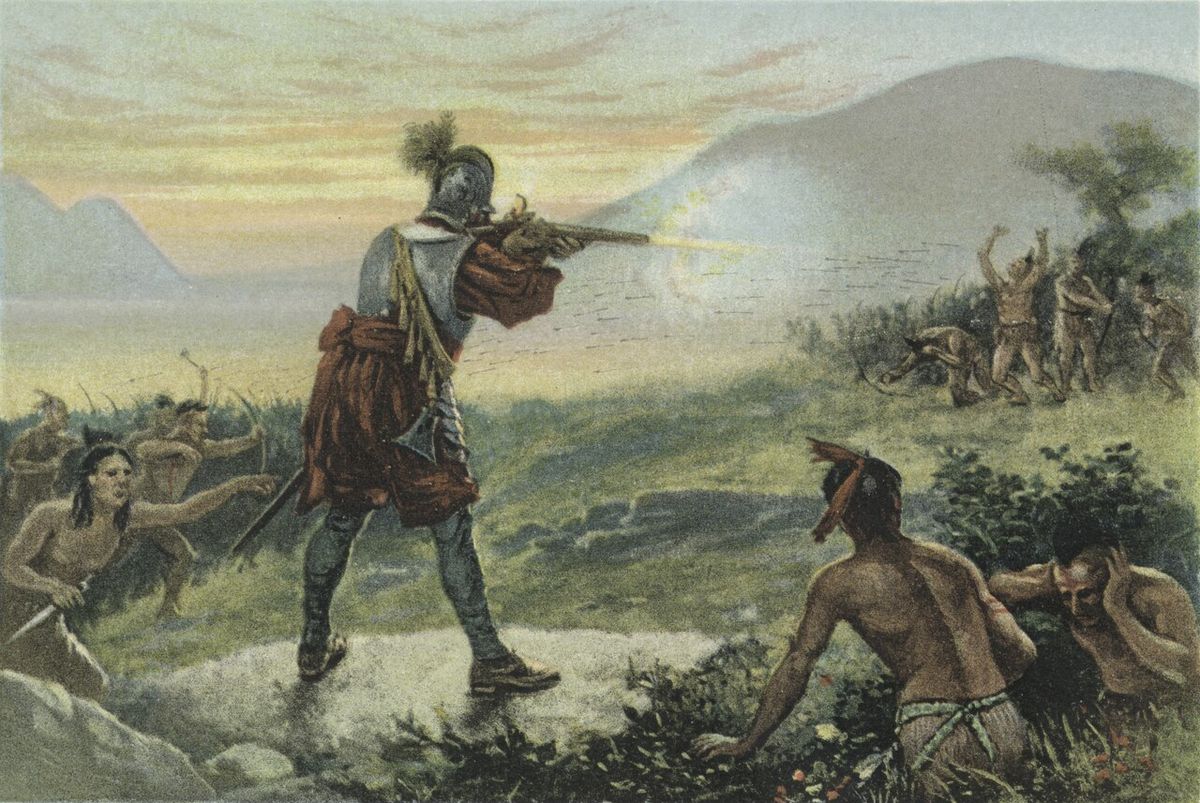
Neutral Confederacy
The Neutral Confederacy, also known as the Neutral Nation or Attawandaron, was a tribal confederation of Iroquoian peoples in what is now southwestern Ontario. Its heartland was along the Grand River and the eastern end of Lake Ontario. At its height, its wider territory extended west along the shores of Lake Erie to Lake Huron, and east to the Niagara River. The confederacy's name derived from its efforts to maintain neutrality in the wars between the Haudenosaunee (Iroquois) Confederacy to the south and the Wendat (Huron) Confederacy to the north, a position sustained through strategic trade of flint and other resources. Its history ended in dispersal by the mid-1650s due to warfare, famine, and disease, with survivors absorbed into neighbouring nations.
Territory and Villages
The territory of the Neutral Confederacy during the late 16th and early 17th centuries encompassed dozens of villages in Southwestern Ontario stretching along the north shore of Lake Erie from the Niagara Peninsula to the Detroit River. Their lands extended perhaps as far north as Toronto in the east and Goderich in the west, with significant population concentrations on the Niagara Peninsula and in the regions of modern Hamilton and Milton. A single population cluster also existed east across the Niagara River near modern Buffalo, New York. This territory was described as heavily forested and full of wild fruit trees, nut trees, berry bushes, and wild grape vines, teeming with game such as elk, caribou, black bear, deer, wolves, foxes, martens, and wild cats. The Confederacy lived in a network of villages, most concentrated within a 32-kilometre radius of present-day Hamilton. These settlements included large, palisaded villages and smaller hamlets, typically situated on higher ground near rivers or streams. The people lived in longhouses, which were large, bark-covered dwellings that sheltered multiple related families. One of the largest known villages, the Ivan Elliot site in the Morriston area of Puslinch, covered over 13 acres and is estimated to have had a population of 4,000 people. Another major village, the Lawson site in London, Ontario, has been extensively studied and revealed the remains of 19 longhouses within a fortified community that housed 1,000 to 2,000 people. The village of Ounontisatan, home to Chief Tsouharissen, was visited by the French in 1625 to 1626. Jesuit missionaries Jean de Brébeuf and Pierre Chaumonot gave Christian names to some villages they visited, including Kandoucho (All Saints), Onguioaahra on the Niagara River, Teotongniaton (St. William), and Khioetoa (St. Michel) near modern Windsor.

Society, Governance, and Culture
The Neutral Confederacy was a semi-nomadic, ranked society governed by elected chiefs who presided over village and tribal affairs, including trade, war, justice, and ceremonies. In the mid-17th century, the confederacy developed into a chiefdom under a paramount leader. The most documented of these leaders was Tsouharissen, also known as Souharissen or Child of the Sun, who was described in a 1627 French report as the chief of all the Neutral nation. He lived in a village called Ounontisatan and led warriors in raids against the Mascouten, or Fire Nation, to the west in present-day Michigan and Ohio. Tsouharissen died around 1646. The Neutral economy was based on a mix of agriculture, hunting, and gathering. They cultivated the Three Sisters, corn, beans, and squash, as well as tobacco for ritual and trade. Hunting provided deer, elk, beaver, and other game like raccoon, wolves, and wild cats, while fishing for catfish, whitefish, salmon, and trout supplemented their diet. Community life was rich with ceremony and sport. The Feast of the Dead was an elaborate ceremony where the bones of the deceased were placed in a communal burial pit. Lacrosse games between villages were popular and could last for several days. They also played a hockey-like winter game with curved sticks and a light wooden ball. Evidence from archaeological sites shows they practiced tattooing and body painting, with Jesuit Relations from 1652 noting it was so common among the Neutral and Petun that hardly an individual was found without it. Artistic expression included depictions of humans and animals on stone and wood. Feasts and dances accompanied council meetings and successful hunts, often involving gift-giving practices. Their semi-nomadic lifestyle involved moving villages approximately every 20 years after local game and soil resources were depleted, utilizing a range of sites including hamlets, agricultural field cabins, and specialized camps.
Economy and Strategic Neutrality
The Neutral Confederacy's economic strength and political strategy were deeply intertwined, centred on the control of a vital natural resource: Onondaga chert, a high-quality flint found in the Onondaga Limestone formation within their territory. This stone was superior for making sharp tools, spearheads, and arrowheads, and its deposits marked the furthest northern and western extent of usable chert in the region. The Neutral quarried this material and traded it widely, including to both the Wendat and the Haudenosaunee, who were frequently at war with each other. By supplying this essential material to both sides while refusing to take part in their conflict, the Neutral maintained their neutrality and thrived through commerce. Their trade networks were extensive. In exchange for flint and other local goods like maize, tobacco, and prized black squirrel furs and dressed deerskins, they acquired European trade goods such as steel axes, glass beads, cloth, conch shells, gourd containers, and later, firearms. This active trading posture was noted by the French, who observed that the Neutral thrived on trade, rather than war. However, this advantageous position diminished in the mid-1600s as European firearms became more common, reducing the strategic value of flint for weaponry, though it remained traded for use in gunflints. The Neutral also traded with allies like the Odawa and hunted deer using a distinctive practice of herding them into pens, which was a characteristic of the Chonnonton group within the confederacy. The Wendat nation, which had direct access to French goods, aggressively worked to prevent trade between the Neutrals and the French.
Population Decline and Dispersal
The demographic history of the Neutral Confederacy is a story of rapid decline in the 17th century. When first encountered by French explorers and missionaries around 1615 to 1616, they had an estimated 40 villages and 4,000 warriors. In 1626, the Recollect priest Joseph de La Roche Daillon estimated their population as 40,000 people. Within a single generation, this number collapsed. A combination of catastrophic factors led to their dispersal as a distinct political entity by the early 1650s. European-introduced epidemic diseases, particularly smallpox and measles in the late 1630s, caused massive loss of life. This was compounded by periods of severe famine. The final blow came from warfare. After defeating the Wendat and Petun, the Haudenosaunee Confederacy turned its military power against the Neutral around 1650 during the Beaver Wars. Unable to withstand the onslaught, Neutral villages were destroyed, and the people were killed, captured, or forced to flee. Anthropologist Mary Jackes identified the year 1651 as particularly significant, noting the Neutral fled into the woods and dispersed for the last time during the final Iroquois attack. By 1653, references to the Neutral as an independent society cease, with a later historical mention in 1864 referring to Hurons neutres. Survivors were absorbed into neighbouring nations, particularly Seneca villages in present-day New York. The last known families claiming Neutral ancestry, such as the Kenjockety family, lived among the Senecas. The French records do not discuss the Neutrals as a nation or confederacy after 1672. Jackes' analysis concluded that the combination of natural disruption, disease, famine, severe weather, and intensifying war with many killed or taken captive led to an almost complete population collapse.
| Year | Notable Event |
|---|---|
| c. 1615 to 1616 | First French contact. 40 villages and 4,000 warriors recorded. |
| 1626 | Estimate by Recollect priest Joseph de La Roche Daillon after visiting 28 villages. Population 40,000. |
| c. 1641 | Jesuit count after epidemics. 40 villages and hamlets with about 12,000 people. |
| 1650 to 1651 | Haudenosaunee attacks during Beaver Wars. Society destroyed and dispersed. |
| 1653 | Last reference to Neutrals as an independent society. |
Archaeology and Rediscovery
Modern archaeology has been crucial in reconstructing the history and scale of the Neutral Confederacy, as written records are limited to European missionary accounts. Numerous village sites have been excavated across southern Ontario, revealing a complex society. The Southwold Earthworks near St. Thomas, with its conspicuous and well-preserved defensive earthworks rare in southern Ontario, is a National Historic Site of Canada. The Lawson site in London, adjacent to the Museum of Ontario Archaeology, has been studied since the early 1900s and has yielded over 30,000 artifacts and the remains of 19 longhouses. Excavations led by scholars like McMaster University professor William Noble identified a cluster of villages southwest of Hamilton believed to be the core of the confederacy centred at the Walker site under Chief Tsouharissen. Noble also excavated and documented sites in Thorold, Grimsby, and Binbrook. Key archaeological finds have provided deep insights into Neutral life. Bone remains from sites near Milton and Oakville show they hunted deer, elk, moose, beaver, raccoons, squirrels, black bear, fox, and muskrat. The discovery of a large village in Tillsonburg excavated in 2000 to 2001, covering over 8 hectares, suggests some centrally located communities felt secure without fortification. Recovered items include stone tools, a 4,000-year-old arrowhead from a Kitchener site, glass trade beads like chevron beads from Italy, and metal axes such as the French Biscay trade axe. A significant Neutral cemetery uncovered in Grimsby in 1976 during housing development contained over 100 individuals in a sheltered embayment of the Niagara Escarpment, offering clues about health and burial practices. Archaeologist Mary Jackes' re-examination of the Grimsby site and historical records concluded it was a place of refuge, especially for women and children, during the final collapse. These sites continue to be important for understanding pre-contact Indigenous history in Ontario, with a 2020 find in Kitchener uncovering artifacts from an Iroquoian village inhabited circa 1300 to 1600 among a cluster of Attawandaron villages.
Language, Identity, and Relations
The Neutral language was part of the Iroquoian language family and was distinct but related to the languages of the Wendat and Haudenosaunee. Jesuit missionaries in the 1600s noted the similarity, believing all three groups had once been a part of a single group. The Wendat name for the Neutral, Attawandaron, translates to those whose speech is awry or a little different, indicating a perceptible dialectal difference, and the Neutral likely used a similar term for the Wendat. The Jesuits Jean de Brébeuf and Pierre Chaumonot, who lived with them in 1630, found the language different enough from Wendat to attempt to compile a separate Neutral grammar and dictionary, though these works are now lost. Linguist Marianne Mithun cites Jesuit reports calling them a Nation different in language, at least in many respects. The confederacy was composed of several tribes or nations, with names recorded by Jesuits including the Aondironon, Wenrehronon, and Ongniaahraronon, the latter group on the Niagara Peninsula possibly giving the region its name. They had an alliance with the Wenrohronon to defend against the Haudenosaunee, but that ended in 1639. They were frequently at war with the Algonquian-speaking Mascouten or Fire Nation to the west. With the dispersal of the Neutral people by 1651, their language became extinct. Today, there is no modern Neutral nation with a culturally and linguistically distinct population, though some individuals trace lineage to Neutral ancestors absorbed into other nations, such as the Seneca. The legacy of the Confederacy lives on primarily through archaeological sites, historical records like the Jesuit Relations, and its important place in the narrative of Indigenous history in the Great Lakes region.
Questions about Neutral Confederacy
Where did the Neutral Confederacy live?
The heartland of the Neutral Confederacy was along the Grand River and the eastern end of Lake Ontario in what is now Ontario. Their wider territory extended west along the shores of Lake Erie to Lake Huron, and east to the Niagara River. They inhabited dozens of villages in Southwestern Ontario stretching along the north shore of Lake Erie from the Niagara Peninsula to the Detroit River, perhaps as far north as Toronto and Goderich. They had population concentrations on the Niagara Peninsula and in the vicinity of Hamilton and Milton. A single population cluster also existed east across the Niagara River near modern Buffalo, New York.
What happened to the Neutral Confederacy?
The Neutral Confederacy ceased to exist as an independent political entity by the early 1650s. Their population was severely reduced by European-introduced diseases like smallpox and measles, and by famine. The final blow came around 1650 to 1651 when the Haudenosaunee, having defeated other rivals, attacked and dispersed the Neutral villages during the Beaver Wars. Survivors were killed, captured, or absorbed into neighbouring Iroquoian nations, particularly the Seneca. The last historical mention of them as a distinct group is from 1653, and French records do not discuss them as a nation after 1672.
What was the Neutral Confederacy's population?
In 1626, the Recollect priest Joseph de La Roche Daillon estimated the Neutral population as 40,000 people. In 1641, after serious epidemics, the Jesuits counted 40 Neutral villages with about 12,000 people. Earlier, around 1616, the Neutral Confederacy had an estimated 40 villages and 4,000 warriors. By the early 1650s, the society was dispersed due to wars, diseases, and famine.
What was the importance of flint to the Neutral Confederacy?
Flint, specifically Onondaga chert from their lands, was a critical resource for the Neutral economy and strategy. This high-quality stone was used to make essential tools and weaponry like arrowheads and spearheads. They traded it extensively with both the Wendat and Haudenosaunee, which allowed them to maintain profitable trade relations with both warring groups and support their political neutrality. Control of this resource was a major advantage until European firearms became more common, though flint remained traded for use in gunflints.
Are there any modern descendants of the Neutral Confederacy?
There is no modern, politically distinct Neutral nation today. After their dispersal in the early 1650s, surviving Neutral individuals and families were incorporated into other Iroquoian nations, most notably the Seneca. Some families, such as the historically noted Kenjockety family, have traced their ethnicity to Neutral ancestors within Seneca communities. Their cultural and genetic legacy persists within these descendant communities.
Why were they called the 'Neutral'?
The French called them 'Neutral' because they tried to remain neutral in the many wars between the Wendat (Huron) confederacy and the nations of the Haudenosaunee (Iroquois) Confederacy. This strategic neutrality allowed them to trade simultaneously with these often warring groups, particularly by supplying valuable Onondaga chert. However, they were not neutral in all conflicts, as they were frequently at war with the Algonquian speaking Mascouten, or Fire Nation, to the west. The Wendat referred to them as Attawandaron, meaning 'people whose speech is awry'. Some scholars argue their own name was Chonnonton, meaning 'people of the deer'.
Sources and further reading
- Neutral Confederacy (Wikipedia)
- The Neutral Confederacy (thecanadianencyclopedia.ca)
- About Neutral Confederacy and Jesuits (brantfordexpositor.ca)
Checked by the Nosy Mag desk. Last updated 2026-10-28.