Jean de Brébeuf
Jean de Brébeuf was a 17th-century French Jesuit missionary who became a central figure in the early European colonization and religious history of Canada. Arriving in New France in 1625, he devoted his life to missionary work among the Wendat (Huron) people, mastering their language and documenting their culture. He was captured and killed by Haudenosaunee (Iroquois) warriors in 1649 and was later canonized as a Catholic saint. His legacy is reflected in numerous place names and educational institutions across Canada, and he authored the 'Huron Carol,' Canada's oldest Christmas song.
Early Life and Arrival in New France
Jean de Brébeuf was born on 25 March 1593 in Condé-sur-Vire, Normandy, France, and was the uncle of the poet Georges de Brébeuf. He entered the Society of Jesus in 1617 at the age of 24, spending the next two years under the direction of Lancelot Marin. His early years in the Jesuit order included a period as a teacher at the college in Rouen between 1619 and 1621. A severe and nearly fatal bout of tuberculosis in 1620 nearly led to his expulsion from the Society, as it interrupted his studies. He recovered and was ordained as a priest at Pontoise Cathedral in February 1622. After serving as Steward at the College of Rouen for three years, he was chosen by the Provincial of France, Father Pierre Coton, for the missions to New France. Brébeuf arrived in Québec in June 1625 alongside fellow Jesuits Charles Lalemant and Énemond Massé, as well as lay brothers François Charton and Gilbert Burel. He worked at the Sainte-Marie among the Hurons mission. For about five months Brébeuf lived with a tribe of Innu, who spoke an Algonquian language, before he was assigned in 1626 to work with the Wendat alongside Father Anne Nouée.
Missionary Work and Life in Huronia
Brébeuf’s mission centred on the Wendat territory near Georgian Bay, an area the French called Huronia. He initially resided with the Bear Tribe at Toanché but met little success in his early attempts at conversion. In 1629, the English capture of Québec forced Brébeuf and other missionaries to return to France. In Rouen, he served as a preacher and confessor, taking his final Jesuit vows in 1630, and between 1631 and 1633 he worked at the College of Eu in northern France as a steward, minister and confessor. He returned to New France in 1633 and, with fellow missionaries Antoine Daniel and Ambroise Davost, chose Ihonatiria (Saint-Joseph I) as the centre for missionary activity. Brébeuf immersed himself in Wendat life, earning the name Échon and gaining a deep understanding of their culture and spirituality through lengthy conversations. His work occurred against a tragic backdrop of epidemics, as Wendat communities, lacking immunity to European diseases like smallpox, suffered catastrophic population losses, with nearly half the population dead by 1640. Many Wendat began to view the seemingly immune Jesuits as figures of power, which slowly opened doors for conversion, though many also believed Brébeuf was a sorcerer. Brébeuf’s progress was measured, with his first baptisms occurring around 1635, claiming 14 converts that year and 86 by 1636. He documented Wendat customs extensively, including a detailed 1636 account of the Huron Feast of the Dead, a mass reburial ceremony. In 1638, he turned over direction of Saint-Joseph I to Jérôme Lalemant to become Superior at the newly founded Saint-Joseph II mission.
Expansion, Setbacks and the Huron Carol
Brébeuf’s missionary efforts extended beyond the Wendat heartland. In 1640, he went with Father Chaumonot on an unsuccessful mission to the Neutral Nation territory north of Lake Erie, returning after a winter of hardship. During this period, he broke his collarbone and was sent to Québec to recover. While in Québec from 1640 to 1644, he worked as a mission procurator, taught Wendat languages, and acted as confessor and advisor to the Ursuline nuns and Religious Hospitallers. On Sundays and feast days, he preached to the French colonists at the settlement. It was around 1642, during this time, that Brébeuf composed the 'Huron Carol,' Canada's oldest Christmas song. He wrote the lyrics in the Wendat language, setting them to the melody of the traditional French folk song 'Une Jeune Pucelle.' The carol was an attempt to convey Christian narrative using indigenous linguistic and cultural concepts. His return to Huronia in 1644 coincided with escalating violence between the Wendat and the Haudenosaunee confederacy, which had already claimed the lives of other Jesuits like Isaac Jogues in 1646 and Antoine Daniel in a 1648 raid. Brébeuf remained at the central mission station of Sainte-Marie among the Hurons, overseeing activities in a context of increasing danger and societal disruption for the Wendat people.
Linguistic and Ethnographic Contributions
Jean de Brébeuf’s facility with language was a fundamental reason he was chosen for the Wendat mission in 1626 and formed a critical part of his missionary strategy and lasting scholarly contribution. He dedicated immense effort to mastering the Wendat language, believing mutual intelligibility was vital for communicating complex Christian theology. Brébeuf became widely acknowledged for his mastery of Native oratory styles, which utilized metaphor, circumlocution and repetition. His linguistic work provided essential tools for future missionaries and colonists, building on earlier work by Recollects priests but significantly advancing the study, particularly in his representations of sounds. He made a significant breakthrough by identifying the feature of compound words in Wendat, a discovery that became the foundation for all subsequent Jesuit linguistic work in the region. Brébeuf’s practical contributions included translating a catechism by Ledesma from French into Wendat, producing the first printed text in that language using French orthography. He also compiled a dictionary of Wendat words, with a particular focus on translating religious phrases from prayers and scripture. His extensive ethnographic writings, contained in the annual reports known as The Jesuit Relations, have been described as the longest and most ambitious piece of ethnographic description in those volumes. In these accounts, he tried to find parallels between Wendat religion and Christianity to facilitate conversion, though he personally considered their spiritual beliefs to be undeveloped and foolish delusions.
Capture, Torture and Death in 1649
On 16 March 1649, Haudenosaunee (Iroquois) warriors raided and destroyed the Wendat mission village of Saint-Louis. Brébeuf and his fellow missionary Gabriel Lalemant were captured, along with Wendat converts. The captives were taken to the nearby occupied village of Taenhatenteron, also known as St. Ignace. There, they were subjected to ritual torture before being killed. According to Jesuit accounts compiled by Christophe Regnault and Paul Ragueneau from Wendat witnesses who escaped, Brébeuf endured particularly brutal treatment. His torturers poured boiling water over his head in a mock baptism, placed a collar of red-hot tomahawk heads around his neck, and thrust a red-hot iron down his throat. Throughout the ordeal, he was reported to have been stoic and silent, more concerned for his fellow captives than for himself. After he died, his captors scalped him, then ritually cannibalized his body, eating his heart. Brébeuf’s death was part of a broader, intensifying conflict between the Wendat and Haudenosaunee confederacies, which also claimed the lives of several other Jesuit missionaries in the same period, including Charles Garnier in December 1649 and Noël Chabanel later that year. The Jesuits interpreted these martyrdoms as proof that their mission to the Native Americans was blessed by God.
Recovery of Remains and Early Veneration
The bodies of Brébeuf and Lalemant were recovered by Jesuit colleagues on 21 March 1649 and initially buried together in a cemetery at Sainte-Marie. In the late spring of 1649, Father Christophe Regnault prepared their skeletal remains for transport to Québec for safekeeping. Regnault boiled away the remaining flesh and reburied it in the mission church, then scraped, dried, and wrapped the bones in silk before depositing them in two small chests. Brébeuf’s skull became a particularly venerated relic, later donated by his family in a silver reliquary to Catholic orders in Québec. It was held by the women of the Hôtel-Dieu de Québec and the Ursuline convent from 1650 until 1925, when it was moved to the Québec Seminary for his beatification ceremony. Stories of miracles attributed to his relics quickly fostered a local cult. The Hospitaller nun Catherine de Saint-Augustin reported visions in which Brébeuf acted as her spiritual advisor. She was said to have used slivers of his bone in drinks to cure a mortally ill heretic and to have aided in exorcising a possessed woman in 1660-61 using one of his ribs. Nuns treating wounded Huguenot soldiers also reported that putting bone slivers in their drinks helped rescue these patients from heresy. In 1652, Paul Ragueneau formalized material from The Jesuit Relations about the martyrs into a document entitled 'Memoires touchant la mort et les vertus,' intended as the foundation for future canonization proceedings.
Path to Sainthood and National Patronage
The formal process for the canonization of Jean de Brébeuf began with an ecclesiastical court that sat for the entire year of 1904 to examine his life, virtues, and the cause of his death. This lengthy investigation led to his beatification in 1925. Jean de Brébeuf was canonized by Pope Pius XI on 29 June 1930 as one of the North American Martyrs, a group of eight Jesuit missionaries. A contemporary newspaper account of the canonization described Brébeuf as the 'Ajax of the mission,' a man of giant frame and noble birth whose vigorous passions were tamed by religion. Later, on 16 October 1940, Pope Pius XII proclaimed Brébeuf one of the patron saints of Canada, solidifying his status within Canadian Catholic tradition. His sainthood reinforced the notion, held by religious communities in New France, that Canada was a land of saints and that its martyrs were imitators of earlier saints in Church history. The Jesuits of Canada and the United States announced a tour of the relics throughout both countries in 2024.
Cultural and Institutional Legacy
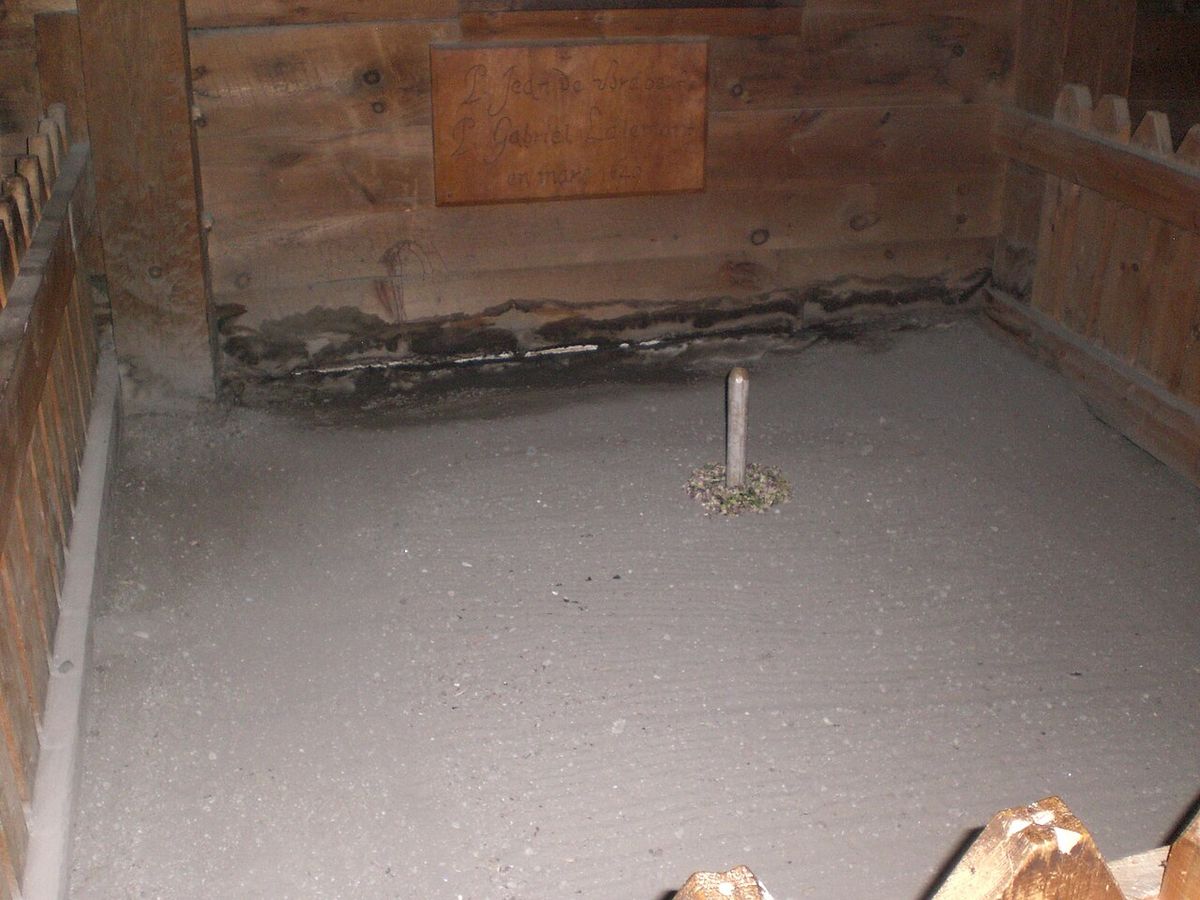
Jean de Brébeuf’s legacy is woven into many aspects of Canadian society, from toponymy and education to literature and popular culture. He is informally credited with giving the modern name to lacrosse, as he thought the sticks used in the Native game reminded him of a bishop's crosier (la crosse in French). His story has inspired Canadian arts, notably as the subject of E. J. Pratt’s epic blank-verse poem 'Brébeuf and his Brethren,' for which Pratt won a Governor General’s Award in 1940. The character of Christophe in Joseph Boyden’s 2013 novel The Orenda, which won the 2014 Canada Reads competition, is based on Brébeuf. In September 1984, Pope John Paul II prayed before Brébeuf’s skull during an outdoor ecumenical service at the Martyrs' Shrine near Midland, Ontario, an event attended by an estimated 75,000 people that mixed pre-Christian First Nations ritual with Catholic liturgy. His burial site at the Church of St. Joseph on the grounds of the reconstructed Sainte-Marie among the Hurons mission remains a place of pilgrimage. A plaque unearthed there in 1954 bears the inscription 'P. Jean de Brébeuf /brusle par les Iroquois /le 17 de mars l'an/1649,' a historical marker of his death.
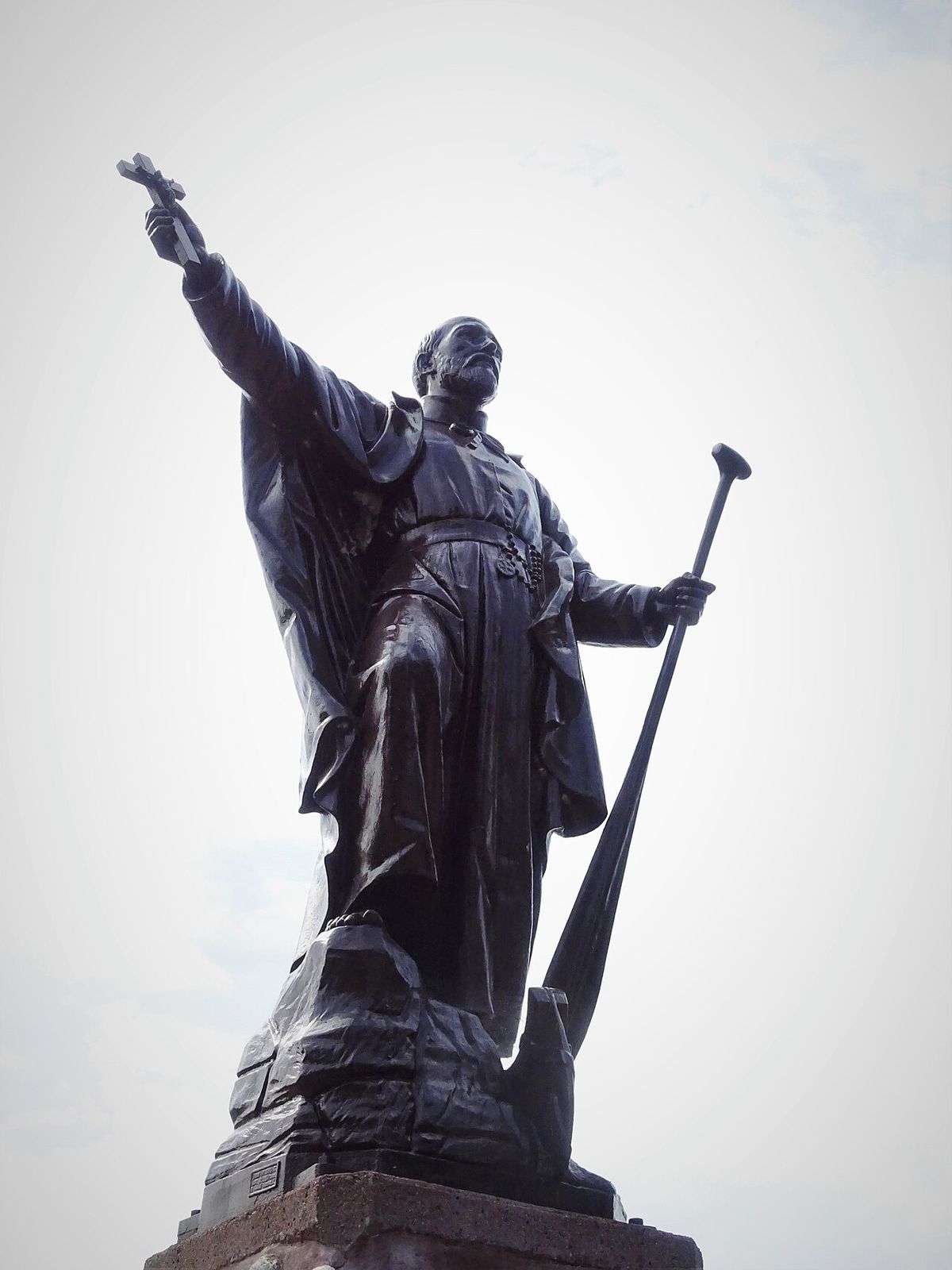
The parish municipality of Brébeuf, Quebec, is named after him. Rue de Brébeuf is located on the Plateau Mont-Royal in Montreal. Parc Brébeuf in the Hull region of Gatineau, Quebec, features a statue in his honour. The Martyrs' Shrine Catholic Church near Midland, Ontario, is a major site dedicated to him and the other North American Martyrs. A unit at Camp Ondessonk in the Shawnee National Forest in Illinois is named after him. Église St-Jean de Brebeuf is a church in Sudbury, Ontario. There is also a St. John Brebeuf Catholic Church and its parish school in Niles, Illinois.
- The parish municipality of Brébeuf, Quebec, is named after him.
- Rue de Brébeuf is located on the Plateau Mont-Royal in Montreal.
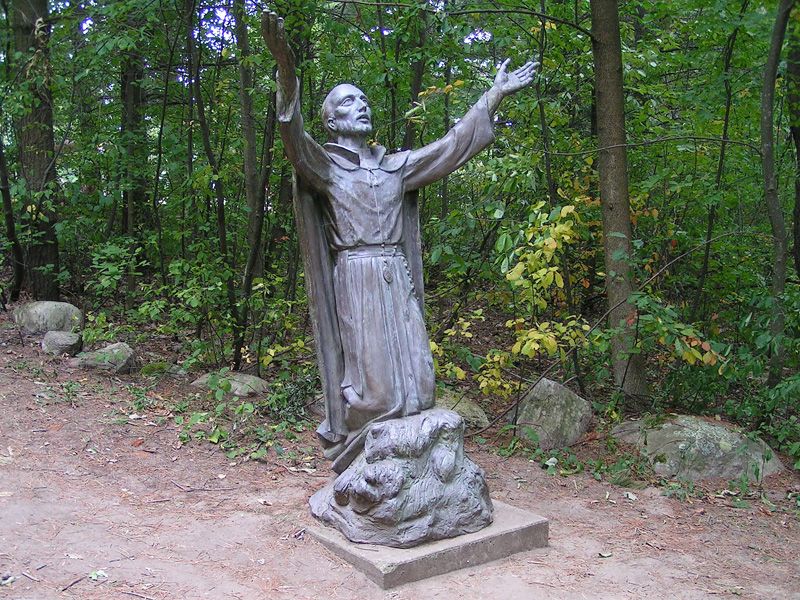
- Parc Brébeuf in the Hull region of Gatineau, Quebec, features a statue in his honour.
- The Martyrs' Shrine Catholic Church near Midland, Ontario, is a major site dedicated to him and the other North American Martyrs.
- A unit at Camp Ondessonk in the Shawnee National Forest in Illinois is named after him.
- Église St-Jean de Brebeuf is a church in Sudbury, Ontario.
Schools and Institutions Named for Jean de Brébeuf
Numerous educational institutions across Canada and the United States have been named in honour of Jean de Brébeuf. These schools reflect his status as a figure of historical and religious significance within the Jesuit educational tradition. Examples include St. Jean Brebeuf School in Calgary, Alberta, and Brebeuf College School in Toronto, Ontario. Other named schools are in Abbotsford, British Columbia, Winnipeg, Manitoba, Hamilton, Ontario, Vaughan, Ontario, Brampton, Ontario, and Erin, Ontario.
- Collège Jean-de-Brébeuf in Montreal, Quebec (founded by the Jesuits in 1928).
- Brebeuf College School in Toronto, Ontario.
- St. Jean de Brébeuf Catholic Secondary School in Hamilton, Ontario.
- St. Jean Brebeuf Catholic School in Brampton, Ontario.
- St. John Brebeuf Regional Secondary School in Abbotsford, British Columbia.
- St. Jean Brebeuf School in Calgary, Alberta.
- St. John Brebeuf School in Winnipeg, Manitoba.
- École Jean-de-Brébeuf in Gatineau, Québec.
- Brebeuf Jesuit Preparatory School in Indianapolis, Indiana, USA.
- St. John Brebeuf Catholic School in Erin, Ontario.
- St. Jean de Brebeuf Catholic High School in Vaughan, Ontario.
Other Jesuit Martyrs of the 1640s
Brebébeuf's death was not an isolated event but part of a series of killings of Jesuit missionaries in the 1640s. Three priests had been killed in Mohawk country at Ossernenon in 1642 and 1646. Antoine Daniel was killed in a similar Haudenosaunee raid in 1648. Charles Garnier was killed by Haudenosaunee in December 1649, and Noël Chabanel was also martyred that year. The Jesuits considered these deaths together as evidence of martyrdom blessed by God.
- René Goupil was killed at Ossernenon in 1642.
- Isaac Jogues was killed by Mohawks at Ossernenon in 1646.
- Jean de Lalande was killed at Ossernenon in 1646.
- Antoine Daniel was killed in a Haudenosaunee raid in July 1648.
- Gabriel Lalemant was captured and tortured alongside Brébeuf on 16 March 1649.
- Charles Garnier was killed by Haudenosaunee in a Petun (Tobacco People) village in December 1649.
- Noël Chabanel was martyred in 1649 in the conflict between the Mohawk and other tribes.
These eight missionaries were collectively canonized as the North American Martyrs in 1930. The group includes Jean de Brébeuf and his fellow Jesuits Gabriel Lalemant, Antoine Daniel, Charles Garnier, and Noël Chabanel. They were all killed in the conflict between the Haudenosaunee and the Wendat in the 1640s. The canonization ceremony was performed by Pope Pius XI on 29 June 1930.
Questions about Jean de Brébeuf
What is Jean de Brébeuf most famous for?
Jean de Brébeuf is most famous for being a French Jesuit missionary to the Wendat (Huron) people in New France. He is renowned for learning their language and customs, writing extensively about them. He composed the 'Huron Carol,' Canada's oldest Christmas song, around 1642. He was captured and killed by Haudenosaunee (Iroquois) in 1649, beatified in 1925, and canonized as a saint in 1930.
How did Jean de Brébeuf die?
Jean de Brébeuf died on 16 March 1649 after being captured by Haudenosaunee warriors during a raid on the Wendat mission village of Saint-Louis. He and fellow missionary Gabriel Lalemant were taken to the village of St. Ignace, where they were subjected to ritual torture. Accounts describe Brébeuf being scalded with boiling water, burned with red-hot irons, and wearing a collar of heated tomahawk heads. He was scalped and, after his death, his heart was ritually eaten by his captors.
What did Jean de Brébeuf contribute to the study of Indigenous languages?
Jean de Brébeuf made significant contributions to the study of the Wendat language. He dedicated himself to mastering it, creating essential tools for future missionaries. His key linguistic breakthrough was identifying the feature of compound words in Wendat. He translated a catechism from French into Wendat, producing the first printed text in that language using French orthography. Brébeuf also compiled a dictionary of Wendat words focused on religious terminology. His work provided the foundation for all subsequent Jesuit linguistic studies in the region.
Where is Jean de Brébeuf buried?
The physical remains of Jean de Brébeuf are buried in the Church of St. Joseph at the reconstructed Jesuit mission of Sainte-Marie among the Hurons near Midland, Ontario. This site is located across Highway 12 from the Martyrs' Shrine Catholic Church. His bones were relocated there after initially being buried at Sainte-Marie and later transported to Québec for safekeeping. A plaque marking his grave was unearthed during excavations at Ste. Marie in 1954. His skull, however, was kept as a sacred relic and was long held at the Hôtel-Dieu in Québec.
When was Jean de Brébeuf made a saint?
Jean de Brébeuf was canonized as a saint in the Catholic Church on 29 June 1930 by Pope Pius XI. This formal declaration followed a lengthy process that included an ecclesiastical court reviewing his life and death in 1904 and his beatification in 1925. He was canonized as part of a group known as the North American Martyrs, which included eight Jesuit missionaries. Later, on 16 October 1940, Pope Pius XII proclaimed Brébeuf one of the patron saints of Canada.
Are there schools in Canada named after Jean de Brébeuf?
Yes, many schools across Canada are named after Jean de Brébeuf, reflecting his historical significance. Notable examples include Collège Jean-de-Brébeuf, a prominent private college in Montreal founded in 1928, and Brebeuf College School in Toronto. There are also St. Jean de Brébeuf Catholic Secondary School in Hamilton, St. John Brebeuf Regional Secondary School in Abbotsford, British Columbia, and elementary schools in cities like Calgary, Winnipeg, and Brampton. Additional schools include St. John Brebeuf Catholic School in Erin, Ontario and St. Jean de Brebeuf Catholic High School in Vaughan, Ontario.
Sources and further reading
- Jean de Brébeuf (Wikipedia)
- CATHOLIC ENCYCLOPEDIA: Jean de Brebeuf (newadvent.org)
- Jean de Brébeuf (thecanadianencyclopedia.ca)
Checked by the Nosy Mag desk. Last updated 2026-10-26.