Maliseet-Passamaquoddy language
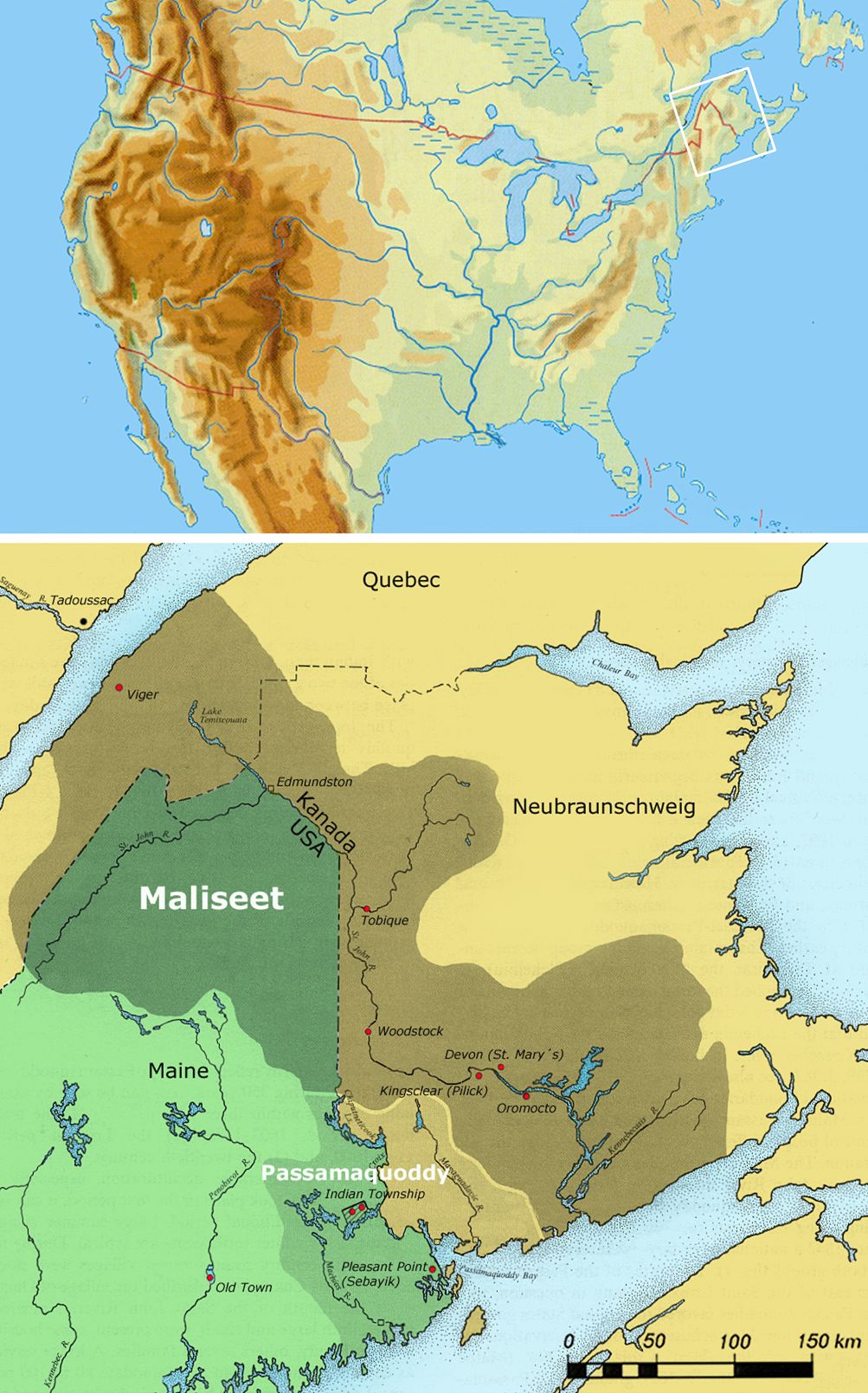
The Maliseet-Passamaquoddy language, also known as Peskotomuhkati-Wolastoqey, is an endangered Algonquian language spoken by the Wolastoqey and Passamaquoddy peoples in New Brunswick, Canada, and Maine, United States. It comprises two closely related dialects, Maliseet and Passamaquoddy, with an estimated 600 fluent speakers, most of whom are older adults. The language is central to the cultural identity and heritage of these First Nations. Significant revitalization efforts, including digital resources, educational programs, and artistic works, are underway to preserve and teach the language.
Language Status and Revitalization Efforts
The Maliseet-Passamaquoddy language is classified at level 7 on the Expanded Graded Intergenerational Disruption Scale, indicating a shifting state where the child-bearing generation can use the language but it is not being transmitted to children. This critical status is the result of historical pressures including changes in the education system post-World War II and increased intermarriage outside the speech community. In response, a community-driven revitalization movement has emerged over recent decades. This movement uses both traditional knowledge and modern technology to document the language and create new learning pathways. Key projects have been developed in close collaboration between Indigenous speakers, educators, and academic linguists.
One significant documentation initiative is the Language Keepers project, which began in 2006. This project focused on recording natural group conversations rather than structured linguistic elicitation, capturing the language in authentic use. Over its first three years, the team filmed over 50 hours of conversation with 70 speakers, resulting in eight DVDs with Maliseet-Passamaquoddy dialogue and English subtitles. This footage has been used in language revival programs, particularly for passive speakers who understand but cannot speak. The project also contributed valuable material to the comprehensive Passamaquoddy-Maliseet Dictionary, providing real-world examples and pronunciations.
Educational outreach extends into formal academic settings, with Maliseet-Passamaquoddy classes being taught at the University of New Brunswick to foster intergenerational communication and cultural transmission. The language has gained wider public recognition through the work of contemporary artists. Jeremy Dutcher, a member of the Tobique First Nation and a classically trained singer, has released two albums which feature songs sung entirely or partially in Wolastoqey. These artistic contributions engage audiences both within and outside Indigenous communities.
- The Language Keepers project began documentation work in 2006.
- The project filmed over 50 hours of natural conversation with 70 speakers in its first three years.
- This work produced eight educational DVDs with Maliseet-Passamaquoddy and English subtitles.
- Jeremy Dutcher released the Wolastoqey-language album Wolastoqiyik Lintuwakonawa in 2018.
- Dutcher's second album, Motewolonuwok, featuring the language, was released in 2023.
- Maliseet-Passamaquoddy language classes are offered at the University of New Brunswick.
Key Resources for Learning and Preservation
A central resource for language preservation is the Passamaquoddy-Maliseet Dictionary, a project started in the 1970s by linguist Philip S. LeSourd. The first edition, published in 2008, contained over 18,000 entries, many with accompanying audio and video files of native speaker pronunciations. This work was the result of collaboration with Passamaquoddy elder David Francis, University of New Brunswick professor Robert Leavitt, and community research coordinator Margaret Apt. An enlarged two-volume second edition was published. This new edition adds more than 1,000 entries and features an extensive introduction, updated grammatical charts, and sample sentences drawn from both oral tradition and contemporary conversation.
Building directly from the dictionary is the Peskotomuhkati-Wolastoqey Language Portal, a comprehensive online resource. The portal links the dictionary's now over 19,000 entries to an extensive archive of videos showing everyday conversations and cultural activities like canoe-building. It is designed as a free, public resource for language learning and linguistic research, providing users with written entries, audio pronunciations, and subtitled video context. For more targeted community use, the Passamaquoddy Tribe at Indian Township and Pleasant Point developed a dedicated smartphone application. This app, available for iPhone and Android, includes words and phrases for everyday use, games, quizzes, and progress tracking, and is used in cultural classes for grades one through eight.
The dedication of individuals to this work has been formally recognized. Professor Emeritus Robert Leavitt, along with his long-time collaborators Margaret Apt and the late Elder David Francis, were awarded the Governor General's Meritorious Service Medal for their contributions to Indigenous language revitalization. Their work, spanning more than 50 years, has been crucial in creating the foundational tools that support current learners. The revitalization efforts also creatively incorporate historical recordings, such as the 31 wax cylinders of songs, stories, and words made by anthropologist Jesse Walter Fewkes in 1890. These recordings, housed at the Wabanaki Cultural Centre in Calais, Maine, have been digitized, allowing songs not heard for generations to be recovered and studied.
- The first edition of A Passamaquoddy-Maliseet Dictionary was published in 2008 with over 18,000 entries.
- A second, enlarged edition was published, adding more than 1,000 new entries.
- The Peskotomuhkati-Wolastoqey Language Portal provides free online access to over 19,000 dictionary entries.
- The Passamaquoddy language app was developed for tribal members on iPhone and Android platforms.
- Robert Leavitt, Margaret Apt, and David Francis received the Governor General's Meritorious Service Medal for their work.
- Anthropologist Jesse Walter Fewkes made 31 wax cylinder recordings of the language in Calais, Maine, in 1890.
Phonology and the Standard Orthography
The Maliseet-Passamaquoddy sound system is documented in the standard orthography developed for the language, which uses 17 letters from the English alphabet plus an apostrophe. This writing system was not formally developed until the early 1980s, prior to which the language was transmitted solely through oral tradition. The consonant inventory includes stops like p, t, k, and q (a voiceless uvular stop), affricates like c (pronounced as [tʃ] or [dʒ]), fricatives like s and h, and nasals like m and n. A distinctive feature is the use of the apostrophe to indicate a historical word-initial consonant that is no longer pronounced in certain forms, such as in 'tomakéyu (s/he is poor) where the apostrophe marks a dropped k that appears in the related form nkótomakey (I am poor).
The vowel system consists of six monophthongs and five diphthongs. The monophthongs are a, e, i, o, u, and eh (the latter representing the sound [æ]). Diphthongs are written as combinations of a vowel and a glide, like aw or ey. Several important phonological processes govern pronunciation. Certain consonants, like p, t, k, s, and c, have voiced allophones when they appear between vowels or after the prefix n-, and voiceless allophones elsewhere. Syncope, or the deletion of an unstressed vowel o, is very common, as seen in the verb stem -kotomakey- becoming ktomakeyu when the first o is unstressed. Verb stems ending in h trigger vowel harmony, where the vowel before the h changes to match the vowel of the following inflectional suffix.
One of the most prominent differences between the Maliseet and Passamaquoddy dialects lies in their stress and pitch accent systems. While both dialects assign stress based on complex rules involving syllable count from the right, the finer details of these rules and the resulting pitch contours vary. In Passamaquoddy, stressed syllables can be relatively high-pitched or low-pitched, and final unstressed syllables can be distinctively low. Maliseet exhibits slightly different pitch assignments. These prosodic features are not just phonetic details but are sometimes used grammatically, such as in marking the absentative case on nouns through changes in pitch contour alongside specific suffixes.
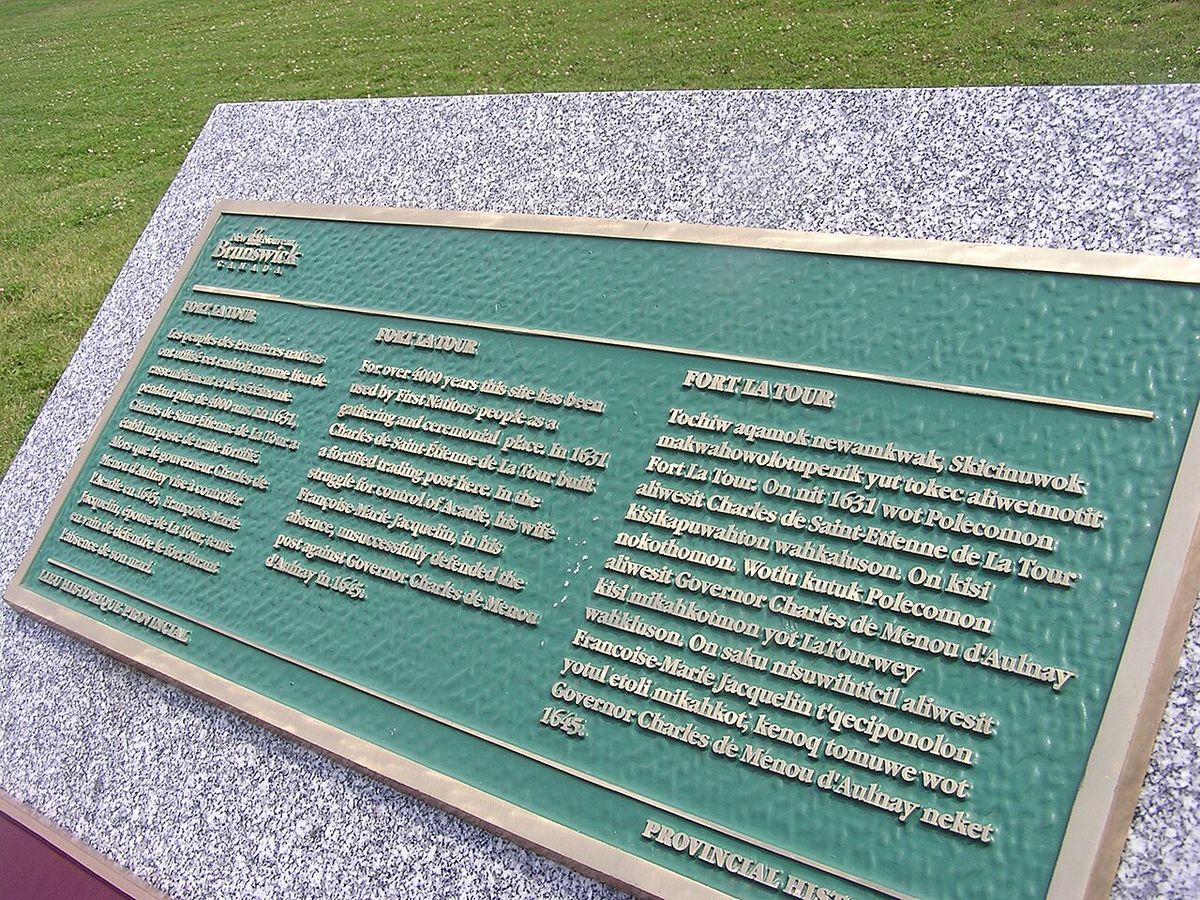
Grammatical Structure and Word Classes
Maliseet-Passamaquoddy is a polysynthetic and agglutinative language, meaning complex ideas are often expressed within a single word built from multiple morphemes, each typically carrying a single unit of meaning. All words belong to one of four categories: nouns, pronouns, verbs, and particles. With the exception of particles, all are inflected. A fundamental grammatical feature is the classification of all nouns and pronouns as either animate or inanimate. This classification is not always based on literal animacy. For instance, 'fingernail' and 'knee' are grammatically animate, while 'heart' and 'tongue' are inanimate. The plural forms differ by class: animate nouns take the plural suffix -k, while inanimate nouns take -l.
Animate nouns and pronouns are further marked for obviation, a grammatical distinction that indicates whether a third person is proximate (the central focus of the discourse) or obviative (more peripheral). When more than one animate third person appears in a clause, one must be proximate and the others obviative. Nouns can also be inflected for other cases including the locative, vocative, and a distinctive absentative case, which refers to someone or something that is absent. Diminutive and feminine suffixes can be added to noun stems, and a specific order is followed when combining these with case and number endings. Some nouns, particularly body parts and kinship terms, cannot appear without a possessive prefix and must always be in a possessed form.
Pronouns in Maliseet-Passamaquoddy include personal, demonstrative, and interrogative types. The personal pronouns distinguish between inclusive and exclusive forms for 'we' and have unique forms for each person and number. Demonstrative pronouns like wot (this, near me) and not (that, near you) are inflected for animacy, number, and obviation. A unique feature is the existence of a hesitator pronoun, which functions like English 'uh' or 'er' but is inflected to match the anticipated grammatical class of the upcoming word. For example, in the sentence 'nkisi puna ntahtuwossomut ihik... tuwihputik' (I put my cup on the uh... table), the hesitator pronoun ihik is inanimate to agree with the inanimate noun 'table' that follows.
Verb System and Sentence Structure
The verb is the most complex word class in Maliseet-Passamaquoddy, capable of incorporating subjects, objects, and various adverbial meanings. Verbs are built from stems that combine initial, medial, and final roots. Initial roots often convey adjectival meanings like colour or state, medial roots can be nominal (referring to body parts or objects), and final roots provide the core verbal action. This structure allows for the creation of highly descriptive words, such as posonutehke (he/she makes baskets), where the noun 'basket' is incorporated into the verb. Verbs are classified as transitive or intransitive based on their final root, and further subcategorized by the animacy of their subject or object, leading to four main types: Animate Intransitive (AI), Inanimate Intransitive (II), Transitive Animate (TA), and Transitive Inanimate (TI).
Verbs are inflected through a rich system of modes, tenses, and personal markers. The primary modes include the Independent Indicative for statements, the Changed and Unchanged Conjunct for dependent clauses and questions, the Subordinative for subsequent actions or polite commands, and the Imperative for direct commands. Tenses include Present, Preterite (past), Dubitative Preterite (expressing doubt about a past action), and Absentative. Because so much grammatical information is packed into the verb, a single verb can constitute a complete sentence, making one-word utterances common. The language operates on an ergative-absolutive alignment, meaning the subject of an intransitive verb is treated the same way as the object of a transitive verb.
Maliseet-Passamaquoddy is also a direct-inverse language. This means the grammatical marking on a transitive verb changes depending on a person hierarchy that ranks speech act participants (first and second person) above third persons. If the subject outranks the object on this hierarchy, the verb is marked in the direct form. If the object outranks the subject, the verb takes the inverse form. This system handles scenarios where, for example, 'he sees me' requires inverse marking because the object 'me' (first person) outranks the subject 'he' (third person). This verb system allows for precise expression while often eliminating the need for separate subject and object nouns.
Community Context and Personal Narratives
The story of language loss and reclamation is deeply personal for many community members. Donald Soctomah, a Passamaquoddy author, historian, and former tribal representative to the Maine House of Representatives, was born in 1955 and grew up hearing the language spoken fluently by his grandmother, mother, and older sisters. Soctomah describes himself as a comprehender, understanding more of the language than he can actively speak, and has been a driving force behind revitalization efforts, including the development of the tribe's language app for schoolchildren. Newell Lewey, a lifelong speaker, began an academic path after being asked to teach the language, eventually earning a master's degree in linguistics from the Massachusetts Institute of Technology. He now teaches Passamaquoddy at the university level and highlights the descriptive nature of the language, noting that conversation is often deeply connected to immediate physical context. Lewey also points to the work of elder David Francis, who painstakingly translated words and created sample sentences on stacks of yellow notepads, forming the foundational material for the dictionary. The collaborative spirit of these projects involves generations of speakers from both the Passamaquoddy and Wolastoqey communities in New Brunswick and Maine.
The contemporary tools for learning are carefully managed by the community to balance accessibility with cultural protection. While the online Peskotomuhkati-Wolastoqey Language Portal is freely available to the public, the tribe's smartphone app requires a PIN number for activation, which is provided only to enrolled tribal members. This measure is a deliberate exercise of sovereignty and self-determination, aimed at preventing cultural appropriation and misuse of the language while ensuring it remains a living resource for the people to whom it belongs. These efforts represent a holistic approach, combining technology with respect for tradition to ensure the language's future.
- Donald Soctomah was born in 1955 and served as a tribal representative to the Maine House of Representatives.
- Soctomah helped develop a language app for Passamaquoddy tribal members.
- Newell Lewey earned a master's degree in linguistics from the Massachusetts Institute of Technology.
- The Passamaquoddy written system, using 17 English letters, was developed in the early 1980s.
- The language app is used in cultural classes for students in grades 1 through 8.
- The Wabanaki Cultural Centre in Calais, Maine, houses the original 1890 wax cylinder recordings.
Questions about Maliseet-Passamaquoddy language
How many people speak Maliseet-Passamaquoddy today?
There are 600 speakers of both Maliseet and Passamaquoddy dialects today. The majority of these speakers are older adults. The Maliseet dialect is mainly spoken in the Saint John River Valley in New Brunswick, Canada. The Passamaquoddy dialect is spoken mostly in the St. Croix River Valley of eastern Maine in the United States.
What is being done to save the Maliseet-Passamaquoddy language?
Revitalization efforts include the Language Keepers video documentation project, which filmed over 50 hours of natural conversation. The Passamaquoddy-Maliseet Dictionary, with over 18,000 entries, serves as a key resource. The Peskotomuhkati-Wolastoqey Language Portal provides free online access to dictionary entries, audio, and video. Community tools include a smartphone app for tribal members and language classes in schools and at the University of New Brunswick.
What is the difference between the Maliseet and Passamaquoddy dialects?
The Maliseet and Passamaquoddy dialects are mutually intelligible and differ only slightly. The primary distinctions are phonological, involving differences in pronunciation and sound patterns. One notable difference is in their stress and pitch accent systems, where the rules for assigning stress and the resulting pitch contours vary. Vowels are generally not as long in Passamaquoddy as in Maliseet.
Can I learn Maliseet-Passamaquoddy online?
Yes, you can learn Maliseet-Passamaquoddy online. The primary online resource is the Peskotomuhkati-Wolastoqey Language Portal, which is free and open to anyone. It features an online dictionary with over 18000 entries, many with audio and video files of pronunciations. A dedicated smartphone app developed by the Passamaquoddy Tribe is restricted to enrolled tribal members.
Who created the Passamaquoddy-Maliseet dictionary?
The dictionary project was started in the 1970s by linguist Philip S. LeSourd. The work was deeply shaped by Passamaquoddy elder David Francis. University of New Brunswick professor Robert Leavitt and community research coordinator Margaret Apt were also central figures. In recognition of their work, Leavitt, Apt, and the late Francis received the Governor General's Meritorious Service Medal.
Are there any famous works of art or music in this language?
Yes, the language has been featured in contemporary music by Jeremy Dutcher, a classically trained singer from the Tobique First Nation in New Brunswick. Dutcher's debut album, Wolastoqiyik Lintuwakonawa, was released in 2018. His 2023 album, Motewolonuwok, also includes songs sung partially or entirely in Wolastoqey. These works represent a modern artistic expression of the Maliseet-Passamaquoddy language.
Sources and further reading
- Maliseet-Passamaquoddy language (Wikipedia)
- Peskotomuhkati-Wolastoqey Language Portal: Kulasihkulpon ... (pmportal.org)
- Passamaquoddy rely on new and old technology to ... (cbc.ca)
- Passamaquoddy-Maliseet language, News & Stories (abbemuseum.org)
- A Passamaquoddy-Maliseet Dictionary, Second Edition (lib.unb.ca)
Checked by the Nosy Mag desk. Last updated 2026-10-31.