Lac-Mégantic rail disaster
The Lac-Mégantic rail disaster was a catastrophic freight train derailment and explosion that occurred in the early morning of July 6, 2013, in downtown Lac-Mégantic, Quebec. An unattended 73-car Montreal, Maine and Atlantic Railway (MMA) train carrying crude oil rolled down a 1.2% grade from Nantes and derailed, resulting in massive explosions and fires that killed 47 people. The disaster destroyed roughly half of the town's downtown core, spilling approximately six million litres of oil and causing environmental contamination. This event is the fourth-deadliest rail accident in Canadian history and the deadliest since Confederation in 1867, leading to significant legal proceedings, regulatory scrutiny, and a prolonged community recovery effort.
Background and Contributing Factors
The railway line through Lac-Mégantic was a former Canadian Pacific Railway (CPR) main line, built in the late 1880s as part of the transcontinental link between Montreal and Saint John, New Brunswick. The Montreal, Maine and Atlantic Railway (MMA) had owned and operated the section from Saint-Jean-sur-Richelieu, Quebec, to Brownville Junction, Maine, since January 2003. Under MMA ownership, aggressive cost-cutting led to deferred maintenance, leaving much of the track in marginal condition. By 2013, speed reductions were required on 23 portions of the line, including an 8 km/h limit at Sherbrooke yard and a 16 km/h limit on an 18-kilometre stretch east of Magog. A 1970s proposal to reroute the line to bypass downtown Lac-Mégantic was never implemented due to cost, leaving trains travelling directly through the populated centre. The train was composed of five locomotives, a remote-control car, a buffer boxcar, and 72 DOT-111 tank cars, each carrying 113,000 litres of crude oil from the Bakken Formation in North Dakota. The oil was destined for the Irving Oil Refinery in Saint John, New Brunswick, with CPR subcontracting the Quebec-Maine leg to MMA. The DOT-111 tank cars, which represented close to 80 percent of the Canadian tank car fleet at the time, were known to have a high incidence of tank failures during accidents due to inadequate design.
Regulatory decisions in the years preceding the disaster played a role. Transport Canada and the U.S. Federal Railroad Administration had allowed MMA to implement single-person train operation (SPTO), meaning only one engineer was responsible for the entire train. An average of 80 tank cars per train was carried on the Lac-Mégantic route under the supervision of one person. Former MMA engineer Jarod Briggs had publicly expressed safety concerns about this practice as early as 2010, stating that a second crew member could help catch mistakes. Transport Canada had repeatedly reprimanded MMA from 2004 to 2009 and again in 2011 and 2012 for violations of handbrake rules on parked trains in Nantes but had issued no fines for these infractions.
Chronology of the Disaster
The sequence of events began months before the derailment. In October 2012, the lead locomotive, GE C30-7 No. 5017, experienced an engine failure and was repaired with an epoxy-like material that lacked required strength. This repair later failed, leading to engine problems. On July 5, 2013, train MMA 2 departed from the CPR yard in Côte-Saint-Luc and changed crews in Farnham, Quebec. Engineer Tom Harding parked the train on the main line at the designated crew-change point in Nantes, approximately 11 kilometres west of Lac-Mégantic, at about 23:00. He could not use the adjacent siding as it was routinely used to store empty boxcars for the local Tafisa factory.
Harding followed procedure by shutting down four of the five locomotives but left the lead locomotive running to maintain air pressure for the air brakes. He applied hand brakes, but the Transportation Safety Board later concluded he set them on just the five locomotives, the buffer car, and the remote control car. Harding incorrectly left the locomotive air brakes on during a brake test, creating a false impression that the hand brakes alone would hold the train. After reporting mechanical issues with the lead locomotive, which was emitting excessive black and white smoke, he departed for a hotel in Lac-Mégantic by taxi, telling the driver he felt unsafe leaving the locomotive in that condition.
Later that evening, witnesses reported seeing the unattended train emitting thick smoke and sparks. At 23:50, the Nantes Fire Department responded to a 911 call reporting a fire on the lead locomotive. Fire Chief Patrick Lambert stated that firefighters shut down the engine to stop fuel circulation before extinguishing the blaze, a standard protocol. They notified MMA's rail traffic controller in Farnham. MMA did not send the engineer back but dispatched two track maintenance employees from Lac-Mégantic, who confirmed the train was safe. With all locomotives shut down, the air compressor stopped supplying the brake system. Air slowly leaked from the system, gradually depleting the main reservoirs and reducing braking effectiveness.
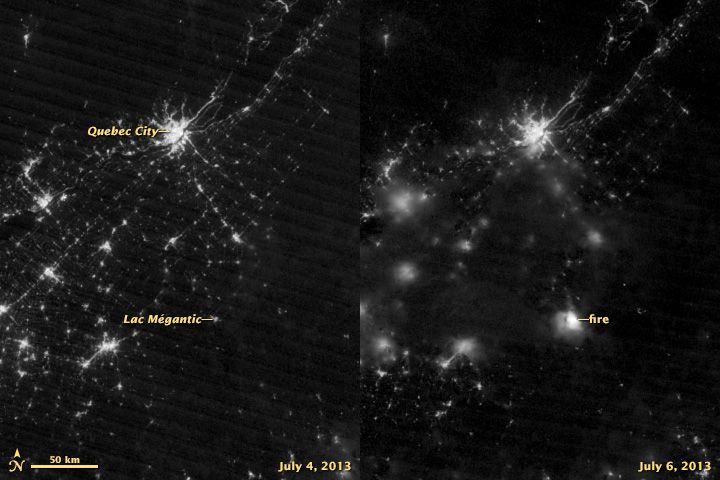
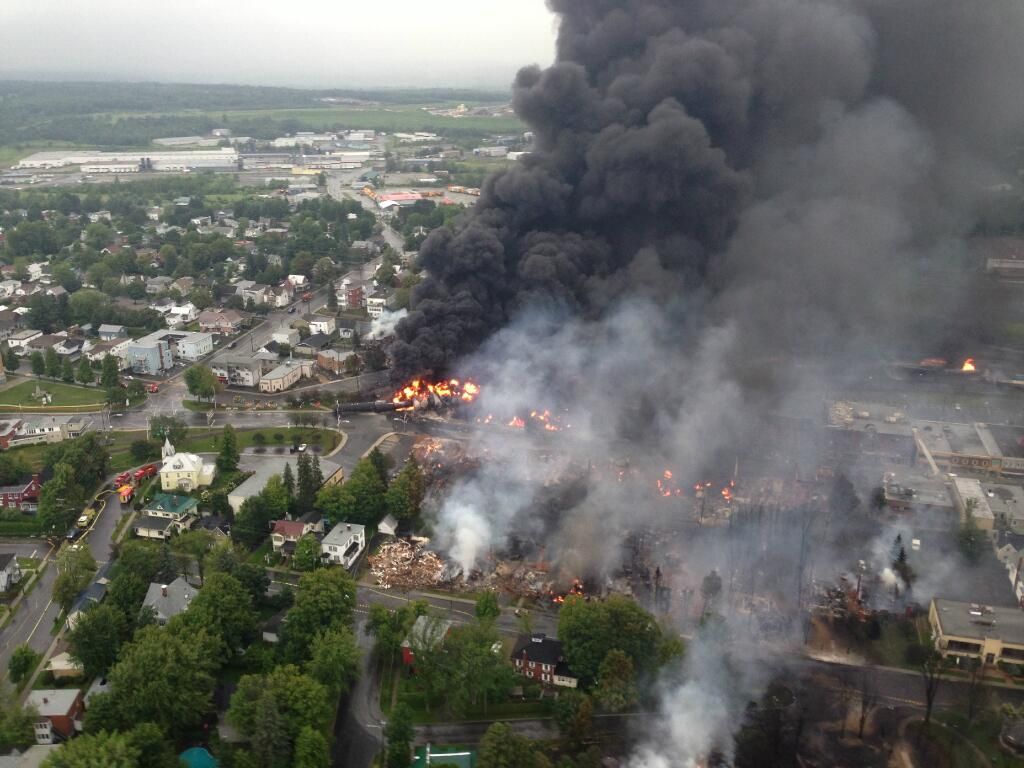
At approximately 00:56, with air pressure depleted, the train began rolling downhill from Nantes toward Lac-Mégantic on the 1.2 percent grade. The town of Nantes sits 515 metres above sea level, while Lac-Mégantic is 108 metres lower at 407 metres. At about 1:14 a.m. on July 6, the train derailed in the heart of downtown Lac-Mégantic near the crossing of Frontenac Street. The derailment caused multiple tank cars to rupture, releasing nearly six million litres of crude oil that ignited into a massive fireball. The initial blast radius was described as one kilometre, and more than 30 buildings in the town centre were immediately destroyed or consumed by fire.
Immediate Aftermath and Response
The explosions and fires killed 47 people, making it the deadliest rail disaster in Canada since 1867. First responders faced an inferno that obliterated a large section of the historic downtown. Approximately 2,000 residents were evacuated from their homes. The scale of destruction was immense, with all but three of the 39 remaining buildings in the core later requiring demolition due to petroleum contamination. The disaster also caused a significant environmental incident, with about 100,000 litres of oil leaking into the nearby Chaudière River, raising long-term contamination concerns for the waterway and downstream communities.
Emergency crews from across Quebec and neighbouring regions responded to assist with firefighting, search and recovery, and victim support. The Transportation Safety Board of Canada (TSB) launched a major investigation immediately. In the days following, the focus turned to identifying the victims, supporting grieving families, and stabilizing the devastated community. The physical and psychological trauma inflicted on the town of roughly 6,000 people was severe and has persisted for years.
Investigations and Identified Causes
The Transportation Safety Board of Canada's investigation identified multiple causes and contributing factors. The direct cause was the insufficient application of hand brakes to secure the parked train on a slope. The TSB estimated that between 17 and 26 hand brakes would have been needed to hold the train, but only a fraction were set. The practice of leaving the train unattended on a main line was a critical factor. The shutdown of all locomotives by firefighters stopped the compressor that recharged the air brake system, allowing air pressure to bleed off slowly until the brakes released entirely.
The investigation highlighted systemic failures. MMA's single-person train operation policy meant there was no second crew member to perform a proper stabilization test by releasing air brakes to check if hand brakes alone would hold the train. The company's safety management system was found to be deficient, and its special instructions for securing trains were inadequate. The TSB also found that the lead locomotive's 'reset safety control' was not wired to set the entire train's brakes in the event of an engine failure. Broader contributing factors included the known vulnerabilities of the DOT-111 tank cars, the poor condition of MMA's track infrastructure, and inadequate regulatory oversight from Transport Canada, which had knowledge of MMA's safety violations but had not enforced compliance effectively.
Legal Proceedings and Corporate Accountability
The disaster triggered complex legal and financial repercussions. The Montreal, Maine and Atlantic Railway, lacking sufficient assets or insurance to cover damages, was forced into bankruptcy in both Canada and the United States shortly after the derailment. Victims and creditors launched a class-action lawsuit against numerous companies connected to the disaster, including the oil shipper, railcar owners, and track owners. A settlement fund was established, with about 25 companies contributing a total of $450 million in exchange for being removed from the lawsuit.
Canadian Pacific Railway (CP), which had subcontracted the shipment to MMA, refused to contribute to the settlement, claiming it bore no responsibility. CP was subsequently dropped from the class action, but legal proceedings against it continued separately, merged with a lawsuit from the Quebec government. Criminal charges were also laid against three former MMA employees: engineer Tom Harding, traffic controller Richard Labrie, and operations manager Jean Demaître. After a lengthy trial process, they were each acquitted of criminal negligence causing death in 2018. In a second trial, six MMA employees pleaded guilty to Railway Safety Act charges, with Harding receiving six months house arrest. A MMA subsidiary was fined $1 million for polluting the river.
Community Impact and Long-Term Recovery
The human and community toll of the disaster has been severe and long-lasting. Beyond the 47 immediate fatalities, the trauma led to at least two subsequent suicides. Twenty-seven children lost their parents, and the entire town was enveloped in grief. Health studies in the years following found large segments of the population experiencing symptoms of post-traumatic stress disorder, high levels of anxiety and depression, and increased medication use. The destruction of the downtown core erased businesses, cultural landmarks, and the town's social heart, creating an economic void that challenged recovery.
Environmental concerns persist. Independent research indicated hydrocarbons were interacting with water and contaminating the food chain, though no comprehensive government-led eco-toxicity study was conducted. The reconstruction process itself became a source of tension. Authorities used the language of urgency and risk to impose a redevelopment agenda on the traumatized community, often sidelining residents' wishes. Citizen groups, notably the Lac-Mégantic Citizens’ Coalition for Rail Safety, formed to advocate for rail safety improvements, a public inquiry, and a railway bypass around the town. A decade after the federal government promised a bypass, construction had still not begun as of recent reports, leaving the community to continue its fight for safety and justice.
Regulatory Changes and Unlearned Lessons
In the wake of the disaster, some regulatory changes were implemented. The federal government quickly banned single-person train operations for trains carrying dangerous goods. There was an accelerated phase-out of the oldest, most vulnerable DOT-111 tank cars for transporting crude oil and a move toward cars with thicker shells and enhanced safety features. However, critics argue that fundamental problems persist. A report from the Environmental Commissioner within the Auditor General's Office warned that the window for a recurrence of a Lac-Mégantic-type disaster remains open, indicating that risks have not been fully mitigated.
The Transportation Safety Board's Watchlist, which highlights the greatest risks to Canada's transportation system, continues to include issues pertinent to Lac-Mégantic: inadequate company safety management systems, uncontrolled train movements, and poor fatigue management for railway employees. Rail shipments of dangerous goods, including crude oil, have continued to grow. Advocacy groups and experts argue that the root causes, deregulation, industry-captured regulators, and corporate prioritization of profit over safety, have not been fully addressed. The Quebec legislature's unanimous 2018 call for a full public commission of inquiry was rejected by the federal government, which stated the TSB report was sufficient, leaving many questions about systemic accountability unanswered.
Key Facts and Figures
The Lac-Mégantic disaster is defined by several stark statistics that illustrate its scale. Nearly six million litres spilled during the derailment and fire, which killed 47 people and destroyed more than 30 buildings in the town centre. The subsequent evacuation displaced about 2,000 residents, and roughly 100,000 litres of oil contaminated the Chaudière River. In the legal aftermath, a settlement fund of $450 million was established from contributions by 25 companies, though Canadian Pacific Railway did not participate.
- Train Length and Weight: 1,433 metres (4,701 feet) long, weighing 10,287 metric tons.
- Tank Cars: 72 DOT-111 cars, each carrying 113,000 litres.
- Fatalities: 47 confirmed deaths, the deadliest rail accident in Canada since 1867.
- Property Destruction: More than 30 buildings destroyed immediately. All but 3 of 39 remaining downtown buildings later demolished.
- Evacuation: Approximately 2,000 residents displaced.
- Environmental Spill: Roughly 100,000 litres of oil entered the Chaudière River.
- Legal Settlement: $450 million settlement fund from 25 companies.
Questions about Lac-Mégantic rail disaster
What caused the Lac-Mégantic train derailment?
The direct cause was an insufficient number of hand brakes applied to secure a parked freight train on a 1.2 percent downhill grade. The train's lead locomotive had caught fire and was shut down by firefighters, which disabled the air compressor that recharged the train's air brake system. As air pressure slowly leaked away, the brakes lost effectiveness, and the unmanned train began rolling toward Lac-Mégantic. Contributing factors included the Montreal, Maine and Atlantic Railway's single-person crew policy, inadequate safety procedures, poor track maintenance, and the use of vulnerable DOT-111 tank cars known to rupture easily in accidents.
What changes were made to rail safety after Lac-Mégantic?
In response, Transport Canada quickly banned single-person train operations for trains carrying dangerous goods. Regulations were strengthened to accelerate the phase-out of the oldest DOT-111 tank cars, moving the industry toward cars with thicker shells and enhanced safety features. The new TC-117 tank car became the standard. However, critics and oversight bodies argue more comprehensive reform is needed. Issues like inadequate safety management systems, uncontrolled train movements, and fatigue management remain on the Transportation Safety Board's Watchlist of high-risk problems.
Was anyone held criminally responsible for the disaster?
Three former Montreal, Maine and Atlantic Railway employees, engineer Tom Harding, traffic controller Richard Labrie, and operations manager Jean Demaître, were charged with criminal negligence causing death. After a lengthy trial process, all three were acquitted of those charges in 2018. In a second trial, six MMA employees pleaded guilty to Railway Safety Act charges. Harding received six months house arrest for not testing the handbrakes. Civil liability was addressed through a $450 million settlement fund involving numerous companies, though Canadian Pacific Railway continues to face separate lawsuits.
What is the environmental legacy of the oil spill in Lac-Mégantic?
The disaster spilled nearly six million litres of crude oil, with approximately 100,000 litres contaminating the Chaudière River. Independent research indicated hydrocarbons interacted with water and entered the food chain, raising long-term ecological and health concerns. No comprehensive government-led eco-toxicity study has been conducted to fully assess the damage. Environmental contamination, alongside the psychological and physical destruction, forms a central part of the disaster's ongoing impact on the community.
How many people died in the Lac-Mégantic disaster?
Forty-seven people were killed in the explosions and fires that followed the derailment. This death toll makes it the fourth deadliest rail accident in Canadian history and the deadliest involving a non-passenger train. It is also the deadliest rail accident since Canada's confederation in 1867. The previous Canadian rail accident with a higher death toll was the Beloeil train disaster in 1864, which killed 99 people.
What is the status of the railway bypass around Lac-Mégantic?
A proposal to reroute the rail line to bypass downtown Lac-Mégantic was made in the 1970s but was never implemented due to cost. The railway line continued to pass through the town centre at the time of the 2013 disaster. Following the disaster, the community renewed its advocacy for a bypass. A decade after the federal government promised a bypass, construction had still not begun as of recent reports. The railway assets were sold in 2014 to the Central Maine and Quebec Railway.
Sources and further reading
- Lac-Mégantic rail disaster (Wikipedia)
- Remembering the Lac-Mégantic rail disaster | CCPA (policyalternatives.ca)
- Lac-Mégantic Rail Disaster (thecanadianencyclopedia.ca)
- A cautionary tale for oil-by-rail: the Lac-Mégantic disaster ... (thenarwhal.ca)
Checked by the Nosy Mag desk. Last updated 2026-10-28.