History of rail transport in Canada
The history of rail transport in Canada began in the early 19th century and is deeply intertwined with the nation's political and economic development. The construction of railways was integral to Confederation, with promises of transcontinental lines helping to unite provinces from the Maritimes to British Columbia. The system experienced dramatic booms, financial collapses leading to nationalization, and a postwar transition that saw passenger services largely transferred to the crown corporation Via Rail. Today, railways remain a critical component of the Canadian economy, moving the majority of the country's intercity freight and exports while continuing to evolve with new investments and technologies.
Early Tramways and Pre-Railway Systems
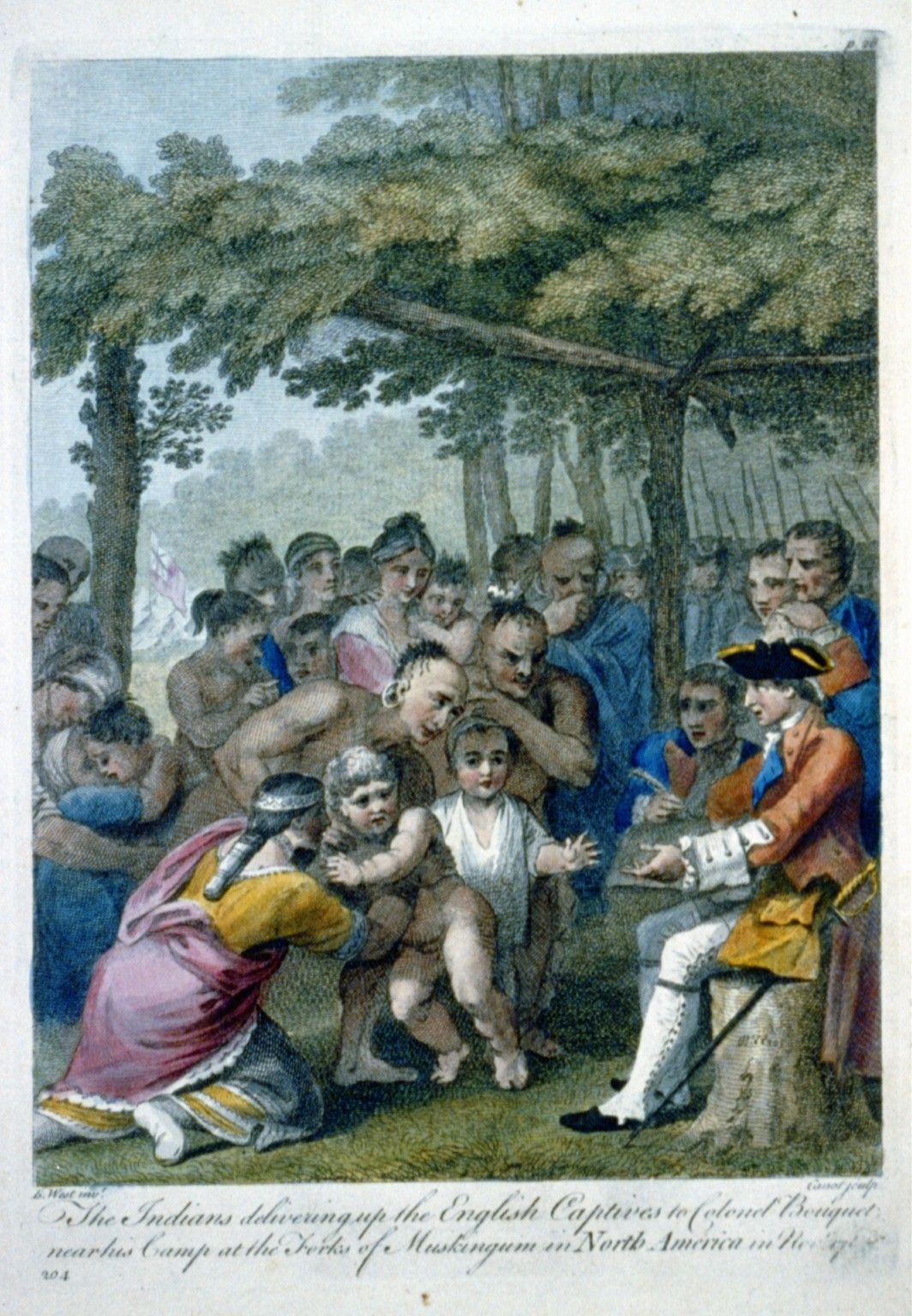
The earliest railway-like systems in Canada were primitive tramways built for industrial purposes, predating the steam locomotive era. Local oral history from Cape Breton Island suggests a tramway may have been constructed around 1720 to transport coal from mines to the Fortress of Louisbourg when the island was under French control, though physical and written evidence is sparse. A more documented incline tramway was built by British forces in 1762 near Niagara Falls to create a portage route between Lake Ontario and Lake Erie, replacing a trail long contested by the Seneca nation. This project sparked violence, including the Battle of Devil's Hole during Pontiac's War, but the British maintained the tramway until ceding the land to the United States in 1783. In Quebec City, a significant incline tramway was built on Cap Diamant, possibly as early as 1823, to haul stone for the construction of the Citadelle of Quebec. This system was powered by a stationary steam engine, was double-tracked, and operated until the late 1840s, also carrying members of the public as passengers, marking several Canadian firsts. Another early system was used during the building of the Rideau Canal to carry stone from the Hog’s Back quarry in Ottawa, illustrating the use of rail technology in major public works projects before the advent of locomotive-powered railways.
The First Railway Boom and Government Guarantees
The era of true steam railways in Canada commenced with the opening of the Champlain and St. Lawrence Railroad outside Montreal on July 21, 1836, a short portage line designed to connect river traffic. It was followed in 1839 by the Albion Mines Railway in Nova Scotia, built to transport coal from mines to a seaport. Widespread expansion, however, did not begin until the passage of the Railway Guarantee Act of 1849 in the Province of Canada. This legislation, sponsored by Francis Hincks, guaranteed bond returns of up to six percent on half the bonds for any railway over 75 miles long, which spurred rapid but often uneconomic construction. The government's finances were strained disastrously by these subsidies, nearly bankrupting the Canadas. The largest project of this period, the Grand Trunk Railway linking Montreal to Sarnia, was completed in 1860 but was mired in deep debt, forcing a government bailout that released the state from its bond guarantees. Other lines from this boom included the Montreal and Lachine Railroad, opened in 1847, and the St. Lawrence and Atlantic Railroad, completed in 1853 with significant promotion from Alexander Tilloch Galt and American interests seeking a year-round port for Montreal.
Railways and Confederation: Building a Transcontinental Nation
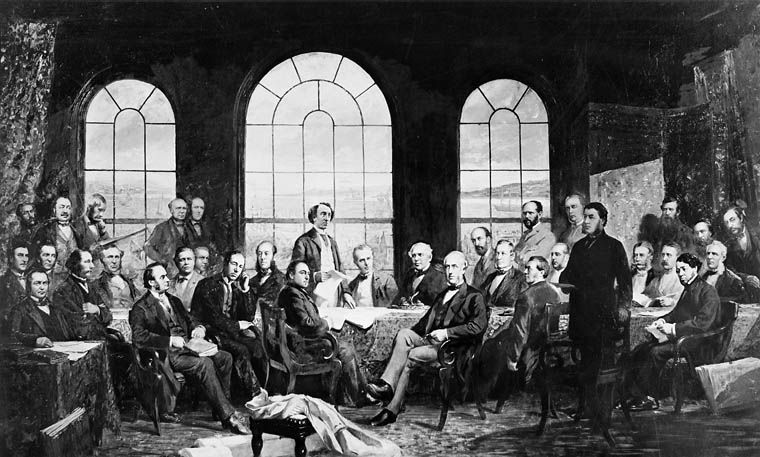
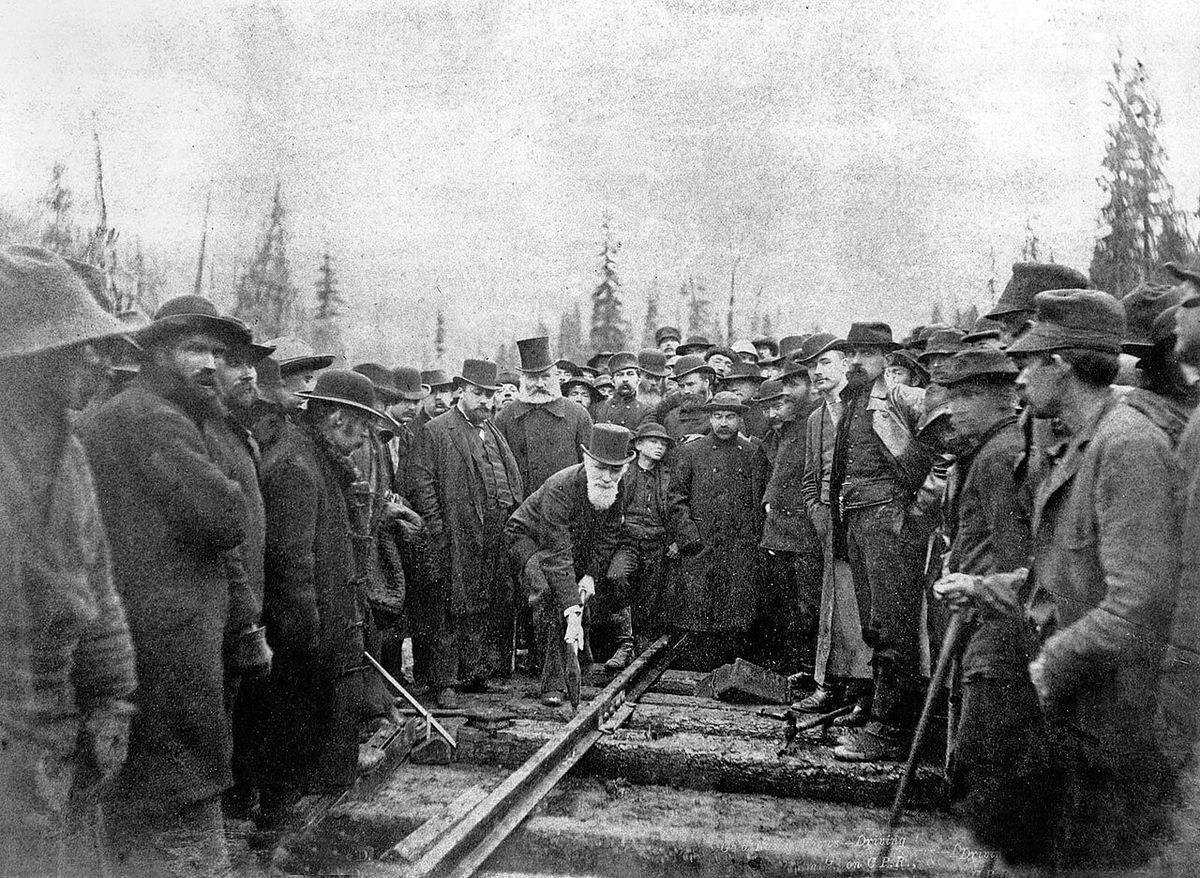
Railway policy was a central catalyst for Canadian Confederation in 1867. The Intercolonial Railway, promised to the Maritime provinces, was built as a fully government-controlled project under the direction of engineer Sandford Fleming, marking Canada's first major experiment in railway nationalization. The transcontinental railway to the Pacific was the Canadian Pacific Railway, financed by private funds, massive land grants in the prairies, $25 million in cash, and a guaranteed monopoly. The CPR began regular service between Winnipeg and Calgary in December 1883 and was completed in 1885, becoming the longest railway in the world at the time and fundamentally enabling western settlement. The booming economy after 1900 led to plans for two additional transcontinentals, the Canadian Northern Railway and the Grand Trunk Pacific, alongside the government-built National Transcontinental Railway from Moncton to Winnipeg. The federal government initially encouraged the Canadian Northern and Grand Trunk Pacific to cooperate on a single new line, but when no agreement was made, it supported the expansion of both, setting the stage for a massive overbuild of capacity.
Crisis, Nationalization, and the Creation of Canadian National
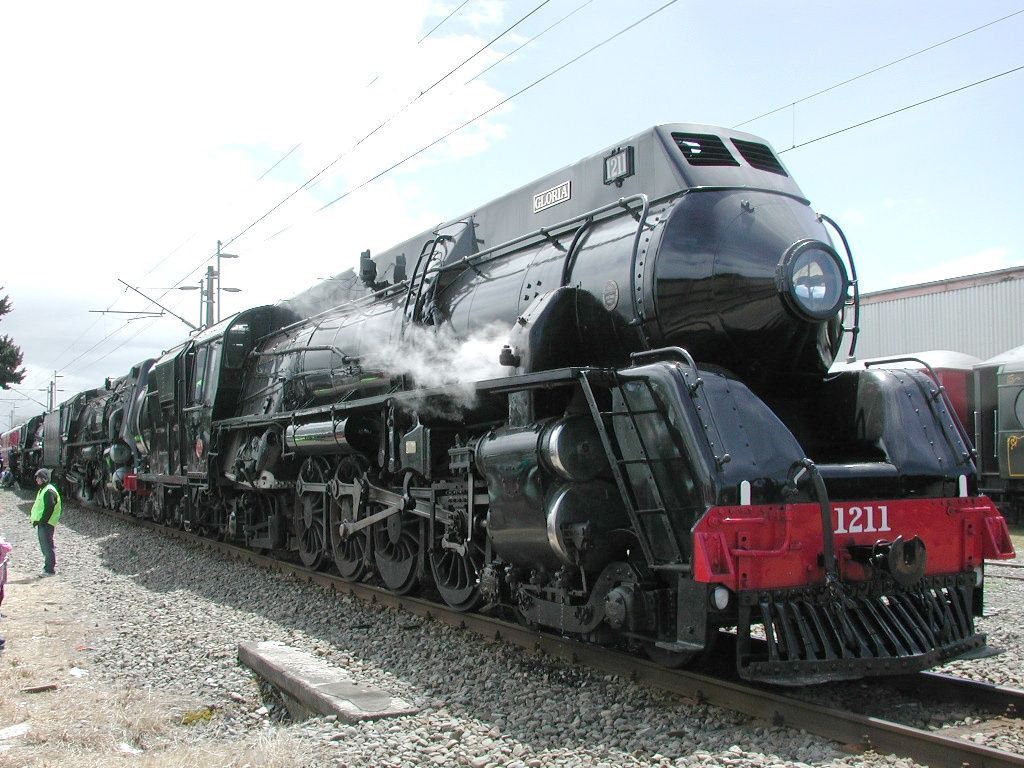
The aggressive expansion of multiple transcontinental lines proved financially catastrophic with the outbreak of the First World War, which halted immigration and capital flows. The overextended Canadian Northern, Grand Trunk Pacific, and Grand Trunk railways collapsed, threatening the national infrastructure. The federal government nationalized these systems, absorbing over two billion dollars in debt. In 1923, these railways were merged with the government-owned Canadian Government Railways, which included the Intercolonial and National Transcontinental, to form the Canadian National Railways (CNR), a massive crown corporation. This consolidation ended the era of great railway expansion in Canada. Competition from automobiles in the 1920s and later from airlines after the Second World War began a long decline in passenger rail traffic. CNR was an early North American adopter of diesel technology, experimenting with self-propelled oil-electric cars from 1924 and introducing a prominent diesel locomotive, CN No. 9000, on its flagship International Limited train in 1929. The locomotive was built by the Canadian Locomotive Company using diesel engines imported from Britain, demonstrating early domestic interest in the technology that would eventually replace steam.
- Railways nationalized: Canadian Northern, Grand Trunk Pacific, Grand Trunk.
- Debt absorbed by government: Over $2 billion.
- CNR formation year: 1923.
- Predecessor government system: Canadian Government Railways.
- First CN diesel experiments: 1924 with oil-electric cars.
- Prominent diesel debut: CN No. 9000 in 1929 on the International Limited.
The Postwar Transition and Passenger Rail Reform
The postwar decades saw a continued shift away from steam to diesel locomotion and a steep decline in passenger ridership. The National Transportation Act of 1967 attempted comprehensive reform, providing government subsidies for branch lines and passenger services still operated by CN and Canadian Pacific. This model proved insufficient to sustain passenger rail, leading to a more decisive change in 1978 when the federal government transferred most passenger services from CN and CP to a new crown agency, Via Rail. This move aimed to preserve a national passenger network while allowing the freight railways to focus on commercial operations. In a major policy reversal, the Canadian National Railways was privatized in November 1995, ending its 72-year history as a government-owned enterprise. The Great Depression led to a decline in rail traffic, and the sudden reversal of this during the Second World War left railways with overtaxed, aging, and poorly maintained infrastructure.
The Modern Rail Industry: Performance and Investment
Canada's rail industry is a fundamental part of the national economy, demonstrated by record-setting performance in recent years. In 2024, the industry moved 348 million metric tonnes of freight, a record volume, and invested $4.5 billion into Canadian assets, bringing the total decade-long investment to $35.5 billion. Key areas of investment included $2.4 billion in track and roadway infrastructure and nearly $900 million in new, high-capacity railcars and low-emission locomotives. The sector directly employed 38,000 people, its highest level since 2001, with average compensation of $110,000, approximately 50 percent higher than the average full-time Canadian salary. Railways also paid a record $2.7 billion in taxes to various levels of government. The industry's operational and environmental performance has also seen marked improvement. The freight accident rate in 2024 fell to 1.61 accidents per billion gross ton-miles, a record safety performance. Fuel efficiency reached a new peak, with railways able to move one tonne of goods 229 kilometres on a single litre of fuel, confirming rail as the most fuel-efficient land freight mode. The industry is also increasing its use of renewable fuels, consuming an estimated 176 million litres of biofuels in 2024, accounting for 8.3 percent of total industry fuel consumption. Passenger rail has shown a strong recovery, with commuter ridership increasing by 22.7 percent and intercity ridership by 8.6 percent year-over-year in 2024. A significant recent development was the return of passenger rail locomotive assembly to Canada, with an announcement made in Montreal in July 2026.
- Freight volume in 2024: 348 million metric tonnes.
- Total industry investment in 2024: $4.5 billion.
- Direct employment in 2024: 38,000 people.
- Taxes paid in 2024: $2.7 billion.
- Freight accident rate in 2024: 1.61 per billion gross ton-miles.
- Fuel efficiency in 2024: 229 km per litre of fuel per tonne.
- Biofuel consumption in 2024: 176 million litres.
- Average employee compensation: $110,000.
Key Statistics and Recent Trends
The Railway Association of Canada's annual Rail Trends report provides a detailed snapshot of the industry's financial and operational health. The 33rd edition, covering 2015 to 2024, highlights a sector that has grown more efficient and productive despite challenges like labour disruptions and supply chain uncertainty. The data shows railways move 70 percent of Canada's intercity freight traffic and 50 percent of the country's exports, underlining their systemic importance. The report notes that 2024 was marked by significant challenges but also notable achievements, with the industry maintaining low average terminal dwell times and recovering quickly from disruptions to deliver record tonnage. The table below summarizes key performance indicators from the 2024 report, illustrating the scale and scope of the modern railway network in Canada.
| Metric | 2024 Performance | Notes |
|---|---|---|
| Freight Volume | 348 million metric tonnes | Record high |
| Capital Investment | $4.5 billion | 9.5% year-over-year increase |
| Average Freight Rate Change | -0.3% | Globally competitive, stable rates |
| Direct Employment | 38,000 | Highest since 2001 |
| Taxes Paid | $2.7 billion | Record high contribution |
| Freight Accident Rate | 1.61 per billion gross ton-miles | 4.8% reduction, record safety |
| Fuel Efficiency | 229 km/litre per tonne | Record efficiency |
| Passenger Accident Rate Improvement | 12.4% | Year-over-year improvement |
These figures illustrate an industry that is investing heavily in its network, maintaining competitive rates, and achieving new benchmarks in safety and environmental stewardship. The recovery in passenger ridership and the strategic investments in new equipment and biofuels point to a sector adapting to modern economic and environmental demands. The industry's role in decarbonizing transportation is expanding, with biofuels and fleet modernization driving emissions reductions. The return of locomotive assembly to Canada in 2026 represents a recent development in rebuilding domestic industrial capacity for passenger rail.
Historical Impact and Enduring Role
The development of steam-powered railways in the 19th century revolutionized transportation in Canada and was integral to the very act of nation building. Railways played an integral role in the process of industrialization, opening up new markets and tying regions together, while at the same time creating a demand for resources and technology. However, railways had a divisive effect as well, as the public alternately praised and criticized the involvement of governments in railway construction and the extent of government subsidies to railway companies. The cycle of boom, guarantee, bailout, and eventual nationalization defined much of the first century of Canadian rail history. The legacy of this history is a network that, despite the decline of passenger service, continues to serve as the primary freight mover for a vast, resource-based economy. The industry's current record levels of investment, employment, and tax contribution demonstrate its sustained economic weight. From the primitive tramways of the 1720s to the diesel-powered, biofuel-consuming networks of the 21st century, railways have been a constant and evolving force in shaping Canada's economic geography and connecting its disparate regions across formidable distances.
Questions about History of rail transport in Canada
What was the first railway in Canada?
The first true steam railway in Canada was the Champlain and St. Lawrence Railroad, which opened on July 21, 1836. It was a short portage railway built outside Montreal to connect river traffic on the St. Lawrence to Lake Champlain. Earlier primitive tramways existed, such as an incline railway used in the 1820s during the construction of the Quebec Citadel, but the Champlain and St. Lawrence is recognized as the first proper railway. The Albion Mines Railway in Nova Scotia opened in 1839, becoming the first railway in the Maritimes.
How did railways contribute to Canadian Confederation?
Railways were a direct political catalyst for Confederation. Promises to build the Intercolonial Railway linking the Maritimes to central Canada were crucial to gaining Maritime support for union in 1867. The transcontinental Canadian Pacific Railway was seen as vital for binding the new nation together geographically and economically. The local governments' bankruptcy from earlier railway guarantees also made a larger, more stable union necessary for future infrastructure financing.
Why was Canadian National Railways (CN) created?
Canadian National Railways was formed in 1923 through the nationalization and merger of several bankrupt private railways. The financial collapse of the Canadian Northern, Grand Trunk Pacific, and Grand Trunk railways during and after the First World War threatened Canada's transportation infrastructure. The federal government took over these companies, absorbing over two billion dollars in debt, and consolidated them with existing government lines like the Intercolonial and the National Transcontinental to create a single, publicly owned railway system to ensure continued service. This ended the period of aggressive, competitive expansion and created a nationalized carrier.
What is Via Rail and when was it established?
Via Rail is a federal crown corporation responsible for most intercity passenger rail services in Canada. It was established in 1978 to take over the money-losing passenger operations of the Canadian National and Canadian Pacific railways. This separation allowed the freight railways to focus on commercial operations while the government could directly manage and subsidize a national passenger network, which continues to operate today. The creation of Via Rail followed the National Transportation Act of 1967, which first provided subsidies for passenger services.
Is Canadian National still a government-owned company?
No, Canadian National Railways (now CN) is no longer government-owned. After operating as a crown corporation for 72 years, it was privatized in November 1995. The company is now a publicly traded corporation on the Toronto and New York stock exchanges, operating as a private freight railway, though it remains one of the two major rail systems in the country alongside Canadian Pacific Kansas City. Its privatization marked a significant shift in Canadian transportation policy towards market-oriented operations for major freight carriers.
How important are railways to Canada's economy today?
Railways remain critically important to Canada's modern economy. In 2024, they moved 348 million metric tonnes of freight, accounting for 70 percent of all intercity freight traffic and 50 percent of the country's exports by volume. The industry directly employed 38,000 people and invested a record $4.5 billion in infrastructure and equipment. Railways are also the most fuel-efficient land freight mode, moving one tonne of goods 229 kilometres on a single litre of fuel as of 2024. They paid $2.7 billion in taxes in 2024, showing their significant fiscal contribution to federal, provincial, and municipal governments.
Sources and further reading
- History of rail transport in Canada (Wikipedia)
- Railway History in Canada (thecanadianencyclopedia.ca)
- Annual Rail Trends (railcan.ca)
Checked by the Nosy Mag desk. Last updated 2026-10-30.