History of Canadian newspapers
The history of Canadian newspapers is marked by a struggle for a free press and the shaping of a collective identity. From their origins as tightly controlled government organs in the 18th century, newspapers evolved into powerful instruments of partisan debate and, later, nation-building. This journey encompasses five distinct periods: the Transplant Period (1750 to 1800), the Partisan Period (1800 to 1850), the Nation-Building Period (1850 to 1900), the Modern Period (1900 to 1980s), and the Current History since the 1990s. The story is populated by pioneering printers and editors who faced persecution, debt, and physical violence to establish newspapers as a vital public forum.
The Transplant Period: Government Organs and American Roots (1750 to 1800)
The initial era of Canadian newspapers, known as the Transplant Period, was characterized by the absence of a free press under the French regime and the establishment of printing as a tool of British colonial administration. All early newspapers were transplanted from the American colonies, following the migration of approximately 60,000 Loyalists after the American Revolution in 1783, with around 30,000 moving to Canada. The primary function of the press was to propagate official government news and proclamations, with no concept of a public political sphere. Colonial administrators used weekly publications modelled on The London Gazette, known as Gazettes, to circulate official notices. Any attempt by printers to publish material not condoned by the government was met with severe harassment, intimidation, and legal prosecution. The first advertising began to appear in the 1780s, including classified ads in publications like the Quebec Gazette, which in 1787 carried an advertisement for the sale of an enslaved Black woman.
The pioneering printers of this era operated under immense pressure and personal risk. John Bushell published the first edition of the Halifax Gazette on March 23, 1752, becoming the colony's first King's Printer but was given no government salary. Anton Heinrich, who anglicized his name to Henry Anthony, took over Bushell's enterprise but fled to Massachusetts in 1765 after printing an editorial opposing the Stamp Act. In Quebec, William Brown and Thomas Gilmore launched the government-sponsored, bilingual Quebec Gazette in 1764 under heavy government censorship. Fleury Mesplet, who immigrated from France, was jailed before printing anything due to his American sympathies but later published Canada's first entirely French newspaper, The Gazette of Montreal, in 1778, for which he and his editor were imprisoned. Louis Roy launched the Upper Canada Gazette on April 18, 1793, but left in 1797 due to political persecution after printing incendiary opinions, fleeing to New York.
The Partisan Period: A Press Enters the Public Sphere (1800 to 1850)
The Partisan Period marked a significant transformation as printers and publishers began liberating the press from direct government control, establishing newspapers as vital organs of political parties. This era saw the democratization of information, with editors playing major roles in local politics and using their columns to challenge policies and promote candidates. The central political debate of the time focused on achieving responsible government. A major victory was won in 1891 when the right to report on political proceedings was finally secured. The newspapers of this period were non-deferential and actively worked to undermine the traditional hierarchical societal structure, though publishers continued to operate under difficult conditions.
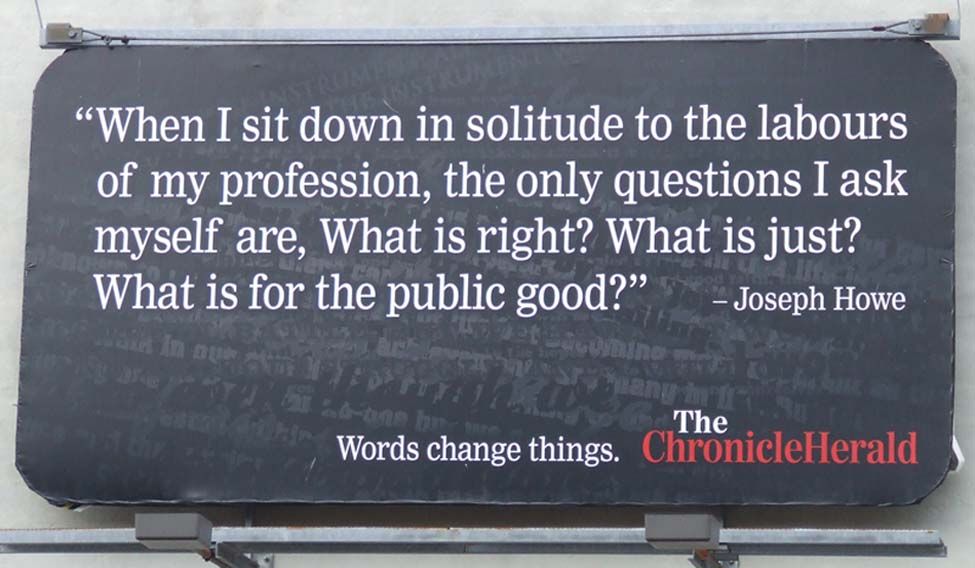
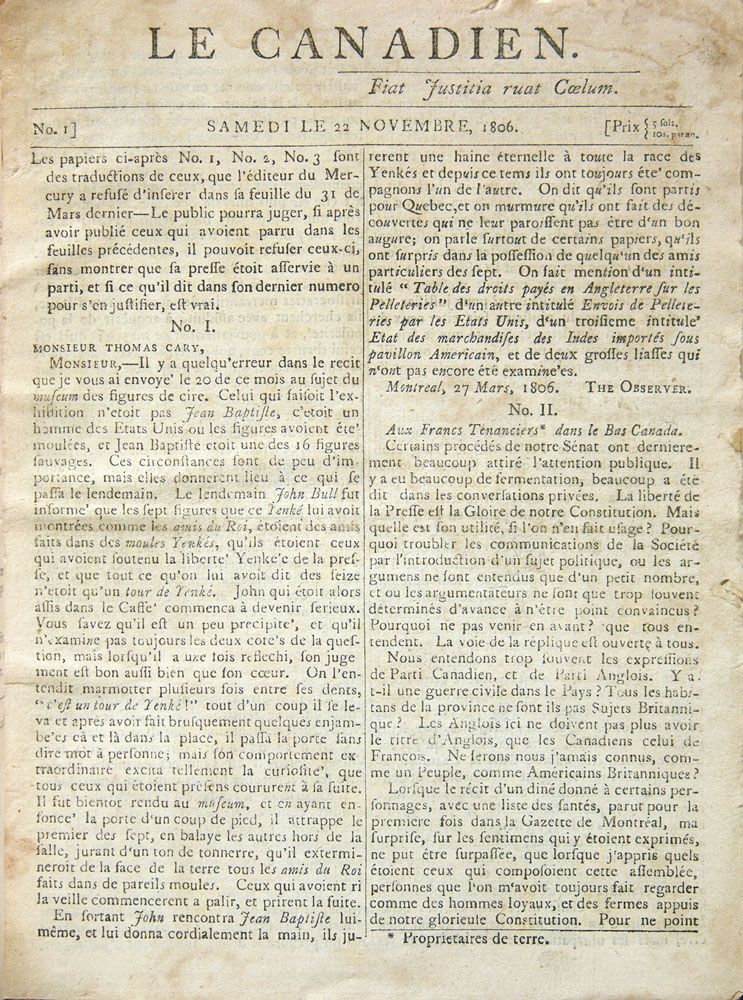
Key publications and figures defined this combative era. In Lower Canada, the French weekly Le Canadien was founded on November 22, 1806, as the mouthpiece of the Parti canadien. Its motto reflected its advocacy for responsible government, leading to the arrest and imprisonment of its editor, Pierre Bédard, in 1810 by Governor James Craig. In Upper Canada, William Lyon Mackenzie founded the Colonial Advocate in 1824, the first independent paper in the province to wield significant political impact. Mackenzie used the paper to criticize the colonial administration, and in 1826 his printing office was destroyed by a mob, though a successful lawsuit for damages allowed him to continue. In Nova Scotia, Joseph Howe took over the Novascotian and through aggressive journalism became the voice of the province, famously being acquitted of criminal libel in 1835 after a powerful defence of a free press.
- Le Canadien (1806 to 1810, revived 1830s): French-language weekly, voice of Parti canadien, editors imprisoned.
- Colonial Advocate (founded 1824): First independent paper in Upper Canada with major political impact, founded by William Lyon Mackenzie.
- Novascotian: Edited by Joseph Howe, whose 1835 libel acquittal became a landmark for press freedom.
- Public Ledger and Newfoundland General Advisor (founded 1820): Published in St. John's by Henry David Winton, who was attacked and had his ears cut off in 1835 for his political writings.
- Upper Canada Guardian. Or Freeman's Journal: Published by Joseph Willcocks starting in 1806, who was jailed for contempt and later charged with treason.
- Royal St. John's Gazette (first issue 1807): Newfoundland's earliest newspaper, published by John Ryan and William Lewis, who were indicted for libel in 1784.
Nation-Building and the Forging of Identity (1850 to 1900)
With editors largely free from direct government control by the mid-19th century, Canadian newspapers entered a Nation-Building Period where their role shifted from partisan combat to establishing a common nationalistic view of Canadian society. While government influence persisted through means like directing paid advertising to friendly papers, the press took on the work of celebrating conformity, orthodoxy, and technological progress. Publications of this era focused on constructing a Canadian identity, moving away from the incendiary tone of the past towards a narrative that supported order and national unity. Technology became increasingly important for expanding circulation and influence.
The dominant figure of this period was George Brown, a Scottish immigrant who, with his father, founded the Presbyterian Banner in 1843 before establishing The Globe in 1844. Brown built The Globe into Canada's largest newspaper by 1860 through buying out competitors and employing advanced technology. He also entered politics, becoming the Reform Party leader and playing a role in the negotiations that led to Canadian Confederation in 1867. After Confederation, he resigned from Parliament but continued to promote his political views through his paper, while also engaging in battles with the typographical union from 1843 to 1872. He was killed by an angry ex-employee in 1880. On the West Coast, the Demers press imported by Bishop Modeste Demers in 1856 was used by American printer Frederick Marriott starting in 1858 to publish several newspapers, most influentially the British Colonist, which was founded by Amor De Cosmos. De Cosmos used the paper to express his political opinions, push for responsible government, and later entered politics, representing Victoria in the House of Commons.
The Modern and Current Periods: Professionalization, Chains, and Digital Disruption
The Modern Period, spanning from 1900 to the 1980s, witnessed the professionalization of the newspaper industry and the significant growth of corporate chains, which consolidated ownership and standardized operations across the country. This era saw newspapers solidify their formats, with broadsheets and tabloids becoming the two main types, and sections dedicated to business, sports, and entertainment becoming standard. The industry reached a peak in terms of physical circulation and local presence. However, the Current History period beginning in the 1990s brought challenges, as traditional chains faced takeover by outside interests and new competition from the Internet. This digital disruption forced a rethinking of business models, led to the bolstering of online presences, and resulted in the cessation of print operations for some publications.
The contemporary newspaper landscape in Canada is diverse but operates in a time of transition. As of 2016, there were 98 daily newspapers, including 84 paid and 14 free publications, with a total weekly circulation of 31.6 million across print and online platforms. The linguistic breakdown of these dailies was 85 per cent English, 13 per cent French, and 2 per cent Chinese. In terms of format, about 64 per cent of daily newspapers are broadsheets, like the National Post and The Globe and Mail, while 36 per cent are tabloids, such as the Sun Media chain and the French-language Le Journal de Montréal. The ecosystem also includes alternative weekly tabloids like Vancouver's Georgia Straight, multicultural papers such as Sing Tao Daily and The Canadian Jewish News, and independent student publications like The Ubyssey and The Varsity. Primary historical research is now facilitated by digital archives like the ProQuest Historical Newspapers: Canada Collection, which provides access to 18 influential titles from their first issues.
Formats, Types, and the Contemporary Landscape
Canadian newspapers today are categorized by their physical format, frequency, and target audience. The two primary formats are broadsheets and tabloids, each with distinct characteristics. Broadsheets, folded twice and organized into bundled sections, are the traditional format for most local and national daily newspapers, including the Globe and Mail, National Post, Montreal Gazette, and Vancouver Sun. Tabloids, typically half the size of a broadsheet and sometimes stapled, are the preferred form for many weekly and local daily newspapers. About 36 per cent of Canadian dailies are tabloids, a category that includes populist publications like the Sun newspaper chain and the French-language Le Journal de Montréal, as well as alternative, left-leaning weeklies such as Toronto's NOW and Halifax's The Coast, which are typically distributed for free.
Beyond the mainstream dailies, a rich ecosystem of specialized publications serves distinct communities. Multicultural or ethnic newspapers reflect the languages, interests, and politics of specific cultural groups, with major examples including the Chinese-language World Journal and Ming Pao, The Canadian Jewish News, and the Punjabi-Hindi-English paper Asian Vision. Student newspapers, funded by advertisements and student fees and operating independently of their universities, provide training grounds for journalists and serve campus communities. Major examples include The Ubyssey at the University of British Columbia and The McGill Daily at McGill University. The industry's historical record is now extensively digitized, with resources like the ProQuest Historical Newspapers: Canada Collection offering access to 18 major titles and Canadian Newsstream providing full-text access to current and archived content from over 400 sources dating back to the 1970s.
| Newspaper Type | Key Examples | Primary Format |
|---|---|---|
| National Broadsheet Dailies | The Globe and Mail, National Post | Broadsheet |
| Major Local Dailies | Montreal Gazette, Vancouver Sun, Toronto Star | Broadsheet |
| Tabloid Dailies/Chains | Sun Media papers, Le Journal de Montréal | Tabloid |
| Alternative Weeklies | Georgia Straight (Vancouver), NOW (Toronto) | Tabloid |
| Multicultural Papers | Sing Tao Daily, The Canadian Jewish News | Varies |
| Student Newspapers | The Ubyssey (UBC), The Varsity (U of T) | Varies |
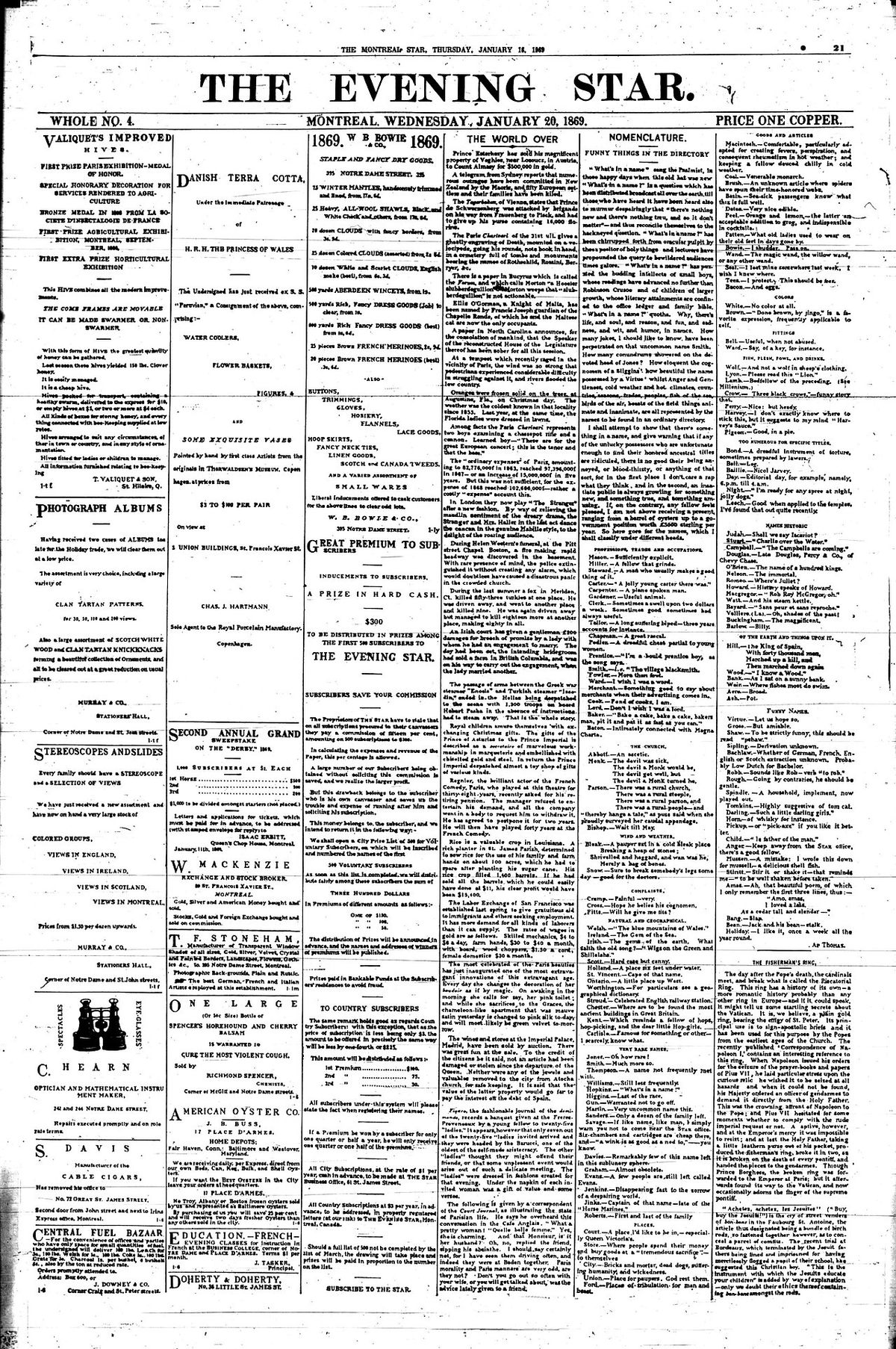
Archival Collections and Historical Resources
The preservation and study of Canadian newspaper history is supported by several major archival collections and digital initiatives that provide access to millions of pages of primary source material. The most comprehensive digital archive is the ProQuest Historical Newspapers: Canada Collection, which brings together 18 influential Canadian newspapers from five provinces, offering high-resolution page views from their first historical issues to the present. This collection includes major titles such as the Toronto Star, Ottawa Citizen, The Globe and Mail, Edmonton Journal, and The Vancouver Sun. Another critical resource is the Canadiana Collections, managed by the Canadian Research Knowledge Network, which spans five centuries of Canadian documentary history.
The Canadiana Collections are vast and multidisciplinary, comprising several distinct sets of materials. The Monographs collection spans three and a half centuries of Canadian documentary history. The Serials collection includes a wide range of dailies, weeklies, specialized journals, and mass-market magazines, as well as city directories and annual reports. The Government Publications collection holds over 1.7 million pages of historical pre-1920 colonial, provincial, and federal government documents. The Maps collection contains nearly 22,000 digitized Canadian maps from the National Topographic Series, dating from 1905 to 2012. The CRKN explicitly acknowledges that the content and metadata in these historical collections contain language reflecting the biases and perspectives of their time, including harmful wording and stereotypes.
Questions about History of Canadian newspapers
What was the first newspaper published in Canada?
The first newspaper published in Canada was the Halifax Gazette. Its first edition was published by John Bushell on March 23, 1752. Bushell became the colony's first King's Printer, though he operated as an independent entrepreneur without a government salary. The paper was an official government organ, heavily controlled by colonial administrators who made the Provincial Secretary its editor to ensure only sanctioned news was printed.
Who was William Lyon Mackenzie and why is he important to newspaper history?
William Lyon Mackenzie was a printer, editor, and political reformer in Upper Canada. In 1824, he founded the Colonial Advocate, which became the first independent newspaper in the province to have a significant political impact. He used the paper to criticize the colonial administration. In 1826, his printing office was destroyed by a mob, but he successfully sued the assailants and used the damages to rebuild. He later led the Upper Canada Rebellion in 1837.
What was the Partisan Period in Canadian newspaper history?
The Partisan Period in Canadian newspaper history lasted from 1800 to 1850. During this time, newspapers successfully broke free from being mere government organs and became active instruments of political parties and debate. Editors like Joseph Howe in Nova Scotia and the publishers of Le Canadien in Lower Canada played major roles in politics, using their papers to challenge government policies. They advocated for issues like responsible government, with Howe being acquitted in a landmark libel trial in 1835 and the Le Canadien editors being imprisoned for their criticism.
How did George Brown contribute to Canadian newspapers and politics?
George Brown was a Scottish immigrant who founded The Globe in Toronto in 1844. He used advanced technology and bought out competitors to build it into Canada's largest newspaper by 1860. Brown also entered politics, becoming leader of the Reform Party and playing a role in the negotiations that led to Canadian Confederation in 1867. After Confederation, he resigned from Parliament but continued to promote his views through The Globe. He was killed by a former employee in 1880.
What is the state of the newspaper industry in Canada today?
As of 2016, the Canadian newspaper industry included 98 daily newspapers, comprising 84 paid and 14 free publications, with a total weekly circulation of 31.6 million across print and online platforms. Linguistically, 85 per cent of dailies are in English, 13 per cent in French, and 2 per cent in Chinese. The industry is diverse, including broadsheet national dailies, tabloid chains like Sun Media, alternative weeklies, multicultural papers, and student publications. Since the 1990s, the industry has faced significant challenges from digital disruption.
Where can I find historical Canadian newspapers for research?
For research, the premier digital archive for historical Canadian newspapers is the ProQuest Historical Newspapers: Canada Collection. This collection provides full access to 18 major titles from their first issues. The Canadiana Collections, managed by the Canadian Research Knowledge Network, also contain vast serial collections including newspapers, magazines, and government documents spanning five centuries. Library and Archives Canada provides guides to exploring the availability and locations of newspapers in its physical and digital collections.
Sources and further reading
- History of Canadian newspapers (Wikipedia)
- Canadiana (canadiana.ca)
- Newspapers in Canada (thecanadianencyclopedia.ca)
- ProQuest Historical Newspapers: Canada Collection (about.proquest.com)
- Canada's History, Canada's History (canadashistory.ca)
Checked by the Nosy Mag desk. Last updated 2026-11-02.