Fathers of Confederation
The Fathers of Confederation are the 36 delegates who attended the foundational political conferences leading to Canadian Confederation in 1867. They represented the British North American colonies at meetings in Charlottetown (1864), Quebec City (1864), and London, England (1866-67), where they negotiated the terms of union. Their work produced the 72 Quebec Resolutions, which formed the basis of the British North America Act, 1867, Canada's original constitution. This group, comprised entirely of men from the political elite of the time, is credited with forging the political compromises that created the Dominion of Canada, balancing regional interests and laying the groundwork for a federal parliamentary democracy.
The Conferences and Their Purpose
The process of Confederation was advanced through three major conferences held between 1864 and 1867. The Charlottetown Conference from 1 to 9 September 1864 was originally convened to discuss a union of the Maritime colonies of Nova Scotia, New Brunswick, and Prince Edward Island. Delegates from the Province of Canada, which comprised present-day Ontario and Quebec, asked to attend and successfully broadened the agenda to a union of all British North American colonies. The conference was marked by both formal discussions at Province House and extensive social diplomacy at banquets and balls. Delegates agreed in principle to the proposed wider union and scheduled a follow-up meeting for the next month to settle the details. The Québec Conference followed from 10 to 27 October 1864, with Newfoundland also sending a delegation. This meeting was dedicated to hammering out the specific framework for the new country, resulting in the 72 Quebec Resolutions. This comprehensive plan covered the division of powers between federal and provincial governments, the structure of Parliament, and financial arrangements. The resolutions aimed to balance the desire for a strong central government with protections for regional, linguistic, and religious minorities. Ratification was not assured as Prince Edward Island and Newfoundland ultimately rejected the deal at this stage, leaving only Nova Scotia, New Brunswick and the Province of Canada as supporters.
The London Conference was the final legislative stage, lasting from 4 December 1866 to March 1867. Sixteen delegates from the Province of Canada, Nova Scotia, and New Brunswick met in England to refine the 72 Resolutions into a statute. They made minor concessions to the Maritime Provinces and drafted the British North America Act, 1867. The Act passed through the British Parliament and received royal assent on 29 March 1867. An anti-union delegation from Nova Scotia, led by Joseph Howe, was also present in London but failed to stop the act's passage. The Dominion of Canada was officially proclaimed on 1 July 1867.
Key Delegates and Their Roles
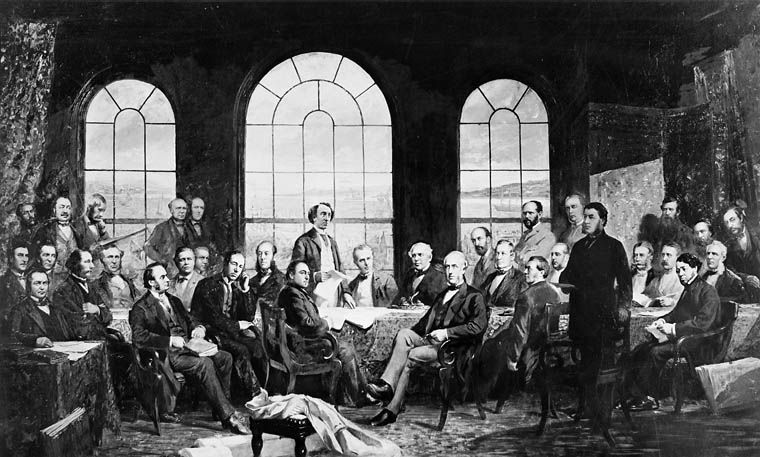
The Fathers of Confederation included prominent politicians from each of the participating colonies, with a core group attending multiple conferences and playing distinct roles in the negotiations. Sir John A. Macdonald, a co-premier of the Province of Canada, is widely regarded as the chief political architect and strategist of Confederation and later became Canada's first prime minister. George Brown, the Reform Party leader from Canada West, was instrumental in pushing for representation by population and was a key member of the Great Coalition that made the conferences possible. Sir George-Étienne Cartier, co-premier from Canada East, was the principal advocate for French Canadian interests, arguing forcefully for a federal system that would protect provincial rights and minority cultures. From the Maritime colonies, several figures played decisive roles, including Charles Tupper, the premier of Nova Scotia, who strongly advocated for union despite significant anti-Confederation sentiment in his province. Samuel Leonard Tilley, premier of New Brunswick, was a steadfast supporter whose insistence on the Intercolonial Railway became a condition for his colony's entry. Other significant delegates included Alexander Galt, who shaped the financial terms of union, and Thomas D'Arcy McGee, a passionate orator who promoted a Canadian national identity distinct from the United States.
The Fathers of Confederation were exclusively male and drawn from the political and professional classes of the colonies. Only twelve of the 36 men attended all three conferences. Hewitt Bernard, the recording secretary at the Charlottetown Conference, is considered by some to be a Father of Confederation. The following individuals are among the 36 Fathers of Confederation who attended at least one conference.
- Hewitt Bernard (recording secretary at Charlottetown, sometimes considered a Father)
- William McDougall (Province of Canada)
- Oliver Mowat (Province of Canada)
- Jonathan McCully (Nova Scotia)
- Edward Barron Chandler (New Brunswick)
- John Hamilton Gray (Prince Edward Island)
- Frederick Carter (Newfoundland)
Major Political Compromises
The negotiations were defined by fundamental compromises between competing visions for the new country. A critical compromise was between representation by population and regional protection. The solution was a bicameral Parliament with a House of Commons based on representation by population and an appointed Senate providing regional equality. Another major compromise was the division of powers between the federal and provincial governments. This federal system protected provincial jurisdiction over matters like education and civil rights, which was crucial for safeguarding French Canadian language and culture. Economic and infrastructure promises were essential to securing Maritime agreement. Delegates from Nova Scotia and New Brunswick made the construction of the Intercolonial Railway a condition of union. The Canadian delegates agreed to guarantee its completion. The federal government would cover five sixths of the cost of the railway. The key constitutional compromises are summarized in the list below.
- Government Structure: A federal system with a strong central government and provincial powers over local matters.
- Parliament: A bicameral legislature with a representation-by-population Commons and a regionally equal Senate.
- Minority Rights: Protections for French language, Catholic education, and civil law in Quebec.
- Infrastructure: A binding guarantee to build the Intercolonial Railway.
- Finance: Federal assumption of provincial debts and a system of subsidies.
Later Fathers of Confederation
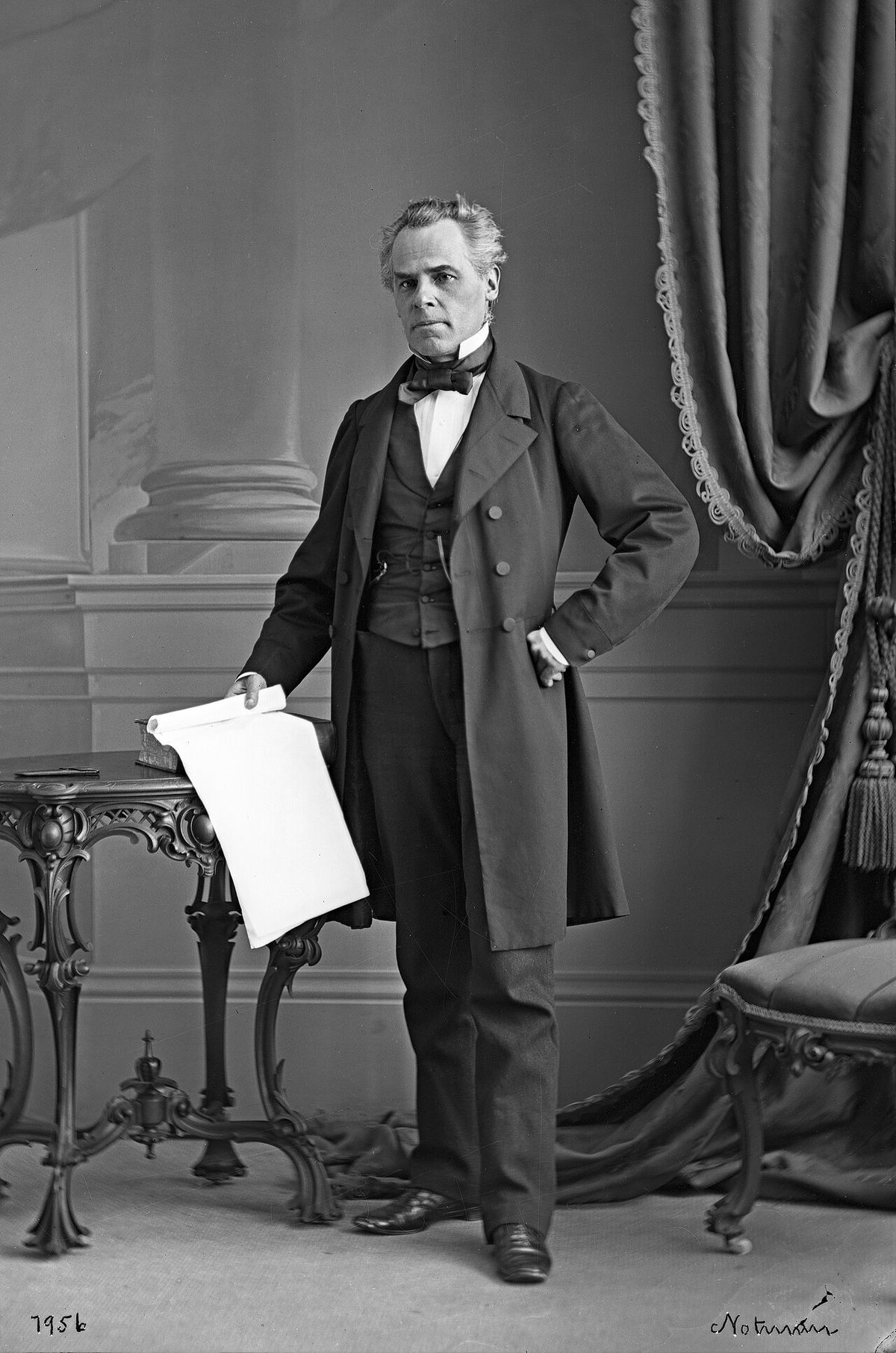
The leaders most responsible for bringing other provinces into Confederation after 1867 are also referred to as Fathers of Confederation. The provisional government established by Louis Riel negotiated the terms for Manitoba's entry in 1870. Amor De Cosmos was instrumental in bringing British Columbia into Confederation in 1871. Prince Edward Island, which had rejected the Quebec Resolutions, joined Confederation in 1873. The province of Newfoundland entered Confederation in 1949 after a referendum campaign led by Joey Smallwood. Joey Smallwood was then referred to as the only living Father of Confederation. This demonstrates how the title is applied to leaders of later accession movements. The terms and key figures for each province's entry are detailed in the following list.
- Manitoba (1870): Entered under terms negotiated by Louis Riel's provisional government, which secured land and language rights for the Métis.
- British Columbia (1871): Joined under the leadership of Amor De Cosmos, with a promise to build a transcontinental railway within ten years.
- Prince Edward Island (1873): Entered Confederation to resolve its crippling railway debt crisis, receiving federal assumption of its debt.
- Newfoundland and Labrador (1949): Joined after a close referendum campaign led by Joey Smallwood, who became its first premier.
Contemporary Perspectives and Historical Debate
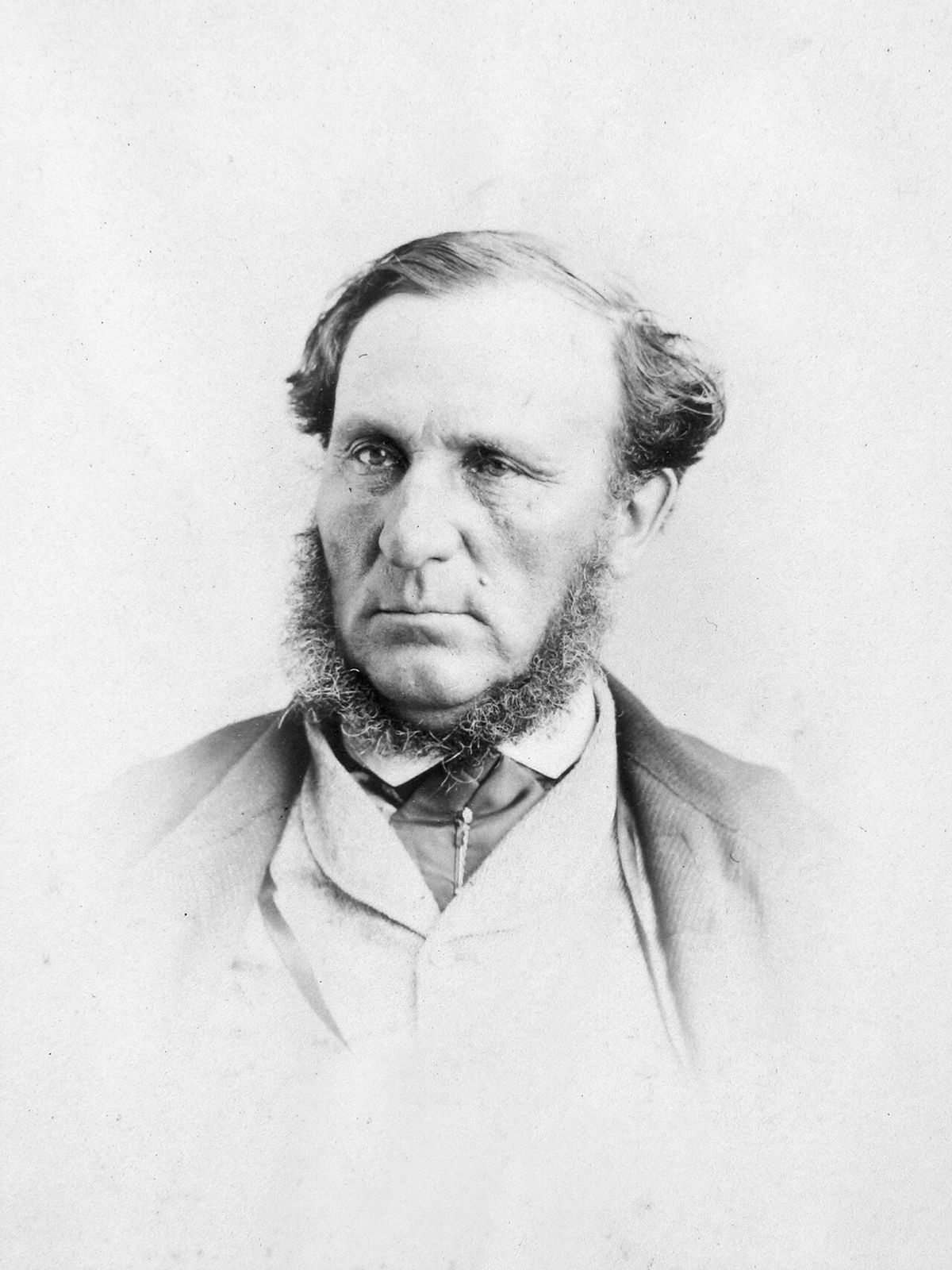
Historical assessment of the Fathers of Confederation has evolved over time. For years, a dismissive view characterized them as hayseed colonials who were not democrats. Critics noted they did not put Confederation to the people and did not extend voting rights to women. In recent years, some historians have begun to challenge this dismissive account. Scholars have argued that the Fathers were sophisticated parliamentary democrats who believed in government by discussion. Their achievement in forging a constitutional agreement through negotiation, without violence, is now more widely appreciated. This occurred during a period of global instability like the American Civil War. The debates they engaged in remain central to Canadian politics today. The foundational federal structure they designed in the 72 Resolutions endures as the framework of Canadian governance. The 36 Fathers of Confederation are recognized as Persons of National Historic Significance.
Legacy and Commemoration
The legacy of the Fathers of Confederation is embedded in the Canadian state. Their most direct legacy is the Constitution, built from the 72 Resolutions. The federal system and parliamentary model they designed continue to frame Canadian governance. Key infrastructure promises like the Intercolonial Railway were subsequently built. The group is commemorated across Canada in numerous ways. Province House in Charlottetown, the site of the first conference, is a National Historic Site. The painting Fathers of Confederation by Robert Harris is a familiar image. Their portraits appear on Canadian currency and stamps. The 150th anniversary of the conferences in 2014 spurred renewed public interest. Modern examinations contextualize their achievements within their time. They also acknowledge the perspectives and peoples excluded from their negotiations. This includes Indigenous nations, women, and racial minorities. This ongoing dialogue ensures their legacy remains a living part of Canada's historical consciousness. The Fathers of Confederation are listed among Canada's national founders.
Questions about Fathers of Confederation
Which provinces joined Canada in 1867?
Only four provinces formed the original Dominion of Canada on 1 July 1867: Ontario, Quebec, New Brunswick, and Nova Scotia. These were the jurisdictions whose delegates from the Province of Canada, New Brunswick, and Nova Scotia finalized the deal at the London Conference and whose legislatures ratified the union. Prince Edward Island and Newfoundland, which participated in the early conferences, rejected the Quebec Resolutions and did not join at that time. Prince Edward Island entered Confederation in 1873, and Newfoundland and Labrador became a province in 1949.
What were the 72 Resolutions?
The 72 Resolutions were the detailed constitutional plan drafted by the delegates at the Quebec Conference in October 1864. They outlined the proposed structure of the new federation, including the division of powers between the federal and provincial governments, the framework for a bicameral Parliament, financial arrangements, and the process for admitting other territories. These resolutions formed the direct blueprint for the British North America Act, 1867, which was passed by the British Parliament to create Canada. Most of Canada's original constitution is based on this document.
Why is Louis Riel considered a Father of Confederation?
Louis Riel is recognized as a Father of Confederation for Manitoba because he led the provisional government that negotiated the province's terms of entry into Canada. His delegation forced the Canadian government to negotiate, resulting in the Manitoba Act of 1870. This act created the province and included specific protections for Métis land, and French and Catholic rights. In 1992, Parliament passed a unanimous resolution naming Louis Riel the founder of Manitoba.
Was Confederation approved by a popular vote?
No, Confederation was not put to a direct popular vote or referendum. The constitutional deal required ratification by the elected legislatures of the participating colonies. This process was far from automatic. In fact, four of the five involved legislatures initially refused or hesitated. Prince Edward Island and Newfoundland rejected it outright. In Nova Scotia and New Brunswick, ratification passed despite significant and vocal public opposition, which led to anti-Confederation movements.
What was the main motivation for the Maritime colonies to join Confederation?
The Maritime colonies were motivated by a mix of economic, defensive, and political factors. A primary economic motivation was the guaranteed construction of the Intercolonial Railway, linking them to central Canadian markets, which was a condition of their entry. They also faced concerns about their economic future as separate, small entities. Defensively, the threat of American expansionism after the Civil War made a larger union appealing for collective security. Politically, some leaders like Charles Tupper and Samuel Leonard Tilley saw union as a path to greater influence and development.
How many Fathers of Confederation attended all three conferences?
Only twelve of the 36 Fathers of Confederation attended all three conferences. These individuals participated in the Charlottetown Conference of 1864, the Quebec Conference of 1864, and the London Conference of 1866. Key figures in this group included John A. Macdonald, George-Étienne Cartier, Alexander Galt, and Charles Tupper. The total attendance at each conference was 23 in Charlottetown, 33 in Quebec, and 16 in London.
Sources and further reading
- Fathers of Confederation (Wikipedia)
- Fathers of Confederation (thecanadianencyclopedia.ca)
- Collegiality, Compromise and Confederation: The 1864 ... (sencanada.ca)
- Fathers of Confederation | Teachers' Zone (historymuseum.ca)
Checked by the Nosy Mag desk. Last updated 2026-10-30.