Economic history of Canada
The economic history of Canada traces the development of a nation built on the extraction and export of natural resources, shaping its settlement, institutions, and regional identities. It begins with the trade networks of Indigenous peoples and the early European fisheries, evolving through the mercantile fur and timber trades before industrialization and Confederation forged a national market. The staples thesis, developed by scholars like Harold Innis, frames this history around key commodities such as fish, fur, timber, and wheat, which linked Canada to imperial markets and dictated patterns of internal development. This history is key to understanding Canada's enduring regional economic disparities, its integration into global trade, and contemporary challenges of diversification.
Indigenous Foundations and European Arrival
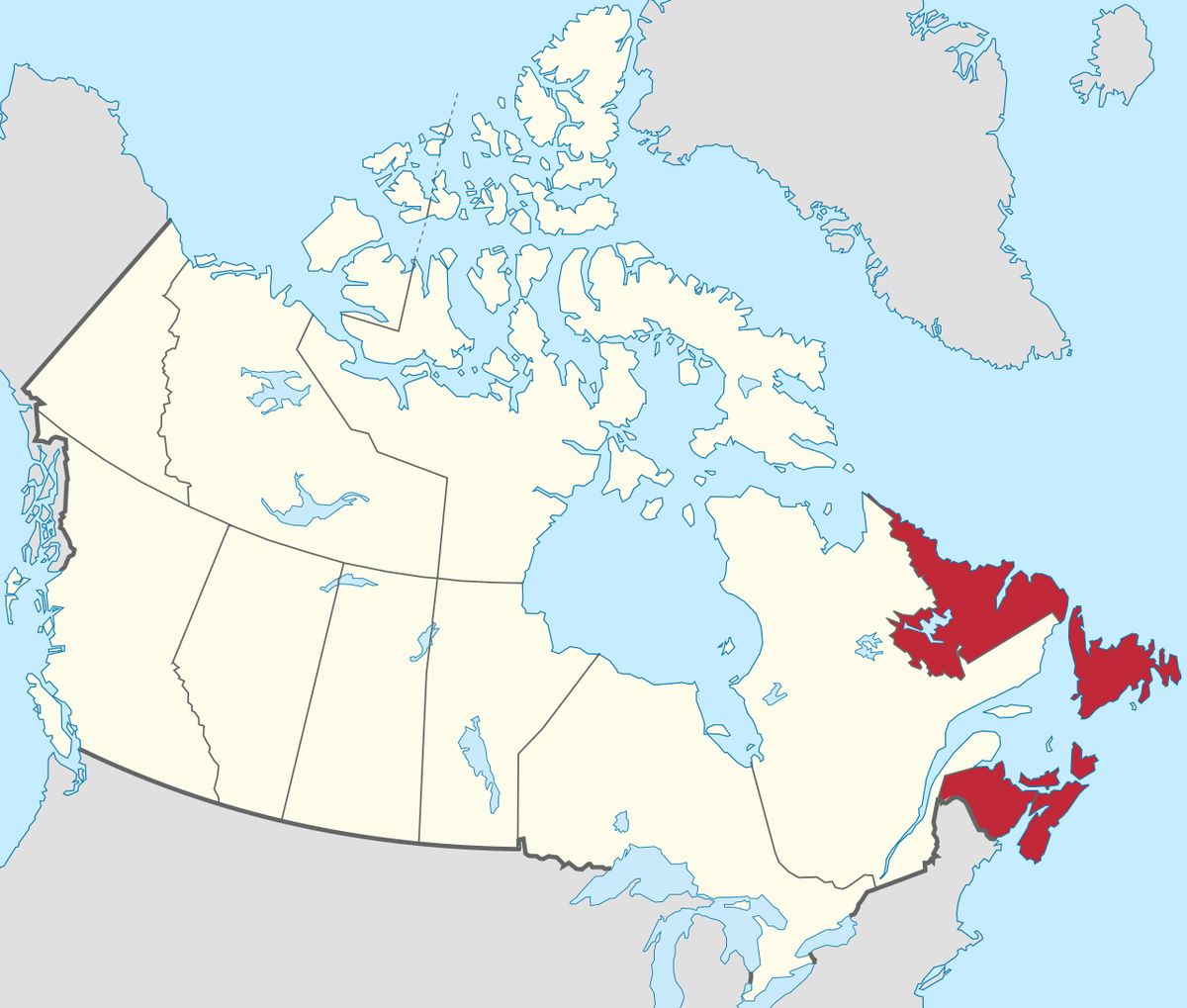
Long before European contact, Indigenous peoples established economic foundations through extensive trade networks. Goods such as furs, tools, and decorative items were transported thousands of kilometres, primarily via river and lake systems using canoes. The first major European economic activity was the Atlantic fishery, particularly on the Grand Banks off Newfoundland, where ships from France, Portugal, Spain, and Great Britain would fish seasonally. Southern European fishers salted their catch on board while northern fishers from Britain and France established drying stations on shore. These seasonal stations in areas like Newfoundland and Nova Scotia gradually became permanent settlements. This pattern marked the first sustained European economic presence in northern North America and set a precedent for resource extraction aimed at external markets.
Mercantilism and the Corporate Monopolies
The colonial economic development of New France was directed by the European policy of mercantilism, which aimed to extract maximum material benefit for the homeland with minimal imperial investment. This ideology was implemented through a series of royally chartered corporate trading monopolies. La Compagnie des Marchands operated from 1613 to 1621, followed by the Compagnie de Montmorency until 1627. The most significant of these early corporations was La Compagnie des Cent-Associés, created by King Louis XIII in 1627. This entity was later joined by the Communauté des habitants in 1643. These were the first corporations to operate in what is now Canada. Their exclusive control over trade, particularly in furs, established a centralized, corporate model of economic development that would influence later business structures.
The Staples Thesis and Core-Periphery Model
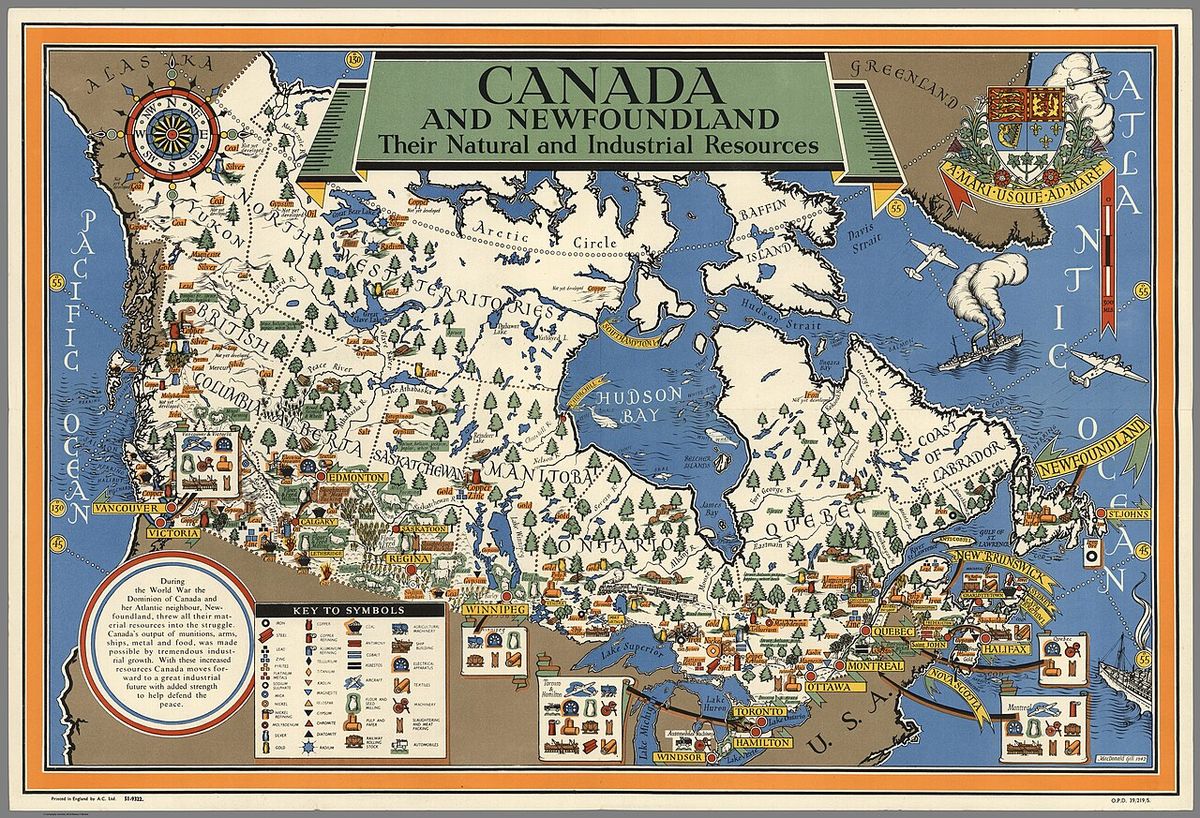
The dominant framework for understanding Canadian economic history is the staples thesis, developed in the 1920s and 1930s by Harold Innis of the University of Toronto and W.A. Mackintosh of Queen's University. They argued that the Canadian economy was historically built on the sequential export of staple commodities like fish, fur, timber, and wheat to Britain and its empire. Innis emphasized that the physical characteristics of each staple shaped the institutions and political culture of the regions that produced them. Cod fishing in Atlantic Canada fostered a decentralized, co-operative society while wheat farming on the Prairies encouraged independence. The fur trade in Central Canada, controlled by large firms like the Hudson's Bay Company, produced a more centralized, business-oriented society. Innis also developed the core-periphery, or heartland-hinterland, model to describe intra-Canadian relationships. The metropolitan core, dependent on staples from the hinterland, gained economic and political power by exploiting the resource-rich periphery. This model remains useful in analyzing British Columbia where metropolitan Vancouver functions as a corporate and transportation core dominating a staple-exporting hinterland.
The Fur Trade Era
European demand for beaver pelts used in hat making drove the fur trade. The trade was a partnership with Indigenous peoples who hunted the animals and traded pelts to Europeans for goods like guns, textiles, and metal tools. French voyageurs dominated the trade routes through New France and into the western interior. The English challenged this monopoly through the Hudson's Bay Company and its network of posts, which fostered fierce rivalry and conflict. A critical long-term effect of the fur trade was that it did not encourage widespread settlement, as it required only a small number of skilled workers. This kept the population of New France low, which became a strategic disadvantage. The colony's continued economic dependence on Europe also meant its inhabitants were largely unwilling to join the American Revolution, ensuring the remaining British territories stayed loyal to the Crown.
The Timber Trade and Settlement
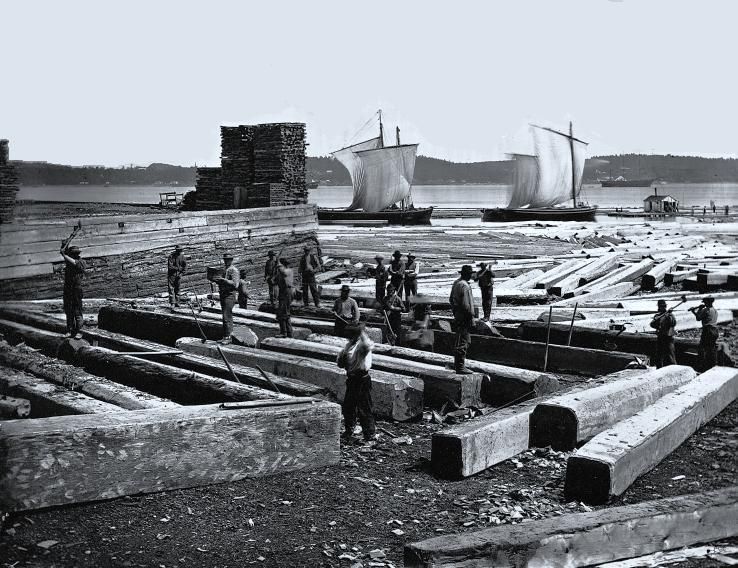
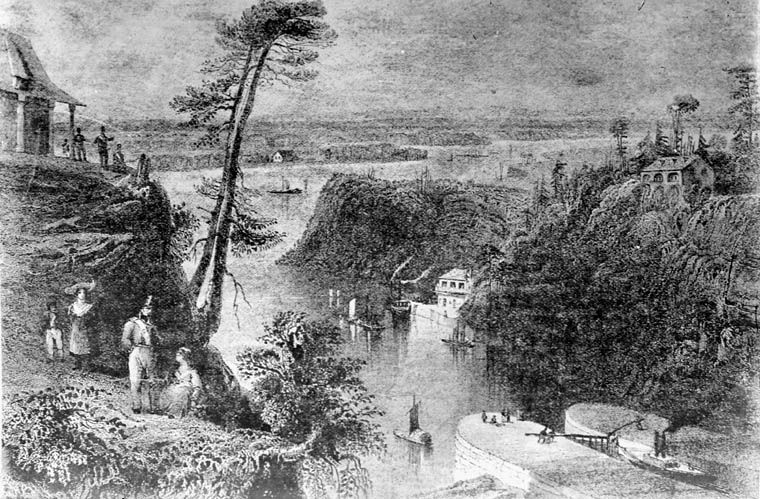
In the early nineteenth century, timber replaced fur as the dominant staple export, driven by Britain's depleted forests and the blockade of Baltic supplies during the Napoleonic Wars. The industry concentrated in three regions: the Saint John River system in New Brunswick, the St. Lawrence River around Quebec City, and the Ottawa River system, which by 1845 supplied three-quarters of the timber shipped from Quebec. The trade was massive, with 1200 ships loaded at Quebec City in a single summer. Timber was cut by crews in isolated camps, shaped into square timbers, and floated downstream in enormous rafts. The wealth generated funded institutions like the Bank of Montreal, founded in 1817. The timber trade had a major demographic impact by driving immigration.
- Timber ships returning to British North America had empty space, leading ship owners to carry immigrants cheaply.
- An average timber ship could carry about 200 passengers, leading to an unprecedented influx.
- At its peak in the 1840s, 15,000 Irish loggers were employed in the Gatineau region alone.
- The industry also spurred permanent agricultural settlement, as farmers followed the logging camps to supply them with food.
- This process formed the basis of many communities in what is now Ontario.
Transition to a National Economy
Following Confederation in 1867, Canada's separate regional economies began integrating into a single national unit. The construction of transcontinental railways between 1867 and 1915 was the primary catalyst, physically linking the provinces and territories. This integration meant that regional booms, such as wheat exports from the Prairies, could create nationwide prosperity, while slumps in Central Canadian manufacturing would ripple across the country. After 1945, highway and pipeline systems further strengthened these connections. By the 1980s, Canada had become a predominantly urban nation with a majority of workers in service industries. Income disparities had narrowed significantly since the mid-20th century. However, deep regional economic differences persisted, with manufacturing concentrated in Ontario and Quebec, the West continuing to generate large surpluses of natural resources, and the Atlantic provinces struggling with comparatively lower living standards. This led to the entrenched system of federal equalization payments.
Modern Context and Economic Resilience
Canada's modern economy continues to grapple with its historical legacy as a resource exporter while facing global trade tensions and seeking diversification. The economy demonstrated resilience in 2025, growing by 1.7 per cent. Labour markets remained strong with Canada adding nearly three times as many jobs per capita as the United States from the start of 2025. Wage growth outpaced inflation for over three consecutive years. A key factor in this resilience has been the Canada-United States-Mexico Agreement (CUSMA), which protected approximately 85 per cent of Canadian goods exports from recent U.S. trade measures. Forecasts for 2026 project growth of 1.1 per cent, with a pickup to 1.9 per cent expected in 2027. The International Monetary Fund anticipates Canada will post the second-fastest growth in the G7 over 2026 and 2027. However, challenges persist, including regional fragmentation, an affordability crisis, and the need to diversify trade and boost productivity.
| Year | Real GDP Growth | Key Context |
|---|---|---|
| 2025 | 1.7% | Avoided recession despite trade tensions. CUSMA protected 85% of goods exports. |
| 2026 (Projection) | 1.1% | Growth expected to pick up. |
| 2027 (Projection) | 1.9% | IMF expects Canada to have second-fastest growth in G7 over 2026 to 2027. |
Historiography and Evolving Interpretations
The study of Canadian economic history has been deeply shaped by the staples thesis, but the field has expanded considerably since the mid-20th century. Early work by Innis, Mackintosh, and historians like Donald Creighton focused on geography, resources, and foreign markets. Later scholars supplemented this approach with modern economics, statistics, and new areas of inquiry. Work in labour history, urban growth, business history, and the industrial development of central Canada addressed topics that fit poorly within the original staples framework. Historical geographers contributed detailed studies of settlement patterns and town growth. Debates continue, such as over the interpretation of the timber industry where historian Robert Gillis has noted operators' interest in conservation. The prevailing view, influenced by A.R.M. Lower's 1938 work, often portrays lumbermen as wasteful 'buccaneers' or 'robber barons' dedicated to laissez-faire exploitation, highlighting the field's ongoing reinterpretation.
Questions about Economic history of Canada
What is the staples thesis in Canadian economic history?
The staples thesis is the dominant school of thought in Canadian economic history, formulated by Harold Innis and W.A. Mackintosh. It argues that the Canadian economy was historically built on exporting raw staple commodities like fish, fur, timber, and wheat to Britain and its empire. This trading link cemented Canada's cultural ties to Britain. The search for these staples shaped regional institutions and societies, such as the cooperative cod fishing in Atlantic Canada, the independent wheat farming in the West, and the centralized fur trade in Central Canada.
What is the core-periphery model in Canadian economic history?
Also known as the heartland-hinterland model, this concept was developed by Harold Innis from the staples thesis. It describes the economic relationship between different regions within Canada. The core, or heartland, is the centre of corporate management, finance, and manufacturing, such as metropolitan Toronto or Montreal. The periphery, or hinterland, is the resource-rich region that produces staple commodities for export, like Northern Ontario or the Prairies. The model argues that the core gains economic and political power by exploiting the hinterland's resources. This framework is still used to analyze regional disparities.
How did the fur trade shape early Canada?
The fur trade was key to the development of the Canadian interior, driven by European demand for beaver pelts. It closely involved Indigenous peoples who hunted and traded pelts for European goods like guns and textiles. The trade was dominated first by French corporate monopolies and later by the English Hudson's Bay Company, fostering a centralized business society in Central Canada. Unlike agriculture, the fur trade did not encourage large scale settlement as it required few highly skilled workers. This economic dependence on Europe also contributed to Canada remaining loyal to Britain during the American Revolution.
Why was the timber trade so important in the 1800s?
The timber trade became British North America's most important export commodity in the early nineteenth century. Britain needed new timber sources after the Napoleonic Wars disrupted Baltic supplies. The industry was concentrated in New Brunswick, the St Lawrence River, and the Ottawa River system. It generated immense wealth, funding institutions like the Bank of Montreal. Crucially, timber ships carried cheap immigrant passengers on their return voyages, leading to a major influx of people. At its peak in the 1840s, 15,000 Irish loggers were employed in the Gatineau region alone. The trade also spurred permanent agricultural settlements as farmers followed to supply the lumber camps.
How did Canada's economy perform in 2025 and what is the outlook?
Canada's economy grew by 1.7 per cent in 2025, avoiding a recession despite trade tensions. Labour markets were strong, with wage growth outpacing inflation. The Canada-United States-Mexico Agreement (CUSMA) protected about 85 per cent of Canadian goods exports from U.S. trade measures. Forecasts project growth of 1.1 per cent in 2026, picking up to 1.9 per cent in 2027. The International Monetary Fund expects Canada to have the second-fastest growth in the G7 over the 2026 to 2027 period.
What were the first corporations to operate in Canada?
The first corporations to operate in what is now Canada were a series of royally chartered trading monopolies in New France. These included La Compagnie des Marchands (1613 to 1621), the Compagnie de Montmorency (1621 to 1627), and the most significant, La Compagnie des Cent-Associés, created in 1627. They were later joined by the Communauté des habitants in 1643. These corporations held exclusive control over trade, particularly in furs, under the mercantilist policies of the French crown.
Sources and further reading
- Economic history of Canada (Wikipedia)
- Economic History of Canada (thecanadianencyclopedia.ca)
Checked by the Nosy Mag desk. Last updated 2026-11-01.