Section 15 of the Canadian Charter of Rights and Freedoms
Section 15 of the Canadian Charter of Rights and Freedoms is the constitutional guarantee of equality rights for all individuals in Canada. It prohibits discrimination by governments on grounds including race, national or ethnic origin, colour, religion, sex, age, and mental or physical disability. The section came into force on April 17, 1985, three years after the rest of the Charter, to allow governments time to review and amend discriminatory laws. Through landmark court decisions, Section 15 has been a powerful tool for advancing substantive equality and has been central to the recognition of rights for LGBTQ+ people, women, and people with disabilities.
Text and Historical Background
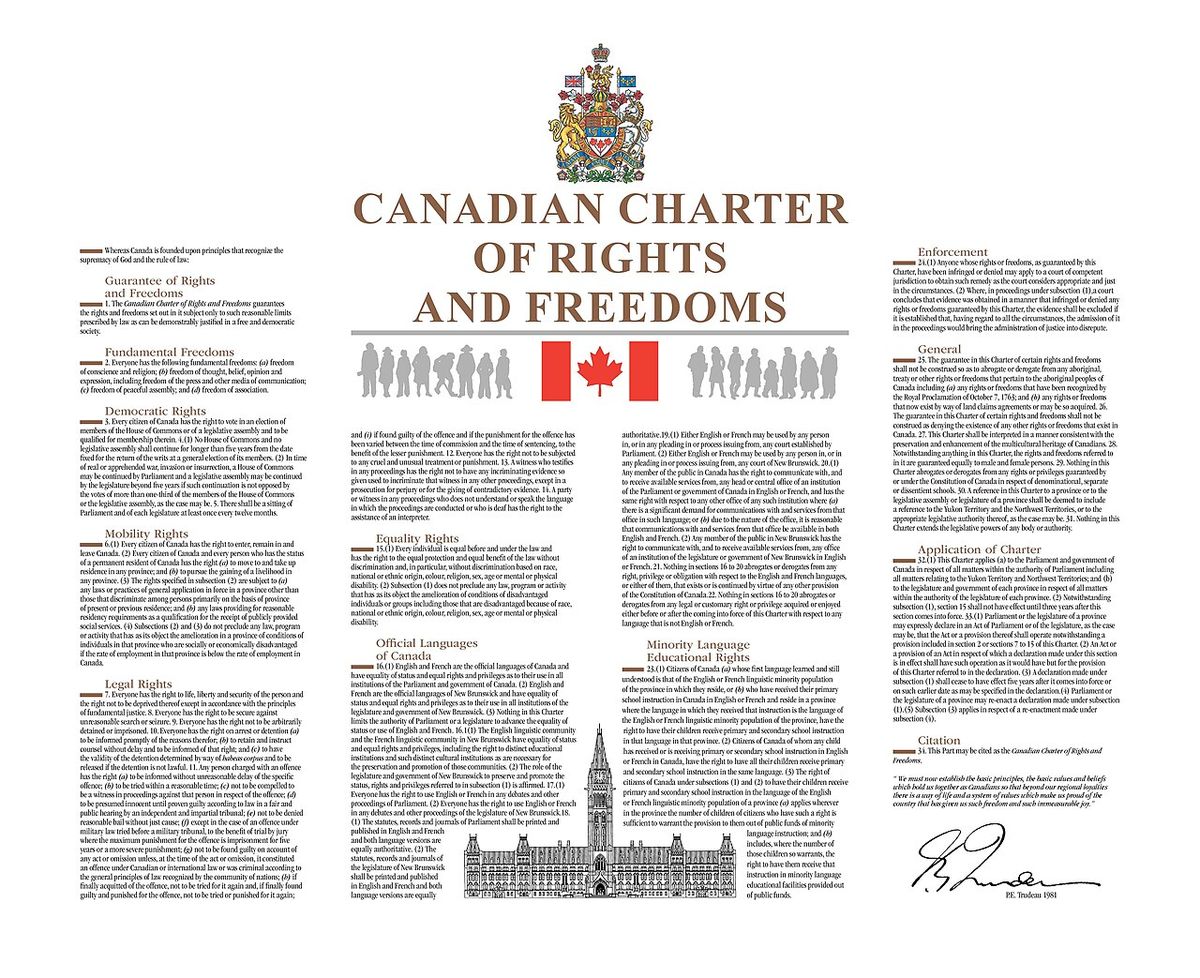
The full text of Section 15 contains two subsections that together define the scope of equality rights in Canada. Subsection 15(1) guarantees that every individual is equal before and under the law and has the right to equal protection and equal benefit of the law without discrimination. It specifically lists prohibited grounds of discrimination. Subsection 15(2) clarifies that the equality guarantee does not preclude laws or programs aimed at improving conditions for disadvantaged individuals or groups, such as employment equity initiatives. This provision explicitly protects affirmative action or ameliorative programs from being challenged as discriminatory.
The concept of legal equality in Canada predates the Charter. The Canadian Bill of Rights of 1960 included a guarantee of equality before the law and the protection of the law. The Supreme Court cases Attorney General of Canada v. Lavell (1974) and Bliss v. Canada (1979) interpreted this guarantee narrowly. These rulings held that the law only had to be applied equally, not that its substance or benefits had to be equal. This restrictive interpretation directly influenced the more expansive wording of Section 15, which explicitly includes equality under the law and equal benefit of the law to prevent such narrow readings.
Section 15 was part of the original Charter draft published in October 1980 but underwent significant changes before enactment. The draft version guaranteed rights to everyone, but the final text uses the term every individual to clarify that corporations and other legal persons cannot claim equality rights. Although the Charter itself came into effect on April 17, 1982, Section 15 was subject to a three-year delayed coming into force, as per section 32(2). This delay, until April 17, 1985, was intended to give federal and provincial governments time to audit their statutes and regulations for compliance with the new equality standard.
Purpose and Dimensions of Equality
The Supreme Court of Canada has articulated that the purpose of Section 15 is to prevent the violation of essential human dignity and freedom through the imposition of disadvantage, stereotyping, or prejudice. Its goal is to promote a society where all persons enjoy equal recognition at law as human beings equally deserving of concern, respect, and consideration. This purposive interpretation, established in cases like Law v. Canada (1999), moves beyond mere formal equality, which requires identical treatment, toward a model of substantive equality concerned with the real-world impact of laws. Substantive equality requires an examination of the full context of a case, including the law's real impact on the claimants and the group to which they belong.
Section 15 recognizes and protects four distinct but interrelated dimensions of legal equality. Equality before the law refers to equal treatment in the administration of justice, ensuring all individuals are subject to the same laws and procedures. Equality under the law concerns the substance of the law itself, requiring that the content of laws be fair and result in equal outcomes. Equal benefit of the law ensures that government-imposed benefits are distributed proportionately and without discrimination. Equal protection of the law guarantees that legal protections safeguard the human dignity of every person equally. Together, these dimensions aim to address both the application and the effects of legislation.
Grounds of Discrimination
Section 15 explicitly lists nine prohibited grounds of discrimination: race, national or ethnic origin, colour, religion, sex, age, and mental or physical disability. The phrase in particular within the text indicates this list is not exhaustive. The courts have developed the concept of analogous grounds, which are personal characteristics considered immutable or changeable only at excessive cost, making discrimination on such bases unconstitutional. A claimant must demonstrate that a distinction was made based on an enumerated or analogous ground to trigger Section 15 protection. The Supreme Court has recognized several analogous grounds since the landmark 1989 case Andrews v. Law Society of British Columbia.
- Sexual orientation, established in cases like Egan v. Canada (1995) and Vriend v. Alberta (1998).
- Marital status, recognized in Miron v. Trudel (1995).
- Citizenship status, affirmed in Andrews v. Law Society of British Columbia (1989).
- Aboriginality-residence (off-reserve status), recognized in Corbiere v. Canada (1999).
- Income, accepted as an analogous ground in Dartmouth/Halifax County Regional Housing Authority v. Sparks (1993).
Not all proposed grounds have been accepted by the courts as analogous grounds under Section 15. Characteristics that have been rejected include having a taste for marijuana, general employment status, and being a litigant against the Crown. Other rejected grounds are province of residence, membership in the military, and being a new resident of a province. The courts have also rejected begging and extreme poverty as analogous grounds. The determination of a new analogous ground requires a rigorous demonstration that discrimination based on that personal characteristic violates the core purpose of Section 15.
Legal Test and Interpretation
The framework for analyzing a potential violation of Section 15(1) has evolved through Supreme Court jurisprudence. The current test was solidified in the 2015 case Kahkewistahaw First Nation v. Taypotat. This two-part test asks first whether the law creates a distinction based on an enumerated or analogous ground. The second part asks whether the distinction creates a disadvantage by perpetuating prejudice or stereotyping. This framework replaced an earlier, more complex test from Law v. Canada (1999) that focused on whether a law violated human dignity, which was criticized as being too vague and subjective. The burden of proof in a Section 15 challenge always rests with the claimant.
The courts undertake a contextual analysis, examining the full social, political, and legal reality of the claimant's situation. The analysis considers factors such as pre-existing disadvantage experienced by the group, the correspondence between the ground of discrimination and the claimant's actual circumstances, and the nature of the interest affected by the law. The Supreme Court has clarified that Section 15 does not impose a positive obligation on governments to act to remedy societal inequalities. However, when a government does choose to act, whether through law, policy, or program, it must do so in a non-discriminatory manner.
Section 15(2) provides a crucial defence for governments. It states that subsection (1) does not preclude laws, programs, or activities designed to ameliorate conditions of disadvantaged individuals or groups. This means affirmative action programs, such as employment equity or targeted social benefits, are constitutionally protected from challenges that they constitute reverse discrimination. The Supreme Court affirmed this in R. v. Kapp (2008), noting that such programs are not only permitted but are a necessary part of the Charter's equality project.
Landmark Cases and Impact
The interpretation of Section 15 has been shaped by numerous landmark Supreme Court decisions that have expanded the understanding of equality in Canadian law. Andrews v. Law Society of British Columbia (1989) was the Court's first Section 15 case and established the foundational concepts of enumerated and analogous grounds, moving Canadian jurisprudence firmly toward substantive equality. Section 15 has been instrumental in securing rights for LGBTQ+ Canadians and addressing discrimination against other groups.
- Egan v. Canada (1995): Recognized sexual orientation as an analogous ground.
- Vriend v. Alberta (1998): Held that omitting sexual orientation from human rights law violated Section 15.
- Corbiere v. Canada (1999): Found denying off-reserve band members the vote violated Section 15.
- Brooks v. Canada Safeway Ltd. (1989): Ruled pregnancy discrimination is sex discrimination.
- Halpern v. Canada (Attorney General) (2003): Ontario Court of Appeal used Section 15 to legalize same-sex marriage.
- Law v. Canada (1999): Articulated the purpose of Section 15 and an early legal test.
- R. v. Kapp (2008): Reaffirmed the constitutionality of affirmative action under Section 15(2).
- M. v. H. (1999): Extended spousal support obligations to same-sex couples.
- Little Sisters Book and Art Emporium v. Canada (2000): Found customs censorship targeting gay and lesbian materials was discriminatory.
These decisions demonstrate the section's role in challenging systemic barriers and promoting inclusion across Canadian society. The reasoning in the sexual orientation cases led provincial courts to find laws against same-sex marriage in Canada would be unconstitutional. For example, in Halpern v. Canada (Attorney General) in 2003, the Court of Appeal for Ontario used Section 15 to legalize same-sex marriage in Ontario. This created momentum for broader legal change across the country. The section has been a significant source of LGBT rights in Canada through its jurisprudence.
Enforcement and the Court Challenges Program
Section 15 is enforced through litigation in the courts, primarily using the remedies available under sections 24 and 52 of the Constitution Act, 1982. Such constitutional litigation can be prohibitively expensive for individuals and advocacy groups. To address this barrier, the federal government expanded the Court Challenges Program in 1985, the same year Section 15 came into force, to fund important test cases challenging federal laws under the Charter's equality rights provisions. The program has been critical in enabling landmark cases that have defined the scope of Section 15.
The program's funding and existence have fluctuated with changes in government. In September 2006, the federal Conservative government announced the cancellation of the Court Challenges Program. This left a significant gap in access to justice for equality-seeking groups for nearly a decade. In 2016, the newly elected Liberal government restored the program, committing $5 million in annual funding to support Charter challenges, particularly those related to official language and equality rights. The restoration of the program has been hailed as a vital support for the continued enforcement and evolution of Section 15 rights.
International Context
Canada's equality rights under Section 15 exist within a broader framework of international human rights law. Canada is a party to several binding international treaties that contain similar non-discrimination provisions. These include Article 26 of the International Covenant on Civil and Political Rights, the Convention on the Elimination of All Forms of Discrimination Against Women, the International Convention on the Elimination of All Forms of Racial Discrimination, and the Convention on the Rights of Persons with Disabilities. While these international instruments do not directly form part of Canadian domestic law, Canadian courts often reference them as persuasive sources when interpreting Charter rights. The principles in Section 15 also find parallels in other democratic constitutions and regional human rights systems.
For example, the Equal Protection Clause of the Fourteenth Amendment to the United States Constitution has influenced Canadian legal thought, though the Canadian approach to substantive equality has developed distinct characteristics. Similarly, Article 14 of the European Convention on Human Rights provides a comparative framework. The Supreme Court of Canada has noted that the Charter's equality guarantee should be interpreted in a manner consistent with Canada's international human rights obligations, ensuring that Canadian law remains aligned with global standards of dignity and non-discrimination. This international context shows the universal values that support the domestic protections found in Section 15 of the Charter.
Questions about Section 15 of the Canadian Charter of Rights and Freedoms
What is the difference between Section 15(1) and Section 15(2) of the Charter?
Section 15(1) is the primary equality guarantee, stating that every individual has the right to equal treatment before, under, and by the law without discrimination based on listed grounds like race, sex, or disability. Section 15(2) is an explanatory clause that protects affirmative action programs. It clarifies that subsection (1) does not prevent governments from creating laws or programs designed to improve conditions for disadvantaged individuals or groups. This means initiatives like employment equity for women or targeted benefits for Indigenous communities are constitutionally permitted and cannot be successfully challenged as discriminatory under Section 15(1).
Can corporations claim equality rights under Section 15?
No, corporations and other legal persons generally cannot claim equality rights under Section 15. The section specifically guarantees rights to every individual, which the courts have interpreted to mean natural persons. This wording was a deliberate choice during the drafting of the Charter to exclude corporations, contrasting with other Charter sections that use the term everyone. The Supreme Court has affirmed this interpretation in cases like Canada (Attorney General) v. Hislop (2007), which dealt with the estates of deceased individuals, reinforcing that Section 15 is fundamentally about protecting the human dignity of natural persons.
How did Section 15 contribute to the legalization of same-sex marriage in Canada?
Section 15 was the constitutional foundation for court rulings that ultimately led to the nationwide legalization of same-sex marriage. After the Supreme Court recognized sexual orientation as an analogous ground in Egan v. Canada (1995), lower courts applied Section 15 to marriage laws. In the landmark case Halpern v. Canada (Attorney General) in 2003, the Ontario Court of Appeal ruled that the common law definition of marriage as between one man and one woman violated Section 15 and was unconstitutional. This decision legalized same-sex marriage in Ontario, creating pressure for a uniform national law. The federal government later passed legislation to legalize same-sex marriage across Canada.
What is the difference between formal equality and substantive equality under Section 15?
Formal equality is the idea that laws should treat everyone the same way, focusing on identical treatment. This was the approach under the old Canadian Bill of Rights. Substantive equality, which Section 15 guarantees, looks at the actual impact of laws on different groups. It recognizes that treating everyone identically can sometimes perpetuate disadvantage. For example, a law that provides no sign language interpreters in hospitals treats deaf and hearing patients the same formally, but substantively denies deaf patients equal benefit of healthcare. The Supreme Court has consistently held that Section 15 requires a substantive equality analysis, considering the real-world context and effects of government action to achieve true equality of outcome.
What are analogous grounds, and what are some examples?
Analogous grounds are personal characteristics, not explicitly listed in Section 15, that are considered immutable or changeable only at great personal cost. Discrimination based on these grounds is unconstitutional under Section 15. The Supreme Court determines a new analogous ground by assessing whether the characteristic is a fundamental part of a person's identity or dignity. Key examples recognized by the Court include sexual orientation, established in Egan v. Canada (1995). Marital status, recognized in Miron v. Trudel (1995). Citizenship status, affirmed in the 1989 Andrews case. And Aboriginality-residence (off-reserve status), recognized in Corbiere v. Canada (1999). The recognition of analogous grounds allows Section 15 to evolve and address new forms of discrimination not foreseen in 1982.
What is the Court Challenges Program and why is it important for Section 15?
The Court Challenges Program is a federal government initiative that provides funding for test cases of national significance that challenge laws under the equality and language rights provisions of the Charter. It was expanded in 1985 to help individuals and groups cover the high costs of constitutional litigation. The program has been crucial for advancing Section 15 jurisprudence by enabling cases that might otherwise not be brought due to financial barriers. After being cancelled in 2006, the program was restored in 2016 with an annual funding commitment of $5 million. Its existence ensures that the promise of Section 15 is accessible not just in theory but in practice, allowing marginalized communities to seek justice and shape the law.
Sources and further reading
- Section 15 of the Canadian Charter of Rights and Freedoms (Wikipedia)
- Charterpedia, Section 15, Equality rights (justice.gc.ca)
- Equality Rights (constitutionalstudies.ca)
- Section 15 of Canadian Charter of Rights and Freedoms ... (lawsociety.sk.ca)
Checked by the Nosy Mag desk. Last updated 2026-11-02.