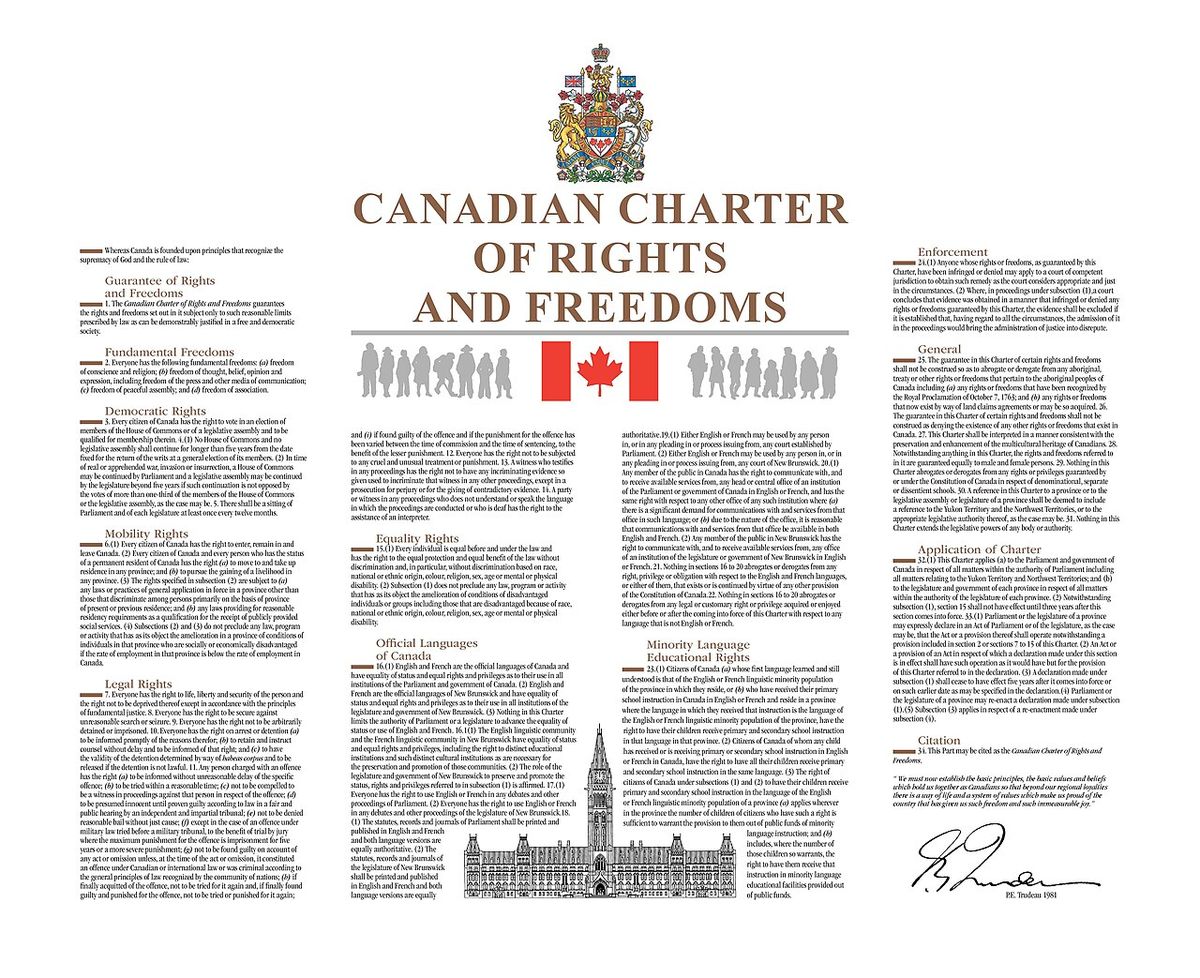
Section 10 of the Canadian Charter of Rights and Freedoms
Section 10 of the Canadian Charter of Rights and Freedoms specifies rights upon arrest or detention. It guarantees three specific rights: to be informed promptly of the reasons for the arrest or detention, to retain and instruct counsel without delay and to be informed of that right, and to have the detention's validity determined by way of habeas corpus and to be released if it is not lawful. This section is a part of the Charter's legal rights. Its application has been the subject of extensive litigation, shaping police procedure and the rights of the accused across the country.
Text and Scope of Section 10
The full text of section 10 guarantees everyone the right on arrest or detention to be informed promptly of the reasons, to retain and instruct counsel without delay and to be informed of that right, and to have the validity of the detention determined by way of habeas corpus and to be released if it is not lawful. These rights form a critical part of the Charter's legal rights category. The rights under section 10 are subject to reasonable limits under section 1 as established by the Oakes test. The section is a direct constitutional entrenchment of rights that were previously found, in more limited form, in the statutory Canadian Bill of Rights of 1960. Section 10 is only triggered if a person is arrested or detained. The Charter is part of the Constitution Act, 1982, which was enacted as a schedule to the Canada Act 1982.
Defining Arrest and Detention
The application of section 10 hinges on whether a person has been arrested or detained. An arrest occurs with the actual seizure or touching of a person's body with a view to detention, or when an officer states words of arrest and the individual submits. Detention is a broader concept. The Supreme Court of Canada in R v Grant defined detention as a suspension of an individual's liberty interest by a significant physical or psychological restraint. Psychological detention is established either where the individual has a legal obligation to comply, such as at a traffic stop, or where a reasonable person in the individual's circumstances would conclude they had no choice but to comply with state conduct. To determine if a psychological detention has occurred in the absence of physical restraint or legal obligation, courts consider a non-exhaustive list of factors. These factors include the circumstances giving rise to the encounter as would reasonably be perceived by the individual, such as whether police were providing general assistance or singling the person out for focused investigation. The nature of the police conduct is also examined, including the language used, physical contact, the place of interaction, the presence of others, and the duration of the encounter. Finally, the particular characteristics of the individual, such as age, physical stature, minority status, and level of sophistication, are considered where relevant.
The Right to be Informed of Reasons
Section 10(a) guarantees the right to be informed promptly of the reasons for an arrest or detention. This requirement ensures an individual is not obligated to submit to an arrest without understanding why and allows the person to make meaningful choices about exercising other rights, such as the right to counsel. The information must be provided in ordinary, plain language. The Supreme Court clarified the application of this right in the case of R. v. Latimer in 1997. Robert Latimer argued that because police told him he was being detained in connection with his daughter's death but did not use the word arrest, his section 10(a) right was infringed. The Court rejected this argument, finding that section 10(a) was not infringed. It ruled that the specific words used are not determinative. Instead, what matters is whether, in all the circumstances, the suspect could reasonably understand the gravity of the situation. In Latimer's case, the Court found he could be expected to understand the seriousness since he was explicitly told he was being detained in connection with his daughter's death, the police said the situation was serious, and he was informed of rights one has when arrested.
The Right to Retain and Instruct Counsel
Section 10(b) contains the right to counsel, which includes two distinct components: the right to retain and instruct counsel without delay, and the right to be informed of that right. This dual guarantee was a significant development from the earlier Canadian Bill of Rights. In the 1978 Bill of Rights case Hogan v. The Queen, the Supreme Court had found no right to be informed of the right to a lawyer. Section 10(b) of the Charter overrules that precedent. The courts have interpreted this right broadly to ensure it is meaningful. For example, the right applies even if a person with a low IQ initially declines to see a lawyer, as they may not have understood the right or its importance. The Supreme Court has further elaborated on the duties this right imposes on the state. In R. v. Bartle (1994), the Court ruled that the duty to inform a detained person of their right to counsel includes informing them of the availability of duty counsel and how to access it, such as through a free telephone call. The right has also been interpreted to include a right to legal aid in certain circumstances. The implementation requires police to cease questioning until the detainee has had a reasonable opportunity to consult with a lawyer.
- The right to be informed of the right to counsel.
- The right to be informed of the availability of duty counsel (R. v. Bartle, 1994).
- The right to a reasonable opportunity to consult with counsel before questioning.
- The right to legal aid in appropriate circumstances.
- Special protections for vulnerable detainees, such as those with low cognitive ability.
- The right to choose one's own lawyer, subject to availability.
- The right to confidentiality in communications with counsel.
The Right to Habeas Corpus
Section 10(c) guarantees the right to have the validity of a detention determined by way of habeas corpus and to be released if the detention is not lawful. Habeas corpus is an ancient common law writ that allows a person who is detained to challenge the legality of that detention before a court. The inclusion of this right in the Charter constitutionally entrenches this vital safeguard against unlawful imprisonment. The remedy is a swift and direct procedure where the detaining authority must justify the legal basis for holding the individual. If the court finds the detention is unlawful, it must order the person's immediate release. This right serves as a crucial check on state power, ensuring that no one is held arbitrarily or without proper legal authority. The writ of habeas corpus has its origins in English law and was a key legal instrument for protecting individual liberty long before the Charter.
Drafting History and Legal Context
The rights in section 10 exist within a broader framework of Charter protections. They are categorized as legal rights, which also include protections against unreasonable search and seizure (section 8), arbitrary detention (section 9), and cruel and unusual treatment (section 12). These rights collectively ensure fair treatment within the justice system. All rights in the Charter, including those in section 10, are subject to the reasonable limits clause in section 1, which allows the government to justify infringements if they are prescribed by law and demonstrably justified in a free and democratic society as determined by the Oakes test. The Charter itself is part of Canada's supreme law, and it applies to government actions. This means section 10 rights are primarily invoked against state actors like police officers and other authorities. The Charter generally does not apply to disputes between private individuals or businesses. The rights under section 10 have spawned considerable litigation since 1982, leading to a rich body of case law that clarifies their scope and application in countless real-world scenarios.
Comparison with Pre-Charter Rights
The legal landscape before the Charter's enactment in 1982 provided a useful comparison for understanding the significance of section 10. The primary precursor was the Canadian Bill of Rights, a federal statute enacted in 1960. While the Bill of Rights contained a right to counsel, it was interpreted narrowly by the courts. As noted, the Supreme Court in Hogan v. The Queen (1978) held that the Bill of Rights did not include a right to be informed of the right to counsel. Section 10(b) of the Charter explicitly created this new duty. The Bill of Rights was a statute that could be amended by a simple act of Parliament and did not apply to provincial laws. Another key difference is the remedy for violation. Under the Bill of Rights, courts could only refuse to apply a law that violated its provisions. Under the Charter, courts can grant remedies including the exclusion of evidence, which is a more powerful tool for enforcing rights.
| Feature | Canadian Bill of Rights (1960) | Charter Section 10 (1982) |
|---|---|---|
| Legal Status | Federal Statute | Constitutional Law |
| Application | Federal laws only | All government laws & actions |
| Right to Counsel | Recognized | Recognized and expanded |
| Right to be Informed of Counsel | Not recognized (Hogan, 1978) | Explicitly guaranteed |
| Remedy for Violation | Statutory interpretation | Constitutional remedy, potential exclusion of evidence |
| Habeas Corpus | Not explicitly mentioned | Explicitly guaranteed in section 10(c) |
| Right to be Informed of Reasons | Not explicitly mentioned | Explicitly guaranteed in section 10(a) |
Questions about Section 10 of the Canadian Charter of Rights and Freedoms
When do my Section 10 rights begin?
Your rights under section 10 begin at the moment you are arrested or detained. Arrest involves physical seizure or a statement of arrest followed by submission. Detention is broader and includes situations where you are physically restrained or where a reasonable person in your situation would believe they are not free to leave due to psychological pressure from state authorities, such as a police officer. A common example of a detention that triggers section 10 is a traffic stop, where you have a legal obligation to comply.
What is the difference between arrest and detention under Section 10?
Arrest is a specific type of detention involving the actual seizure or touching of a person with a view to detention, or the pronouncement of words of arrest. Detention is a wider concept defined by the Supreme Court as a suspension of liberty by significant physical or psychological restraint. Psychological detention occurs either where the law requires compliance with a police demand or where a reasonable person would feel they have no choice but to comply. Both arrest and detention trigger the full suite of section 10 rights.
Do I have the right to a free lawyer under Section 10?
Section 10(b) guarantees the right to retain and instruct counsel without delay. This includes the right to be informed of the availability of duty counsel, which is free, immediate legal advice available 24 hours a day. The Supreme Court ruled in R. v. Bartle (1994) that police must inform detained persons about duty counsel and how to access it, such as through a free telephone call. If you cannot afford a lawyer, you may also have the right to legal aid, depending on your circumstances and the nature of the charges.
What happens if police violate my Section 10 rights?
If a court finds that your section 10 rights were violated, it can grant a remedy under section 24(1) of the Charter. A common remedy in criminal cases is the exclusion of evidence obtained as a result of the violation. For example, this could include a statement made to police before you were properly informed of your right to counsel. The exclusion of such key evidence can sometimes lead to charges being stayed or dismissed by the court.
What does Section 10 of the Charter do?
Section 10 of the Canadian Charter of Rights and Freedoms specifies rights upon arrest or detention. It guarantees three specific rights to everyone who is arrested or detained. First, it provides the right to be informed promptly of the reasons for the arrest or detention. Second, it guarantees the right to retain and instruct counsel without delay and to be informed of that right. Third, it provides the right to have the validity of the detention determined by way of habeas corpus and to be released if the detention is not lawful.
Can the government limit Section 10 rights?
Yes, the rights in section 10 may be limited. As a part of a broader range of legal rights guaranteed by the Charter, section 10 rights are subject to the Oakes test under section 1. This test allows for reasonable limits prescribed by law that can be demonstrably justified in a free and democratic society. The notwithstanding clause allows Parliament or a provincial legislature to expressly declare that an act shall operate notwithstanding a provision in section 2 or sections 7 to 15 of the Charter. Such a declaration is effective for a maximum of five years but can be reenacted.
Sources and further reading
- Section 10 of the Canadian Charter of Rights and Freedoms (Wikipedia)
- The rights and freedoms the Charter protects (justice.gc.ca)
- REPORT: Rights Upon Arrest or Detention, Section 10 of ... (primarydocuments.ca)
- What is Section 10 of the Charter? | Edmonton Criminal ... (criminalappeals.net)
Checked by the Nosy Mag desk. Last updated 2026-11-02.