Postage stamps and postal history of Canada
The postage stamps and postal history of Canada chronicle the nation's development from colonial origins to modern identity. The story begins with the earliest postal services in the 18th century and includes the distinctive stamps issued by separate colonies before Confederation. Since 1867, Canadian stamps have evolved from portraits of monarchs to commemorative designs celebrating the country's culture, achievements, and diversity. Today, Canada Post's annual stamp program continues to reflect and honour the people, events, and values that shape the country.
Early Postal Services and Colonial Stamps
The foundations of Canada's postal system were laid long before the first adhesive stamp was issued. The earliest known letter sent from North America was written by John Rut from St. John's, Newfoundland, to King Henry VIII on August 3, 1527. Under French control, a courier service for official dispatches began in 1705, with a regular postal route between Montreal and Quebec established in 1734. After British control began in 1763, a civilian postal network expanded, with postmarks introduced in 1764. The colonial era of stamp issuance began after the Province of Canada resolved to adopt postage stamps on May 25, 1849. Each colony operated its own postal administration and issued its own stamps until joining Confederation, after which they ceased production. The Province of Canada led the way, issuing its first stamps on April 23, 1851.
The first stamp was the Three-Penny Beaver, designed by Sir Sandford Fleming, notable for being the first official postage stamp anywhere to feature an animal instead of a monarch. It was printed alongside a 6d stamp portraying Prince Albert and a 12d stamp of Queen Victoria. These early issues were imperforate and printed on laid paper, which was soon replaced with wove paper for better adhesion. Between 1852 and 1857, new denominations were introduced, including a 10d stamp featuring explorer Jacques Cartier. The Province of Canada switched to a decimal currency system in 1859, necessitating a new series of stamps printed by the American Bank Note Company of New York, which remained in use until Confederation.
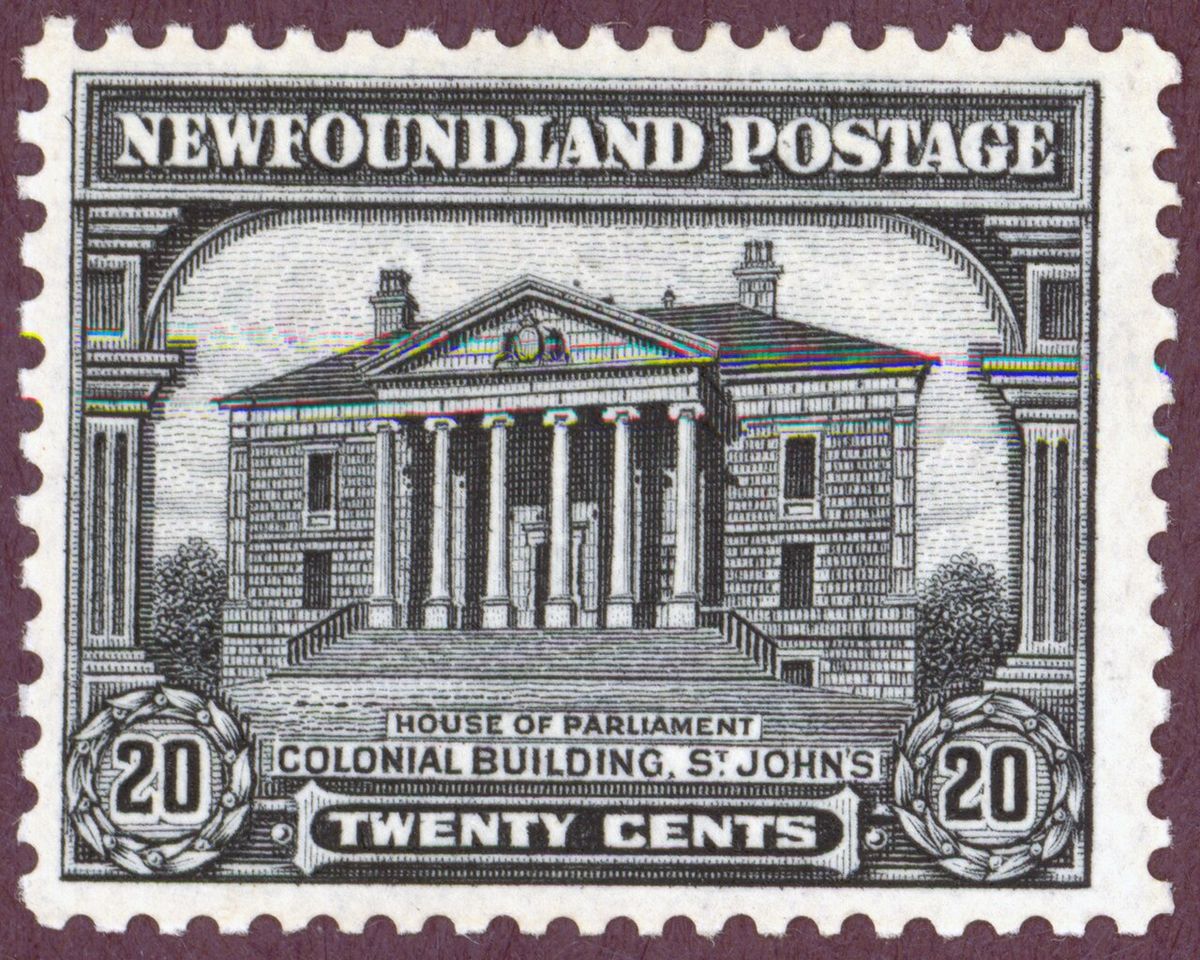
Other colonies developed their own philatelic identities during this period. New Brunswick issued its first diamond-shaped stamps bearing the colony's coat of arms in 1851. Newfoundland began its 90 year history of stamp issuance in 1857, with its final pre Confederation issue in 1947. Nova Scotia issued stamps in pence from 1851 to 1857, followed by a decimal series. British Columbia and Vancouver Island issued joint stamps in 1860 before merging and issuing stamps as a united colony. Prince Edward Island issued stamps in pence from 1862 and in cents in 1872, liquidating its remaining stock at a discount after joining Canada in 1873.
The First Decades of Dominion: Victorian to Edwardian Eras
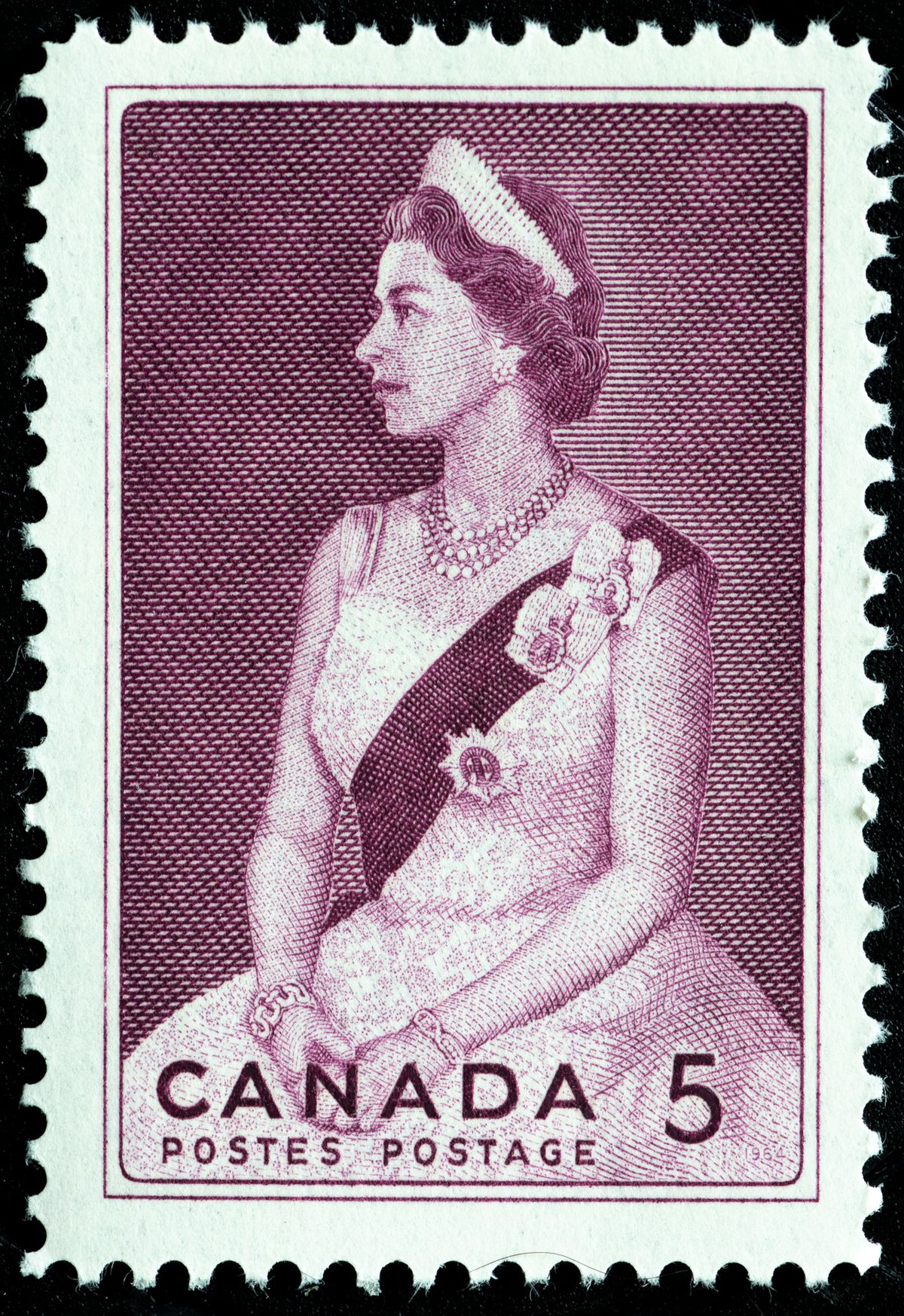
Following Confederation on July 1, 1867, the new Dominion of Canada issued its first unified stamp series on April 1, 1868, known as the Large Queens. These stamps featured a profile of Queen Victoria, based on an engraving by Charles Henry Jeens, and replaced all previous colonial issues. The Large Queens ranged in value from a half cent to 15 cents and were mostly printed on wove paper, though a few rare examples exist on laid paper. They were soon succeeded in 1870 by the Small Queens, a smaller version of the same design that allowed for faster production. The American Bank Note Company secured the contract to print Canadian stamps in 1897, a partnership that lasted until 1923. Their first assignment was the 1897 Diamond Jubilee series, Canada's first commemorative stamps, celebrating Queen Victoria's 60th year on the throne and the 30th anniversary of Confederation.
The late Victorian period saw several notable stamp issues. The 1897 Maple Leaf issue featured a portrait of Victoria surrounded by maple leaves, though the design was quickly modified to include Arabic numerals for clarity. In 1898, Canada participated in the Imperial Penny Postage initiative, issuing a striking two colour stamp for Christmas that depicted a world map with British possessions in red. The stamp bore the inscription WE HOLD A VASTER EMPIRE THAN HAS BEEN. Upon the accession of King Edward VII, new definitive stamps updated the maple leaf design with his portrait, first issued in 1903. A commemorative stamp for the 1908 Quebec Tercentenary featured Edward VII and Queen Alexandra, and this era also saw Canada's first experiments with coil stamps.
Twentieth Century Definitive and Commemorative Issues
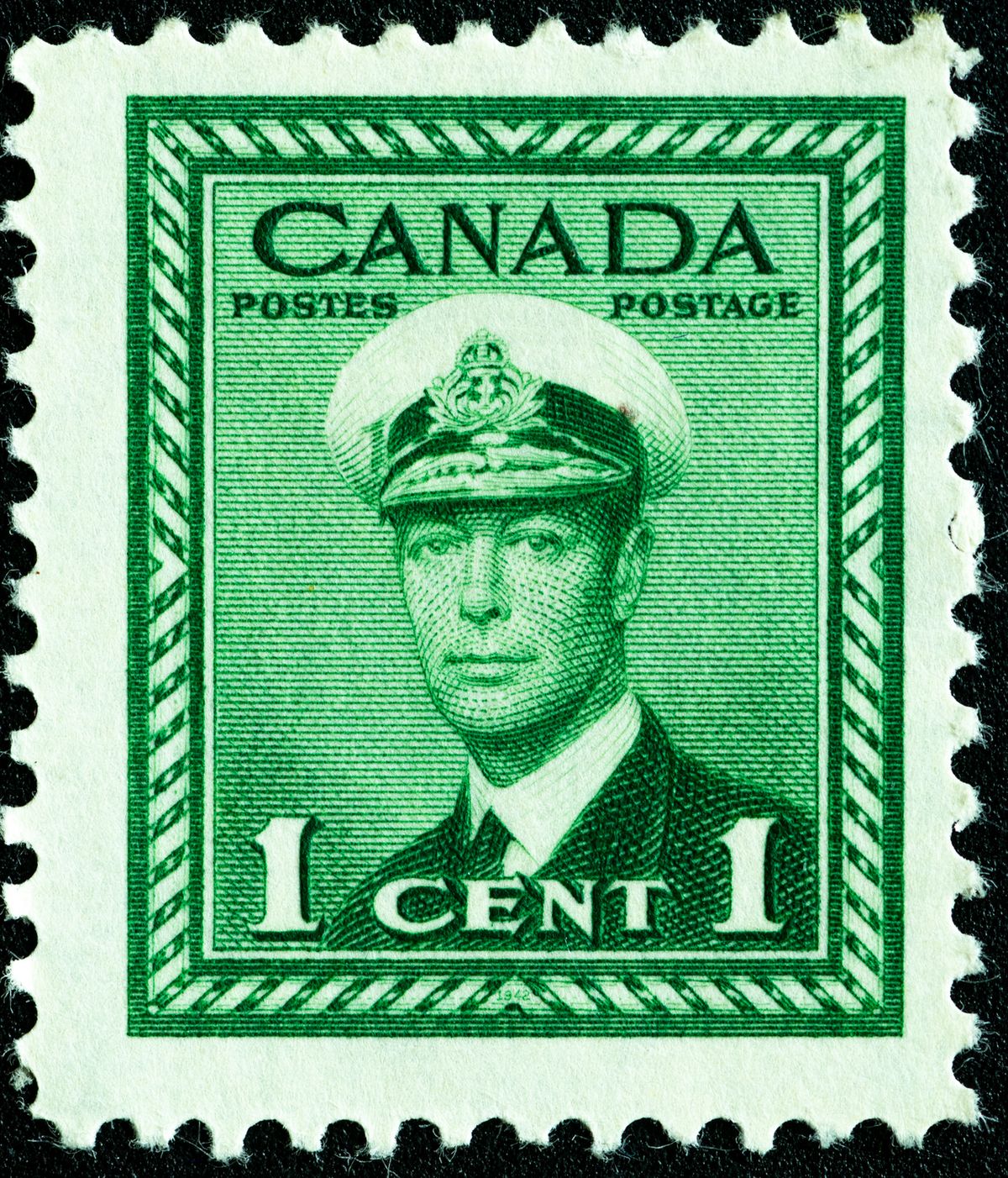
The reign of King George V brought a period of admired stamp design. The 1911 issue depicted him as Admiral of the Fleet, a design that remained in use for 17 years. The 1928 Scroll Issue was a landmark as Canada's first bilingual stamp series, with the country's name appearing in a scroll across the top. This issue included celebrated pictorial stamps, most notably the 50 cent Bluenose stamp portraying the legendary schooner. The elegant Arch Issue followed in 1930, and the Dated Die Issue of 1935 incorporated the year into the design. No stamps were issued for Edward VIII due to his abdication. For King George VI, the dated die concept was used again in 1937. The 1942 War Issue highlighted Canada's military and industrial contributions, depicting the King in service uniforms and scenes of production like a Ram tank.
The postwar era began with the 1946 Peace Issue, presenting Canadian scenes and economic activities. The reign of Queen Elizabeth II commenced with a 1953 definitive series based on a portrait by photographer Yusuf Karsh. This was replaced in 1954 by a design using Dorothy Wilding's portrait, during which the post office began experimenting with fluorescent papers and inks. The Cameo series, a horizontal design by Ernst Roch, was introduced in 1962. From the 1960s onward, Canada Post policy favoured issuing a large number of single commemorative stamps at the prevailing first class rate. Definitive series often combined thematic designs, such as native wildlife for lower values and Canadian architecture for dollar values in the late 1980s. A notable definitive stamp in 2003 featured a portrait of Queen Elizabeth II taken by musician Bryan Adams.
Modern Stamp Programs and Cultural Reflection
Canada's contemporary stamp program is a dynamic reflection of the nation's diversity, history, and current events. The issuance of commemorative stamps has become a regular and planned event, with annual programs announcing themes well in advance. The program consistently includes stamps for major holidays, cultural celebrations, and acknowledgments of historical milestones. Recent years have seen a strong emphasis on honouring Indigenous history and culture, with stamps dedicated to the National Day for Truth and Reconciliation and Orange Shirt Day. The 2026 stamp program, for example, includes issues for Black History Month, Pride, Remembrance Day, and various religious holidays like Eid and Diwali. This approach ensures stamps act as a public canvas for national conversation and celebration.
The subjects of modern commemoratives are wide ranging. They have celebrated Canadian achievements in sports, science, and the arts, and honoured notable citizens from all walks of life. A key policy has been the extensive use of works by well known artists for stamp designs, while historically avoiding images of living people, though this has seen exceptions in recent years. The 2026 Black History Month issue honouring Canadian hip hop pioneers like Maestro Fresh Wes and Michie Mee is a prime example of stamps capturing contemporary cultural movements. Canada Post also issues semi postal stamps where a portion of the proceeds supports charitable foundations. The design process involves graphic designers and photographers, with stamps produced using techniques like offset printing and sometimes incorporating special effects like fluorescent ink.
- Black History Month stamps began in 2009, featuring figures like Abraham Doras Shadd.
- The Spring Flowers stamp series is a perennial bestseller, featuring species like Yoshino cherry blossoms.
- Holiday stamps for Christmas and other celebrations have been issued for nearly 60 years.
- Stamps for Pride celebrations reflect Canada's commitment to LGBTQ2+ communities.
- The National Day for Truth and Reconciliation has been commemorated with stamps since 2021.
- Remembrance Day stamps annually honour Canadian military service and sacrifice.
The Canadian Stamp Collection and Philatelic Resources
The definitive repository of Canada's philatelic history is the Canadian Stamp Collection, housed at the Canadian Museum of History in Gatineau. This exhibition is the only place in the world to view the entire national stamp collection in one location, featuring every stamp ever issued in Canada more than 3,000 in total. The collection is the result of an ongoing partnership with Canada Post, which ensures it expands with each new annual issue. The exhibition uses digital touchscreens to allow visitors to zoom in on stamps, explore the stories behind them, and see connections to other artifacts in the museum's collections. It also features a rotating display of mail themed artwork from the museum's holdings under the theme Artists Inspired by the Post.
For collectors and researchers, several organizations provide resources and community. The British North America Philatelic Society and the Royal Philatelic Society of Canada are key institutions for serious study. Online databases, such as those maintained by the Canadian Philatelic Society of Great Britain, offer searchable catalogues and research materials. Publications like the specialized catalogues by Stanley Gibbons and historical works by scholars like Winthrop Smillie Boggs provide detailed references. The virtual exhibition Detecting the Truth: Fakes, Forgeries and Trickery from Library and Archives Canada offers insight into philatelic fraud, including a forged Prince Edward Island stamp from the 1870s. These resources collectively preserve and promote the study of Canadian stamps as historical documents and artistic achievements.
Technical Evolution and Production
The production of Canadian postage stamps has undergone significant technical evolution since 1851. The earliest stamps for the Province of Canada were printed by the American firm Rawdon, Wright, Hatch and Edson on laid paper, a type of paper with visible parallel lines. This was quickly found unsuitable for adhesion and was replaced with wove paper. All stamps before 1858 were imperforate, meaning they had to be cut from the sheet with scissors. The first perforated stamps, allowing for easy separation, were issued by the Province of Canada in 1858. For most of the early Dominion period, contract printing was handled by the American Bank Note Company from 1897 to 1923, after which production moved to the Canadian Bank Note Company.
Design and colour techniques have advanced considerably. The 1898 Imperial Penny Postage stamp was Canada's first multi colour stamp. The mid 20th century saw experiments with fluorescence, where stamps would glow under black light, creating many collectible varieties. Modern stamp production primarily uses offset lithography, allowing for detailed and colourful designs. Security features are incorporated to prevent forgery. The process involves collaboration between Canada Post, graphic designers, and photographers, with subjects often chosen through public consultation or to mark anniversaries. The shift to self adhesive stamps has been another major change in recent decades, moving away from traditional water activated gum.
Notable Stamps and Philatelic Rarities
Certain Canadian stamps stand out for their historical significance, design beauty, or extreme rarity. The 1851 Three Penny Beaver is forever significant as the first stamp and for its beaver motif. The 1897 Diamond Jubilee $4 stamp is a great rarity, with only 9,937 copies sold, making it highly valuable today. The 1928 50 cent Bluenose stamp is widely regarded as one of the most beautiful stamps ever produced. The 2 cent Large Queen stamp printed on laid paper is considered Canada's rarest stamp, with only three known examples. The 1870s forgeries of Prince Edward Island stamps have, ironically, become more valuable than the originals due to their scarcity, as the market was flooded with cheap genuine stamps when the colony joined Canada.
Commemorative issues have also created notable stamps. The 1908 Quebec Tercentenary stamp was an early multi figure commemorative. The 1939 Royal Visit issue marked a historic tour. The 1942 War Issue stamps are powerful historical documents of the national wartime effort. The 1953 Karsh portrait of Queen Elizabeth II is a classic of photographic stamp design. Modern issues, like the 2026 Black History Month stamps celebrating hip hop pioneers, continue this tradition of capturing cultural moments. The first definitive stamp for King Charles III, featuring a portrait by Alan Shawcross, was issued on May 8, 2023, beginning a new chapter in the royal definitive series.
| Stamp | Year | Significance |
|---|---|---|
| Three Penny Beaver | 1851 | First Canadian stamp, first official animal stamp worldwide |
| Diamond Jubilee $4 | 1897 | First commemorative issue, extreme rarity |
| Imperial Penny Postage | 1898 | First multi colour Canadian stamp |
| Bluenose 50c | 1928 | Famous design from first bilingual issue |
| 2c Large Queen on laid paper | 1868 | Canada's rarest stamp, only 3 known |
| Karsh Portrait of Elizabeth II | 1953 | First definitive of Elizabeth II's reign |
| Charles III Definitive | 2023 | First stamp for the new monarch |
Questions about Postage stamps and postal history of Canada
What was Canada's first postage stamp?
Canada's first postage stamp was the Three Penny Beaver, issued by the Province of Canada on April 23, 1851. It was designed by Sir Sandford Fleming and is considered the first Canadian postage stamp. This stamp is historically significant as it was the first official postage stamp anywhere to picture an animal, the beaver, instead of a monarch. It was printed by the firm of Rawdon, Wright, Hatch and Edson of New York alongside a 6d stamp of Prince Albert and a 12d stamp of Queen Victoria.
Where can I see the complete collection of Canadian stamps?
The complete national collection of every stamp issued in Canada is on permanent display at the Canadian Museum of History in Gatineau, Quebec. This exhibition, called the Canadian Stamp Collection, comprises more than 3,000 items and is the only overview of its kind in the world. It features digital touchscreens that allow visitors to explore the stories behind the stamps and view related artifacts. This provides a comprehensive public record of Canadian philatelic history.
What are some of the rarest and most valuable Canadian stamps?
Several Canadian stamps are renowned for their rarity and value. The rarest is the 2 cent Large Queen stamp printed on laid paper from 1868, with only three known examples. The 1897 Diamond Jubilee $4 stamp is also extremely rare, with only 9,937 copies sold. Forged versions of 1870s Prince Edward Island stamps can be more valuable than the originals because genuine stamps were sold cheaply in bulk when the province joined Canada.
How does Canada Post choose subjects for new stamps?
Canada Post plans its stamp program years in advance, selecting subjects that reflect Canadian history, culture, achievements, and diversity. Themes often mark significant anniversaries, honour notable individuals, celebrate cultural traditions, or recognize national holidays. The process involves research, public consultation, and collaboration with historians and community groups. The goal is to create an annual portrait of the nation that is both commemorative and contemporary.
When was the first stamp for King Charles III issued?
The first definitive postage stamp for the reign of King Charles III was unveiled by Canada Post on May 5, 2023. It became available for purchase on May 8, 2023. The stamp features a portrait of His Majesty King Charles III, then The Prince of Wales, taken by photographer Alan Shawcross. This issue continues the long standing tradition of featuring the reigning monarch on Canadian definitive stamps following the precedent set by Queen Victoria.
Sources and further reading
- Postage stamps and postal history of Canada (Wikipedia)
- The Canadian Stamp Collection (historymuseum.ca)
- 2026 Canadian stamps, WOW, I actually wrote them up! (bittergrounds.com)
Checked by the Nosy Mag desk. Last updated 2026-10-28.