Languages of Canada
The languages of Canada form a complex and dynamic mosaic that reflects the country's history, diversity, and constitutional foundations. At the core of Canada's linguistic identity are English and French, the two official languages with legal status at the federal level and varying degrees of recognition across provinces and territories. Beyond these, Canada is home to a rich array of Indigenous languages, many of which are endangered, and numerous immigrant languages spoken in homes and communities across the nation. Understanding Canada's linguistic landscape is essential to grasping the social fabric and policy challenges of the country, from bilingual government services to efforts at language revitalization and the integration of new Canadians.
Constitutional and Legal Framework
The legal foundation for Canada's official languages is the Official Languages Act of 1969, which grants English and French equal status in all federal government institutions, services, and courts. All federal legislation is enacted bilingually. This framework ensures that Canadian citizens have the right to receive federal services in either official language. Provincially, the landscape is more varied. New Brunswick is the only province constitutionally committed to the equality of English and French. Quebec's official language is French, though its legislation is also enacted in both languages. Ontario, Manitoba, and Alberta have English as their official language but provide French-language services in designated regions. The remaining provinces do not have a single official provincial language, though government operations are conducted primarily in English. In the territories, the Northwest Territories and Nunavut recognize multiple Indigenous languages as official alongside English and French, reflecting their unique demographic and cultural realities.
Recent legislative developments have further shaped the linguistic landscape. In 2019, the federal government passed the Indigenous Languages Act (Bill C-91) to support the reclamation, revitalization, and maintenance of Indigenous languages. This act established the Office of the Commissioner of Indigenous Languages. In 2022, Nova Scotia passed the Mi'kmaw Language Act, affirming Mi'kmawi'simk as the first language of the province and establishing a framework for its protection and promotion. These acts represent significant steps in addressing the historical suppression of Indigenous languages, particularly through the residential school system, and in supporting their future vitality.
Use of English and French
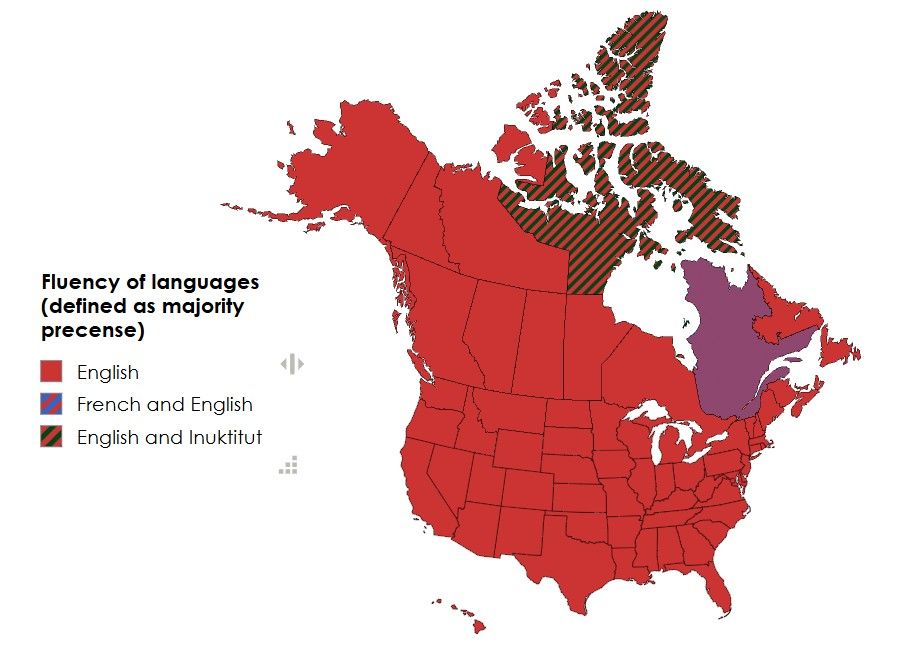
English is the dominant language across most of Canada. According to the 2011 census, 65% of Canadians spoke English most often at home, and 58% declared it their mother tongue. Nationally, about 85% of Canadians can speak English. Its use is nearly universal outside Quebec, though even within Quebec, a majority of the population (51.7% as of 2021) can conduct a conversation in English. The English-speaking population in Quebec is concentrated largely in Montreal and represents only 3.2% of Canada's total English-speaking population. The use of English at home has seen a gradual decline in its proportion of the total population since 1986, a trend attributed to demographic changes and increased linguistic diversity from immigration.
French maintains a strong base, particularly in Quebec, where about 85% of Canada's Francophones reside. In 2011, just over 7.1 million Canadians spoke French most often at home, though this represented a slight decline in the overall proportion to 21.5%. Outside Quebec, significant Francophone communities exist in New Brunswick (home to 3.1% of Canada's Francophones) and Ontario (4.2%), with smaller historic communities in provinces like Newfoundland and Labrador. A key demographic challenge for French is the language continuity index, which measures the retention of French as a home language among those for whom it is a mother tongue. Outside Quebec, this index has declined significantly, from 0.73 in 1971 to 0.45 in 2011, indicating that more people with French as a mother tongue are speaking another language, primarily English, at home.
The dynamics between the two official languages reveal an asymmetry in bilingual capability. Francophones are far more likely to know English than Anglophones are to know French. As of 2011, 44% of Francophones could speak English, compared to only 9% of Anglophones who could speak French. This disparity influences social, economic, and political interactions between the two linguistic groups and is a persistent focus of official language policy aimed at fostering greater mutual understanding.
Bilingualism and the Bilingual Belt
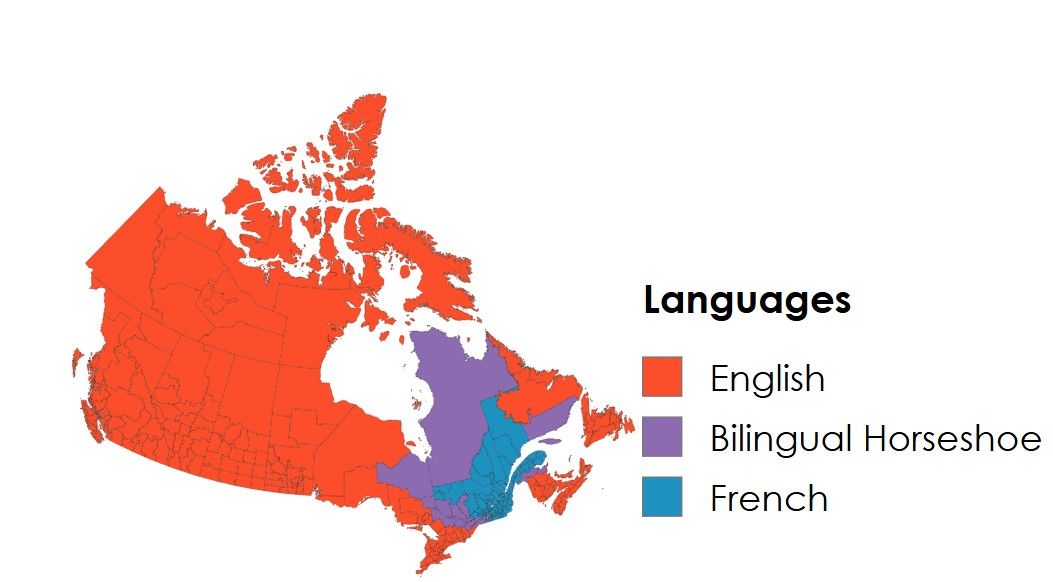
English-French bilingualism is a defining, though not universal, feature of the Canadian experience. The national bilingualism rate was 17.5% in 2011, a slight increase from 17.4% in 2006. This growth was driven largely by increasing bilingualism in Quebec. The geographic distribution of bilingual Canadians is highly concentrated. Approximately 85% of all bilingual Canadians live in Quebec, Ontario, and New Brunswick. A majority, 57.4%, are Quebecers themselves. This concentration creates a region often called the "bilingual belt," a strip of territory encompassing Quebec, northern New Brunswick, and parts of eastern Ontario, including Ottawa, where significant populations of both official language groups coexist.
Bilingualism rates are highest among members of official language minority communities. In Quebec, Anglophones have a very high rate of bilingualism, while Francophones living outside Quebec are also significantly more likely to be bilingual than the Anglophone majority around them. It is rare for Canadians to be unilingual in the minority official language of their region. Only 1.5% of Canadians can speak only the minority language, and most of those individuals live within the bilingual belt. The rate of bilingualism in Quebec has risen dramatically, from 26% in 1951 to 42.5% in 2011. In contrast, in the rest of Canada excluding Quebec, the bilingualism rate was only 7.5% in 2011.
Indigenous Languages
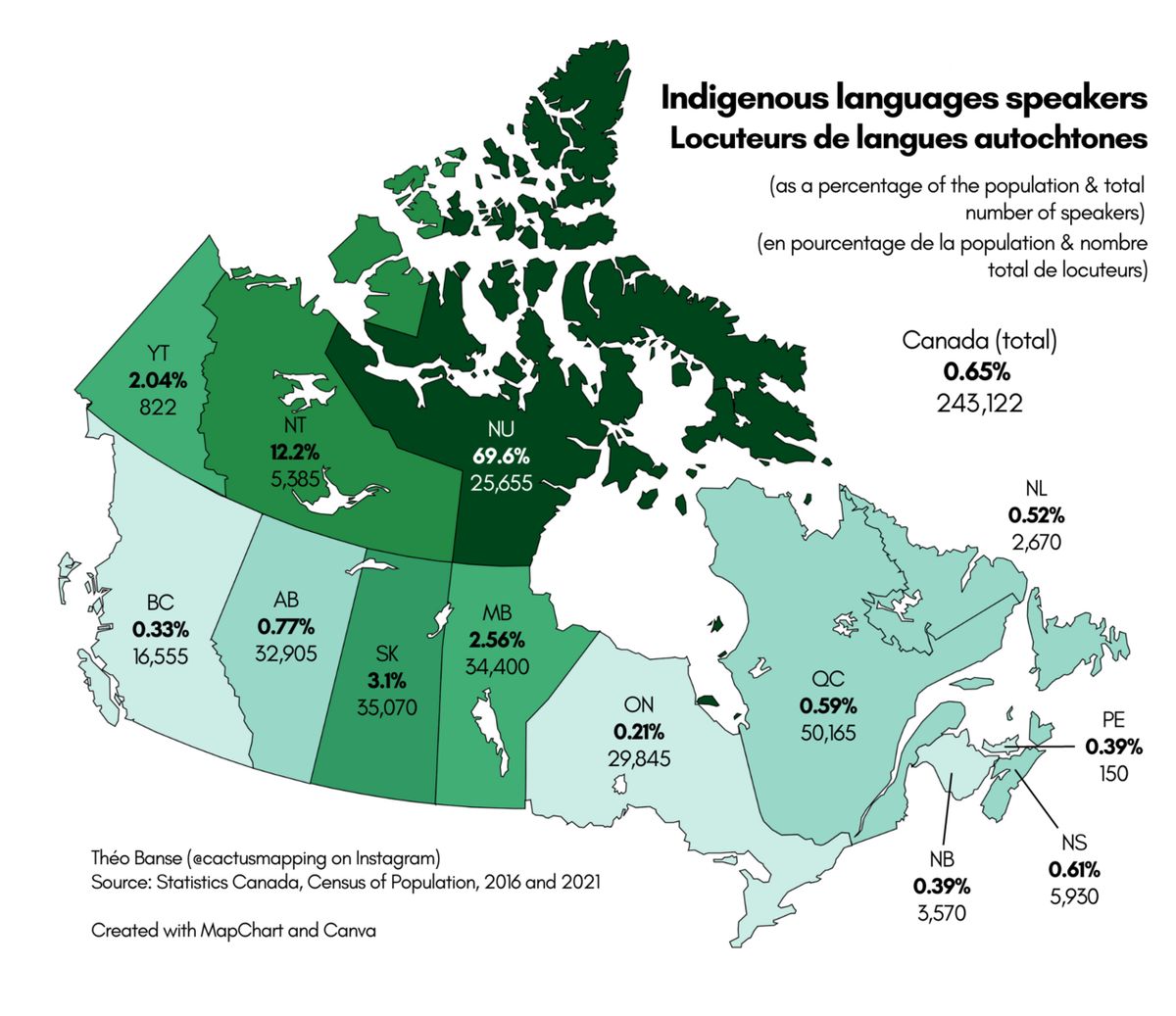
Canada's Indigenous languages represent a deep cultural heritage, with prior to colonization over 70 distinct languages spoken across roughly 12 language families. Today, most of these languages are endangered. According to the 2016 census, less than one percent of Canadians (approximately 213,225) reported an Indigenous language as their mother tongue, and a similar number reported speaking one most often at home. Despite this, there are signs of revitalization, as the number of people who can speak an Indigenous language sometimes exceeds the number who learned it as a mother tongue, indicating new learners are engaging with these languages.
Several Indigenous languages have been granted official status within certain jurisdictions. In Nunavut, Inuktitut and Inuinnaqtun (collectively Inuktut) are official alongside English and French. The Northwest Territories recognizes eleven official languages, including Cree, Dënësųłıné, Gwich’in, Inuvialuktun, and Tłįchǫ Yatıì. These statuses entitle citizens to request government services in these languages. Academically, Indigenous languages in Canada are often categorized by culture area and language family.
- Arctic cultural area: Inuit languages (e.g., Inuktitut) and Inuit Sign Language.
- Subarctic culture area: Na-Dene and Algonquian languages.
- Eastern Woodlands cultural area: Algonquian and Iroquoian languages.
- Plains cultural area: Algonquian, Siouan languages, and Plains Sign Language.
- Northwest Plateau cultural area: Ktunaxa, Na-Dene, and Salishan languages, including Secwepemcékst.
- Northwest Coast cultural area: Haida, Salishan, Tsimshianic, and Wakashan languages.
A significant moment for Indigenous languages in national institutions occurred on January 28, 2019. On that date, Cree Member of Parliament Robert Falcon Ouellette delivered a speech in Cree in the House of Commons. This marked the first time an Indigenous language was used there with full translation services. Ouellette was instrumental in obtaining unanimous consent to change the standing orders to allow Indigenous languages to be spoken in the House. This historic change preceded the passage of Bill C-91, the Indigenous Languages Act, later in 2019. The Act aims to reclaim, revitalize, and maintain Indigenous languages through sustainable funding and the establishment of the Office of the Commissioner of Indigenous Languages.
Non-Official and Immigrant Languages
Canada's linguistic diversity extends far beyond its official and Indigenous languages, shaped significantly by immigration. The 2021 census reported that 20.0% of the population spoke a language other than English or French at home. For about 6.4 million people, this other language was an immigrant language, spoken most often or regularly. This reflects Canada's multicultural reality, where languages like Punjabi, Mandarin, Cantonese, Spanish, Arabic, and Tagalog are commonly heard in communities from coast to coast. Nearly 25,000 people reported using a sign language at home, which includes both American Sign Language and Indigenous sign languages.
The presence of these languages contributes to widespread multilingualism that includes non-official languages. Many Canadians, particularly in urban centres, are fluent in English plus an immigrant language. This linguistic asset is increasingly recognized in economic and social policy. The demographic trend shows a gradual increase in the proportion of the population speaking neither English nor French at home, a clear indicator of the country's evolving cultural composition. Government services, including translation of key information, are increasingly adapting to this reality, though the primary focus of official language policy remains on English and French.
Demolinguistic Trends and Census Data
The Canadian census is a crucial tool for tracking the complex dynamics of language use, collecting detailed data on mother tongue, home language, first official language, and knowledge of official languages. This granular data reveals important trends. Since 1986, the percentage of the population speaking either English or French most often at home has declined, with the decline more pronounced for French. Conversely, the proportion speaking a non-official language at home has increased. The table below illustrates the shift in home language use for Canada's official languages over several decades.
These figures highlight the relative stability of English as a home language alongside a gradual erosion of French in this domain, paired with the steady growth of other languages. The data on knowledge of languages tells a different story. In 2011, 28.4 million Canadians had knowledge of English, but only 21.6 million spoke it most often at home, indicating many use it as a second or public language. Similarly, the number of people who can conduct a conversation in French is higher than the number who speak it most often at home, pointing to its role as a language of education, work, and culture beyond the household sphere for many Canadians.
Language Education and Sector Support
Canada supports the learning of its official languages through a strong education sector for both domestic and international students. Organizations like Languages Canada represent over 160 accredited English and French language programs across nine provinces. This sector is a significant part of Canada's educational exports, attracting international students who come to learn English or French while experiencing Canadian culture. The sector also plays a responsive role during disruptions, as seen when member programs helped students affected by the closures of private language schools like EC English and ILAC in 2026. For Indigenous languages, education is a central component of revitalization efforts, supported by the federal Indigenous Languages Act which mandates assistance for language education and cultural transmission.
In provinces like Nova Scotia, new legislation fosters collaboration between the Mi'kmaq and the provincial government to develop language strategy in education. Within the federal public service and parliamentary institutions, translation and interpretation services for both official languages are mandatory, and services for Indigenous languages are expanding following the 2019 rule change in the House of Commons. These educational and institutional supports are critical for maintaining Canada's linguistic fabric in the face of globalization and demographic change. The sector's annual conferences, such as the Languages Canada 2027 Annual Conference in Vancouver, further professional development and advocacy for language education across the country.
Questions about Languages of Canada
What are the official languages of Canada?
Canada has two official languages at the federal level: English and French. This status was formalized by the Official Languages Act of 1969, which mandates that all federal government services, legislation, and courts operate in both languages. Provincially, New Brunswick is the only province with constitutional equality for both languages. Quebec's official language is French, while Ontario, Manitoba, and Alberta have English as their official language but provide French services in certain regions.
How many people in Canada speak French?
According to the 2021 census, 20.2% of Canadians report French as their mother tongue. The 2016 census found that 29.8% of Canadians could conduct a conversation in French. However, the population that speaks French most often at home is concentrated, with about 85% of Canada's Francophones living in Quebec. Outside Quebec, the largest Francophone communities are in New Brunswick and Ontario. The proportion of Canadians speaking French most often at home has seen a slight decline over recent decades.
Are Indigenous languages official in Canada?
Indigenous languages are not official at the federal level, but they have official status within specific territories. Nunavut recognizes Inuktitut and Inuinnaqtun (Inuktut) as official languages alongside English and French. The Northwest Territories has eleven official languages, including nine Indigenous languages such as Cree, Gwich’in, and Tłįchǫ. In 2022, Nova Scotia passed legislation affirming Mi'kmawi'simk as the province's first language. The federal Indigenous Languages Act of 2019 provides a framework to support the revitalization of all Indigenous languages.
What is the bilingual belt?
The bilingual belt is a term for a geographic region in Canada where there is a significant concentration of people who are bilingual in English and French. It primarily encompasses Quebec, northern New Brunswick, and parts of eastern Ontario, including Ottawa. This region accounts for a large majority of Canada's bilingual population. Within this belt, official language minority communities, such as Anglophones in Quebec or Francophones outside Quebec, have high rates of bilingualism compared to the majority language group in the rest of the country.
What percentage of Canadians are bilingual?
The rate of English-French bilingualism in Canada was 17.5% according to the 2011 census, a slight increase from 17.4% in 2006. This bilingualism is not evenly distributed geographically. In Quebec, the bilingualism rate was 42.5% in 2011, driven largely by Anglophones and allophones learning French. In contrast, in the rest of Canada excluding Quebec, the rate was only 7.5%. Overall, 98.2% of Canadians have knowledge of at least one of the two official languages.
How does Canada support the learning of official languages?
Canada supports official language learning through public education systems, which teach French immersion and core French programs across English-majority regions, and English instruction in Quebec. For international students and newcomers, a large accredited private sector, represented by organizations like Languages Canada, offers English and French language programs. Federally, the Official Languages Act commits to promoting both languages. Policies aim to increase the bilingual capacity of the public service and ensure availability of language training for citizens.
Sources and further reading
- Languages of Canada (Wikipedia)
- Languages Canada | The Voice of Canada's Language ... (languagescanada.ca)
Checked by the Nosy Mag desk. Last updated 2026-10-26.