Land of the Silver Birch
Land of the Silver Birch is a traditional Canadian folk song that dates from the 1920s. It is known for its rhythmic melody, often used to keep time while canoeing, and its romanticized portrayal of the Canadian wilderness from an Indigenous perspective. For generations, it has been a staple at summer camps, in school choirs, and around Scout and Guide campfires across the country. In recent years, the song has become a focal point for debates on cultural appropriation and the romanticization of Indigenous peoples within Canadian culture.
Origins and Musical Characteristics
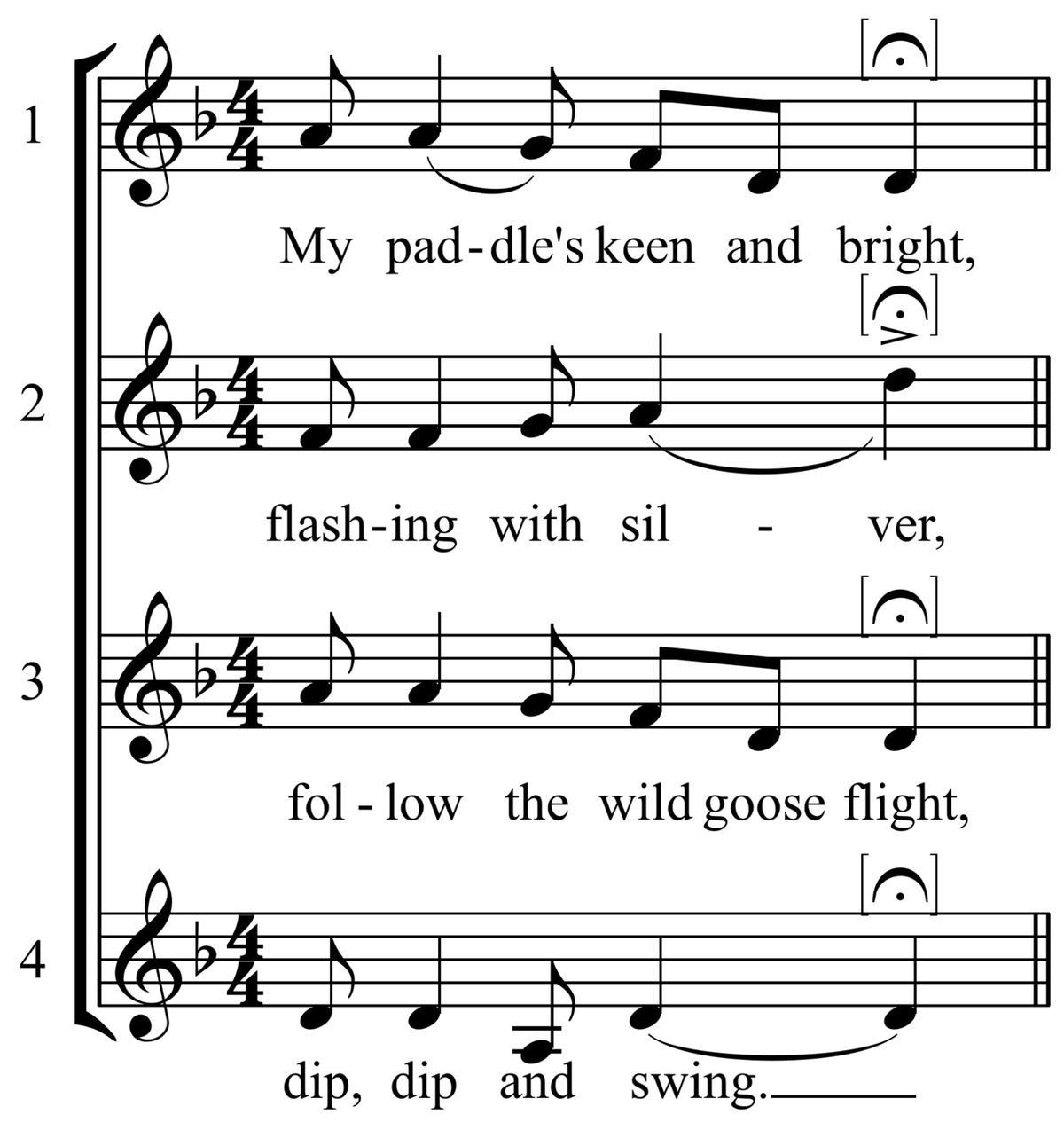
The song Land of the Silver Birch first appeared in the 1920s, though its precise origins remain unclear. It is a traditional folk song, meaning it has been passed down orally with many lyrical variations. The song is set in a minor key, specifically the Aeolian or natural minor mode, though it is frequently sung with a raised sixth note, giving it a Dorian character. This musical structure, combined with its steady, rhythmic refrain of boomdidi boom boom, made it ideally suited for keeping time while paddling a canoe. The arrangement commonly used today is credited to British watercolour artist John Cozens, as noted in the 1993 Jubilee Songbook. The song is closely related to another paddling song, My Paddle's Keen and Bright, which was written by Margaret Embers McGee in 1918 and whose lyrics are often intermingled with those of Land of the Silver Birch during performances. The song is catalogued as Roud Folk Song Index number 4550, a standard reference for traditional English-language folk songs.
Lyrics and Common Variations
The lyrics of Land of the Silver Birch paint an idyllic picture of the Canadian landscape, mentioning the silver birch, beaver, and moose. The narrator speaks from a romanticized Indigenous perspective, expressing a longing to return to the hills of the north and build a wigwam close to the water's edge. As with most folk songs, numerous lyrical variations exist across different regions and groups. Common alternate verses include lines about being as swift as a silver fish in a birch bark canoe and as high as an eagle soaring over the mountains. The song has also been translated into other languages, including a French version titled Terre du bouleau blanc distributed by Orff Canada and an Italian version, Terra di Betulla, sung by Scouts. The lyrics are sometimes erroneously attributed to the Mohawk poet Pauline Johnson, likely due to confusion with her poem The Song My Paddle Sings, which shares similar canoeing themes.
- The line Follow the wild goose flight has colloquial variants including Follow the pale moonlight and Follow the waters light.
- In some United States Boy Scout camps, eagle is sung in place of beaver.
- A Dutch version, Land van de Zilverberk, is sung in Dutch Scout groups and likely travelled to the Netherlands through international scout jamborees.
- In 1979, the Canadian Cultural Workers' Committee, a musical group associated with the Communist Party of Canada (Marxist-Leninist), used the melody for a song titled Death to the Traitors on their album 'The Party is the Most Precious Thing'.
- Additional documented verses include Deep in the forest, Down in the lowlands and Though I am forced to flee, Far from my homeland.
Role in Scouting and Guiding
Since the 1930s, Land of the Silver Birch has been a popular and enduring song within the Scout and Girl Guide movements in Canada and beyond. Its strong rhythm and simple melody make it an ideal campfire song, often sung as a round. The song is a regular feature at numerous Canadian camps, including Doe Lake, Camp Maple Leaf, Camp Wenonah, and Camp Peaceful Waters in Quebec's lower Laurentians. Its use extends to Boy Scout camps in the United States, such as Ma-Ka-Ja-Wan Scout Reservation in Pearson, Wisconsin and Camp Babcock-Hovey in Ovid, New York, where it is frequently part of opening and closing ceremonies. The song is also used to close campfire programs at Cuyuna Scout Camp in Crosslake, Minnesota. The translated Italian version Terra di Betulla is a frequent campfire song for Italian scouts, demonstrating the song's international reach within the movement. The song's deep integration into these youth organizations has cemented its place in the collective memory of generations, associating it strongly with outdoor experiences and communal singing.
Contemporary Criticism and Controversy
In recent decades, the song's popularity with non-Indigenous Canadians has declined amid growing awareness of colonization and cultural appropriation. Critics argue that while not intentionally racist, the song presents a simplistic and romanticized vision of Indigenous peoples as inherently pre-modern and one with nature, which can justify colonial narratives of a vanishing culture. Indigenous scholars and artists, such as Haudenosaunee poet Janet Rogers, have noted that the song erases the complex realities of Indigenous lived experience under colonialism. Mi'kmaq professor Bonita Lawrence has clarified that while the song is sometimes misattributed to poet Pauline Johnson, Johnson's own work was complex and politically subversive, not a replication of colonial ideas. The controversy entered the legal sphere in 2016 following an incident at Toronto's High Park Alternative School. Music teacher Violet Shearer included the song in a spring concert, leading to parent complaints that children were being told to play Indian. The school's principal and vice-principal subsequently sent an apology email to parents stating the song was inappropriate and is racist. Shearer launched a defamation lawsuit against the school officials and the board, seeking $75,000 in damages and an apology, claiming she had been set up despite prior approval of the program. The case proceeded after a judge ruled the concert was an extracurricular, unpaid activity, setting the stage for a legal examination of whether labelling the song as racist constitutes libel. The Toronto District School Board defended the suit vigorously, and the outcome could influence how educators approach similar cultural material in the future.
Cultural Impact and Modern Reckoning
Land of the Silver Birch occupies a complex space in Canadian cultural history. It has been a ubiquitous part of childhood for many, symbolizing camping, canoeing, and a connection to the natural world. Its use in the 2019 film Brotherhood, which depicts a tragic 1926 canoeing accident, shows its historical association with outdoor Canadian life. The film is based on a true story where ten boys and a camp counsellor died when their 30 foot canoe capsized on an Ontario lake. However, the modern reckoning involves recognizing the disconnect between the song's romantic imagery and the actual histories and ongoing struggles of Indigenous peoples. The debate has prompted educators and community leaders to consider more thoughtful engagement with Indigenous themes. This includes the use of land acknowledgements and the inclusion of authentic Indigenous voices and music, such as traditional drumming and performances of O Canada in Cree, as seen at National Indigenous Peoples Day events. The song's future now hinges on whether it can be contextualized historically or if it will be retired from common use as Canadian society grapples with issues of representation and appropriation.
Notable Recordings and Performances
While Land of the Silver Birch is primarily a folk song transmitted through oral tradition, several notable recordings and performances have been documented. Canadian folk singer Michael Mitchell has a well-known version of the song. In 2025, a track titled Land of the Silver Birch (Canadian Indian Song) was included on a Saint-Patrick album by Traditionnel Oxun and Nation Efon. The song also features in children's music resources, such as the 1999 book The Round Book: Rounds Kids Love to Sing. Its most poignant modern usage was in the film Brotherhood, where a hearty rendition by campers at the start of a canoe trip is revisited in subdued tones throughout the film, mirroring the tragedy that unfolds. Other uses include its inclusion in various camp songbooks and online repositories of folk music, ensuring its continued, though increasingly scrutinized, presence in Canadian media and performance.
Questions about Land of the Silver Birch
Who wrote 'Land of the Silver Birch'?
The author of Land of the Silver Birch is unknown, as it is a traditional folk song that first appeared in the 1920s. The lyrics are frequently and erroneously attributed to the Indigenous poet Pauline Johnson, likely due to confusion with her poem The Song My Paddle Sings. The common musical arrangement used today is credited to John Cozens, a British watercolour artist, as noted in the 1993 Jubilee Songbook. The related song My Paddle's Keen and Bright was definitively written by Margaret Embers McGee in 1918.
Why is 'Land of the Silver Birch' considered controversial?
The song is considered controversial because its subject matter is a romanticized vision of nature from the perspective of an Indigenous person. Critics argue it is a form of cultural appropriation, as it reduces complex cultures to stereotypes. A 2016 incident at a Toronto school, where administrators apologized for the song being performed, calling it inappropriate and racist, led to a defamation lawsuit by the music teacher involved. Its past popularity in schools is declining with greater awareness of the impacts of colonization.
Is 'Land of the Silver Birch' a racist song?
The song is not generally considered to have racist intent, but its content is criticized for perpetuating stereotypes. Indigenous scholars note it romanticizes Indigenous life as pre-modern and connected to nature, which can erase contemporary Indigenous experiences. The question of whether labelling the song as racist constitutes defamation was central to a 2016 lawsuit involving a Toronto music teacher. There is no societal consensus, and the interpretation often depends on the context and education surrounding its performance.
Where is 'Land of the Silver Birch' commonly sung?
The song has been a staple at Canadian Scout and Girl Guide camps since the 1930s, including locations like Doe Lake and Camp Wenonah. It is also sung at Boy Scout camps in the United States, such as Ma-Ka-Ja-Wan Scout Reservation in Wisconsin and Camp Babcock-Hovey in New York, often with slight lyrical changes. It was traditionally used as a canoeing song to keep paddlers in rhythm. The song is also used at Cuyuna Scout Camp in Minnesota and has translated versions sung by Italian and Dutch scouts.
What are the alternative lyrics to 'Land of the Silver Birch'?
Common alternate verses include lines about being as swift as a silver fish in a birch bark canoe and as high as an eagle soaring over the mountains. The line Follow the wild goose flight is sometimes sung as Follow the pale moonlight or Follow the waters light. In some American Scout camps, eagle is substituted for beaver. The song also has translated versions in French (Terre du bouleau blanc), Italian (Terra di Betulla), and Dutch (Land van de Zilverberk). Additional verses speak of a heart crying out for the hills of the North.
Has 'Land of the Silver Birch' been used in any movies?
Yes, the song features prominently in the 2019 Canadian film Brotherhood, directed by Richard Bell. This film is based on the true story of a fatal 1926 canoeing accident at a boys' summer camp on a lake in Ontario, Canada. The film uses the boys' hearty rendition of Land of the Silver Birch at the start of their canoe trip as a recurring motif. This auditory element is replayed in subdued tones to reflect the tragedy where ten boys and a camp counsellor died after their 30-foot canoe capsized in the dark, frigid waters.
Sources and further reading
- Land of the Silver Birch (Wikipedia)
- Land of the Silver Birch (notesofthenorth.com)
- 'Racist' camp song Land of the Silver Birch headed for libel ... (nationalpost.com)
Checked by the Nosy Mag desk. Last updated 2026-10-28.