Medicine wheel
The medicine wheel is a sacred stone structure and a symbol central to many Indigenous cultures across North America, particularly among Plains nations in Canada and the United States. Physically, medicine wheels are circular petroforms, often featuring a central cairn, an outer ring of stones, and radiating spokes, with many aligned to cardinal directions or astronomical events. These ancient constructions, some dating back over 5,000 years, serve as ceremonial sites and embody complex worldviews. As a contemporary visual symbol, the medicine wheel represents holistic teachings on balance, interconnectedness, and the integration of physical, emotional, mental, and spiritual well-being, making it a vital element of Indigenous cultural heritage and identity in Canada.
Physical Structure and Archaeological Characteristics
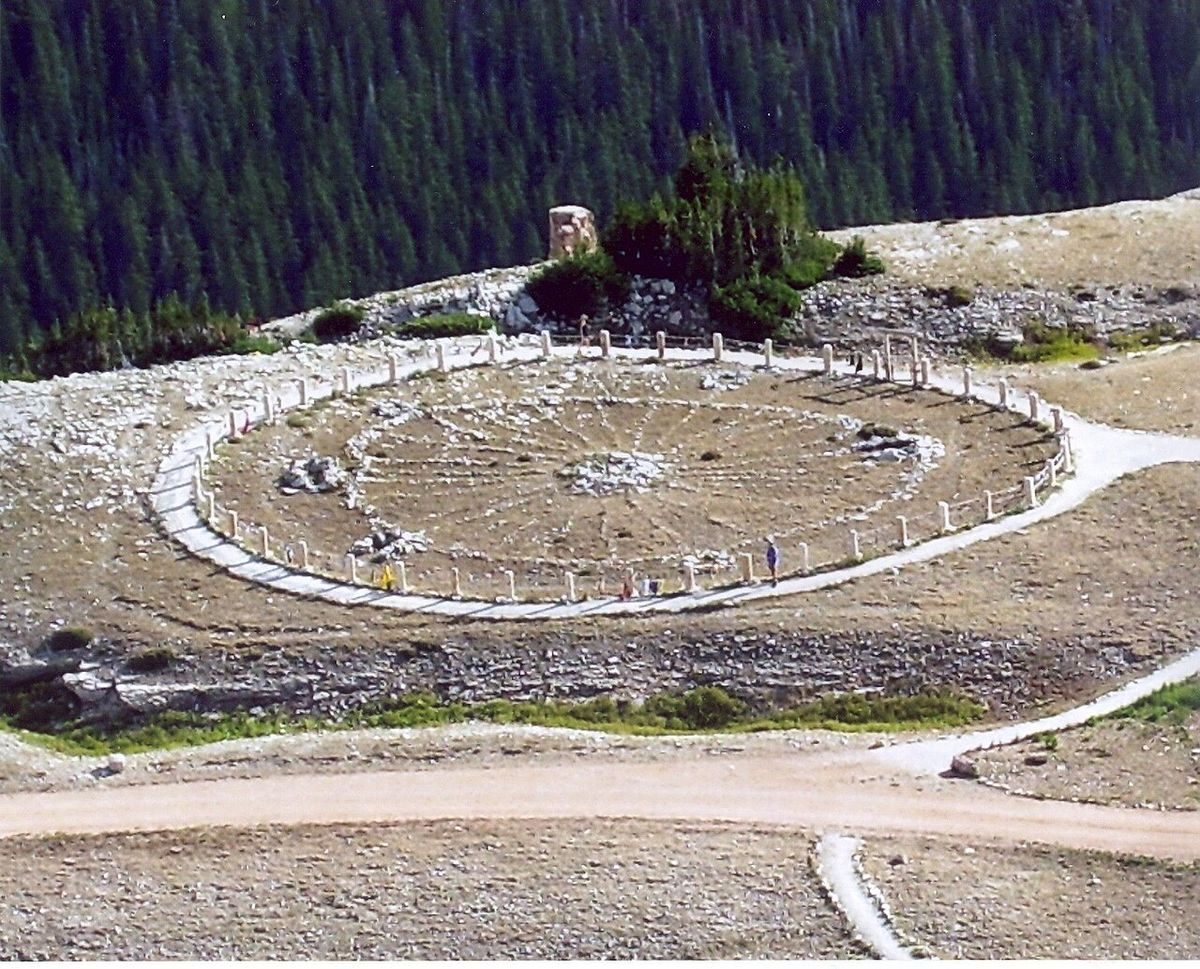
Medicine wheels are physical constructions of unmodified, locally available stones arranged in specific patterns on the landscape. Archaeologist John Brumley's widely cited definition states that a structure qualifies as a medicine wheel if it possesses at least two of three primary components: a central stone cairn, one or more concentric stone circles, or two or more stone lines radiating outward from a central point. These components are arranged in a radially symmetrical manner, often creating a wagon-wheel-like appearance from above. The size of these structures varies considerably, with diameters ranging from about 5 metres to over 27 metres. The Bighorn Medicine Wheel in Wyoming, a prototypical example, measures 23 metres across and features 28 spokes connecting its outer ring to a central cairn. In contrast, the Ellis Medicine Wheel in southern Alberta consists of a smaller 5-metre circle with ten spokes extending outward between 14 and 19 metres.
The number and arrangement of spokes are highly variable, though 28 spokes are common, corresponding to the number of days in a lunar cycle. Spokes are rarely evenly spaced or uniform in length, and some wheels feature one notably longer spoke. The outer ring may sometimes be broken to form a doorway or passageway leading to the centre. Secondary features commonly found in association with medicine wheels include tipi rings, small ancillary cairns, stone hearths, and anthropomorphic stone effigies. All known physical medicine wheels are located within the northern Plains region, spanning from Wyoming and South Dakota northward into the Canadian provinces of Alberta and Saskatchewan, with the majority of the approximately 70 documented sites found in Alberta.
Historical Origins and Archaeological Significance
The construction and use of stone medicine wheels span millennia, indicating deep and enduring cultural traditions. The Majorville medicine wheel, located south of Bassano, Alberta, is one of the oldest known examples, with archaeological evidence dating its initial construction to approximately 3200 BCE, over 5,200 years ago. Like Stonehenge, the Majorville wheel was built up by successive generations who added new features over a long period, with a notable gap in use between 3,000 and 2,000 years ago, suggesting its function evolved over time. Evidence indicates that some of the earliest use of medicine wheels is associated with the Oxbow Complex peoples. Other wheels have origins in the late prehistoric to historic periods, constructed by nations such as the Blackfoot as memorials for prominent warriors. The word 'medicine' in this context denotes the sacred, religious, and spiritual significance of the sites rather than a direct association with healing. These structures are considered sacred architecture, part of a broader tradition of erecting massive stone formations for ceremonial purposes. Their precise functions are diverse and not fully understood, but archaeological and limited ethnographic evidence suggests they were sites for ceremonial activities involving large social groups.
Astronomical Alignments and Interpretive Debates
A significant area of study and debate surrounds the potential astronomical alignments of medicine wheels. Some wheels feature spokes or stone lines aligned with the cardinal directions, while others may be oriented toward astronomical phenomena involving the sun, moon, stars, or planets relative to the local horizon. This theory suggested the wheels were used to signal important ceremonial dates within the annual cycle. Subsequent scholarly analysis has challenged the statistical validity of these specific stellar alignments. Professor Bradley Schaefer, in a paper for the Journal for the History of Astronomy, found no strong statistical evidence supporting the claimed stellar alignments for the three wheels studied by Eddy. The debate highlights the complexity of interpreting these ancient sites. While some alignments with solar events like sunrise and sunset on solstices are visually apparent and widely accepted, the case for precise stellar alignments remains contentious within the academic community.
The Medicine Wheel as a Contemporary Symbol and Teaching Tool
Beyond the physical stone circles, the medicine wheel exists as a visual symbol. This modern adaptation was first published in 1972 by Hyemeyohsts Storm and has since been adopted as an icon and teaching tool by many Indigenous and non-Indigenous groups. The symbol typically depicts a circle divided into four quadrants, each with a distinct colour, commonly black, white, red, and yellow, surrounding a central circle often coloured green. It is crucial to understand that there is no single, universal medicine wheel teaching that represents all Indigenous Peoples. The meanings, colour orders, associated animals, elements, and teachings connected to the wheel vary significantly among different First Nations, Métis, and Inuit communities and Knowledge Keepers.
The core symbolic meaning across most interpretations revolves around concepts of balance, harmony, and the interconnectedness of all life. The four quadrants frequently represent the four directions, the four seasons, the four elements, the four sacred medicines, and the four aspects of human well-being: physical, emotional, mental, and spiritual. The circle itself signifies the cyclical nature of existence and the interconnected relationship between the individual, the community, and the natural world. This symbolic framework is now extensively used in educational, health, and community settings as a guide for holistic healing, personal development, and understanding Indigenous worldviews.
- Four Aspects of Wellness: Physical, emotional, mental, and spiritual.
- Common Colour Associations: Black, white, red, and yellow for the quadrants. Green for the centre.
- Representative Elements: Often includes the four directions, seasons, stages of life, and sacred plants.
- Core Teachings: Interconnectedness, balance, cyclical change, and holistic health.
Cultural Significance and Respectful Engagement
The medicine wheel holds cultural significance as a representation of Indigenous worldviews that see all elements of existence as interrelated. In ceremonial contexts, the physical stone wheels are sacred sites, and the symbolic wheel informs approaches to health, justice, education, and community governance. Its teachings emphasize that well-being requires attention to all four aspects of self, and that healing involves restoring balance among them. This holistic framework contrasts with Western paradigms that often compartmentalize these areas.
Given its sacred nature and the diversity of teachings, respectful engagement with the medicine wheel is important. It is not a generic graphic for decoration but a cultural symbol with deep roots. When used in educational or other settings, it is essential to acknowledge its Indigenous origins, explain that teachings vary among nations, and avoid presenting any one version as authoritative. Whenever possible, instruction should connect to knowledge shared by local Indigenous communities and Knowledge Keepers. This approach honours the living traditions behind the symbol and prevents cultural appropriation or oversimplification.
Notable Medicine Wheel Sites in Canada
Canada, particularly the prairie provinces, is home to a high concentration of ancient medicine wheel sites, offering a direct connection to millennia of Indigenous history. Alberta contains the majority of the approximately 70 documented stone medicine wheels. These sites are protected as significant archaeological and cultural resources, though their locations are often sensitive to prevent disturbance. The Majorville medicine wheel, dating to over 5,000 years ago, is among the most significant due to its age and evidence of prolonged, evolving use. Another notable site is the Ellis Medicine Wheel in southern Alberta, a smaller structure believed to have been built by the Blackfoot as a memorial for a warrior.
In Saskatchewan, the Moose Mountain medicine wheel has been a focal point for archaeological study, particularly regarding theories of astronomical alignment. These physical sites, alongside the living symbolic teachings, form an integral part of Canada's heritage. They are tangible reminders of the sophisticated cultural and scientific knowledge systems developed by Indigenous peoples over thousands of years. Preservation efforts and respectful visitation protocols are crucial, as these are not relics of a lost past but active sacred sites for many Indigenous communities today.
| Site Name | Location | Key Features | Noted Cultural Association / Period |
|---|---|---|---|
| Majorville Medicine Wheel | South of Bassano, Alberta | Built up over millennia, dated to c. 3200 BCE | Oxbow Complex, long-term ceremonial use |
| Bighorn Medicine Wheel | Bighorn National Forest, Wyoming, USA | 23m diameter, 28 spokes, prototypical | Plains nations, subject of astronomical studies |
| Moose Mountain Medicine Wheel | Southeastern Saskatchewan | Studied for potential astronomical alignments | Plains nations |
| Ellis Medicine Wheel | Southern Alberta | 5m circle with 10 radiating spokes | Blackfoot, late prehistoric/historic memorial |
Questions about Medicine wheel
What is a medicine wheel?
A medicine wheel refers to two related concepts. First, it is a physical stone structure, a type of petroform built by Indigenous peoples, notably Plains nations, consisting of a central cairn, outer stone circles, and radiating spokes, often aligned with cardinal directions. Second, it is a symbolic circle divided into four quadrants, used as a teaching tool to represent concepts like the four directions, seasons, aspects of wellness, and the interconnectedness of all life. The physical wheels are ancient ceremonial sites, while the symbol conveys Indigenous worldviews.
How old are medicine wheels?
Medicine wheels are ancient constructions with evidence of use spanning thousands of years. The oldest known example is the Majorville medicine wheel in Alberta, which has been dated to approximately 3200 BCE, making it over 5,200 years old. This site shows evidence of being built up by successive generations over a long period, with a gap in use between 3,000 and 2,000 years ago. Other wheels have origins in different eras, with some dating from the Oxbow Complex period and others constructed in the late prehistoric to historic period.
What do the four colours on the medicine wheel mean?
The four colours commonly seen on the symbolic medicine wheel, often black, white, red, and yellow, represent different teachings that vary among Indigenous nations. There is no single universal meaning. The colours can be associated with the four directions, the four seasons, the four races of humanity, the four elements, or the four aspects of life. The central circle is often green, representing self or balance. It is essential to recognize that the specific associations and the order of the colours differ between communities and Knowledge Keepers.
Are medicine wheels astronomical calendars?
Some medicine wheels show alignments with astronomical events, though this is a subject of academic debate. Many wheels are aligned with the cardinal directions, and some spokes point to sunrise or sunset on solstices or equinoxes, suggesting a solar calendar function. However, subsequent analysis by scholars like Bradley Schaefer found insufficient statistical evidence for precise stellar alignments at sites like Bighorn, Moose Mountain, and Fort Smith. While astronomical observation was likely one function for some wheels, they served broader ceremonial and cultural purposes.
Is it appropriate for non-Indigenous people to use the medicine wheel symbol?
Non-Indigenous use of the medicine wheel symbol requires respect, context, and avoidance of appropriation. The symbol is sacred and its teachings are specific to Indigenous cultures. It should not be used as mere decoration or a generic wellness graphic. In educational or professional settings, it is crucial to acknowledge its Indigenous origins, explain the diversity of teachings, and ideally connect its use to guidance from local Indigenous communities. Misappropriation by non-Indigenous groups is disrespectful.
Where can you find physical medicine wheels?
All known physical medicine wheels are located in the northern Plains of North America. The majority of the approximately 70 documented structures are found in Alberta, Canada. Others are located in Saskatchewan, Montana, Wyoming, and South Dakota. Notable examples include the Bighorn Medicine Wheel in Wyoming, the Majorville and Ellis wheels in Alberta, and the Moose Mountain wheel in Saskatchewan. These sites are often on protected lands, and many are considered sacred, so visitation should be done with respect.
Sources and further reading
- Medicine wheel (Wikipedia)
- What is an Indigenous Medicine Wheel? (ictinc.ca)
- 3 Medicine Wheel Activities for Student Wellness (indigenousteacher.ca)
- Medicine Wheel, SH Health Providers (healthproviders.sharedhealthmb.ca)
- Medicine Wheels (torontomu.ca)
Checked by the Nosy Mag desk. Last updated 2026-10-24.