Lower Canada Rebellion
The Lower Canada Rebellion, known in French as the Rébellion des patriotes, was an armed uprising against British colonial rule in the colony of Lower Canada, now southern Quebec, from November 1837 to November 1838. It occurred simultaneously with the Upper Canada Rebellion, together forming the Rebellions of 1837-38, a major crisis in British North America. The conflict was rooted in decades of political frustration among the French-Canadian majority and reform-minded English settlers, who were denied responsible government and economic power by an appointed colonial elite. The rebellion's military defeat led to the union of Upper and Lower Canada into the Province of Canada and, ultimately, to the introduction of responsible government, shaping Canada's constitutional development.
Origins of Political Conflict
The seeds of the rebellion were sown with the Constitutional Act of 1791, which created an elected House of Assembly for Lower Canada. This gave a political voice to the colony's French-Canadian majority, who consistently elected members of the Parti canadien, later the Parti patriote. However, real power resided with the British-appointed governor and his two advisory councils, the Executive Council and the Legislative Council. The Legislative Council was dominated by a small, wealthy group of mostly English-speaking businessmen and officials known as the Château Clique, which could veto any legislation from the elected assembly. This structure created three decades of political deadlock, as the assembly, led from the early 1800s by James Stuart and later Louis-Joseph Papineau, sought control over public spending and greater accountability. Economic shifts in the early 19th century exacerbated tensions, as the rising timber industry seemed to benefit the English mercantile class disproportionately, while French-Canadian farmers and the working class felt economically marginalized.
Governor Sir James Henry Craig's tenure from 1807 to 1812 highlighted early colonial paranoia. He called three elections in 16 months, imprisoned journalists from the reformist newspaper Le Canadien, and feared the Parti canadien desired a French republic. The War of 1812 temporarily unified the colony against the American threat, but the post-war period saw renewed calls for political change. The idea of uniting Upper and Lower Canada, advocated by some English merchants and Governor George Ramsay, Earl of Dalhousie, was fiercely opposed by Papineau and his followers, who saw it as a threat to French-Canadian identity. Dalhousie forced an election in 1827, rather than accept Papineau as Speaker of the Assembly, and then prorogued parliament. This led to a massive petition of 87,000 signatures sent to London, which resulted in Dalhousie's reassignment but did not resolve the fundamental constitutional impasse.
The Ninety-two Resolutions and Radicalization
By the 1830s, frustration had reached a boiling point. Inspired by a list of grievances from Upper Canada, Louis-Joseph Papineau wrote the Ninety-two Resolutions while secretly co-ordinating with Upper Canada. The document that was presented to the House of Assembly on January 7, 1834, had 92 demands to the British government. The resolutions demanded an elected legislative council, responsible government, and control over provincial revenues. The document was immensely popular, and the Parti patriote won a landslide victory later that year, capturing more than three quarters of the popular vote. The resolutions were sent to the British government, which assigned Governor Lord Gosford to assess the situation. Gosford initially attempted conciliation but secretly organized a loyal militia and later received instructions from London rejecting the Patriotes' core demands.
The reform movement itself began to fracture. Moderate reformer John Neilson left the party in 1830 and joined the loyalist Constitutional Association in 1834. Papineau's anticlerical views and advocacy for secular schools alienated the powerful Catholic Church, led by Bishop Jean-Jacques Lartigue, who urged the faithful to support the authorities. The final blow came in 1837 when the British Parliament, under Prime Minister Lord Melbourne, passed the Russell Resolutions, which flatly rejected the Ninety-two Resolutions. These resolutions affirmed the Crown's right to appoint the legislative council and allowed the governor to take funds from the colonial treasury without the assembly's consent. This rejection pushed many Patriotes from political protest towards more radical action.
Mobilization and the Path to Armed Conflict
In response to the Russell Resolutions, the Patriotes organized a series of large public assemblies across Lower Canada in the summer and fall of 1837 to rally support. They promoted a boycott of British goods and encouraged smuggling from the United States. Papineau, still hoping for a political solution, attended many gatherings to advocate for continued peaceful pressure. The largest assembly was the Assembly of the Six Counties in Saint-Charles in late October, which drew thousands and formed the Confédération des Six-Comtés. It was here that a decisive split emerged. While Papineau, in his final speech, argued it was not yet time to fight, Dr. Wolfred Nelson publicly declared that the time for armed resistance had arrived.
The radical wing of the movement soon formed a paramilitary group, the Société des Fils de la Liberté. Tensions in Montreal erupted into street violence on November 6, 1837, when the Fils de la Liberté clashed with members of the anglophone loyalist Doric Club. In the aftermath, the government issued arrest warrants for Papineau and other Patriote leaders, forcing them to flee Montreal and go into hiding. This act of seeking to imprison elected representatives was the immediate trigger for armed rebellion, as many Patriotes chose to resist arrest.
The First Rebellion of 1837
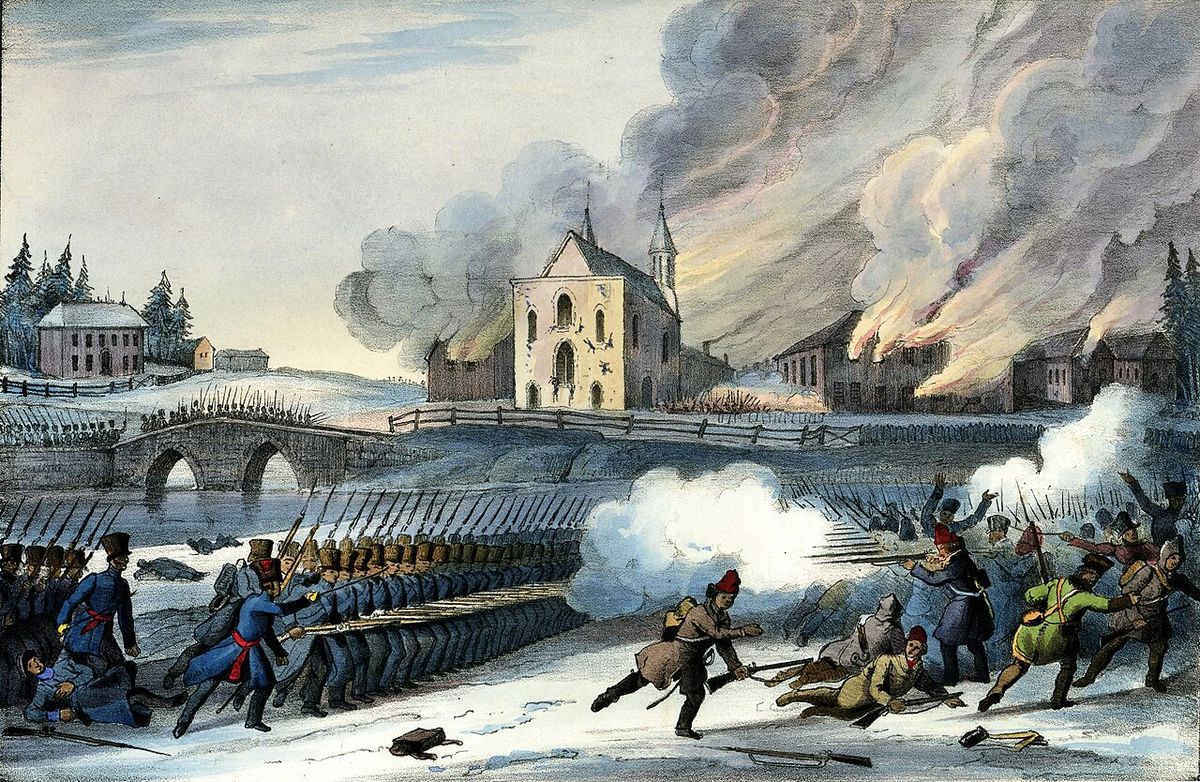
The first armed clashes began in November 1837. An early success for the rebels came on November 16, when about 150 Patriotes intercepted a constable and freed three prisoners near Longueuil. The major engagement of the first uprising was the Battle of Saint-Denis on November 23. Led by Wolfred Nelson, a force of roughly 800 rebels, half armed with firearms, defeated a British regiment. The victory was short-lived. Government forces regrouped and crushed the rebels just two days later at the Battle of Saint-Charles, where poor leadership and discipline led to a Patriote rout.
The rebellion culminated in the Battle of Saint-Eustache on December 14, 1837. Between 500 and 600 Patriotes fortified themselves in the town, but they were overwhelmed by a government force of 2,000 troops and volunteers. The battle was a decisive defeat, with most rebel leaders killed or captured. Montreal was placed under martial law on December 5. Following these defeats, key leaders including Papineau, Nelson, and Edmund Bailey O'Callaghan fled to the United States. The news of these events in Lower Canada directly inspired William Lyon Mackenzie to launch his own, smaller rebellion in Upper Canada that same December.
- 23 November 1837: Patriote victory at the Battle of Saint-Denis.
- 5 December 1837: Martial law declared in Montreal.
- 14 December 1837: Rebellion effectively ends with government victory at the Battle of Saint-Eustache.
The Second Uprising and the Frères Chasseurs
From exile in the United States, Patriote leaders, particularly Robert Nelson (Wolfred's brother), planned a second invasion. During the summer of 1838, they formed a secret society called the Frères chasseurs (Hunters' Lodges) with cells in the U.S. and Lower Canada, aiming to establish an independent republic. The second revolt began in November 1838 with a series of coordinated attacks. The main force gathered at Napierville but suffered from a critical shortage of weapons. Their plan to secure the road from the United States was intercepted by loyalist volunteers at the Battle of Beauharnois.
This second uprising was even more poorly organized than the first. Government spies had infiltrated the movement, and when British troops and loyalist volunteers advanced on the rebel camps, most Frères chasseurs dispersed without a fight. The secondary camps were scattered easily, and the British regular army was barely involved in suppressing the revolt. The failure of the second invasion marked the definitive end of the armed rebellion.
Aftermath and Repression
The colonial government's response to the second rebellion was severe. Martial law allowed for imprisonment without trial, and the Pied-du-Courant Prison in Montreal was filled beyond capacity. Following trials, 99 prisoners from the second rebellion were sentenced to death. Of these, twelve were executed by hanging, with the last executions occurring in February 1839. To avoid creating public martyrs, the government chose exile for many others. A total of 141 prisoners from both Lower and Upper Canada were transported to penal colonies in Australia, where they endured harsh conditions in work camps. They were permitted to return in 1844, with most paying their own fare home by 1845.
| Group | Fate |
|---|---|
| Rebel Prisoners (Second Rebellion) | 99 sentenced to death |
| Executed by Hanging | 12 |
| Transported to Australia | 141 (from both Canadas) |
| Allowed to Return | 1844 |
Constitutional Consequences and Legacy
In the wake of the rebellions, the British government dispatched Lord Durham to investigate their causes. His 1839 report, the Durham Report, diagnosed the problem as a deep conflict between the English and French populations in the colony. He recommended the assimilation of French Canadians through the union of Upper and Lower Canada, which was accomplished by the Act of Union in 1841, creating the Province of Canada. Crucially, Durham also advised granting responsible government, a key reform demand of the rebels. These changes were foundational steps on the path to Canadian Confederation in 1867.
The legacy of the Lower Canada Rebellion is complex. In English-Canadian history, it was often minimized as an unfortunate incident, but its scale and violence left deep wounds in French-Canadian society. The conflict highlighted deep ethnic and political divisions and demonstrated the limits of British colonial policy. The Patriotes' struggle for democratic rights and cultural survival remains a powerful symbol in Quebec, representing both a failed armed revolt and a catalyst for significant political reform that reshaped British North America.
Questions about Lower Canada Rebellion
What were the main causes of the Lower Canada Rebellion?
The rebellion was caused by decades of political frustration stemming from the colonial constitution of 1791. While Lower Canada had an elected assembly, real power lay with a British-appointed governor and an unelected legislative council dominated by the English-speaking Château Clique. The French-Canadian majority and reformist English settlers, led by Louis-Joseph Papineau's Parti patriote, demanded responsible government and control over finances. Economic discontent, ethnic tensions, and the outright rejection of their grievances in the 1837 Russell Resolutions pushed the movement toward armed rebellion.
Who were the key leaders of the rebellion?
The primary political leader was Louis-Joseph Papineau, Speaker of the Legislative Assembly and head of the Parti patriote. The military leadership included Dr. Wolfred Nelson, who led the rebels to victory at Saint-Denis, and his brother Robert Nelson, who led the second uprising in 1838 from the United States. Other important figures included Edmund Bailey O'Callaghan, a close ally of Papineau. Opposing them were colonial governors like Lord Gosford and military commanders such as Sir John Colborne.
What were the major battles of the rebellion?
The first rebellion featured three major battles in quick succession. The Battle of Saint-Denis on November 23, 1837, was a Patriote victory. The Battle of Saint-Charles was a decisive government victory that occurred two days after Saint-Denis. The rebellion effectively ended with the Battle of Saint-Eustache on December 14, where government forces overwhelmed the Patriotes. The second uprising in November 1838 centred on the Battle of Beauharnois, where the Frères chasseurs were quickly defeated by loyalist volunteers.
What happened to the rebels after they were defeated?
Following the defeat of the second uprising, repression was harsh. Ninety-nine prisoners were sentenced to death, and twelve were hanged. To avoid creating martyrs, the government exiled 141 prisoners from both Lower and Upper Canada to Australian penal colonies, where they were held in work camps. They were allowed to return in 1844, with most back by 1845. Leaders like Papineau fled into exile, though he later returned to serve in the parliament of the united Province of Canada.
What was the long-term impact of the rebellion on Canada?
The rebellion directly led to the Durham Report of 1839, which recommended the union of the Canadas and the introduction of responsible government. The Act of Union in 1841 merged Upper and Lower Canada into the Province of Canada. These constitutional changes, forced by the crisis of the rebellions, were crucial precursors to Canadian Confederation in 1867. The event also cemented a lasting sense of national identity and grievance within French Canada.
How many people died in the Lower Canada Rebellion?
The Rebellions of 1837-38 in both Upper and Lower Canada together resulted in approximately 325 fatalities. The Lower Canada Rebellion was the more serious and violent of the two concurrent uprisings against the British colonial government. Historical records indicate only 27 British soldiers died in the fighting across both colonies. The majority of the casualties were therefore rebels and civilians involved in the conflicts in Lower Canada and Upper Canada.
Sources and further reading
- Lower Canada Rebellion (Wikipedia)
- Rebellions of 1837-38 (Plain-Language Summary) (thecanadianencyclopedia.ca)
Checked by the Nosy Mag desk. Last updated 2026-10-27.