Avro Canada CF-105 Arrow
The Avro Canada CF-105 Arrow was a supersonic interceptor aircraft designed and built by Avro Canada in Malton, Ontario. Intended to serve as the Royal Canadian Air Force's primary defence against Soviet bombers during the Cold War, the delta-winged Arrow was capable of speeds exceeding Mach 1.9 at altitudes over 50,000 feet. The project was abruptly cancelled by the federal government on 20 February 1959, leading to the destruction of all completed aircraft and most related materials. The Arrow's dramatic rise and fall has cemented its status as a powerful symbol of lost technological potential in Canadian history.
Cold War Origins and Design Evolution
The genesis of the CF-105 Arrow lay in the urgent defence requirements of the early Cold War. Following the Second World War, the Soviet Union developed a fleet of long-range jet bombers capable of carrying nuclear weapons over the North Pole to North American targets. To counter this threat, the Royal Canadian Air Force required a new, supersonic interceptor to replace its existing Avro CF-100 Canuck. The RCAF's specification, known as AIR 7-3, was issued in April 1953 and called for a twin-engine, two-crew aircraft capable of reaching Mach 1.5 at 70,000 feet with a rapid climb rate and quick turnaround times. An RCAF team led by Ray Foottit surveyed international manufacturers and concluded no existing or planned aircraft could meet these demanding requirements.
Avro Canada had been exploring advanced designs since 1952, initially considering a swept-wing evolution of the CF-100 known as the CF-103. However, interest in this design waned after a CF-100 broke the sound barrier in a dive on 18 December 1952. The company's engineers then turned to the delta wing configuration, which offered superior supersonic performance, ample internal volume for fuel and weapons, and good high-altitude lift. By June 1952, Avro had submitted proposals for delta-winged designs designated C104. Following intensive discussions with the RCAF, Avro submitted a modified two-man design, the C105, in May 1953, which was accepted that July. The project was officially designated CF-105 and given the go-ahead for a full design study. In March 1955, the contract was upgraded to $260 million for five Arrow Mk.1 flight-test aircraft, to be followed by 35 Arrow Mk. 2s.
Groundbreaking Engineering and Production Strategy
The Arrow's design incorporated several cutting-edge technologies that were revolutionary for the mid-1950s. Its thin delta wing necessitated the first 4,000 psi hydraulic system in aviation to effectively move the control surfaces. The aircraft also featured a rudimentary fly-by-wire control system, where pilot inputs were transmitted electronically to hydraulic servos. To provide pilots with necessary feedback, engineers developed an 'artificial feel' system that used actuators in the control stick to simulate aerodynamic forces. The airframe construction was semi-monocoque, utilizing some magnesium and titanium, particularly around the engine bays.
To accelerate the program and meet the RCAF's timetable, Avro adopted the risky Cook-Craigie production plan. Instead of building hand-made prototypes first, the company set up the production line immediately and constructed the first aircraft as production models. This approach aimed to save time but meant design changes discovered during testing would have to be incorporated directly into the manufacturing jigs. A massive testing program supported this strategy, involving extensive wind tunnel work, computer simulations, and the launch of nine instrumented, one-eighth scale models on solid-fuel rockets over Lake Ontario between 1954 and 1957. These free-flight models, launched from Point Petre, reached speeds over Mach 1.7 to test aerodynamics and stability before crashing into the water. Two additional models were launched from the NASA facility at Wallops Island, Virginia.
The Arrow's development was hampered by instability in its supporting systems. The original engine choice, the Rolls-Royce RB.106, was cancelled in 1954, as was its backup, the Wright J67, in 1955. This forced the use of the American Pratt & Whitney J75 engine for the initial test aircraft, with the plan to use the new Canadian Orenda Iroquois engine for production models. Similarly, the advanced RCA-Victor Astra fire-control system and the US Navy's Sparrow II missile, selected by the RCAF in 1956, both ran into severe development problems. Avro had objected to this choice, advocating for the nearly ready Hughes MX-1179 fire-control system and Falcon missile as a more cost-effective and reliable alternative.
Flight Testing and Performance
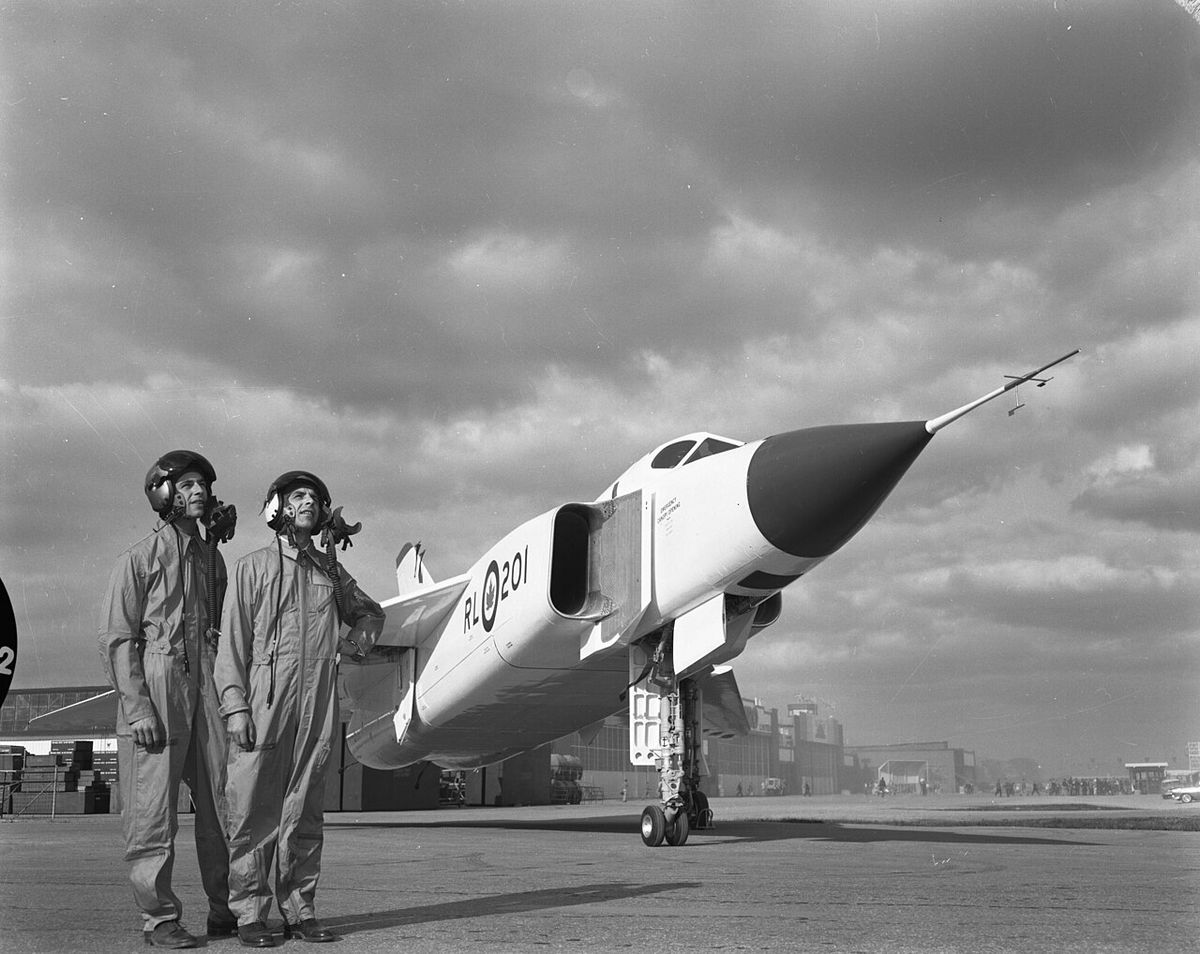
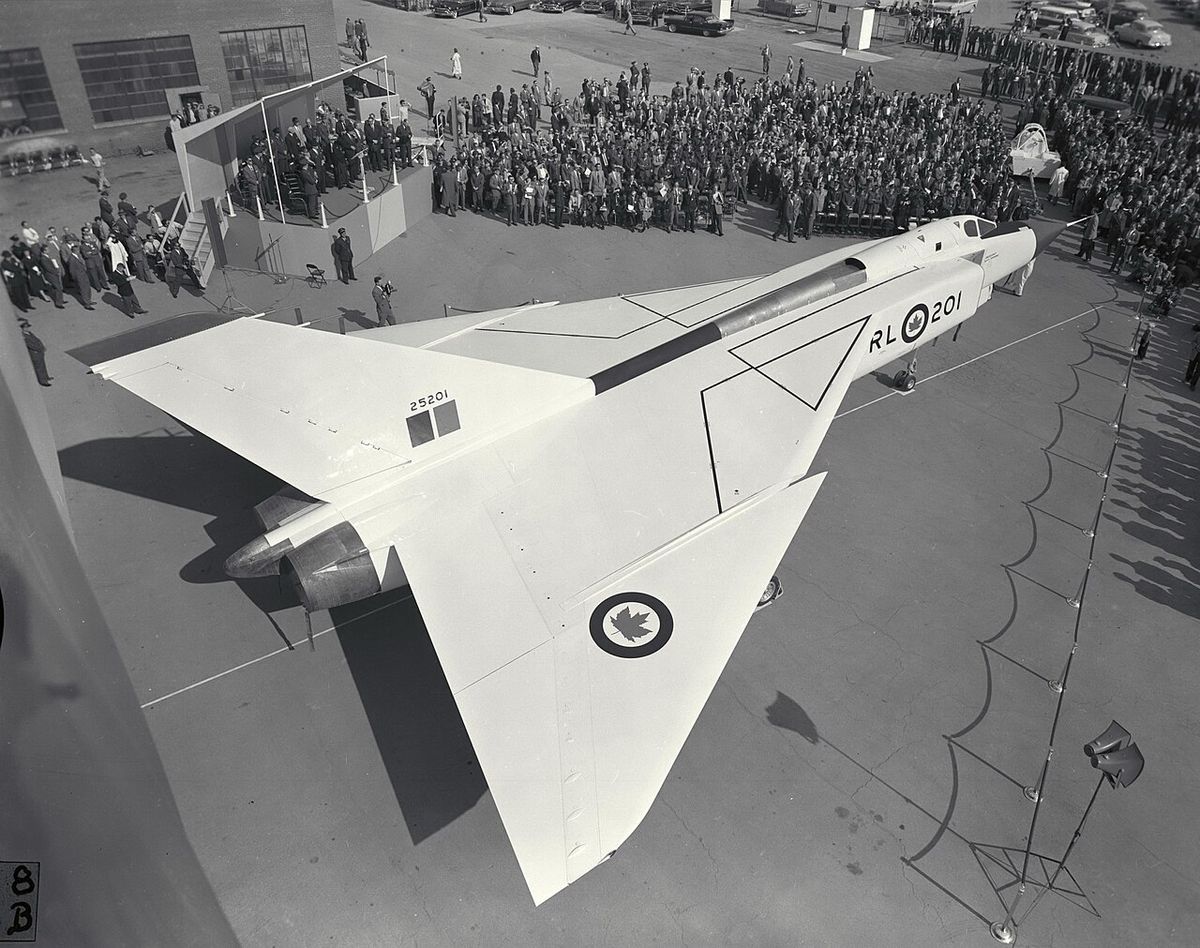
The first complete Arrow, designated RL-201, was publicly rolled out at the Avro plant in Malton on 4 October 1957, an event overshadowed by the Soviet Union's launch of Sputnik I the same day. The aircraft first flew on 25 March 1958 with Chief Development Test Pilot Squadron Leader Janusz Żurakowski at the controls. Four more J75-powered Mk. 1 aircraft, RL-202 through RL-205, were completed and delivered over the next eighteen months. Flight testing revealed no major design faults, with the aircraft demonstrating excellent handling characteristics attributed to its delta wing and its Stability Augmentation System.
The Arrow quickly proved its performance capabilities. It went supersonic on its third flight and on its seventh flight broke 1,000 mph while climbing at 50,000 feet. The highest speed achieved was an indicated Mach 1.95 in a dive, with a confirmed steady level flight speed of Mach 1.90. Avro estimated that the Mk. 2 version with the more powerful Iroquois engines would have a maximum speed of Mach 1.9 at 50,000 feet, a combat speed of Mach 1.5, and could climb to 50,000 feet in 4.1 minutes. The test program did encounter some minor issues, primarily with the complex, narrow tandem main landing gear designed to fit within the thin wing. Two landing incidents in 1958 resulted in gear collapses, one due to a jammed chain mechanism on 11 June and another linked to a flight control system anomaly on 11 November.
By early 1959, the first Mk. 2 Arrow, RL-206, equipped with the Canadian Orenda Iroquois engines, was built and ready for taxi tests in preparation for flight acceptance by RCAF pilots. The Iroquois engine itself had been successfully flight-tested mounted on a Boeing B-47 Stratojet, but it never had the chance to power an Arrow in flight. The five flying Mk. 1s had validated the airframe's design, meeting or exceeding most performance expectations even with the interim American engines.
The Sudden Cancellation and Destruction
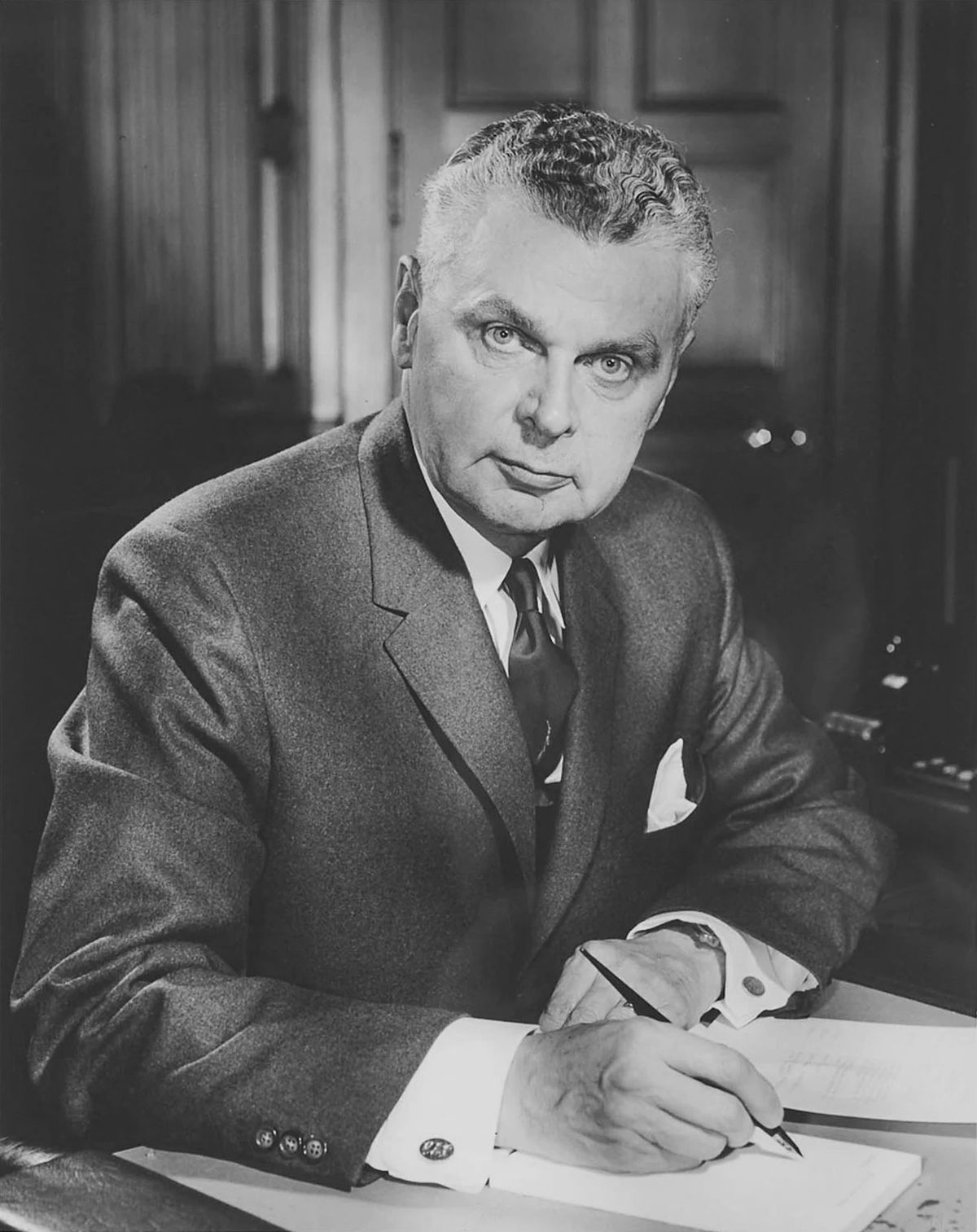
On 20 February 1959, the Conservative government of Prime Minister John Diefenbaker abruptly announced the cancellation of the entire CF-105 Arrow program. The decision was made before a scheduled project review could evaluate the program's status and future. The official reasons cited were the project's escalating costs and a shifting defence philosophy that questioned the need for manned interceptors. The government argued that the threat from Soviet bombers was diminishing and that future air defence could be handled more effectively and cheaply by surface-to-air missiles like the American BOMARC. The cancellation also terminated the development of the Orenda Iroquois engine.
The government's order extended beyond cancellation to the physical destruction of all existing aircraft and related materials. In April 1959, the completed Arrows, along with those still on the assembly line, were ordered to be cut apart and scrapped. Tooling, technical drawings, and plans were also destroyed. This action effectively ended Avro Canada as an aircraft manufacturer and resulted in the dispersal of its highly skilled engineering and production workforce, many of whom found employment with NASA and American aerospace firms. The destruction has remained a topic of intense debate and controversy. Key Artifacts and Surviving Components
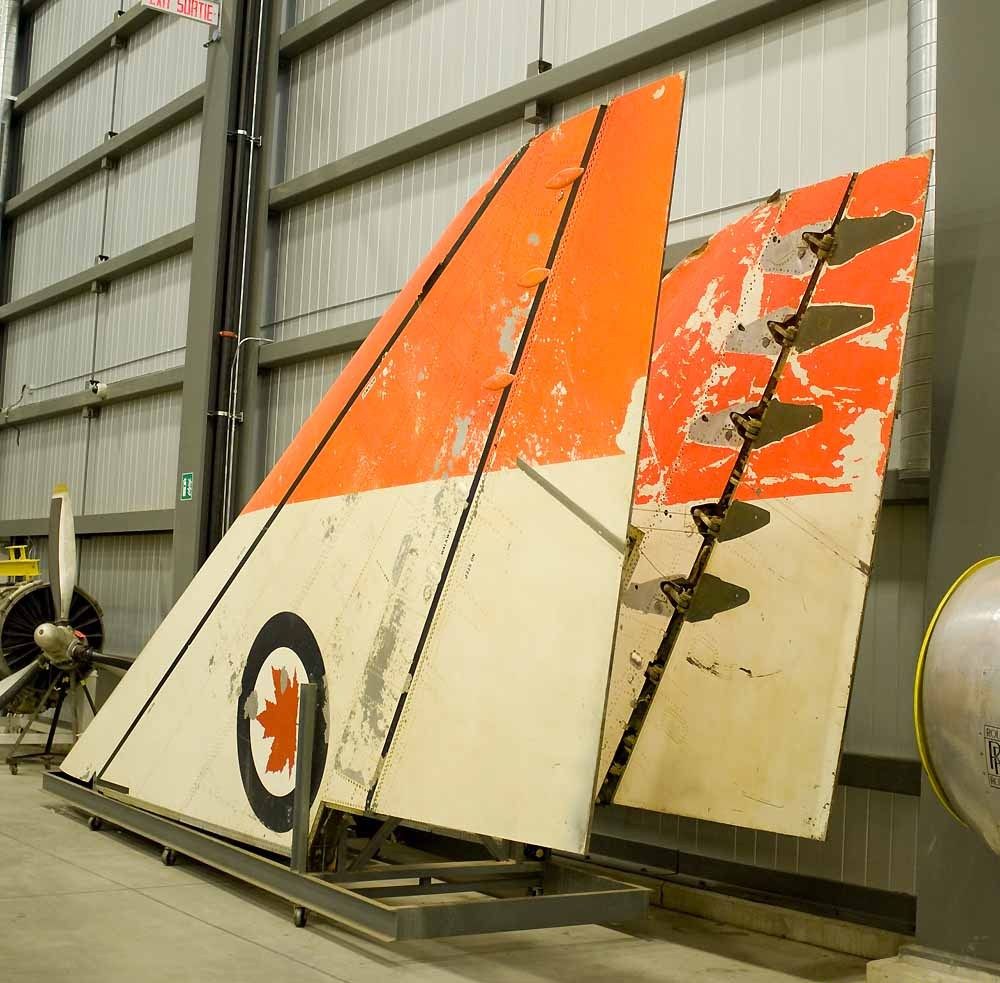
Despite the systematic destruction, a small number of Arrow components survived. The largest surviving piece is the nose section of RL-206, the unflown Mk. 2 aircraft. It was saved to be used as a pressure chamber at the Institute of Aviation Medicine in Toronto and was later donated to the Canada Aviation and Space Museum in Ottawa in 1965. Other surviving artifacts include two main landing gear legs, a Pratt & Whitney J75 engine used in test flights, an Orenda Iroquois engine, and various wingtips and small airframe parts. Extensive archival material including blueprints, photographs, reports, and models is held by museums and Library and Archives Canada. No complete Arrow airframe survived the scrapping order.
The Search for Lost Test Models
While the full-scale Arrows were scrapped, the story of the nine one-eighth scale free-flight test models launched over Lake Ontario between 1954 and 1957 has fueled decades of speculation and underwater search efforts. These models, used for aerodynamic drag and stability testing, were mounted on Nike rocket boosters and launched from Point Petre on the Lake Ontario shore, crashing into the water after their flights. For years, their location was unknown. A dedicated project called 'Raise the Arrow' began a more systematic search, partnering with the Royal Canadian Air Force to narrow a search area on the lakebed. Using sonar technology mounted on an autonomous submarine, the team made a significant discovery in 2017: they located an earlier 'Delta Test Vehicle' that predated the Arrow models. This vehicle was successfully recovered in 2018. Subsequently, the team has located four of the nine small-scale Arrow models. These recovered artifacts are undergoing conservation and are destined for display, with the Delta Test Vehicle already on exhibit at the Canada Aviation and Space Museum.
Technical Specifications and Planned Capabilities
The Avro Arrow was a large, twin-engine, delta-wing interceptor designed for all-weather, high-altitude operation. Its technical specifications, particularly for the never-realized Mk. 2 version with its intended Canadian engines and weapons systems, illustrate the ambitious scope of the project. The aircraft's performance estimates were derived from wind tunnel data, computer simulations, and the flight testing of the Mk. 1 prototypes. The following table outlines key specifications and estimated performance for the Arrow Mk. 2 as projected by Avro in 1955.
| Category | Specification / Estimate |
|---|---|
| Crew | 2 (pilot and weapons systems officer) |
| Length | 77 ft 9 in (23.70 m) |
| Wingspan | 50 ft (15 m) |
| Wing Area | 1,225 sq ft (113.8 m²) |
| Powerplant (Mk. 2) | 2 × Orenda Iroquois turbojets |
| Maximum Speed | Mach 1.9 at 50,000 ft |
| Combat Speed & Manoeuvrability | Mach 1.5 at 50,000 ft, capable of 1.84g turn without energy loss |
| Time to 50,000 ft | 4.1 minutes |
| Service Ceiling | 62,000 ft (rate of climb 500 ft/min) |
| Mission Radius (High-speed) | 400 nautical miles |
| Mission Radius (Low-speed) | 630 nautical miles |
| Ferry Range (estimated) | 1,500 nautical miles |
| Armament (as of 1956) | Internal bay for Sparrow II air-to-air missiles |
The aircraft's armament was housed in a large internal weapons bay to reduce drag. The original plan included a variety of weapons, but by 1956, the RCAF had settled on the advanced, radar-guided Sparrow II missile paired with the Astra fire-control system. The cancellation of the Sparrow II by the US Navy in 1956 forced Canadair to take over its development in Canada, adding cost and complexity. The Arrow's sheer size was notable. At approximately 49,040 lb empty weight, it was a heavily armed, long-range interceptor.
Cultural Legacy and Historical Significance
The Avro Arrow transcends its brief physical existence to occupy a central place in Canadian cultural memory. Its story is a national narrative of technological achievement, cut short by political decision-making, resulting in a 'brain drain' of skilled personnel. The image of the sleek, white delta-winged interceptor has become a symbol of lost potential. The mystery surrounding its destruction and the subsequent searches for remnants have amplified its presence in the national consciousness.
The Arrow is frequently referenced in books, documentaries, and a notable television miniseries. It is commemorated on coins, stamps, and in museum exhibits across the country. Institutions like the Canada Aviation and Space Museum in Ottawa and the Canadian Air and Space Conservancy work to preserve its physical artifacts and the personal stories of those who worked on the program. The recent recovery of the test models from Lake Ontario has renewed public interest. The Arrow endures as an emblem of Canadian ingenuity and ambition.
Questions about Avro Canada CF-105 Arrow
Why was the Avro Arrow cancelled?
The Avro Arrow was cancelled on 20 February 1959 by the government of Prime Minister John Diefenbaker. The primary official reasons were the project's escalating costs and a shift in defence strategy. The government believed the threat from manned Soviet bombers was decreasing and that future air defence could be handled more cost-effectively by unmanned surface-to-air missiles, specifically the American BOMARC system. The cancellation decision was made abruptly, before a scheduled project review could be completed. The government also cited the growing threat of intercontinental ballistic missiles.
How fast could the Avro Arrow fly?
During flight testing, the Arrow Mk. 1 prototypes, powered by Pratt & Whitney J75 engines, achieved a maximum indicated speed of Mach 1.95 in a dive, with a confirmed steady level flight speed of Mach 1.90. Avro engineers estimated that the planned Mk. 2 version, equipped with the more powerful Canadian Orenda Iroquois engines, would have a maximum speed of Mach 1.9 at 50,000 feet. The aircraft was designed for a sustained combat cruise speed of Mach 1.5 at high altitude.
Are there any surviving Avro Arrow aircraft?
No complete Avro Arrow aircraft survived the government-ordered destruction in 1959. However, several significant components were saved. The largest surviving piece is the nose section and nose gear of RL-206, the unflown Mk. 2 aircraft, which is on display at the Canada Aviation and Space Museum in Ottawa. Other surviving artifacts include landing gear legs, a J75 engine, an Iroquois engine, wing outer panels from RL-203, and a vast collection of archival documents and models.
What happened to the scale models launched over Lake Ontario?
During development between 1954 and 1957, Avro launched nine one-eighth scale models on rockets over Lake Ontario from Point Petre for aerodynamic testing. These models crashed into the lake and were lost. Starting in 2017, the 'Raise the Arrow' project, using sonar technology, successfully located and recovered an earlier Delta Test Vehicle in 2018 and has since found four of the nine small-scale Arrow models. These recovered artifacts are being restored for museum display at the Canada Aviation and Space Museum and the National Air Force Museum of Canada.
What made the Avro Arrow technologically advanced?
The Arrow incorporated several groundbreaking technologies for its time. It was one of the first production aircraft designed with a fly-by-wire control system, where pilot inputs were transmitted electronically. Its thin delta wing required the first 4,000 psi hydraulic system to power the control surfaces. It also featured an innovative 'artificial feel' system to give pilots feedback. The aircraft was designed to be built directly from a production line using the Cook-Craigie plan, skipping the traditional hand-built prototype phase to accelerate development.
What was the impact of the cancellation?
The cancellation immediately put 14,528 Avro employees out of work, along with nearly 15,000 in the supply chain. It ended Avro Canada as an aircraft manufacturer. A team of 32 Avro engineers, led by chief aerodynamicist Jim Chamberlin, joined NASA's Space Task Group, contributing significantly to projects Mercury, Gemini, and Apollo, emblematic of a 'brain drain' to the United States. In 1961, the RCAF obtained 66 McDonnell CF-101 Voodoo aircraft to fill the role intended for the Arrow.
Sources and further reading
- Avro Canada CF-105 Arrow (Wikipedia)
- From Lift Off to Legendary: The Lore Behind the Avro Arrow (mint.ca)
- Avro Canada CF-105 Arrow 2 - Ingenium (ingenium.ca)
Checked by the Nosy Mag desk. Last updated 2026-10-19.