Canada Border Services Agency
The Canada Border Services Agency (CBSA) is the federal law enforcement agency responsible for border control, immigration enforcement, and customs services in Canada. Established in 2003, it consolidated customs from the Canada Customs and Revenue Agency, immigration enforcement from Citizenship and Immigration Canada, and port-of-entry food inspection from the Canadian Food Inspection Agency. The agency plays a critical role in national security by screening travellers and goods, enforcing immigration laws, and combating the illegal movement of contraband. It operates at over 1,200 locations across Canada and internationally, employing over 16,500 public servants to protect the country's economic and social integrity.
History and establishment
The Canada Border Services Agency was created in 2003 through an order-in-council that amalgamated border-related functions from three legacy agencies. Prior to this, border security was divided, with customs handled by the Canada Customs and Revenue Agency, immigration enforcement by Citizenship and Immigration Canada, and food inspection at ports of entry by the Canadian Food Inspection Agency. An auditor general's report identified systemic issues with this divided model, including ineffective inter-agency communication and an inability to share certain security information. The consolidation aimed to create a single, integrated border management organization. Alain Jolicoeur was appointed as the CBSA's inaugural president. The agency's creation was later formalized by the Canada Border Services Agency Act, which received royal assent on 3 November 2005.
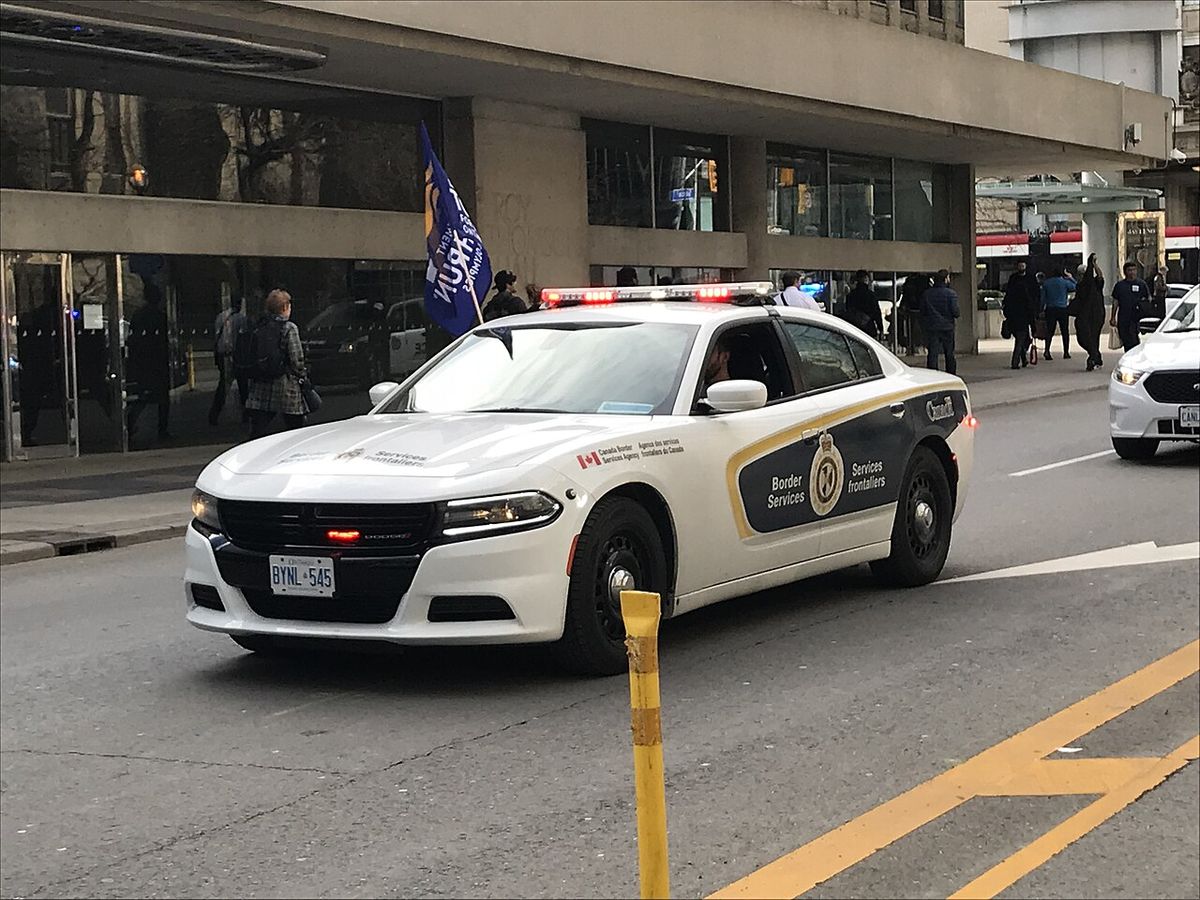
One of the first major operational changes for the new agency was the arming of its front-line officers. Until 2006, Border Services Officers, like their Canada Customs and Revenue Agency predecessors, did not carry firearms. That year, the Government of Canada approved the CBSA Arming Initiative, a ten-year strategy to arm and train officers. The 2006 federal budget allocated $101 million for sidearms and to eliminate single-person border crossings. Prime Minister Stephen Harper announced in August 2006 that arming would begin in early 2007, starting with the busiest and most dangerous ports of entry like the Windsor-Detroit crossing. The initiative officially concluded in 2016, with the Beretta Px4 Storm pistol selected as the standard sidearm. As of 2019, officers at all ports of entry were issued firearms, though those working inside major airport terminals must store and lock their firearms after finishing their duty.
Structure and operations
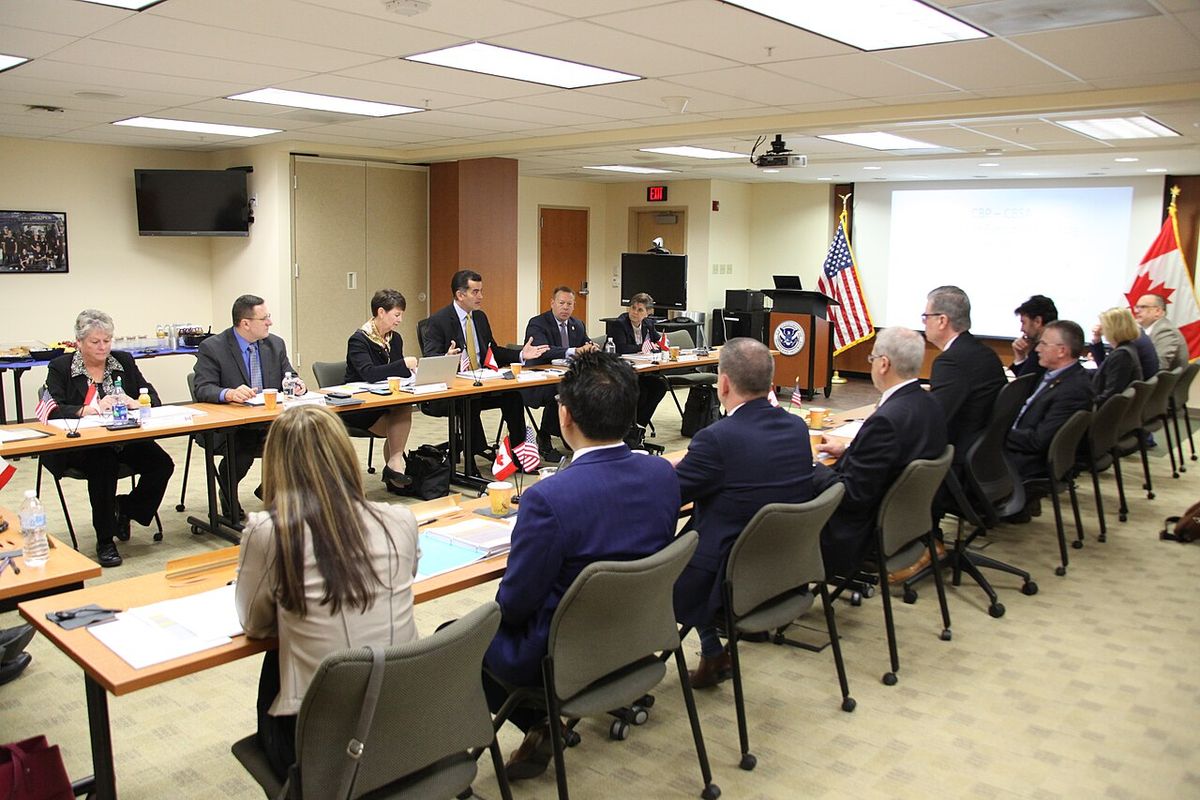
The CBSA is overseen by Parliament through the Minister of Public Safety and Emergency Preparedness. It operates approximately 1,200 service locations across Canada and maintains a presence in 35 other countries. The agency provides 24-hour service at 117 land border crossings and 10 of the 13 international airports it serves. Its operational mandate is divided into two core responsibilities: border management and border enforcement. Border management focuses on intelligence, risk assessment, and facilitating the legitimate flow of people and goods. Border enforcement involves immigration enforcement actions and supporting the prosecution of individuals who violate Canadian law. The agency also oversees operations at three major sea ports and three CBSA mail centres.
In its 2026 to 2027 Departmental Plan, the CBSA outlined key priorities and operational context. Total planned spending for that fiscal year is $3,069,895,577, with a planned full-time equivalent staff of 17,999. A central government commitment is the recruitment, training and deployment of 1,000 new CBSA officers over three years to bolster enforcement capacity. As of April 2, 2026, the agency confirmed that 42 of these targeted officers had been trained and deployed, consisting of 28 previously deployed officers plus a new 14-officer cohort. The agency will also enhance border integrity and expand telephone reporting in remote border areas, with certain permits extended until November 30, 2026.
Border Services Officers
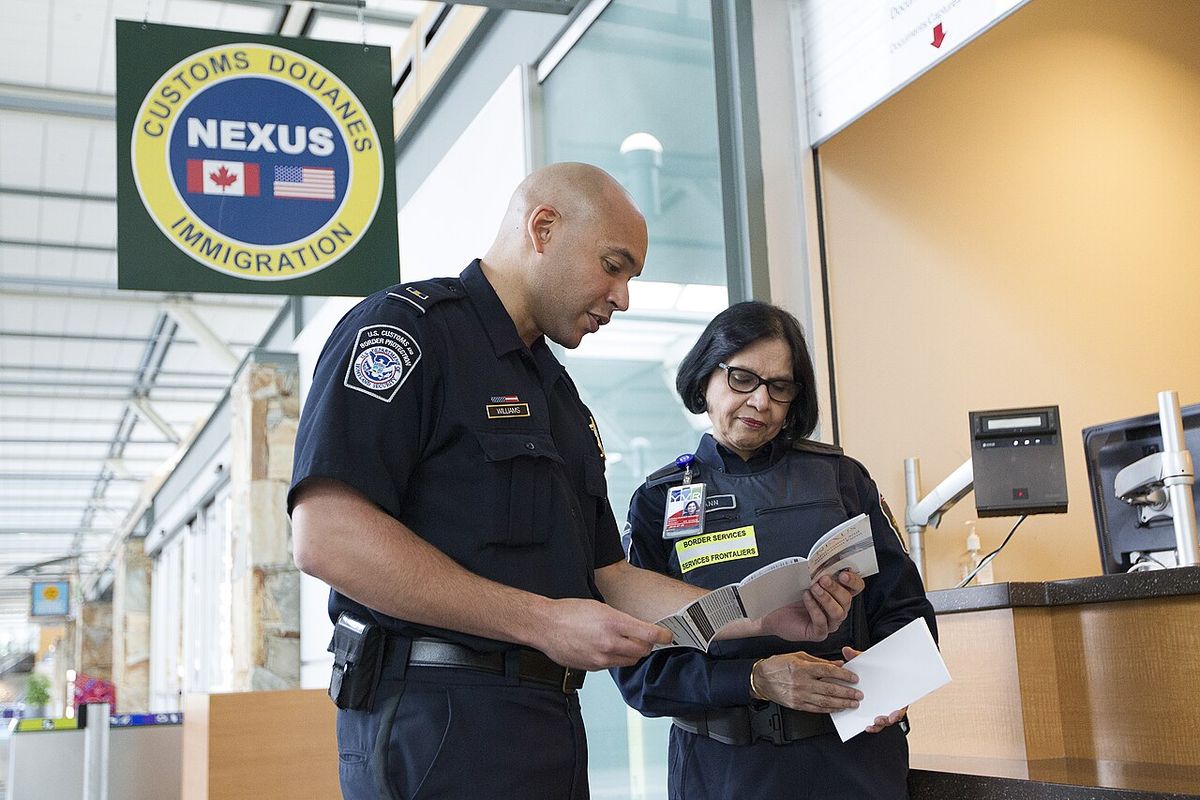
Border Services Officers (BSOs) are the federal law enforcement officers who serve as the CBSA's front-line personnel. While not a title derived from a single piece of legislation, BSOs receive multiple legislative designations that grant them authority. Under the Customs Act they are designated as Customs Officers, under the Immigration and Refugee Protection Act as Immigration Officers, and under the Quarantine Act as Screening Officers. When enforcing customs or immigration legislation, they are considered Peace Officers under the Criminal Code. Their powers to arrest for Criminal Code offences are specifically granted through ministerial appointments under section 163.4 of the Customs Act or by Section 99.1 of the Customs Act when at customs offices performing normal duties.
BSOs are equipped with handcuffs, pepper spray, collapsible batons, and Beretta Px4 Storm pistols. All BSOs undergo rigorous training at the CBSA College in Rigaud, Quebec. The training begins with a four-week online Pre-Officer Induction Training Program, followed by an intensive 18-week in-person Officer Induction Training Program. This program covers a wide range of topics including criminal law, immigration and customs legislation, and control and defensive tactics. The training ensures officers are prepared for the complex decisions required at ports of entry. The CBSA gives hiring preference to eligible veterans, Canadian citizens and permanent residents over other candidates eligible to work in Canada.
Immigration enforcement and detention
The CBSA plays a central role in Canada's immigration system, having assumed the port-of-entry and enforcement mandates formerly held by Citizenship and Immigration Canada. Officers screen persons entering the country and are responsible for removing those found to be inadmissible or unlawfully present. The agency reported that from January to March 2026, it removed 5,260 individuals found inadmissible to Canada. Most individuals in Canada without status are failed refugee claimants whose applications were rejected by the Immigration and Refugee Board, rather than people who entered without examination. As of the end of 2003, estimates suggested there were up to 200,000 illegal immigrants in Canada, most residing in Ontario.
The agency operates inland enforcement teams that track down and remove foreign nationals who are in the country illegally. It also manages detention facilities, known as immigration holding centres, in Laval, Quebec, Toronto, Ontario, and Surrey, British Columbia. The CBSA works closely with domestic law enforcement partners and United States counterparts to manage migration challenges. For instance, the agency and the Royal Canadian Navy have considered increased marine patrols to address illegal migration by boat from Saint Pierre and Miquelon to Newfoundland and Labrador, a distance of about 5.5 nautical miles. High unemployment in the French territory has spurred this migration, acknowledged by the Government of France.
Intelligence, investigations and compliance tools
The CBSA maintains a comprehensive intelligence program to support operational decision-making. Information is collected from sources including domestic and international partners, joint operations, technical means, covert surveillance, and human intelligence. The intelligence directorate conducts a border risk assessment every two to three years, evaluating threats like drug smuggling, illegal migration, and the movement of illicit goods such as child pornography and illicit tobacco. It also prepares a national port risk assessment biennially, ranking ports of entry by risk level based on traffic volume, enforcement data, and intelligence. The 2006 assessment ranked 23 of 168 ports as high-risk, while a 2004 assessment covered 220 ports.
The agency's Criminal Investigations unit investigates and pursues prosecution for offences against border legislation. Investigators handle activities such as executing search warrants, conducting forensic examinations on digital devices, and assisting foreign customs administrations through mutual legal assistance treaties. For technical infractions where intent may not be present, the CBSA uses the Administrative Monetary Penalty System (AMPS), implemented in December 2005, which imposes monetary penalties based on the severity and frequency of the infraction. For more serious or deliberate violations, goods may be seized or subject to forfeiture. The agency also operates the Border Watch toll-free line, a confidential tip line for the public to report suspicious cross-border activity, which is distinct from general crime tip lines.
Detector Dog Service
The CBSA's Detector Dog Service (DDS) is a vital tool for detecting contraband. The program began with three canine units at the Windsor port of entry in 1978 and has since expanded to 69 detector dog teams stationed at ports across Canada. Dogs begin training between 11 and 16 months of age and work for an average of 8 to 10 years. They live full-time with their handler, who is a Border Services Officer, and are transported in air-conditioned vehicles that act as mobile kennels. The CBSA primarily uses Labrador Retrievers for detecting firearms, drugs, and currency, while Beagles are used for detecting food, plants, and animals.
Detector dog teams undergo a 10-week training course at the CBSA Learning Centre. The CBSA uses passive detector dogs, which sit beside the source of a scent when they detect it, a method adopted in 1993. This is preferred over active dogs that bark or scratch, as it allows for more peaceful circulation among passengers. The dogs work in mail, air, land, and marine facilities and are trained for specific detection profiles. The CBSA looks for certain characteristics in potential detector dogs.
- Ability and desire to retrieve
- Good physical condition
- Alertness
- Sociability
- Boldness
- Suitable temperament
Only about one in ten dogs that begin the training at the CBSA Learning Centre eventually become operational detector dogs. These dogs, which start training between 11 and 16 months old, are selected for characteristics like alertness and a good temperament. Detector dogs provide Border Services Officers with one of the most effective tools in the detection of contraband such as drugs, firearms, or currency. Their ability to accurately locate the source of a scent saves significant time during labour intensive examinations of vehicles, luggage, and cargo, speeding up the process for both officers and travellers.
Examination authority and powers
All persons and goods entering Canada are subject to examination by CBSA officers. The intensity of an examination can range from a few questions to a strip-search, depending on the officer's reasonable suspicion. Officers derive their authority from the Customs Act and the Immigration and Refugee Protection Act, and they must adhere to strict search protocols and procedures. Examinations are conducted to ensure compliance with customs and immigration legislation, and officers also enforce other Acts of Parliament as designated Peace Officers under the Criminal Code. The agency will also seize items it labels obscene, as it did in February 2009 when it detained and banned two films by adult film director Michael Lucas.
The agency has the authority to seize items it deems obscene. This power was contested in a case that reached the British Columbia Supreme Court in 2000, involving the targeting of materials imported by Little Sisters Book and Art Emporium. The court found that border officials had wrongly delayed, confiscated, destroyed, damaged, prohibited, or misclassified materials on numerous occasions due to systemic targeting. The CBSA's Policy On The Classification Of Obscene Material states that the ingestion of someone else's urine with a sexual purpose makes a film obscene. These examinations and seizures are a key part of the agency's mandate to control what enters the country.
Recent developments and oversight
In August 2021, around 8,500 employees of the agency represented by the Public Service Alliance of Canada and the Customs and Immigration Union went on a work to rule strike. This strike occurred just days before COVID 19 restrictions on crossing the Canada United States border were due to be eased. Having been without a collective bargaining agreement since 2018, the demands of the strike were an increase in salaries to reach equality with other law enforcement officials in Canada, increased protections against harassment and discrimination, as well as the implementation of a policy to allow non uniformed officials to work from home. An agreement was reached between the workers and the Canadian government in the evening of the same day, ending the strike after one day.
The agency has also faced scrutiny regarding its handling of information. In February 2024, the Information Commissioner initiated a systemic investigation into the CBSA's responses to access to information requests related to the ArriveCAN application. The investigation, detailed in a special report tabled in Parliament in June 2026, found the CBSA failed to conduct reasonable searches for six requests because it did not search a deleted Slack workspace used by the project team between 2020 and 2023. The investigation identified weaknesses in information management, including the use of non-government email accounts and insufficient governance over third-party collaboration tools, but found no evidence to support allegations that a senior official permanently destroyed relevant records. The CBSA accepted the Commissioner's recommendations for new governance policies, enhanced training and improved information management controls.
Canada, United States cooperation and mandate context
One of the central purposes for the CBSA's creation was to address heightened security concerns after the September 11 attacks and to respond to criticisms, particularly from the United States, that Canada was not doing enough to ensure the security of North America. The agency works closely with United States counterparts as part of its mandate to secure the shared border. This cooperation is integral to managing the flow of legitimate trade and travel while intercepting threats. The CBSA's integrated approach, combining customs, immigration, and food inspection, was designed in part to facilitate more effective collaboration with U.S. border agencies.
The agency operates in a complex 24/7 environment, responding to emerging global threats and trends. Its mandate, as outlined in its departmental plan, is to provide integrated border services that support national security and public safety while facilitating legitimate trade and travel. In 2026 to 2027, the agency will continue implementing aspects of Canada's Border Plan, including efforts to prevent the entry of firearms and illicit drugs like fentanyl, combat human trafficking and trade-based money laundering, and counter transnational organized crime. The CBSA's mission balances the need for security with the economic necessity of keeping borders open for business, and it works with partners including the Royal Canadian Mounted Police, provincial and territorial governments, and Indigenous governments to achieve this.
Questions about Canada Border Services Agency
What does the Canada Border Services Agency do?
The Canada Border Services Agency is responsible for integrated border management, including customs, immigration enforcement, and food inspection at ports of entry. Its officers screen travellers and goods entering Canada, enforce immigration laws by removing inadmissible individuals, and work to prevent the illegal importation of drugs, firearms, and other contraband. The agency also conducts criminal investigations related to border offences and manages intelligence programs to assess risks. It oversees approximately 1,200 service locations across Canada and in 35 other countries.
Are CBSA officers armed?
Yes, Border Services Officers are armed. The CBSA Arming Initiative, a ten-year strategy approved in 2006, equipped officers with sidearms, concluding in 2016. Officers carry Beretta Px4 Storm pistols along with other use-of-force equipment like pepper spray and batons. The first officers to be armed were at the busy Windsor-Detroit crossing in early 2007. However, officers working inside major airport terminals are not authorized to be armed while on duty in those areas and must store their firearms after their shift.
How many people does the CBSA employ?
The CBSA employs over 16,500 public servants. According to its 2026 to 2027 Departmental Plan, the agency has a planned full-time equivalent staff of 17,999 for that fiscal year. The agency is also in the process of recruiting and deploying 1,000 new officers over a three-year period to strengthen border security. As of April 2, 2026, 42 of these new officers had been trained and deployed, comprising a 28-officer group from earlier and a new 14-officer cohort.
Can the CBSA search my electronic devices at the border?
Yes, as part of their examination authority, CBSA officers can examine electronic devices such as phones and laptops. The intensity of any examination, including of electronic devices, depends on the officer's reasonable suspicion. All examinations must adhere to strict protocols and procedures established under the Customs Act and other relevant legislation. The purpose is to ensure compliance with Canadian law regarding the importation of goods and the admissibility of persons. Officers are trained to conduct these searches within legal parameters.
How do I report suspicious border activity?
The CBSA operates the Border Watch toll-free info line for citizens to report suspicious cross-border activity directly and confidentially. This line is specifically designed for border-related intelligence, differentiating it from general crime tip lines like CrimeStoppers or the RCMP info line. Reports can include information about suspected smuggling, illegal migration, or other activities that threaten border security. The information is used by the agency's intelligence program to inform risk assessments and operational planning.
What is the CBSA's budget?
For the 2026 to 2027 fiscal year, the CBSA's total planned spending is $3,069,895,577. This funding supports all agency operations, including border management, enforcement, and internal services. The CBSA's 2026 to 2027 Departmental Plan outlines these financial details. The agency oversees approximately 1,200 service locations across Canada and employs over 16,500 public servants. This budget supports its core responsibilities of border control, immigration enforcement, and customs services.
Sources and further reading
- Canada Border Services Agency (Wikipedia)
- Canada Border Services Agency (Re), 2026 OIC 46 (oic-ci.gc.ca)
- Canada Border Services Agency 2026 to 2027 ... (cbsa-asfc.gc.ca)
Checked by the Nosy Mag desk. Last updated 2026-10-27.