South Asian Canadians
South Asian Canadians are Canadians who trace their ancestry to South Asia or the Indian subcontinent, a region that includes the nations of India, Pakistan, Bangladesh, Nepal, Bhutan, Sri Lanka, and the Maldives. This community also includes immigrants from South Asian diaspora communities in places like East and South Africa, Guyana, Trinidad and Tobago, Fiji, and Mauritius. Their history in Canada dates to the late 19th century, with the first well-known record being Punjabi Sikh soldiers visiting British Columbia in 1897. According to the 2021 census, they number 2,571,400 people, constituting 7.1 percent of Canada's total population and forming the country's largest visible minority group.
Terminology and Identity
The term South Asian Canadian encompasses a wide range of ethnic, linguistic, and national origins. In the Canadian context, 'Asian' is a broad category that includes people from East Asia, Southeast Asia, South Asia, Central Asia, and West Asia. The specific designation 'South Asian' refers to individuals with origins in the seven nations of the Indian subcontinent. Historically, the term 'East Indian' was used to distinguish people from India from Indigenous peoples and from Afro-Caribbeans, also known as West Indians. This term has become less common with the adoption of the more inclusive 'South Asian' category in official census and public discourse. Canadians from this background may identify by their specific country of origin, such as Indian Canadian or Pakistani Canadian, or by cultural and linguistic backgrounds like Punjabi, Tamil, Bengali, or Gujarati. While informal terms like 'Brown' or 'Desi' are used in community settings, they are generally avoided in formal contexts due to their ambiguity. Statistics Canada lists both cultural backgrounds like Bengali, Gujarati, Tamil, Malayali, and Goan in addition to categories like East Indian, Bangladeshi, Sri Lankan, and Pakistani.
Early History and Settlement Patterns
The presence of South Asians in Canada dates back to the country's formative years. The 1871 census recorded 11 people of South Asian origin, with eight living in Ontario and three in Nova Scotia. The largest early concentration was in what is now Lakeshore, Ontario. The better-known Pacific migration wave began at the turn of the 20th century, spurred by stories of high wages in British Columbia. Punjabi Sikh soldiers stationed in British territories like Malaya and Hong Kong began emigrating to the western province, finding work in mining, logging, and railways. By 1900, the population was estimated at 100, growing to 5,179 by 1908, concentrated almost entirely in British Columbia. These early settlers, often arriving without families, established tight-knit communities and built the first religious institutions. Many of these men settled in the British Columbia Interior, Greater Vancouver, Vancouver Island, and the Fraser Valley in what is now Abbotsford.
The early 20th century was a period of both community building and severe legal restriction. Punjabi Sikh settlers built the first Gurdwara in Canada and North America in Golden, British Columbia, in 1905. This was followed by temples in Vancouver's Kitsilano neighbourhood in 1908, Abbotsford in 1911, Victoria in 1912, and other mill towns like Fraser Mills and Queensborough. The Gur Sikh Temple in Abbotsford, designated a national historic site in 2002, is now the oldest existing Gurdwara in the country. However, in 1907, the government of British Columbia enacted laws stripping South Asians of provincial voting rights and barring them from public office and other professions. The federal government followed with the 'continuous journey' regulation on January 8, 1908. This law required immigrants to arrive by a direct, unbroken voyage from their country of origin, and with no direct steamship route from India, it effectively banned new immigration. The impact was immediate, with annual immigration from India dropping from 2,623 in 1907-08 to just six in 1908-09. Many South Asians already in Canada migrated to the United States, with some becoming victims of the 1907 Bellingham riots.
- 1871: First census record of South Asians in Ontario and Nova Scotia.
- 1902: Punjabi Sikh settlers arrive in Golden, BC, to work at the Columbia River Lumber Company.
- 1905: First Gurdwara in Canada built in Golden (destroyed by fire in 1926).
- 1907: BC government enacts laws denying South Asians political rights and access to professions.
- January 8, 1908: Federal 'continuous journey' regulation enacted, halting most immigration.
- 1908: Second Gurdwara built in Kitsilano, Vancouver (demolished 1970).
- 1911: Gur Sikh Temple opens in Abbotsford, BC, now the oldest existing Gurdwara in Canada.
- 1912: Gurdwaras established in Victoria and at the Fraser Mills settlement.
- 1919: Gurdwaras built in Queensborough (New Westminster) and Paldi on Vancouver Island.
The Komagata Maru Incident and Community Advocacy
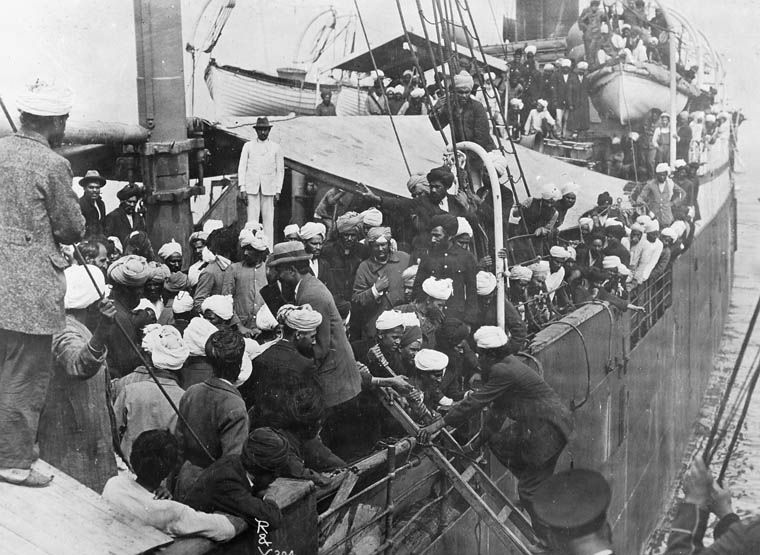
The most significant test of the 'continuous journey' rule was the Komagata Maru incident of 1914. Chartered by Punjabi businessman Baba Gurdit Singh, the Japanese steamship Komagata Maru sailed from Kolkata with 376 passengers, all British subjects from Punjab. Of the passengers, 337 were Punjabi Sikhs, 27 were Punjabi Muslims, and 12 were Punjabi Hindus. Upon arrival in Vancouver, the ship was denied docking rights, with politicians like Conservative MP Henry Herbert Stevens campaigning against its entry. For two months, the vessel was held at Coal Harbour in Burrard Inlet while a 'shore committee' of settled South Asian Canadians, led by Husain Rahim, Muhammad Akbar, and Sohan Lal Pathak, raised $22,000 and launched a legal challenge. The British Columbia Court of Appeal ultimately ruled it had no authority to overrule immigration officials. On July 23, 1914, after the harbour tug Sea Lion attempted to pull the ship out to sea, resulting in rioting, the Komagata Maru was forced to depart. Only 20 passengers were allowed to stay in Canada. The incident remains a central event symbolizing early discriminatory immigration policy and the community's organized resistance against it.

Mid-Century Growth, Political Milestones and Economic Life
The restrictive 'continuous journey' regulation remained in force until 1947, the same year South Asian Canadians finally won the right to vote federally and in British Columbia. Following the independence of India, Pakistan, and Ceylon (Sri Lanka), Canada established annual immigration quotas of 150 Indians, 100 Pakistanis, and 50 Sri Lankans. The community's population, which had declined to 2,342 by 1911, began a slow climb. A landmark moment occurred in 1950 when Naranjan 'Giani' Singh Grewall was elected to the board of commissioners in Mission, British Columbia, becoming the first person of South Asian descent elected to public office in North America. Grewall, a millwright, union official, and sawmill owner, was re-elected in 1952 and became mayor of Mission in 1954. He established himself as a major employer in the Fraser Valley, owning six sawmills and helping create Mission's municipal tree farm. His political career, however, was met with severe racism. During his 1956 provincial election campaign for the Co-operative Commonwealth Federation, he received personal threats, and his mills and house were set ablaze by arsonists. He was found dead from a gunshot wound in a Seattle motel in 1957.
The 1950s and 1960s saw a gradual liberalization of Canada's immigration policies, moving away from racial and national restrictions. This shift, combined with the post-war baby boom, led to rapid population growth. From 2,158 people in 1951, the community grew to 6,774 in 1961 and then to 67,925 by 1971. Settlement patterns in British Columbia urbanized, with new immigrants forming enclaves on the south slope of Vancouver city in the latter half of the 1950s and 1960s, leading to the establishment of the Punjabi Market (Little India) in the Sunset neighbourhood. By the 1970s and 1980s, about 66 percent of South Asians in Metro Vancouver lived in Vancouver city, primarily in Sunset, with the remaining 33 percent in Burnaby, Richmond, and other suburbs. A secondary concentration developed in the Edmonds neighbourhood of South Burnaby in the 1970s.
Diversification and New Immigration Waves
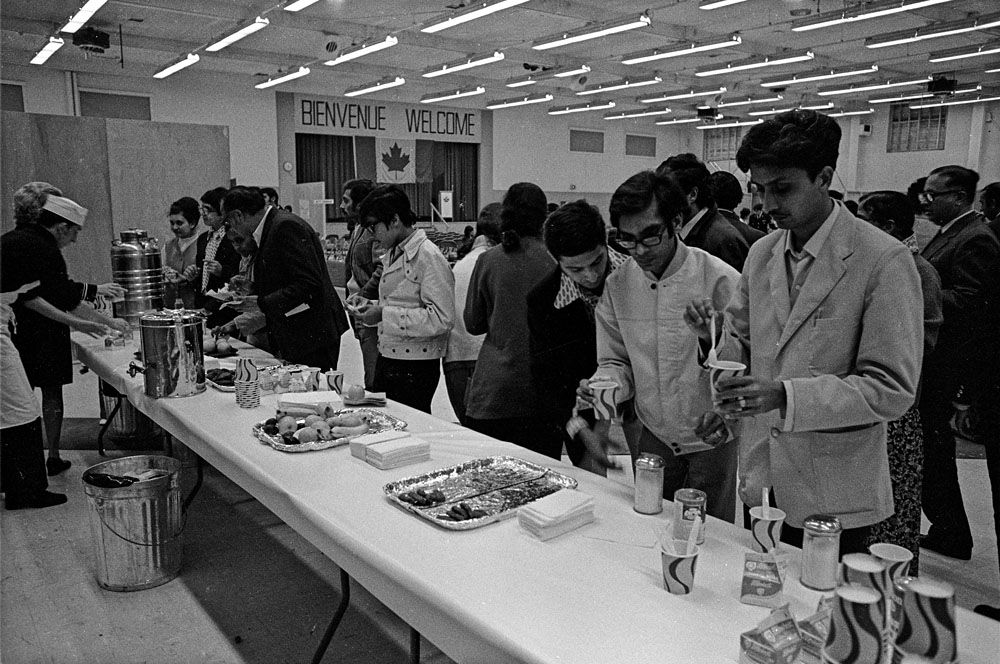
The 1970s marked a significant change in the South Asian Canadian community with new waves of immigrants from around the globe. A major influx came from East African nations like Uganda, Kenya, and Tanzania, where South Asians faced discrimination as a market-dominant minority. One notable event was Ugandan dictator Idi Amin's expulsion of 80,000 Ugandan Indians, with nearly 20,000 eventually coming to Canada. These immigrants were often educated professionals who entered Canada's service sector or started businesses, differing from the earlier industrial focus of many Sikh immigrants. Around the same time, significant numbers of Indo-Caribbeans from Guyana and Trinidad and Tobago, as well as Indo-Fijians, Indian South Africans, and Indo-Mauritians, began arriving. Many of these groups were descendants of indentured labourers brought by the British colonial government and brought distinct cultural traditions. This era transformed South Asian communities in major cities into communities with varied religious, linguistic, and national backgrounds.
Demographic Profile and Geographic Distribution
According to the 2021 Canadian census, 2,571,400 people reported South Asian origins, making them the largest visible minority group in the country at 26.7 percent of the visible minority population. They represent 7.1 percent of Canada's total population and 35.1 percent of the Asian Canadian population. The community is heavily concentrated in a few major urban centres. Over half (60.3 percent) of South Asian Canadians live in the Greater Toronto and Metro Vancouver areas. Toronto is home to the largest population, with 1,182,485 South Asian Canadians. Vancouver follows with 369,295, then Calgary (153,200), Edmonton (123,340), and Montreal (121,260). The provinces of Ontario, British Columbia, and Alberta collectively host the vast majority of the population. This concentrated settlement has led to the development of well-known cultural and commercial districts.
| Metropolitan Area | South Asian Population (2021) |
|---|---|
| Toronto | 1,182,485 |
| Vancouver | 369,295 |
| Calgary | 153,200 |
| Edmonton | 123,340 |
| Montreal | 121,260 |
| Winnipeg | 63,805 |
| Ottawa | 60,780 |
Cultural Contributions, Observances and Recognition
South Asian Canadians have made substantial contributions to all facets of Canadian life, including politics, business, arts, sports, and cuisine. Their cultural influence is visible in the wide availability of restaurants, film festivals, and music. Major religious festivals like Diwali, Vaisakhi, Eid, and Holi are now publicly celebrated in cities across the country. Holi, the Festival of Colours which celebrates spring, is observed on the lunar calendar. In 2026, it falls on March 4. The community's history and achievements are recognized nationally during Asian Heritage Month every May. This month provides an opportunity to learn about the historical and current contributions made by Asian Canadians, including those of South Asian descent. Literature also reflects these experiences, such as Shenaaz Nanji's Governor General's Award-nominated novel 'Child of Dandelions', which deals with the expulsion of Indians from Uganda and their immigration to Canada. In 2011, the 12th International Indian Film Academy Awards were hosted in Toronto. The comedian Russell Peters has drawn on his heritage for much of his comedic material.
Historical Legacy and Commemoration
The historical legacy of South Asian Canadians is preserved in physical sites, place names, and public memory. The Gur Sikh Temple in Abbotsford is a National Historic Site, commemorating the early religious and social life of Punjabi settlers. Streets like Grewall Street in Mission honour pioneers like Naranjan Singh Grewall. The story of the Komagata Maru is taught in schools and remembered in official apologies. The community's growth from a few dozen individuals in the 19th century to millions today demonstrates a trajectory of overcoming legal barriers, building economic prosperity, and enriching Canadian society. Their continued demographic significance ensures their history remains a fundamental part of understanding modern Canada. In 2000, Ujjal Dosanjh became the first Canadian of South Asian origin to serve as a provincial premier when he became premier of British Columbia. In the 2015 federal election, 16 South Asian Members of Parliament were elected from Ontario alone, the highest in Canadian history.
Questions about South Asian Canadians
Who is considered a South Asian Canadian?
A South Asian Canadian is a Canadian who traces their ancestry to South Asia or the Indian subcontinent, which includes India, Pakistan, Bangladesh, Nepal, Bhutan, Sri Lanka, and the Maldives. The term also includes Canadians whose families migrated from South Asian diaspora communities in places like East and South Africa, the Caribbean, Fiji, and Mauritius. People may identify by their specific national origin, such as Indian Canadian, or by cultural-linguistic backgrounds like Punjabi or Tamil. Statistics Canada uses the 'South Asian' category in the census, which can be further divided by nationality.
What was the Komagata Maru incident?
The Komagata Maru incident was a central event in 1914 that highlighted Canada's discriminatory immigration policies. A Japanese steamship, the Komagata Maru, chartered by Punjabi businessman Baba Gurdit Singh, arrived in Vancouver carrying 376 British subjects from Punjab. Citing the 'continuous journey' regulation, authorities refused to let the passengers disembark. After a two-month standoff and a failed legal challenge by a shore committee of settled South Asians who raised $22,000, the ship was forced to return to India. Only 20 passengers were admitted to Canada. The incident is a landmark case of early anti-South Asian sentiment and community resistance.
When did South Asian Canadians get the right to vote?
South Asian Canadians were granted the right to vote in federal elections in 1947. This came after the repeal of the continuous journey regulation and other restrictive laws. The right to vote in provincial elections in British Columbia, where the community was most concentrated, was also restored in 1947. This milestone was a crucial step toward full civic participation and preceded the election of the first South Asian Canadian to public office, Naranjan Singh Grewall, in 1950.
Which Canadian cities have the largest South Asian populations?
The largest South Asian Canadian communities are in the major metropolitan areas of Ontario and Western Canada. As of the 2021 census, Toronto has the largest population at 1,182,485, followed by Vancouver with 369,295. Calgary (153,200), Edmonton (123,340), and Montreal (121,260) also have significant populations. Over half (60.3 percent) of all South Asian Canadians live in the Greater Toronto and Metro Vancouver areas. These urban centres feature cultural districts, religious institutions, and businesses that serve the community.
What are some important cultural festivals celebrated by South Asian Canadians?
South Asian Canadians celebrate a variety of cultural and religious festivals that reflect their diverse heritage. Major observances include Vaisakhi (a Punjabi harvest and religious festival), Diwali (the Hindu, Sikh, and Jain festival of lights), Eid al-Fitr and Eid al-Adha (Islamic holidays), and Holi (the Hindu spring festival of colours). Holi's date varies by the lunar calendar. In 2026, it falls on March 4. These festivals are often marked by public gatherings, parades, religious services, and community feasts, contributing to Canada's cultural scene.
How is the history of South Asian Canadians recognized in Canada?
The history and contributions of South Asian Canadians are recognized nationally during Asian Heritage Month, which is observed throughout the month of May. This provides a platform to learn about and honour the stories of Asian Canadians, including the early pioneers, the fight against discriminatory laws, and contemporary achievements. Specific historic sites like the Gur Sikh Temple in Abbotsford, BC, designated a National Historic Site in 2002, preserve the physical legacy of the community's early settlement. The Komagata Maru incident is also widely commemorated as a key moment in Canadian history.
Sources: Wikipedia and current public reporting, checked by the Nosy Mag desk. Last updated 2026-10-28.