Nuxalk
The Nuxalk Nation is a non-treaty First Nation whose traditional territory is centred on the Bella Coola Valley, known as Nuxalk in their language, and surrounding inlets and watersheds on the central coast of British Columbia. Historically known to outsiders as the Bella Coola, a name derived from the neighbouring Heiltsuk people, the Nuxalk people refer to themselves as Nuxalkmc and their language as It7Nuxalkmc. The Nation maintains a strong cultural identity rooted in ancestral governance, complex ceremonial traditions, and a deep connection to their unceded lands. These lands include areas from Kimsquit, the Dean River, South Bentinck Arm, Kwatna Inlet, King Island, and the Bella Coola River, where their ancestral villages were historically located.
Name and Composition
The name 'Bella Coola' is a derivation of the Heiltsuk word bəlxwəlá, meaning 'stranger,' and is not the preferred term used by the people themselves. Since the late 1970s, the collective term Nuxalk Nation has been adopted, derived from the name for the people of the Bella Coola River valley. The Nuxalkmc are composed of lineages from several ancestral villages that were gathered into the Bella Coola Valley through negotiation and government pressure in the late 19th and early 20th centuries. These groups include the Sutslhmc from Kimsquit, the Nutl'lmc from the Dean River, the Talyumc from South Bentinck Arm, the Kwalhnmc from Kwatna Inlet, the Istamc from King Island, and the Nuxalkmc from the Bella Coola River villages. As all these communities settled in the area of the lower Bella Coola River known as Nuxalk, they took this collective name. The Nation maintains extensive family ties with neighbouring peoples, particularly the Heiltsuk and the Ulkatchot’en.
Territory and Population
The Nuxalk traditional territory, known as Kulhulmcilh, encompasses the Bella Coola Valley, North and South Bentinck Arm, Dean Channel, and Kwatna Inlet on the central coast of British Columbia. By the 1920s, following population decline and colonial pressure, Nuxalk people from throughout this vast territory were consolidated at the village of Q’umk’uts’ at the mouth of the Bella Coola River. Today, the Nuxalk Nation governs seven reserves. According to the Nation, these reserves account for only 0.1 percent of their original traditional territory. The Nuxalk are a non-treaty nation and assert they have never ceded, sold, or surrendered their lands through war or treaty.
Pre-contact population estimates from oral histories and academic research suggest approximately 35,000 Nuxalk people. The 1862 Pacific Northwest smallpox epidemic was catastrophic, reducing the population to about 300 survivors by 1864. According to Indian and Northern Affairs Canada estimates, the total Nuxalk population is approximately 1,400 with nearly 900 living on the Nuxalk reserve in Bella Coola. However, the traditional Nuxalk government estimates the true population, including those not registered with the band, is closer to 3,000 people. More recent data from November 2025 reports a registered population of 1,852, with 926 people living on the Nuxalk reserve.
Language
The Nuxalk language, It7Nuxalkmc, is a Coast Salish language that is geographically isolated from its linguistic relatives. It is distinct from the surrounding Wakashan and Dene languages, though culturally the Nuxalk share many similarities with their Wakashan neighbours, the Heiltsuk. The language is considered critically endangered, with likely fewer than 20 fluent elder speakers remaining. However, there is a growing number of learning speakers due to concerted revitalization efforts. Language programs within Nuxalk communities, including school-based initiatives, aim to preserve and promote the language for future generations. The survival of It7Nuxalkmc is viewed as integral to maintaining cultural knowledge, identity, and the Nation's connection to its territory and history.
Traditional Society and Culture
Traditional Nuxalk society was organized around descent groups tracing lineage to founding ancestors who, according to oral history, descended from mountaintops to establish villages. People typically lived in their fathers' villages but maintained kinship ties to their mothers' lineages, creating a widespread network linking communities. Households lived in large cedar-plank dwellings that could house multiple families. Nuxalk life was characterized by an extremely rich ceremonial culture centred on the potlatch and secret societies. The potlatch, a complex system of governance, law, and wealth distribution, was banned under the Indian Act from 1884 to 1951 but remains a vital cultural institution today.
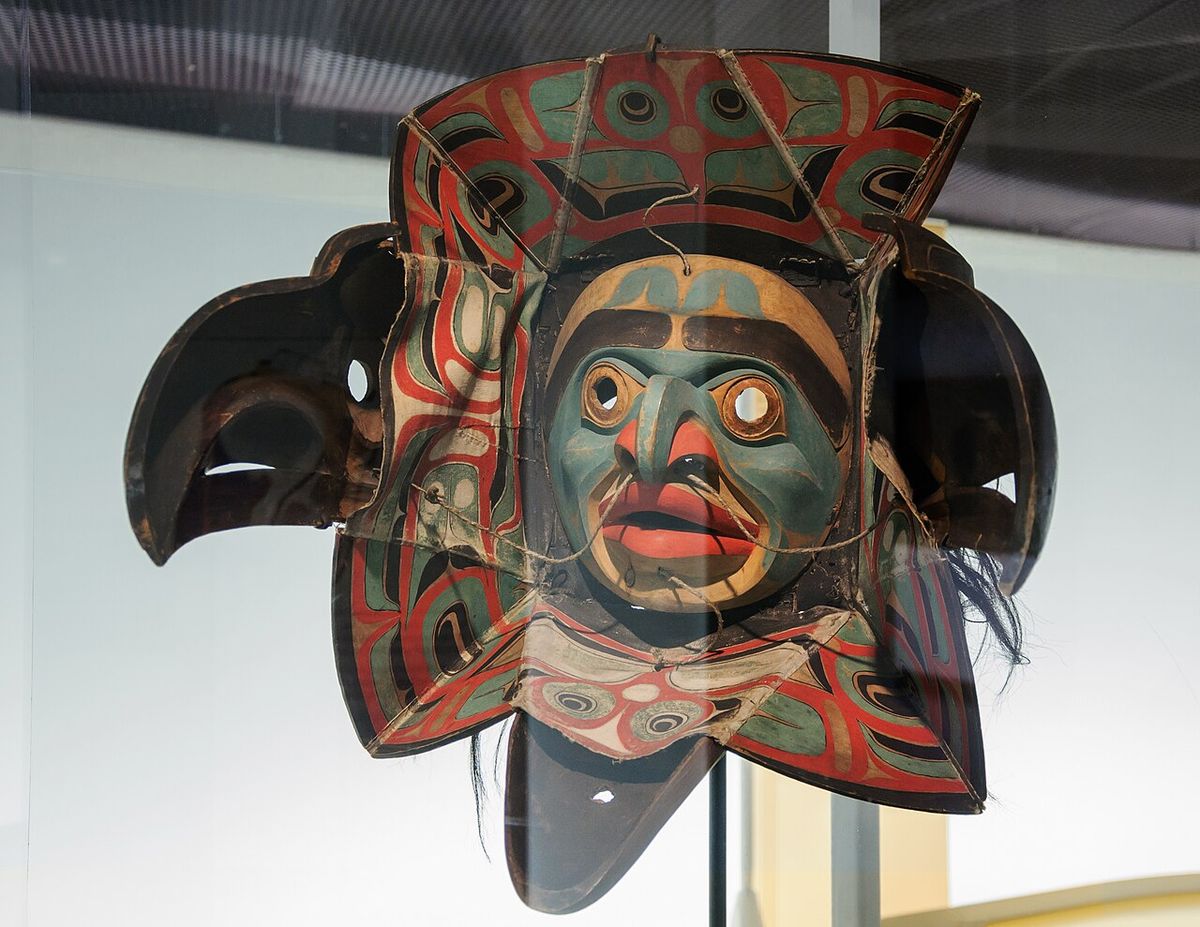
Nuxalk ceremonialism featured two main secret societies. Membership in the sisaok society was limited to chiefs and their relatives, with initiation involving seclusion and a public display of masked crest figures. The kusiut society dominated winter ceremonials, where each member performed dances imitating their supernatural patron. Nuxalk religion included belief in a creator god named Alhkwʼntam, a war goddess named Qamaits, and a sea god named Qʼumakwa. Family ancestry, including village origins, crests, and the sacred narratives known as smayusta, remains a fundamental and active part of Nuxalk identity. Knowledge of these lineages, songs, and dances continues to be passed down and practised through generations, reinforcing social bonds and historical continuity.
Historical Encounters and Colonial Impact
The first recorded European contact with the Nuxalk occurred in the summer of 1793. Captain George Vancouver briefly entered their waters, followed just weeks later by the overland expedition of Alexander Mackenzie, who was welcomed by the Nuxalk. This historic welcome is a point of pride and is preserved in Nuxalk oral tradition. The subsequent increase in settler presence and colonial policies deeply altered traditional life. Beyond the devastating smallpox epidemics, colonial programs like residential schools and the Indian Act aimed to assimilate Indigenous peoples. The Nuxalk were forcibly consolidated onto reserves, a process that involved negotiation with leaders like Chief Pootlass as well as direct government pressure. Despite these challenges, the Nuxalk have steadfastly maintained their systems of governance and refused to enter the British Columbia treaty process, asserting their inherent sovereignty and title to their territory.
Contemporary Governance and Initiatives
The Nuxalk Nation is the governing body for the Nuxalk people, with its Band Office located in Bella Coola. The Nation is a member of the Wuikinuxv Kitasoo Nuxalk Tribal Council and the Coastal First Nations alliance. Governance is rooted in Nuxalk Ancestral Governance, which refers to the roles and responsibilities that uphold the Nation and tether the people to their territories. The Nation is actively engaged with the Province of British Columbia in discussions regarding land and resource use within its asserted traditional territory, operating outside the formal treaty process. Key contemporary initiatives focus on cultural and language revitalization, housing, and sustainable community development.
The Nuxalk Nation Housing Department is committed to finding innovative and sustainable housing solutions. Community programs, such as the Strengthening Families Together, Indigenous workshop scheduled for October 2026, focus on family and community wellness. The Nation's story and cultural resilience have gained wider recognition through documentary films by Nuxalk filmmaker Banchi Hanuse. Her 2020 film Nuxalk Radio and the 2026 documentary Ceremony profile Nuxalk culture, environmental stewardship, and the ongoing journey of cultural survival.
Key Facts and Figures
The demographic and territorial data for the Nuxalk Nation illustrates both the impacts of history and contemporary realities. The following table presents key population statistics. The Nation is a non-treaty First Nation that has never ceded its territory. They govern seven reserves. The Nuxalk language is a critically endangered Coast Salish language with revitalization programs underway. Culturally, they are known for their rich ceremonialism, including the potlatch and secret societies. Their main community is in Bella Coola, British Columbia, and they are affiliated with the Wuikinuxv Kitasoo Nuxalk Tribal Council.
| Year | Registered Population | On-Reserve Population |
|---|---|---|
| 2021 | 1,786 | 912 |
| November 2025 | 1,852 | 926 |
Before contact, the Nuxalk population is estimated to have been approximately 35,000, according to oral histories and academic research. The 1862 Pacific Northwest smallpox epidemic reduced the Nuxalk to only 300 survivors by 1864. In 1902, the population was estimated at 302. Current Indian and Northern Affairs Canada population estimates indicate a total Nuxalk population of approximately 1,400 with nearly 900 of those living on the Nuxalk reserve in Bella Coola. However, according to the traditional Nuxalk government, the true Nuxalk population is closer to 3,000. In November 2025, the Government of Canada reported the registered population of Nuxalk was 1,852, with 926 people living on reserve.
Questions about Nuxalk
What does the name Nuxalk mean?
Within the Nuxalk language, 'Nuxalkmc' is the term for the people, and 'It7Nuxalkmc' is the term for the language. The name 'Bella Coola', often used in academic writing, is not preferred by the Nuxalk as it is a derivation of the neighbouring Heiltsuk people's name for the Nuxalk, meaning 'stranger'. These communities, from villages such as those at Kimsquit and the Dean River, were gathered in the Bella Coola Valley and took the collective name Nuxalkmc. The term is derived from the name for the Bella Coola River area, and its use in English has increased locally.
Where is the Nuxalk Nation located?
The Nuxalk people are centred in the area in and around Bella Coola, British Columbia within their wider traditional territory known as Kulhulmcilh. Their traditional territories are in and around Bella Coola, British Columbia, including North and South Bentinck Arm, Dean Channel, and Kwatna Inlet. By the 1920s, the Nuxalk were gathered in their current location in the Bella Coola Valley. The Nuxalk Nation Administration is located in Bella Coola.
How many Nuxalk people are there?
Current Indian and Northern Affairs Canada population estimates indicate a total Nuxalk population of approximately 1400 with nearly 900 of those living on the Nuxalk reserve in Bella Coola. However, according to the traditional Nuxalk government, the true Nuxalk population is closer to 3,000, including people of Nuxalk ancestry not registered with the band. Historically, before contact, the population is estimated to have been approximately 35,000, but it was drastically reduced to about 300 survivors by 1864 following the 1862 smallpox epidemic. In 1902, an estimate by James Mooney recorded 302 Nuxalk people.
Is the Nuxalk language still spoken?
The Nuxalk speak the Nuxalk language, known as It7Nuxalkmc. The Nuxalk language is considered critically endangered as there are likely under 20 fluent speakers. However, there are more learning speakers, and language programs offered in Nuxalk communities aim to further preserve and promote the language. The language is a Coast Salish language, but it is isolated from other Coast Salish languages.
Are the Nuxalk part of the BC treaty process?
No, the Nuxalk Nation is a non-treaty nation. The Nuxalk Nation has long asserted its rights and obligations and has never ceded, sold, surrendered, nor lost traditional lands through act of war or by treaty. The Nuxalk remain strongly against entering any treaty process. The Nuxalk Nation is engaged with the Province in discussions associated with land and resource use within its asserted traditional territory outside of the B.C. treaty process.
What is a notable recent film about the Nuxalk?
A notable recent film about the Nuxalk is Ceremony (2026), directed by Nuxalk filmmaker Banchi Hanuse. Nuxalk culture and society have been profiled in the documentary films of Banchi Hanuse, which also include Nuxalk Radio from 2020. These films explore themes of cultural survival and the community within the Nuxalk Nation in Bella Coola. The work represents a contemporary profile of Nuxalk society and its traditions.
Sources and further reading
- Nuxalk (Wikipedia)
- Nuxalk (Bella Coola) Nation, Province of British Columbia (www2.gov.bc.ca)
- Nuxalk (Bella Coola) (thecanadianencyclopedia.ca)
Checked by the Nosy Mag desk. Last updated 2026-10-30.