Francis Pegahmagabow
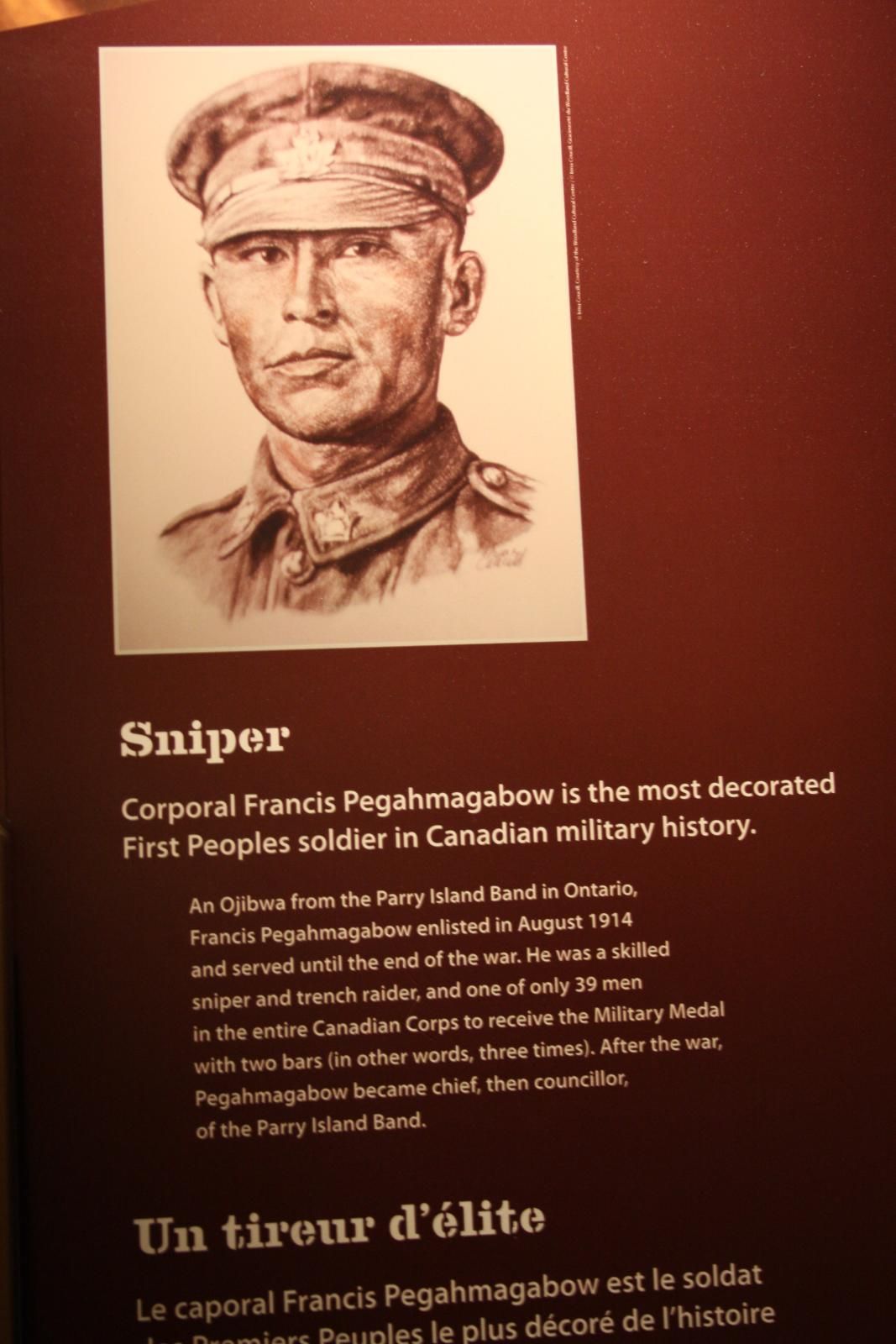
Francis Pegahmagabow was an Ojibwe soldier, politician, and activist from Canada, widely recognized as the most highly decorated Indigenous soldier in Canadian military history and the most effective sniper of the First World War. Serving as a sniper and scout, he was awarded the Military Medal with two bars for extraordinary bravery, one of only 39 Canadians to achieve this distinction. After the war, he became a chief and councillor for the Wasauksing First Nation and a leading advocate for Indigenous rights and self-determination. His legacy as a war hero and political leader continues to be honoured across Canada through memorials, educational institutions, and cultural works.
Early Life and Enlistment
Francis Pegahmagabow was born on March 9, 1891, on the Shawanaga First Nation reserve in Nobel, Ontario. His Ojibwe name was Binaaswi, meaning "the wind that blows off." After his father died when he was three, his mother left him to return to her home at Henvey Inlet First Nation, and Pegahmagabow was raised by elder Noah Nebimanyquod in Shawanaga. There he learned traditional Anishinaabe skills such as hunting, fishing, and the use of traditional medicine, while also practising a blend of Catholicism and Indigenous spirituality. He left school at age 12 to work in lumber and fishing camps, later becoming a marine firefighter. In January 1912, with financial aid secured by Parry Sound crown attorney Walter Lockwood Haight, he returned to complete his public school education. When the First World War began, Pegahmagabow volunteered in August 1914, joining the 23rd Canadian Regiment (Northern Pioneers) despite initial government discrimination that excluded minorities. He was based at CFB Valcartier and decorated his army tent with traditional symbols including a caribou. He deployed overseas in early October 1914 with the 1st Canadian Infantry Battalion of the 1st Canadian Division, the first contingent of Canadian troops sent to Europe, where his fellow soldiers nicknamed him "Peggy."
First World War Service and Sniper Record
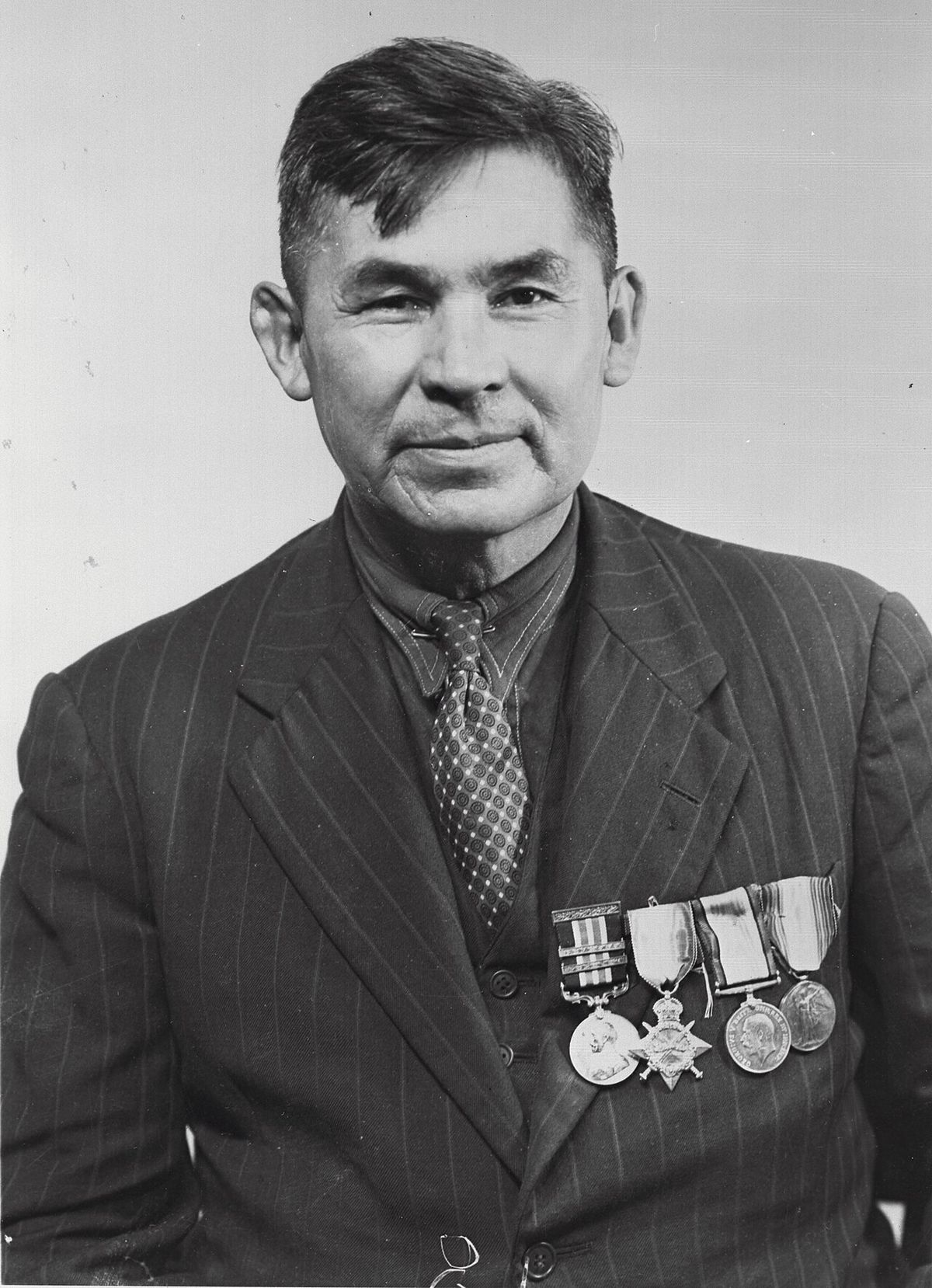
Francis Pegahmagabow's combat service began at the Second Battle of Ypres in April 1915, where he first established his reputation as a sniper and scout amidst the first German use of chlorine gas on the Western Front. He was promoted to lance corporal following this battle. His battalion fought at the Battle of the Somme in 1916, during which he was wounded in the left leg but recovered in time to rejoin his unit in Belgium. He received the Military Medal for carrying messages along the lines during the battles of Ypres, Festubert, and Givenchy. Initially, his commanding officer, Lieutenant Colonel Frank Albert Creighton, had nominated him for the Distinguished Conduct Medal, but it was downgraded. Pegahmagabow was a highly effective sniper, credited with killing 378 Germans and capturing 300 more, using the Ross rifle. He earned his first bar to the Military Medal for his role as a communications link during the Second Battle of Passchendaele in November 1917, where he guided lost reinforcements and maintained contact between flanking units. His second bar was awarded for actions at the Battle of the Scarpe on August 30, 1918, near Upton Wood, when he braved heavy fire to retrieve ammunition for his surrounded company. By war's end, he had achieved the rank of sergeant-major and was one of only 39 members of the Canadian Expeditionary Force to receive the Military Medal with two bars. He was also awarded the 1914-15 Star, the British War Medal, and the Victory Medal before being invalided back to Canada in 1919.
Post-War Military and Early Political Leadership
Upon returning to Canada, Pegahmagabow continued his military service as a non-permanent active member of the militia, joining The Northern Pioneers, later known as the Algonquin Regiment. Following in the footsteps of his father and grandfather, he was elected chief of the Parry Island Band, now known as Wasauksing First Nation, in February 1921. Once in office he caused a schism in the band after he wrote a letter calling for certain individuals and those of mixed race to be expelled from the reserve. He was re-elected in 1924 and served until he was deposed via an internal power struggle in April 1925. Before the motion could go through, Pegahmagabow resigned. A decade later, he was appointed councillor from 1933 to 1936. In 1933 the Department of Indian Affairs changed its policies and forbade First Nation chiefs from corresponding with the DIA. All correspondence had to go through the Indian agent. This gave huge power to the agent, something that grated on Pegahmagabow as he did not get along with his own agent, John Daly. First Nation members who served in the army during World War I were particularly active as political activists. Historian Paul Williams termed these advocates "returned soldier chiefs". This caused intense disagreements with Daly and eventually led to Pegahmagabow being deposed as chief. Daly and other agents were frustrated by his attempts, in his words, to free his people from "white slavery". The Indian agents labelled him a "mental case". In addition to the power struggle, he was a constant agitator over the islands in Georgian Bay of the Huron. The Regional First Nation governments claimed the islands as their own. During the Second World War, he worked as a guard at a munitions plant near Nobel, Ontario, and served as a sergeant-major in the local militia.
Indigenous Rights Advocacy and National Leadership
Francis Pegahmagabow's activism extended beyond local band politics to the national stage. In 1943, he became the Supreme Chief of the Native Independent Government, an early First Nations organization. He corresponded with and met other noted Indigenous figures including Fred Loft, Jules Sioui, Andrew Paull and John Tootoosis. His political career included a second term as chief of Wasauksing First Nation from 1942 to 1945. Pegahmagabow's advocacy was rooted in his wartime experience of equality and respect, which contrasted sharply with the systemic discrimination and control exerted by the Indian Act and its agents upon his return. He was a persistent critic of the Indian agent system and worked to assert First Nations sovereignty.
Personal Life and Family
Francis Pegahmagabow was a married father of six children. He maintained a deep connection to his Anishinaabe heritage and community throughout his life, residing on the Parry Island reserve. His son, Duncan Pegahmagabow, recalled that his father rarely spoke of his wartime exploits. Pegahmagabow died on the Parry Island reserve on August 5, 1952, at the age of 61. He is a member of the Indian Hall of Fame at the Woodland Centre in Brantford, Ontario. His memory is also commemorated on a plaque honouring him and his regiment on the Rotary and Algonquin Regiment Fitness Trail in Parry Sound. He was honoured by the Canadian Forces by naming the 3rd Canadian Ranger Patrol Group HQ Building at CFB Borden after him.
Honours, Memorials, and Cultural Depictions
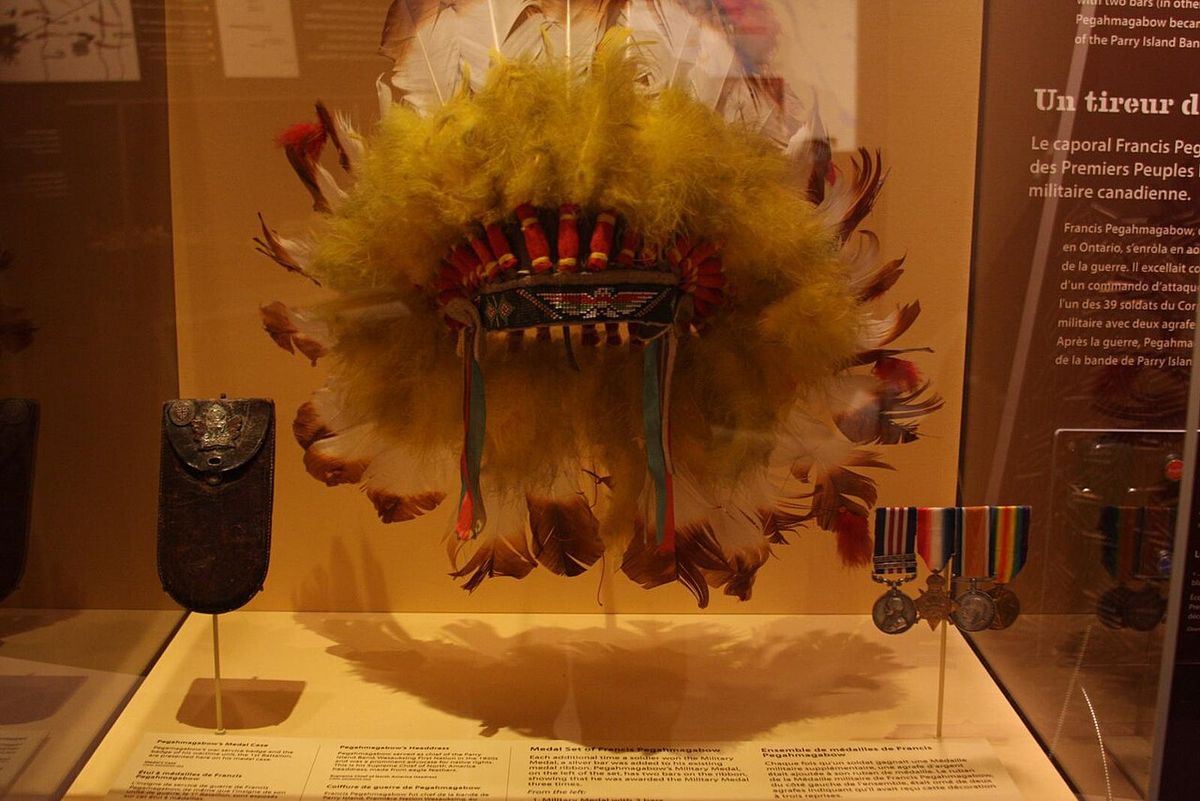
The legacy of Francis Pegahmagabow has been widely commemorated. In 2003, his family donated his Military Medal, bars, and chief's headdress to the Canadian War Museum. A life-sized bronze statue was erected in his honour in Parry Sound on National Aboriginal Day, June 21, 2016. The sculpture by Tyler Fauvelle features an eagle on one arm, a Ross rifle slung over the shoulder, and a caribou at its feet, representing his Caribou Clan. His life has inspired numerous artistic and educational projects. Canadian journalist Adrian Hayes wrote a biography titled Pegahmagabow: Legendary Warrior, Forgotten Hero, published in 2003, and another titled Pegahmagabow: Life-Long Warrior, published in 2009. The protagonist of Joseph Boyden's 2005 novel Three Day Road was inspired in part by Pegahmagabow. The musical Sounding Thunder, The Song of Francis Pegahmagabow has been touring Canada since 2018. The power metal band Sabaton released a song about him titled "A Ghost in the Trenches" in 2019. The play The Two Battles of Francis Pegahmagabow was launched in 2024, and he was portrayed by actor Keenan Keeshig in the 2022 film The Ace and the Scout. In 2020, he was one of eight finalists for the portrait on Canada's new $5 banknote. A significant recent honour is the Francis Pegahmagabow Elementary School, a new K-6 school in Parry Sound that opened on September 15, 2026.
Military Awards and Decorations
Francis Pegahmagabow's exceptional bravery was formally recognized through several military decorations. His awards demonstrate his consistent courage under fire across multiple major battles. The following table details his key service medals and the actions for which he was commended. Pegahmagabow's initial nomination for the Distinguished Conduct Medal was downgraded to the Military Medal. Historians and authors, including Joseph Boyden, have speculated that his First Nations heritage and the extraordinary nature of his sniper record may have contributed to him not receiving higher honours. Nonetheless, his three awards of the Military Medal place him in an elite group.
| Award | Date of Action / Conflict | Noted Reason for Award |
|---|---|---|
| Military Medal (MM) | 1915 to 1916 (Ypres, Festubert, Givenchy) | Carrying messages along the lines with great bravery and success. |
| First Bar to MM | November 6/7, 1917 (Passchendaele) | Maintained contact with flanking units and guided lost reinforcements during the attack. |
| Second Bar to MM | August 30, 1918 (Battle of the Scarpe, Orix Trench) | Retrieved ammunition under heavy fire for his surrounded company. |
| 1914-15 Star | 1914 to 1915 | Service in a theatre of war. |
| British War Medal | 1914 to 1918 | Service in the First World War. |
| Victory Medal | 1914 to 1918 | Service in the Allied forces during the First World War. |
Questions about Francis Pegahmagabow
What made Francis Pegahmagabow such an effective sniper in World War I?
Francis Pegahmagabow was credited with killing 378 Germans, making him one of the deadliest snipers in history. His effectiveness stemmed from his exceptional marksmanship, iron nerves, and patience, honed by his Anishinaabe upbringing where he learned hunting and tracking skills. He used the Ross rifle and operated often as a lone scout, developing a reputation for moving undetected behind enemy lines. He was also credited with capturing 300 enemy soldiers.
How many times was Francis Pegahmagabow awarded the Military Medal?
Francis Pegahmagabow was awarded the Military Medal three times. He received the initial medal for his actions as a messenger at the battles of Ypres, Festubert, and Givenchy. He earned a first bar to the medal for his role as a communications link during the Second Battle of Passchendaele in November 1917. He received a second bar for bravery at the Battle of the Scarpe in August 1918. He was one of only 39 Canadians to receive the Military Medal with two bars.
What political roles did Pegahmagabow hold after the war?
After the war, Francis Pegahmagabow served his community as chief of the Parry Island Band from February 1921. He was re-elected in 1924 and served until April 1925, and he also served as a councillor from 1933 to 1936. On a national level, in 1943, he became the Supreme Chief of the Native Independent Government, an early First Nations organization. His political life was marked by activism against the control of the Department of Indian Affairs and its local agents.
Why did Pegahmagabow have conflicts with the Department of Indian Affairs?
Pegahmagabow's conflicts with the Department of Indian Affairs centred on issues of autonomy and control. After a 1933 policy change, First Nations chiefs were forbidden from corresponding directly with the DIA, requiring all communication to go through the local Indian agent. Pegahmagabow, as a "returned soldier chief", fiercely resisted this imposed authority. He clashed repeatedly with his agent, John Daly, advocating for his people's rights and self-determination, which agents disparaged. These disagreements led to his being deposed as chief in 1925.
How is Francis Pegahmagabow honoured in Canada today?
Francis Pegahmagabow is honoured through numerous memorials and cultural works. A life-sized bronze statue stands in Parry Sound, unveiled in 2016. The Canadian Forces named the 3rd Canadian Ranger Patrol Group HQ Building at CFB Borden after him. His medals are displayed at the Canadian War Museum. A new elementary school in Parry Sound, the Francis Pegahmagabow Elementary School, opened in September 2026. His story is told in biographies, Joseph Boyden's novel Three Day Road, a touring musical, a Sabaton song, a play, and a 2022 film.
What was the Native Independent Government that Pegahmagabow led?
The Native Independent Government was an early First Nations political organization, and Francis Pegahmagabow became its Supreme Chief in 1943. This group was part of a wave of activism led by First Nations veterans of the First World War who sought greater rights and self-determination. Pegahmagabow's leadership in this organization followed his earlier service as chief and councillor for the Wasauksing First Nation. His work represented a continued fight against the restrictive policies of the Department of Indian Affairs.
Sources and further reading
- Francis Pegahmagabow (Wikipedia)
- Francis Pegahmagabow (veterans.gc.ca)
- New school in Parry Sound named after WWI vet Francis ... (cbc.ca)
- Chief Francis Pegahmagabow (bnia.ca)
- Francis Pegahmagabow (thecanadianencyclopedia.ca)
Checked by the Nosy Mag desk. Last updated 2026-10-25.