Coast Salish peoples
The Coast Salish peoples are a large, diverse grouping of ethnically and linguistically related Indigenous nations whose traditional territories span the Pacific Northwest Coast, encompassing the southwestern coast of British Columbia, Washington State, and northwestern Oregon. They are not a single nation but a cultural and linguistic family comprising many independent First Nations and tribes, speaking distinct but related languages. Their ancestral homelands coincide with major modern metropolitan areas including Vancouver, Victoria, and Seattle. Coast Salish cultures have been defined by complex social structures, rich artistic traditions, and a deep relationship with the marine and riverine environments of the Salish Sea.
Historical Overview and European Contact
The history of Coast Salish peoples in their territories extends back thousands of years, with archaeological evidence such as the settlement at X̱á:ytem near Mission, British Columbia, dating to around 3000 BCE. Other significant village sites like c̓əsnaʔəm (Marpole Midden) show occupancy from 2000 BCE, with continuous habitation in places like the Duwamish River estuary from the 6th century CE. Early European contact began with Spanish explorers Juan Carrasco and José María Narváez in the Strait of Georgia in 1791 and the Vancouver expedition's brief encounter with the Squamish in 1792. The fur trade era intensified with Simon Fraser's journey down the Fraser Canyon in 1808, where he was repelled by Musqueam warriors, and the establishment of trading posts like Fort Langley in 1827 and Fort Nisqually in 1833. Throughout the early 19th century, Coast Salish communities also faced raids from northern nations like the Haida and Lekwiltok, who sought slaves and loot. The period from the 1810s to the 1850s was marked by these external pressures alongside increasing trade, which brought new goods but also accelerated social change.
The mid-19th century brought catastrophic demographic collapse due to introduced diseases, most devastatingly the smallpox epidemic of 1862. That outbreak began when an infected miner from San Francisco arrived in Victoria, and the subsequent forced removal of First Nations encampments by authorities spread the disease widely, killing roughly half of the affected Indigenous population, with mortality reaching 90 percent in some communities. This period also saw the imposition of colonial treaties, including the Douglas Treaties on Vancouver Island between 1850 and 1854 and the Stevens Treaties in Washington Territory from 1854 to 1855. These agreements were often misunderstood by Indigenous signatories and led to the loss of vast territories. The subsequent decades involved adaptation to a wage economy in logging, fishing, and hop farming, while government policies like the 1885 ban on the potlatch in Canada aimed to suppress cultural practices. The 20th century witnessed a long struggle for rights, cultural resurgence beginning in the 1960s, and landmark legal victories like the 1974 Boldt Decision in the US, which affirmed treaty fishing rights and was upheld by the Supreme Court in 1979.
Social Structure and Kinship
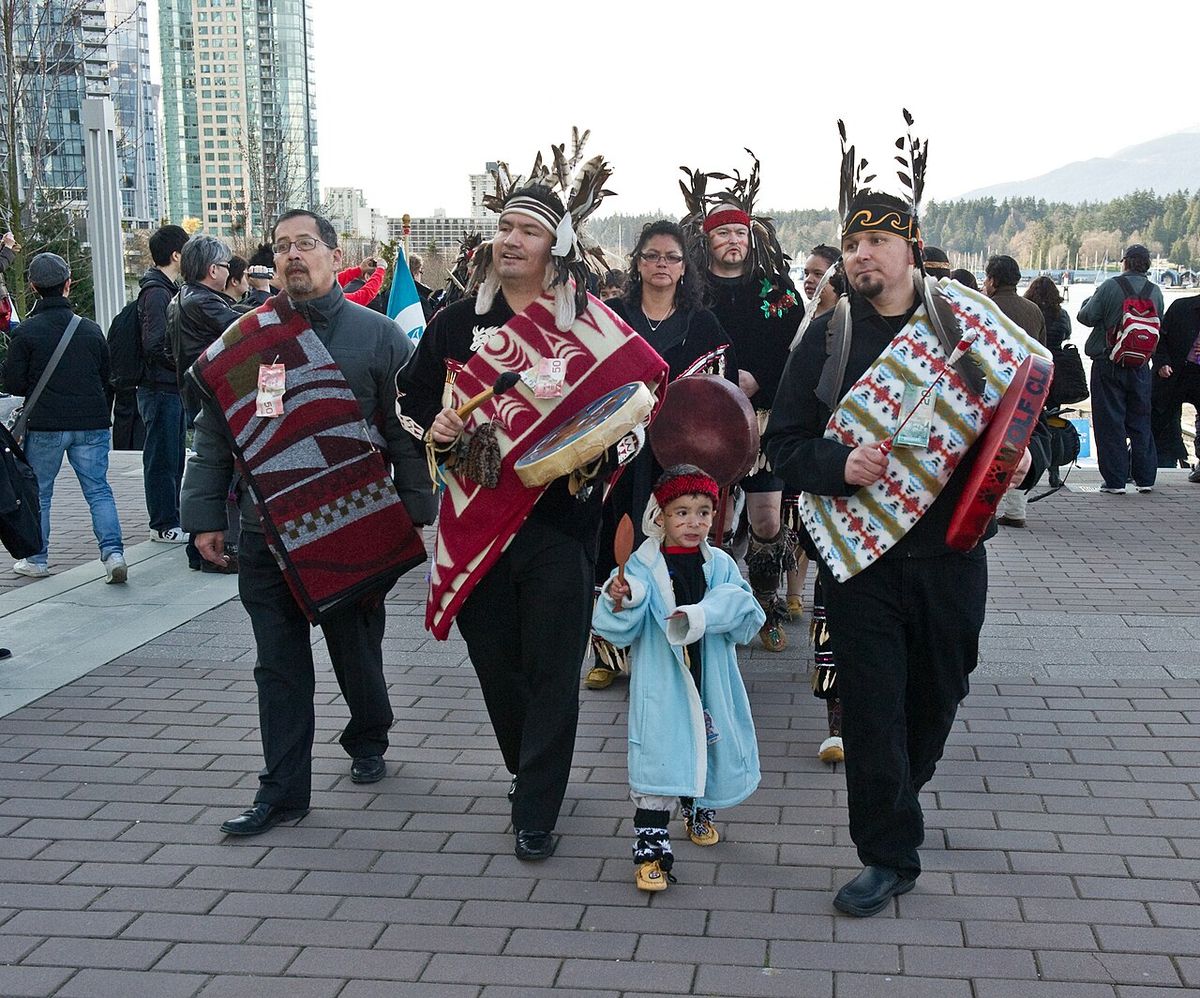
Coast Salish societies were complex, hierarchical and oriented toward property and status. Social organization was based on a class system comprising an upper class, a lower class, and slaves, with status largely hereditary. Nobility was determined by genealogy, wise resource management, intertribal kinship ties, and possession of esoteric spiritual knowledge. Villages, often consisting of large extended families inhabiting longhouses, were linked through extensive networks of marriage, feasting, and ceremony, with strong ties especially within the same watershed. There were no formal political institutions or standing armies. Leadership was assumed by high-ranking males who acted as ceremonial leaders, and warfare was primarily defensive. External relations extended throughout the Puget Sound-Georgia Basin and east to Sahaptin-speaking lands, as well as between coastal and Interior Salish peoples like the Lil'wat, Nlaka'pamux and Syilx.
Kinship systems were both patrilineal and matrilineal, with inheritance and descent passed through both male and female lines. Among groups like the Skagit, bilateral kinship formed a sacred and carefully knit bond within society. A patrilocal residence pattern was common, where a wife moved to her husband's village. The practice of slavery existed, with slaves considered property rather than tribal members, and children were born into slavery. Physical markers of status included the careful shaping of infants' heads using cradleboards to produce a sloping forehead, a practice for free-born children. Recreation included athletic contests and gambling on games like slahal, a sleight-of-hand game, as well as activities similar to lacrosse and rugby.
Traditional Economy and Seasonal Life
The traditional Coast Salish economy was built on the abundant resources of the sea, rivers, and forests, following a detailed seasonal round of food gathering and cultural activities. The dietary staple was salmon, particularly sockeye, chum, and pink salmon, supplemented by a rich variety of other seafoods like shellfish, marine mammals, and forage foods. This reliance on marine resources was especially pronounced among the southern Coast Salish in the temperate climate of Puget Sound and the Strait of Georgia. Villages were strategically located near navigable waterways for transportation by dugout canoe. During winter, communities congregated in permanent villages in sheltered bays, living in large shed-roofed longhouses made of western red cedar planks, which could house forty or more related individuals.
The seasonal cycle dictated movement and work. In late spring, families dispersed to set up summer camps on beaches and coves, using planks from their winter houses to construct smaller shelters. From these camps, they hunted, fished, and gathered seasonally available resources. Mid-summer often saw travel to major fishing sites like the Fraser River for the sockeye run, which was also a time for socializing, trade, and forming alliances. Berries were harvested and dried in large volumes during the summer. In the fall, families fished for pink and chum salmon on rivers, drying most of the catch for winter use or trade. By December, people returned to their winter villages with stored provisions, engaging in indoor activities like wood carving, weaving mountain-goat wool blankets, and holding spiritual ceremonies. This detailed cycle ensured a sustainable and rich livelihood deeply connected to the land and waters. Anthropogenic grasslands were maintained to provide game habitat and forage for vegetable sprouts, roots, bulbs, berries, and nuts.
Spiritual Beliefs and Ceremonial Practices
Coast Salish spiritual beliefs were centred on guardian spirits, transformation between human and animal forms, and complex conceptions of the soul and the afterlife. Widely shared was the belief in vision quests, where individuals sought spiritual power and guidance through journeys in altered states of consciousness. The Duwamish had a soul recovery ceremony. Shamans held vital roles as healers and intermediaries. Among the Quileute, they believed illness resulted from soul loss and would travel to retrieve it. Concepts of the afterlife varied but often mirrored earthly life, where spirits resided in a valley divided by a river, continuing to hunt and live with family.
Ceremonial expression of spiritual power was fundamental. The potlatch was a central institution for distributing wealth, conferring status, and establishing claims to names and territories, though it was banned by Canadian law in 1885 and later in the US before being revived. Spirit dancing ceremonies, commonly held in winter longhouses, allowed community members to display their individually acquired spirit powers through song and dance. These powers, often linked to animals like the raven, bear, or seal, were sought through trials of isolation and were believed to grant abilities in leadership, healing, bravery, or artistry. Artistic expression in dances, masks, and ceremonies was a direct manifestation of these spiritual gifts.
- Guardian spirits and shapeshifting were core beliefs.
- Vision quests were varied and widely practised for acquiring power.
- Shamans performed soul recovery ceremonies to heal the sick.
- The potlatch was a key ceremony for social and economic distribution.
- Winter spirit dances allowed public display of individually held powers.
- Artistic expression in ceremony was tied to spiritual authority.
Artistic Traditions and Material Culture
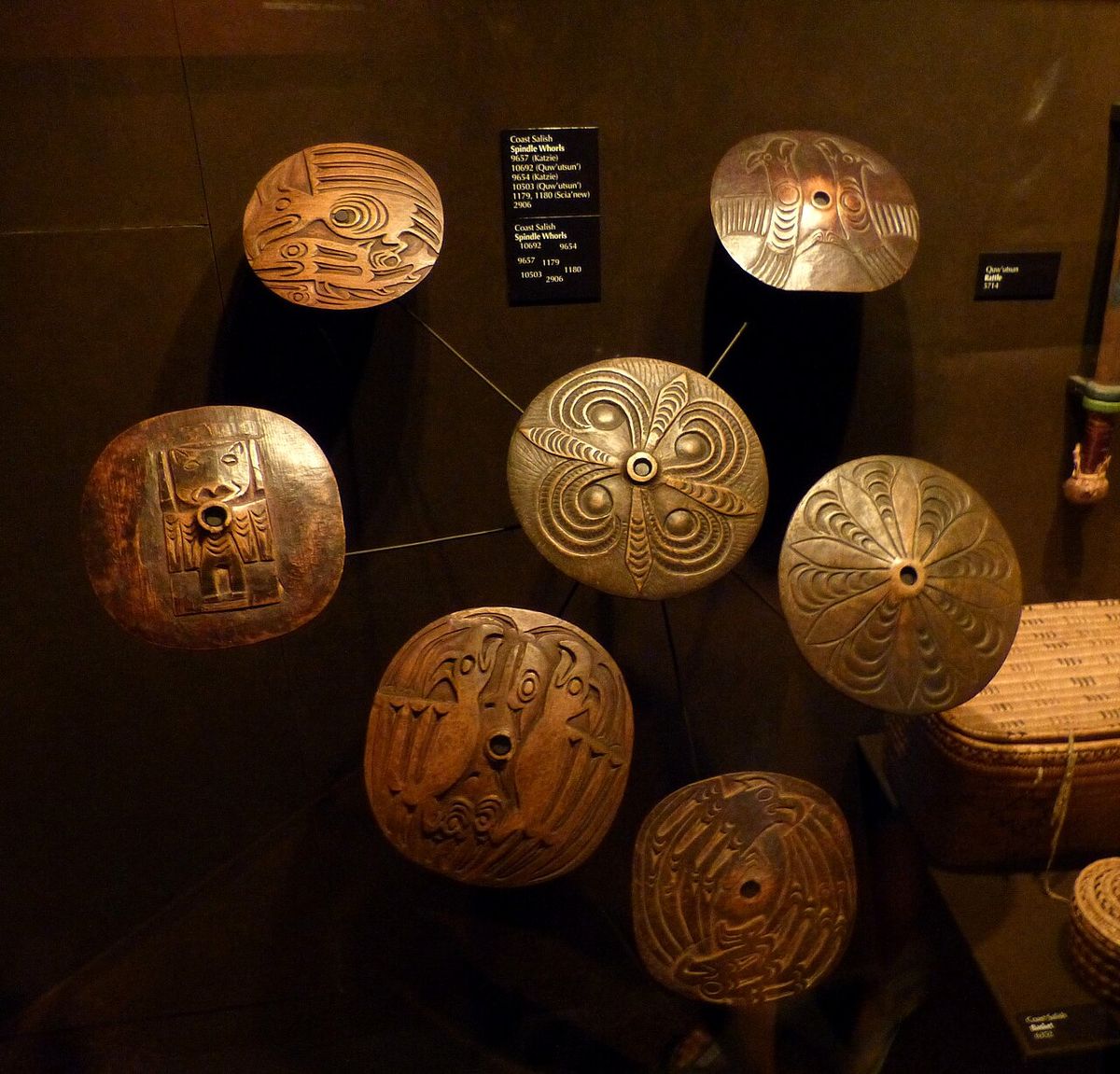
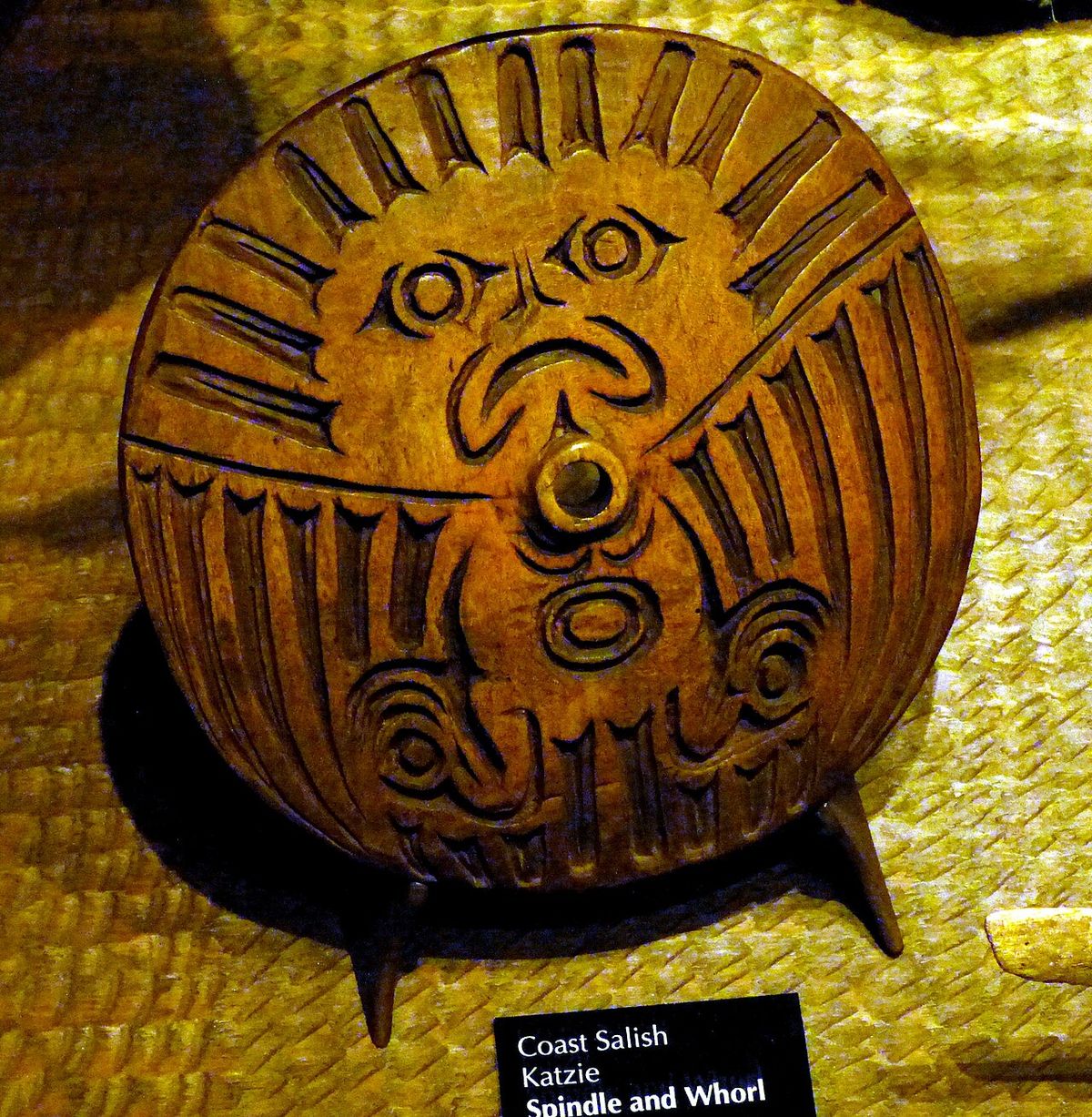
Coast Salish artistic traditions are ancient and distinctive, with archaeological evidence of Salish artistic styles appearing as early as 4500 years ago. Art was deeply integrated into daily and ceremonial life, serving both practical and spiritual purposes. A prominent form was the carved seated human figure bowl, used in rituals such as female puberty ceremonies among the Secwépemc, where it was believed to aid in childbirth. Salish-made bowls exhibited a range of designs from basic animal features to complex depictions of humans intertwined with animals. House posts and design motifs featuring Northwest Coast animals and spiritual beings were central to architectural adornment and storytelling.
Material wealth, including land, food resources, household items, and adornments, was highly valued and publicly displayed to enhance status. Wealth could not buy power outright but was used to validate and support hereditary rank, practical skill, and ritual knowledge. The longhouse, constructed from western red cedar split planks, was the centre of community life, with interior walls lined with sleeping platforms and storage shelves for tools, baskets, and dried food. Other structures included pit-houses, known as kekuli. Transportation relied on dugout canoes, and tools, clothing, and mattresses were crafted from woven reed mats, animal skins, and cedar. The wealthy built extraordinarily large longhouses, such as the Suquamish Oleman House which measured about 152 by 12 to 18 metres.
Demographic History and Contemporary Population
The demographic history of Coast Salish peoples is marked by deep tragedy followed by steady recovery. Prior to European contact and introduced epidemics, population estimates for specific linguistic groups like the Lushootseed and Twana were around 12,600. The first major smallpox epidemic arrived overland from Mexico in the 1680s, but the deadliest was the 1862 outbreak that originated in Victoria from an infected miner from San Francisco. The forced removal of First Nations encampments by authorities contributed to the rapid spread, causing mortality rates that reached 90 percent in some communities and reducing the overall population by an estimated 66 percent between 1774 and 1874. By 1885, the population had fallen to less than 2,000 for some groups, though this likely did not include all off-reservation individuals.
The 20th and 21st centuries have seen a significant demographic rebound and cultural revitalization. By 1984, total population estimates rose to about 18,000. A 2013 estimate indicates a population of at least 56,590, comprising 28,406 Status Indians registered to Coast Salish bands in British Columbia and 28,284 enrolled members of federally recognized tribes in Washington State. This growth coincides with increased political activism, legal victories for treaty rights, and economic development through initiatives in fisheries, stewardship, and other enterprises.
| Period | Estimated Population | Notes |
|---|---|---|
| Pre-epidemics | ~12,600 (Lushootseed & Twana) | Before widespread European contact |
| 1850 | ~5,000 | After early epidemic waves |
| 1885 | < 2,000 | Post-1862 smallpox epidemic |
| 1984 | ~18,000 | Sum total across regions |
| 2013 | ≥ 56,590 | 28,406 in BC, 28,284 in Washington |
Language and Cultural Revitalization
Coast Salish languages form a branch of the Salishan linguistic family, encompassing many distinct languages and dialects. These languages have been critically endangered due to centuries of colonial policies, most notably the residential school system which actively suppressed Indigenous languages as part of a forced assimilation agenda. The resulting decline in fluent speakers threatened the transmission of oral histories, traditional knowledge, and cultural identity. In response, concerted revitalization efforts have emerged since the late 20th century, driven by Coast Salish communities, educators, and linguists.
Language revitalization programs are now hosted at universities, colleges, community centres, and high schools, focusing on recording elders, developing curriculum, and teaching new generations of speakers. Public acts of reclamation, like Carlyn Andres of the Katzie First Nation singing the Beatles' 'Blackbird' in hən̓q̓əmin̓əm̓ in 2019, highlight these efforts. This cultural resurgence is part of a broader movement that began in the 1960s, inspired in part by activism like Chief Dan George's 1967 speech. The movement also involves reclaiming traditional names for communities, such as Sto:lo, Shishalh, and Snuneymuxw, over older anthropological terms. The name "Salish" itself comes from the Salish people of Montana, also known as the Bitterroot Salish or Flathead.
Contemporary Governance and Economic Development
In the contemporary era, Coast Salish nations exercise their sovereignty through modern governance structures and diverse economic initiatives. In British Columbia, many nations are engaged in treaty negotiations and assert their rights and title through legal and political channels. In the United States, numerous Coast Salish tribes are federally recognized, a status that affirms government-to-government relationships. Since the 1970s, economic development has been a priority for achieving greater autonomy. Initial ventures often involved contested but ultimately successful entries into tax-free tobacco retail. This expanded into other sectors, most notably the development of casino gaming operations, which have provided significant revenue for community services, education, and cultural programs.
Stewardship and co-management of fisheries are now critical activities, supported by the 1974 Boldt Decision which restored treaty fishing rights. Nations are also active in sustainable forestry, real estate development, tourism, and ecotourism. Organizations like the Coastal First Nations alliance in BC advocate for environmentally and socially prudent projects. Nations such as the Tsleil-Waututh have developed strategic plans guiding balanced development that respects cultural values. These efforts represent a purposeful move toward self-determination, healing from historical injustices, and building prosperous futures for growing populations. Coast Salish groups also maintain complex land management practices linked to ecosystem health, including forest gardens and managed grasslands.
- Federally recognized tribes in the US and First Nations in BC exercise modern governance.
- Economic ventures include casinos, fisheries, forestry, and tourism.
- The Boldt Decision (1974) restored and guaranteed treaty fishing rights.
- Nations engage in environmental stewardship and co-management of resources.
- Strategic community plans guide development aligned with cultural values.
- Alliances like Coastal First Nations advocate for sustainable regional projects.
Questions about Coast Salish peoples
Who are the Coast Salish peoples?
The Coast Salish peoples are a large grouping of many distinct but culturally and linguistically related Indigenous nations whose traditional territories span the Pacific Northwest Coast. Their homelands include southwestern British Columbia, western Washington State, and northwestern Oregon. They are not a single tribe but a family of nations, including well-known communities like the Cowichan, Musqueam, Squamish, and Tsleil-Waututh. They share similarities in social structure, artistic traditions, and a deep historical connection to the marine resources of the Salish Sea region.
What languages do the Coast Salish speak?
Coast Salish peoples speak distinct languages and dialects that belong to the Coast Salish branch of the Salishan language family. Examples include hən̓q̓əmin̓əm̓, Lushootseed, and Halkomelem. These languages are related but are not mutually intelligible. Due to historical policies like residential schools, many of these languages became endangered. Today, there are active language revitalization programs run by communities, schools, and post-secondary institutions to record, teach, and preserve these critical components of cultural identity.
What was the impact of the 1862 smallpox epidemic?
The smallpox epidemic of 1862 was a catastrophic demographic disaster for Coast Salish peoples and other Northwest Coast nations. It began when an infected miner from San Francisco arrived in Victoria, and the disease spread rapidly. Authorities forced First Nations people living in encampments around Victoria to leave, which helped spread the epidemic to home villages. The outbreak killed roughly half of the affected Indigenous population, with mortality reaching 90 percent or more in some communities. This tragedy significantly accelerated population decline and social disruption during a period of increasing colonial settlement.
What is a potlatch and why was it important?
The potlatch is a complex ceremonial feast fundamental to Coast Salish and other Northwest Coast Indigenous societies. It functioned to distribute wealth, confer status and rank upon individuals and kin groups, and establish claims to names, powers, and rights to hunting and fishing territories. It was a primary institution for social, economic, and political life. The Canadian government banned the potlatch in 1885 under amendments to the Indian Act. The ban was not lifted until 1951, driving the practice underground but failing to eradicate it. Potlatching continues today as a vital expression of cultural resilience.
What was the Boldt Decision?
The Boldt Decision refers to the 1974 United States v. Washington ruling by Judge George Boldt. It upheld the fishing rights reserved by federally recognized Puget Sound tribes, including many Coast Salish tribes, in the 1855 Treaty of Point Elliott and other treaties. Upheld by the Supreme Court in 1979, this landmark ruling was a major victory for tribal sovereignty and has been crucial for the cultural and economic revitalization of Coast Salish fisheries and stewardship practices.
How do Coast Salish peoples live today?
Today, Coast Salish peoples are active, growing communities engaged in cultural revitalization, economic development, and the exercise of self-government. Nations are reclaiming languages, celebrating ceremonies like the potlatch and spirit dances, and practicing traditional arts. Economically, many communities operate businesses in sectors like gaming, fisheries, forestry, tourism, and real estate. They are key stakeholders in environmental stewardship and land-use decisions within their traditional territories. With a combined estimated population of at least 56,590, they continue to shape the social, cultural, and political life of the Pacific Northwest.
Sources and further reading
- Coast Salish peoples (Wikipedia)
- Coast Salish (thecanadianencyclopedia.ca)
- Our Story (twnation.ca)
- North Coast (bcafn.ca)
- Celebrating Indigenous culture: Past, present, and future (doctorsofbc.ca)
Checked by the Nosy Mag desk. Last updated 2026-10-23.