Rebellions of 1837 to 1838
The Rebellions of 1837 to 1838 were two armed uprisings against British colonial authority in Lower Canada, present-day Quebec, and Upper Canada, present-day Ontario. Sparked by decades of political frustration and economic hardship, the rebellions were driven by reformers demanding responsible government and greater democratic control. Though militarily defeated, the uprisings directly led to Lord Durham's Report on the Affairs of British North America and the Act of Union 1840, which merged the two colonies into the Province of Canada. This set Canada on a path toward self-government and eventual Confederation through the Constitution Act, 1867.
Origins and Political Context
Both Upper and Lower Canada operated under a "mixed monarchy" model that was meant to balance monarchy, aristocracy, and democracy, but in practice lacked a genuine aristocratic class. This vacuum was filled by local, unelected oligarchies that controlled trade, government appointments, and religious institutions. In Lower Canada, this group was known as the Château Clique, while in Upper Canada it was the Family Compact. These tightly knit networks were affiliated with broader Tory parties and were vehemently opposed by Reform movements seeking more democratic and accountable government. The elected Legislative Assemblies in both colonies found themselves locked in perpetual conflict with the appointed Legislative Councils, which could veto any reform legislation. In Lower Canada, this conflict became so acute by the mid-1830s that it brought all meaningful legislation to a halt, creating a deep crisis of legitimacy for the colonial government. The British government responded by empowering the governor through Lord John Russell's Ten Resolutions in early 1837, which allowed rule without accountability to the elected assembly.
Economic distress in the mid-1830s exacerbated these political tensions and galvanized popular discontent. A severe Atlantic-wide recession hit the Canadas hard, with farmers suffering from widespread crop failures in 1836 and 1837. Merchants pursued lawsuits to collect old debts, pushing many agrarian families toward poverty. The collapse of international credit also threatened local banks and trade. This economic pressure converged with the political impasse, convincing many reformers that change was impossible within the existing colonial framework. Inspired by political reform movements in Britain and republican ideals from the Atlantic Revolutions, reformers in both colonies began organizing radical democratic associations. In Lower Canada, the Patriotes formed the Société des Fils de la Liberté (Sons of Liberty) in 1837, while in Upper Canada, William Lyon Mackenzie helped establish the Toronto Political Union in July 1837. These organizations became the vehicles for coordinating mass protests and, ultimately, armed rebellion. The political union movement was credited with passing the British Great Reform Bill of 1832, which inspired Canadian reformers.
The Lower Canada Rebellion
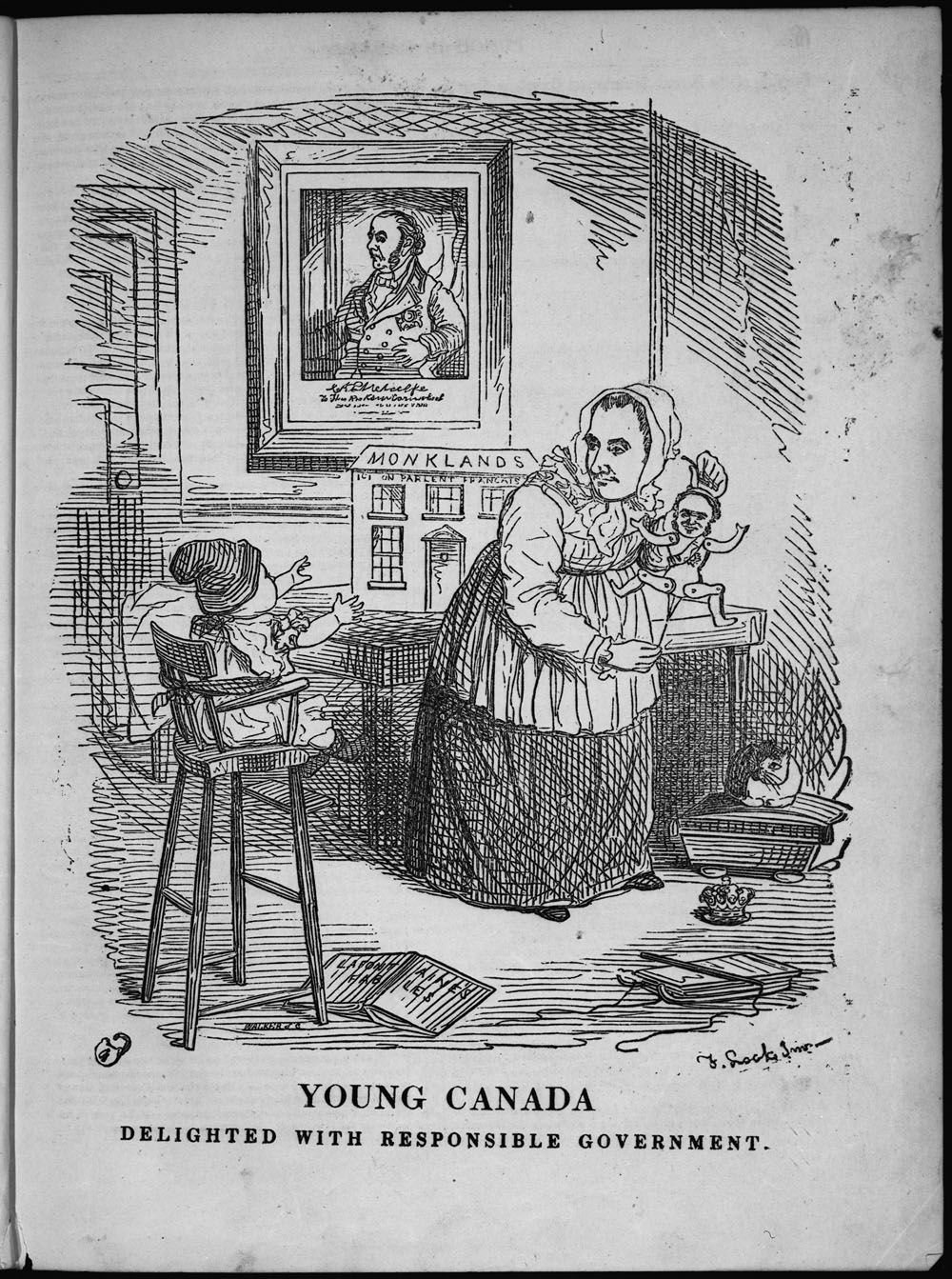
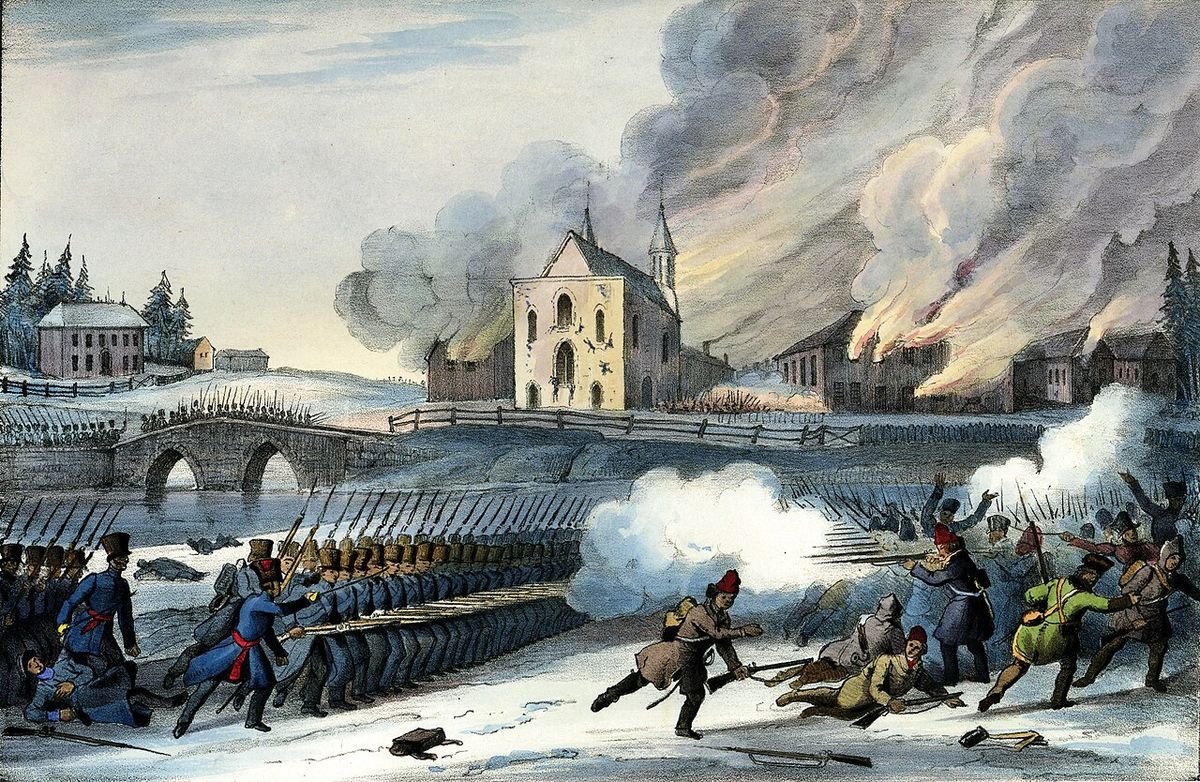
The rebellion in Lower Canada was the larger, more violent, and more broadly supported of the two uprisings. It was led primarily by Louis-Joseph Papineau and the Parti patriote, which held a majority in the elected Legislative Assembly but was consistently blocked by the appointed British governor and his advisers. The Patriotes' demands, including responsible government and control over the colony's budget, were rejected by the British government, which instead empowered the governor through Lord John Russell's Ten Resolutions. This political deadlock, combined with economic depression and rising tensions between French Canadian habitants and anglophone merchants, led to calls for armed resistance. The first outburst of violence occurred in November 1837, with rebels engaging British troops and anglophone volunteers in a series of skirmishes in the countryside surrounding Montreal. Key early engagements included the rebel victory at Saint-Denis, followed by defeats at Saint-Charles and Saint-Eustache in late 1837.
The British military response was harsh and included the burning of entire villages suspected of harbouring rebels. Following these defeats, Papineau and other rebel leaders fled to the United States. A second rebellion was launched in November 1838, organized by figures like Robert Nelson with support from American sympathizers in the Hunters' Lodges. This second uprising was poorly coordinated and was quickly suppressed by British forces and loyalist militias. The two phases of rebellion in Lower Canada resulted in significant casualties and were followed by widespread looting of French Canadian homes and the imprisonment or exile of hundreds of activists. The government also restricted civil liberties in response to the widespread support for the Patriots, which included mass actions like boycotts, strikes and sabotage over many years prior to the armed conflict.
The Upper Canada Rebellion
The uprising in Upper Canada was smaller in scale and less broadly supported by the local population than its Lower Canadian counterpart. It was led by newspaper publisher and former mayor of Toronto, William Lyon Mackenzie, a fierce critic of the ruling Family Compact. Mackenzie and his followers opposed the oligarchy's control of patronage and a system of land grants that favoured British immigrants over those with American ties. After the fraudulent 1836 elections, orchestrated by Lieutenant Governor Francis Bond Head, convinced reformers that peaceful change was impossible, Mackenzie began plotting an armed revolt. His plan was to seize Toronto and declare the colony a republic. In early December 1837, approximately 1,000 of his followers gathered at Montgomery's Tavern on Yonge Street, north of the city. The 1836 elections had been marred by political violence and fraud, and reformers Mackenzie and Samuel Lount lost their seats.
The rebellion quickly unravelled due to poor organization and a lack of popular support. On December 5, several hundred poorly armed rebels marched south on Yonge Street but fled after a brief exchange of gunfire with a smaller group of loyalist militia. Three days later, the remaining rebels were dispersed from the tavern by a force of loyalists that included about 120 Black soldiers from locally raised "Coloured Corps" units. A smaller, related disturbance near Brantford was also swiftly put down. Following these failures, Mackenzie, along with other leaders like Samuel Lount and about 200 followers, fled across the border to the United States. From there, they continued to launch cross-border raids, contributing to a year of border turmoil known as the Patriot War. The Tories in Upper Canada had also passed a bill allowing them to continue sitting in the legislature after the death of King William IV in June 1837, disregarding the practice of dissolution, which further inflamed reformers.
The Patriot War and Cross-Border Raids
After their initial defeats, rebels from both Canadas regrouped in the United States, where they found sympathy among certain American factions, particularly the radical Equal Rights Party (Locofocos). With this support, they formed secret societies known as Hunters' Lodges (Frères chasseurs) dedicated to liberating Canada from British rule. In September 1838, a convention in Cleveland declared a Republic of Lower Canada. William Lyon Mackenzie established a short-lived "Republic of Canada" on Navy Island in the Niagara River in December 1837, but was forced to withdraw after the rebel supply ship Caroline was attacked and burned by Canadian loyalists. This series of cross-border incursions, known collectively as the Patriot War, kept the Canada-US border in a state of tension for nearly a year. The Hunters' Lodges drew on American members of the radical Equal Rights Party for support.
The Patriot War raids were ultimately unsuccessful. They were suppressed through a combination of British military action, Canadian loyalist militia efforts, and increasing cooperation from the administration of U.S. President Martin Van Buren, which sought to prevent an international crisis. The raids culminated in the decisive Battle of Windsor in Upper Canada in December 1838, where a force of Hunters was defeated by local militia. This defeat effectively ended the armed conflict. The cross-border nature of the rebellions fostered an unprecedented level of diplomatic and military cooperation between British and American authorities, who were both keen to maintain peace and stability along the frontier. Both governments were dedicated to a peace policy due to a budding financial crisis and a sense of perceived disadvantage.
Aftermath and Suppression
The colonial authorities moved decisively to punish the rebels and restore order in the wake of the uprisings. In Upper Canada, captured insurgents were put on trial, with most found guilty of insurrection against the Crown. Key figures like Samuel Lount and Peter Matthews were publicly hanged in Toronto's Court House Square in April 1838. Approximately one hundred rebels and American sympathizers were sentenced to transportation for life to Britain's Australian penal colonies. In Lower Canada, hundreds of activists were imprisoned or exiled following the suppression of the second rebellion in November 1838. The British military and loyalist militias maintained a firm grip, and the radical republican movement was effectively crushed. The Orange militia stood guard during the executions in Toronto to deter a rescue attempt.
The political aftermath, however, proved more consequential than the military one. The British government sent John George Lambton, Lord Durham, to investigate the causes of the rebellions. His 1839 Report on the Affairs of British North America became a foundational document in Canadian history. Durham's recommendations included the merger of Upper and Lower Canada into a single Province of Canada, achieved through the Act of Union in 1840. He also advocated for the establishment of responsible government, a key rebel demand, which was fully realized in 1849. More controversially, Durham recommended the cultural assimilation of French Canadians, a proposal that was widely rejected and fueled lasting resentment. The report shifted political momentum toward moderate reformers like Robert Baldwin and Louis-Hippolyte Lafontaine, who worked within the new union to achieve democratic reforms. Durham intended the union to diminish French Canadian political influence.
Historical Significance and Modern Legacy
The Rebellions of 1837 to 1838 were a critical turning point in the evolution of Canadian governance and identity. They demonstrated the untenable nature of the old colonial oligarchic system and forced the British government to reconsider its administration of North American colonies. The resulting Durham Report and Act of Union set in motion a political process that ultimately led to responsible government and, decades later, Confederation in 1867. The rebellions also had a long-term impact on Canada-United States relations, as the cross-border raids of the Patriot War necessitated and fostered greater diplomatic cooperation to secure the shared frontier. Historians view the rebellions as part of the broader Atlantic Revolutions, including the American and French Revolutions.
In modern memory, the rebellions hold different places in English and French Canada. In Quebec, the Patriotes are celebrated as early nationalists and symbols of resistance. The provincial holiday known as La Journée nationale des patriotes (National Patriots' Day) replaces the Victoria Day holiday observed elsewhere in Canada. Scholarly work on the rebellions in Quebec is extensive and continually evolving, with recent historiography placing greater emphasis on the events' transnational and republican dimensions rather than a strictly ethnic conflict. In English Canada, the rebellion is often remembered as a less central, though important, step on the road to self-government. Contemporary historians continue to reassess the rebellions, viewing them not as isolated incidents but as part of the broader Atlantic revolutionary age of the late 18th and early 19th centuries.
The legacy of the rebellions has been invoked in various contexts. In 1937, the names of William Lyon Mackenzie and Louis-Joseph Papineau were applied to the Mackenzie-Papineau Battalion of Canadian volunteers in the Spanish Civil War. The group fought to the rallying cry "The Spirit of 1837 lives on!". In Quebec, the rebellion is commemorated annually on the Journée nationale des patriotes. Some historians see ties between the Canadian rebellions and the Chartist Newport Uprising of 1839 in Wales, which was suppressed by Sir Francis Bond Head's cousin, Sir Edmund Walker Head. These acts of remembrance reflect the enduring, though contested, place of 1837 in the national story.
Key Figures of the Rebellions
- Louis-Joseph Papineau: The charismatic speaker and political leader of the Lower Canadian Patriotes. He fled to the United States after the initial defeats in 1837.
- William Lyon Mackenzie: The fiery newspaper editor and former Toronto mayor who was the principal leader of the Upper Canada rebellion. He later organized the Republic of Canada on Navy Island.
- Samuel Lount: A blacksmith and reformer who helped lead the march down Yonge Street and was executed in April 1838. He lost his seat in the fraudulent 1836 election.
- Robert Nelson: A key leader of the second Lower Canada rebellion in 1838, organized from the United States. He helped establish the Hunters' Lodge militia.
- Sir Francis Bond Head: The Lieutenant Governor of Upper Canada whose partisan actions and election interference helped provoke the rebellion.
- Lord Durham (John George Lambton): The British statesman sent to investigate the rebellions, author of the influential 1839 report that recommended union and responsible government.
- Robert Baldwin and Louis-Hippolyte Lafontaine: Moderate reformers who gained political influence after the rebellions and worked to achieve responsible government through political means, succeeding in 1849.
- Charles Duncombe: A rebel leader in Upper Canada who, with Robert Nelson, helped organize the Hunters' Lodges in the United States.
Questions about Rebellions of 1837 to 1838
What caused the Rebellions of 1837 to 1838?
The rebellions were caused by deep-seated political and economic grievances in Upper and Lower Canada. Politically, reformers were frustrated by the lack of responsible government and the control of colonial affairs by unelected oligarchies, the Family Compact in Upper Canada and the Château Clique in Lower Canada. Economically, a severe recession in the mid-1830s, coupled with crop failures in 1836-37 and debt crises, impoverished many farmers and workers. When the British government rejected reform proposals and empowered colonial governors through the Ten Resolutions, many concluded that armed rebellion was the only path to change.
Who were the main leaders of the rebellions?
In Lower Canada, the primary leader was Louis-Joseph Papineau, the head of the Parti patriote. After the first rebellion failed, Robert Nelson became a key organizer of the second uprising in 1838. In Upper Canada, the rebellion was led by William Lyon Mackenzie, a newspaper publisher and radical reformer. Other notable figures included Samuel Lount, who was executed for his role in the Upper Canada revolt, and Charles Duncombe. On the government side, Lieutenant Governor Sir Francis Bond Head of Upper Canada and the British military commanders played central roles in suppressing the uprisings.
What was the Patriot War?
The Patriot War refers to the phase of the conflict that occurred after the initial rebellions were suppressed, lasting from late 1837 through 1838. Defeated rebels fled to the United States, where they joined with American sympathizers, particularly from the Hunters' Lodges secret societies, to launch cross-border raids into the Canadas. This included William Lyon Mackenzie's occupation of Navy Island and the declaration of a republic there, and the Cleveland convention declaring a Republic of Lower Canada in September 1838. The raids created significant border tension but were ultimately defeated, notably at the Battle of Windsor in December 1838.
What were the immediate consequences of the rebellions?
The immediate consequences were severe for the rebels. Many were captured, with leaders like Samuel Lount and Peter Matthews executed in Toronto in April 1838. Approximately one hundred rebels and American supporters were sentenced to transportation for life to Britain's Australian penal colonies. In Lower Canada, hundreds were imprisoned or exiled. Politically, the rebellions prompted the British government to send Lord Durham to investigate. His 1839 report led to the Act of Union 1840, which merged Upper and Lower Canada into the Province of Canada and set the stage for responsible government.
How are the rebellions remembered in Canada today?
The memory of the rebellions varies regionally. In Quebec, the Patriotes are celebrated as early nationalists and heroes, with a provincial holiday (Journée nationale des patriotes) dedicated to their memory. Scholarly work in Quebec is extensive and increasingly views the conflict in a transnational, republican context. In English Canada, the rebellions are often seen as a catalyst for political reform leading to responsible government and Confederation. The legacy was invoked in 1937 when the Mackenzie-Papineau Battalion in the Spanish Civil War adopted the rebels' names and fought under the cry "The Spirit of 1837 lives on!".
What was the role of the Hunters' Lodges?
The Hunters' Lodges, also known as Frères chasseurs, were secret societies formed in the United States after the initial rebellions were crushed. They were composed of American sympathizers from the Equal Rights Party and exiled Canadian rebels dedicated to liberating Canada from British rule. The Lodges organized the September 1838 Cleveland convention that declared a Republic of Lower Canada and launched the cross-border raids of the Patriot War. Their efforts, along with other raids like the Navy Island episode, were defeated at the Battle of Windsor in December 1838, ending the armed conflict.
Sources and further reading
- Rebellions of 1837 to 1838 (Wikipedia)
- Rebellions of 1837-38 (Plain-Language Summary) (thecanadianencyclopedia.ca)
- A Missed Opportunity: The Canadian Rebellion (1837-38) ... (canadashistory.ca)
Checked by the Nosy Mag desk. Last updated 2026-10-25.