In Flanders Fields
"In Flanders Fields" is a war poem written in 1915 by Canadian physician and soldier Lieutenant-Colonel John McCrae. Composed in the form of a rondeau, it was inspired by the death of a friend during the Second Battle of Ypres and the red poppies that grew amidst the graves. First published in the British magazine Punch in December 1915, the poem quickly became one of the most famous literary works of the First World War. Its powerful imagery directly led to the adoption of the red poppy as a global symbol of remembrance for fallen soldiers. In Canada, "In Flanders Fields" is a central element of Remembrance Day ceremonies and is considered one of the nation's best-known pieces of literature.
John McCrae and the context of war
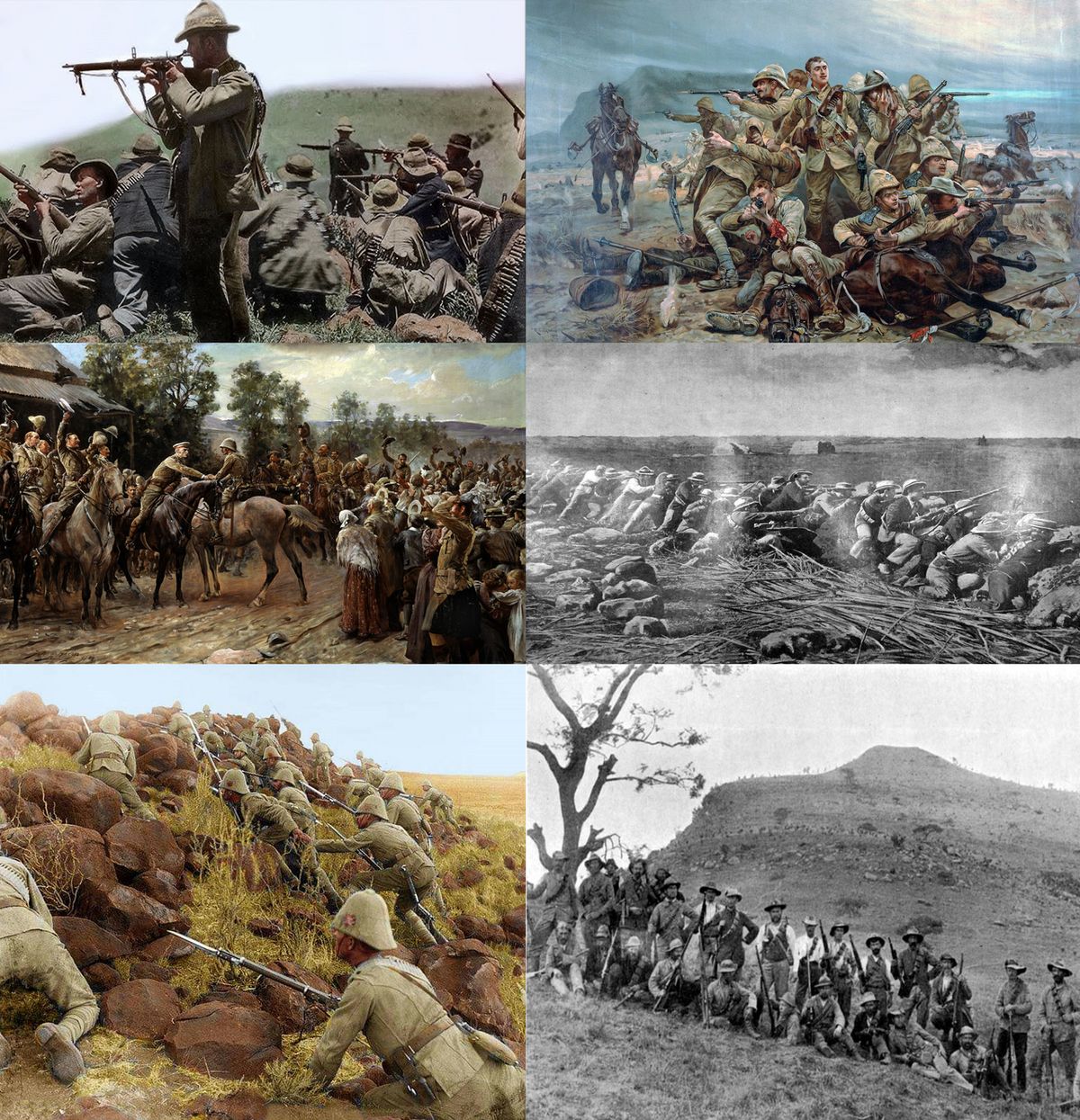
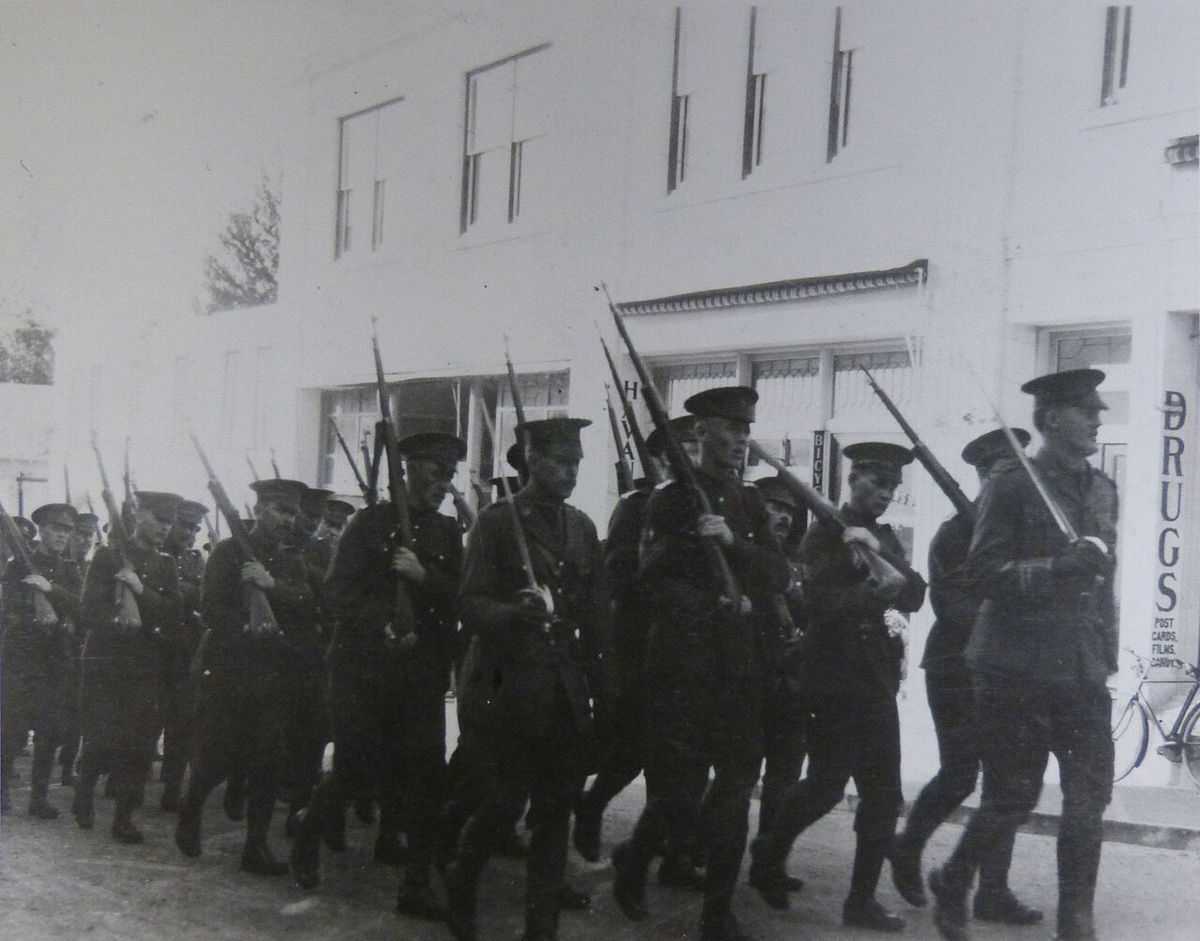
John McCrae was a poet and physician from Guelph, Ontario, who developed an interest in poetry from a young age. He enlisted with the Canadian Expeditionary Force at the age of 41 following the outbreak of the First World War. He had the option of joining the medical corps but volunteered instead to join a fighting unit as a gunner and medical officer. McCrae had previously served in the Second Boer War, and he held a strong belief in the duty of fighting for his country and the British Empire. He was deployed to the Flanders region of Belgium, where he fought in the Second Battle of Ypres in April and May of 1915. This battle was notorious for the German army's first large-scale use of chlorine gas on April 22, 1915. In a letter to his mother, McCrae described the battle as a nightmare that lasted over two weeks. It was in this harrowing context, after presiding over the funeral of his close friend Lieutenant Alexis Helmer on May 2, that McCrae noticed the rapid growth of poppies around the soldiers' graves. The next day, he composed the poem while sitting in the back of an ambulance at an Advanced Dressing Station outside Ypres, a location now designated as the John McCrae Memorial Site.
Composition and publication
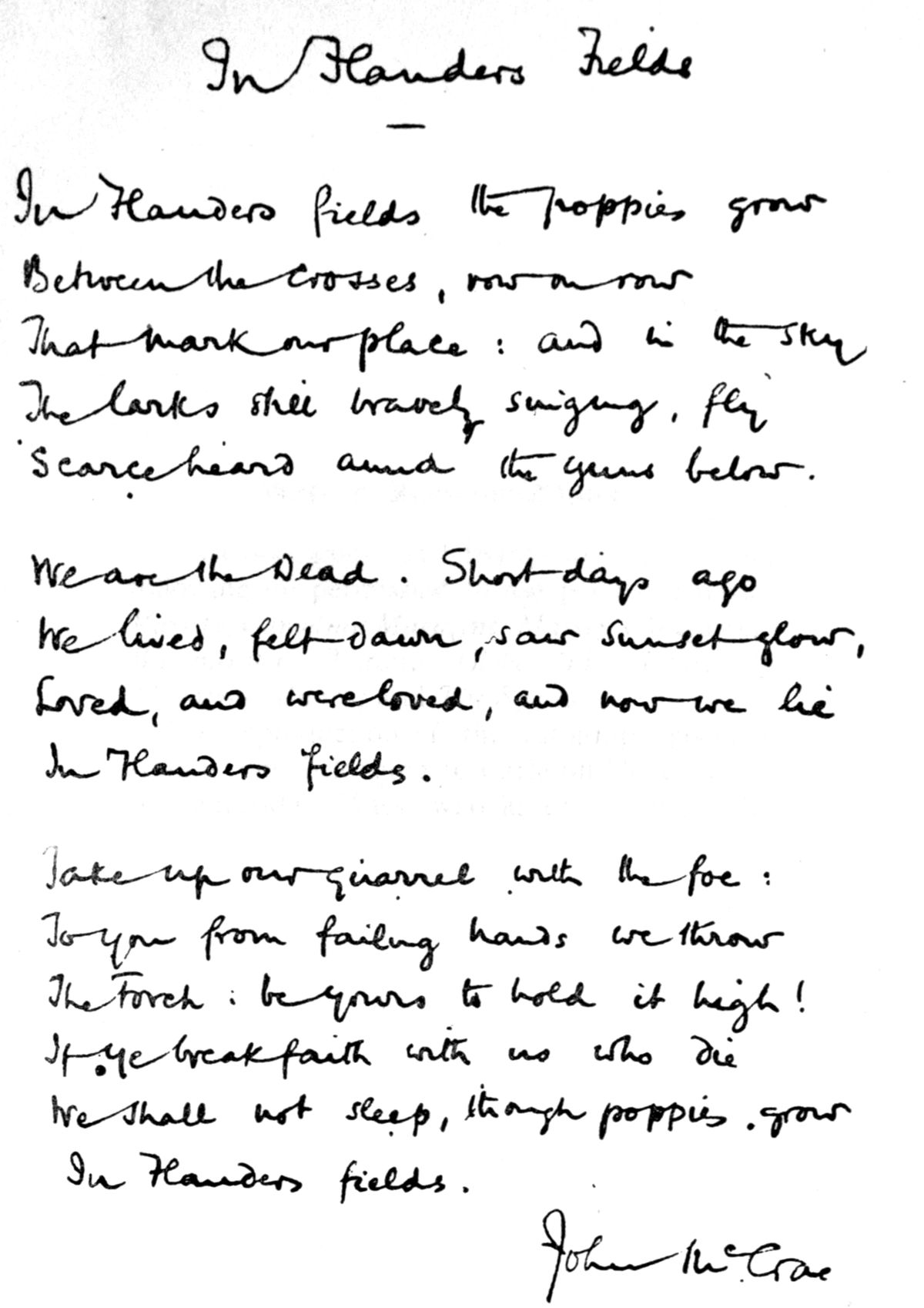
The exact circumstances of the poem's composition have been recounted in several ways, but all agree it was written shortly after Helmer's burial. One account states McCrae wrote it in 20 minutes the morning after the funeral, while another suggests he worked on it between treating wounded soldiers. Sergeant Major Cyril Allinson, who was delivering mail, witnessed McCrae writing and later described the poem as an almost exact description of the scene before them. According to legend, McCrae was initially dissatisfied with his work and discarded the paper, but it was retrieved by a fellow soldier. After being convinced to submit it for publication, McCrae first sent the poem to The Spectator, where it was rejected. It was then accepted by Punch, the London magazine, which published it anonymously on December 8, 1915. The magazine attributed the poem to McCrae in its year-end index. A minor but enduring controversy involves the first line of the poem. The original manuscript reportedly ended the line with "grow", but Punch changed it to "blow" with McCrae's permission. This variation became a public issue in 2001 when the Bank of Canada used the "blow" version on the ten-dollar bill, prompting numerous complaints from Canadians who remembered it as "grow".
Content and literary significance
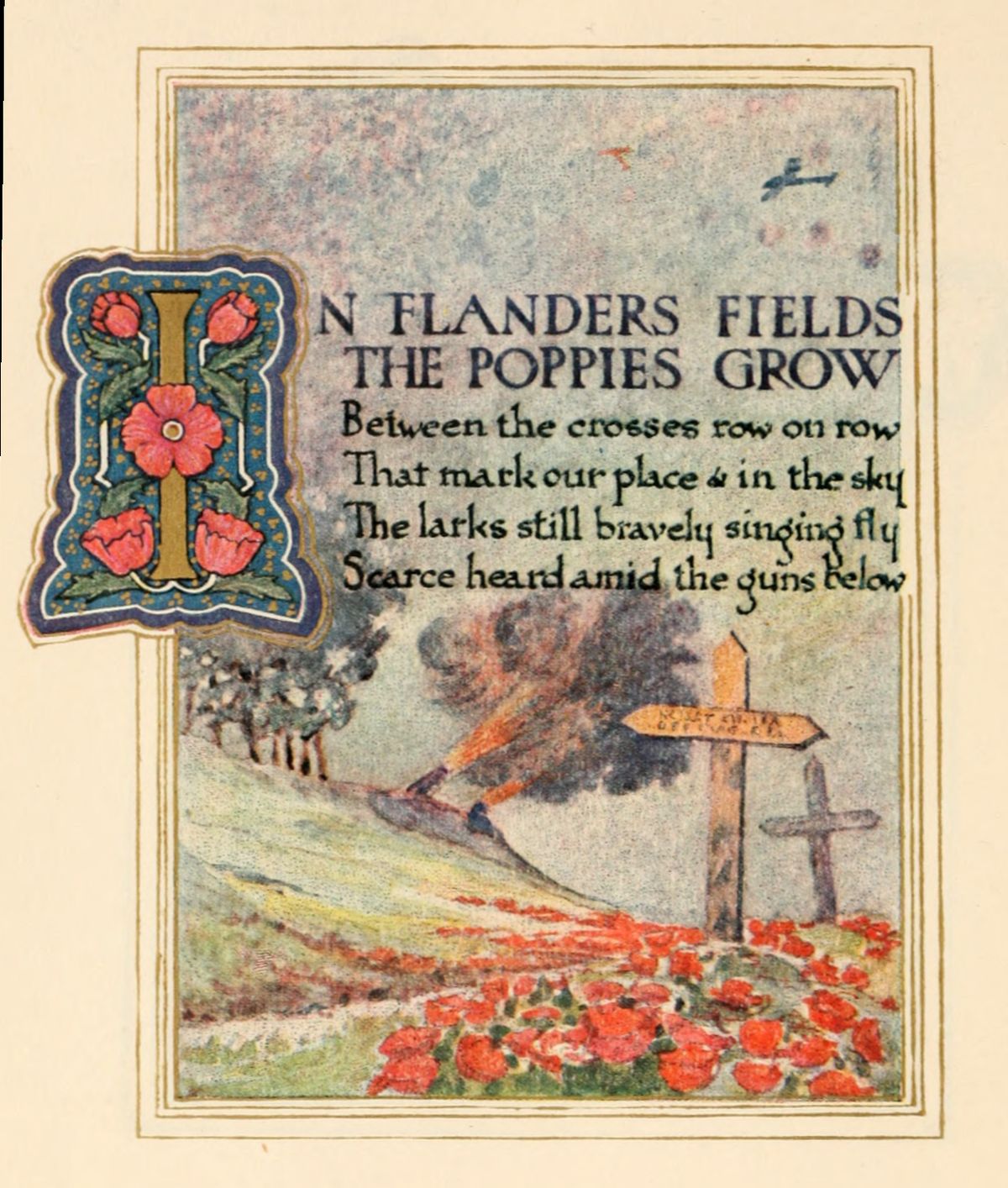
"In Flanders Fields" is a 15-line rondeau, a French verse form, written from the perspective of the dead soldiers buried in Flanders. The poem is structured in three stanzas, with the first focusing on the natural imagery of poppies blowing between rows of crosses and larks singing in the sky. The second stanza establishes the voice of the fallen, who only recently lived, loved, and were now lying in the fields. The final stanza issues a direct command to the living to take up the quarrel with the foe and to keep faith with the dead, lest they break that faith. The poem reflects McCrae's lifelong preoccupation with death as a transition between struggle and peace. Written early in the war, it captures a moment before widespread disillusionment set in, blending pastoral elegy with a call to continued duty. This combination has led to mixed critical reception over time, with some, like historian Paul Fussell, criticizing the third stanza's shift to what he called recruiting-poster rhetoric. Despite such critiques, the poem's emotional resonance and its role as a voice for the dead have secured its place in the popular consciousness far beyond academic literary circles.
Immediate popularity and wartime use
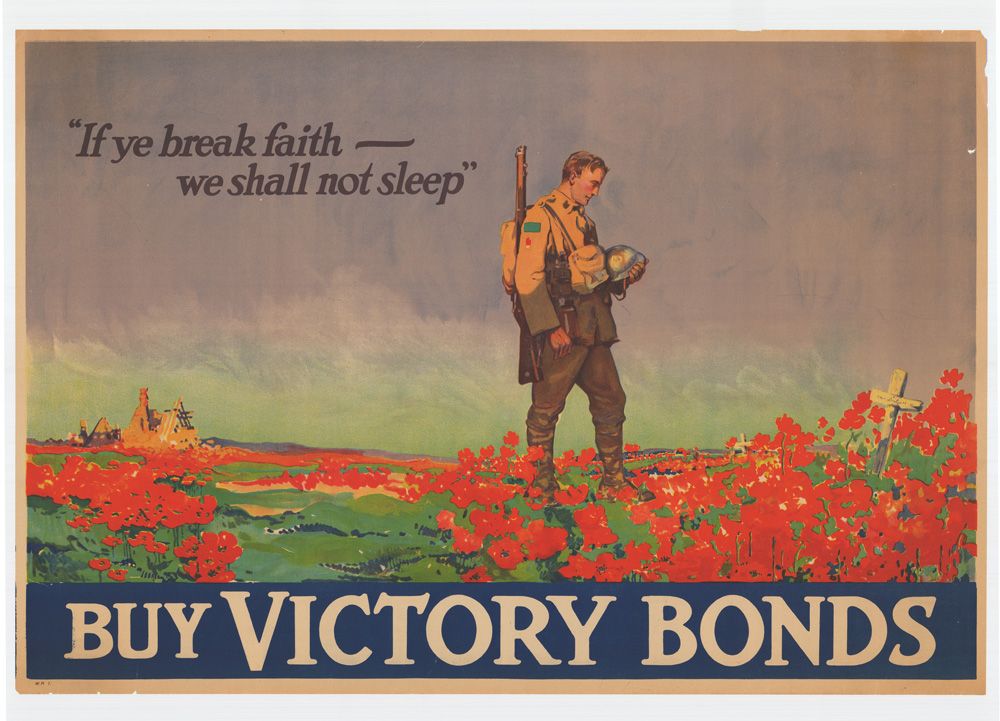
Upon its publication and the revelation of McCrae as its author, "In Flanders Fields" achieved immediate and enormous popularity. It was republished in newspapers and periodicals across the Allied world and translated into numerous languages. The poem was embraced by soldiers as a statement of their duty and by civilians on the home front as a defining explanation of the war's purpose. This popularity made it a powerful tool for propaganda and fundraising. In Canada, it was heavily used by the Unionist Party during the 1917 federal election to support conscription, a move opposed by many French Canadians. One contemporary observer noted the poem did more to bolster support for the war effort than all the political speeches of the campaign. McCrae, a staunch supporter of the empire, expressed pleasure at his poem's political impact. The poem was also used extensively in recruitment campaigns and to sell war bonds in both Great Britain and the United States. Its lines were set to music by at least 55 American composers by 1920, including notable figures like John Philip Sousa and Charles Ives, whose setting premiered in early 1917.
The remembrance poppy
The poem's most deep and legacy is its role in establishing the red poppy as a universal symbol of remembrance. The poppies described by McCrae grew prolifically in the churned-up, lime-rich soil of the Flanders battlefields. Inspired by the poem, American professor Moina Michael vowed in 1918 to wear a red poppy year-round to honour the war dead and wrote a response poem, "We Shall Keep the Faith". She campaigned for the poppy to be adopted as an official symbol by the American Legion. Frenchwoman Madame E. Guérin, attending the Legion's 1920 convention, was inspired to sell silk poppies in France to raise money for war orphans. In 1921, she sent poppy sellers to London, where the practice attracted the support of Field Marshal Douglas Haig, a co-founder of The Royal British Legion. The sale of remembrance poppies quickly spread throughout the British Empire. Today, wearing a poppy in the days leading up to Remembrance Day (or ANZAC Day in Australia and New Zealand) remains a widespread tradition across the Commonwealth, directly linking back to the imagery of McCrae's poem.
Legacy in Canada and Belgium
In Canada, "In Flanders Fields" holds a unique place in national culture and is a staple of Remembrance Day ceremonies in schools, legions, and official gatherings across the country. The Canadian government uses an official French adaptation, "Au champ d'honneur" by Jean Pariseau, for bilingual ceremonies. The poem's legacy is visible on Canadian currency, having been featured on the ten-dollar bill from 2001 to 2013. The Royal Canadian Mint has issued several poppy-themed circulation coins, including a 2004 quarter that was the world's first multi-coloured circulation coin and special issues in 2015 for the poem's centennial. The lines "To you from failing hands we throw / The torch. Be yours to hold it high" serve as the official motto of the Montreal Canadiens hockey club. Canada Post has issued multiple stamps honouring McCrae and the poppy, including ones in 1968, 1975, and 2001. McCrae's Guelph birthplace is a museum dedicated to his life and the war, and he was designated a National Historic Person in 1946. In Belgium, the poem's legacy is centred in Ypres at the In Flanders Fields Museum, a major institution dedicated to the history of the First World War in the region. A monument at the Essex Farm Commonwealth War Graves Commission Cemetery marks the presumed location of Helmer's burial and McCrae's writing of the poem. The connection between the historic landscape and contemporary culture continues to evolve, notably with the Belgian cycling classic Gent-Wevelgem being renamed "In Flanders Fields. From Middelkerke to Wevelgem" starting with its 88th edition on 29 March 2026. This change, under a 10-year agreement with organizer Flanders Classics, explicitly links the sporting event to the historical and memorial significance of the region. The In Flanders Fields Museum will host an international conference titled "Displaced" from 26 to 28 March 2026, examining themes of flight and exile during the First World War.
Commemorative honours and cultural references
The poem and its author have been honoured through various official and cultural channels over the past century. Canada Post issued a stamp for the 50th anniversary of McCrae's death in 1968 and others featuring the poppy in 1975, 2001, 2009, 2013, and 2014. Beyond Canada, postal authorities in Australia, New Zealand, South Africa, and the United Kingdom have also used the poppy on stamps. The poem has permeated popular culture in diverse ways, with the line "We are the dead" spoken by propaganda loudspeakers in George Orwell's novel Nineteen Eighty-Four and later incorporated into the 2005 rock opera The Protomen. Despite its fame, the poem is sometimes overlooked in academic studies of Canadian literature, with some critics viewing its patriotic tone as anachronistic in the context of a war later associated with futility. However, its status as a powerful national symbol and a touchstone for personal and collective remembrance remains unchallenged for most Canadians, a fact demonstrated by its enduring presence in ceremonies, on currency, and in the public imagination.
Key dates in the legacy of 'In Flanders Fields'
The influence of John McCrae's poem is evident in its immediate popularity and subsequent use. The poem was first published in the London magazine Punch on December 8, 1915. Its references to the red poppies that grew over the graves of fallen soldiers resulted in the remembrance poppy becoming a globally recognized memorial symbol. The poem is a prominent Remembrance Day symbol throughout the Commonwealth of Nations, particularly in Canada, where it is one of the nation's best-known literary works. Its legacy includes appearances on Canadian currency and its use as a motto for the Montreal Canadiens hockey club.
- 3 May 1915: John McCrae composes "In Flanders Fields" after the burial of Alexis Helmer.
- 8 December 1915: The poem is first published, anonymously, in Punch magazine.
- 1918: Moina Michael, inspired by the poem, begins campaigning for the red poppy as a symbol of remembrance.
- 1920: Madame E. Guérin attends the American Legion convention and begins selling poppies in France.
- 1921: Poppy sales begin in London, leading to widespread adoption across the Commonwealth.
- 1940: The Montreal Canadiens adopt a line from the poem as their official motto.
- 1946: John McCrae is designated a National Historic Person by the Canadian government.
- 2001 to 2013: The first stanza of "In Flanders Fields" appears on the Canadian ten-dollar bill.
- 2004: The Royal Canadian Mint issues the first multi-coloured circulation coin in the world, a poppy-themed quarter.
- 2015: The poem's centennial is marked with special circulation coins and commemorations.
- 29 March 2026: The cycling classic Gent-Wevelgem is renamed "In Flanders Fields. From Middelkerke to Wevelgem."
- 26-28 March 2026: The "Displaced" conference is held at the In Flanders Fields Museum in Ypres.
Questions about In Flanders Fields
Who wrote 'In Flanders Fields' and why?
"In Flanders Fields" was written by Canadian physician Lieutenant-Colonel John McCrae. He was inspired to write it on May 3, 1915, after presiding over the funeral of his friend and fellow soldier Lieutenant Alexis Helmer, who died in the Second Battle of Ypres. McCrae performed the burial service himself, where he noticed how poppies quickly grew around the graves of those who died at Ypres. The next day, he composed the poem while sitting in the back of an ambulance at an Advanced Dressing Station outside Ypres.
How did the poem lead to the use of the poppy as a remembrance symbol?
The poem's vivid imagery of the poppies blowing between the crosses made a deep impression. American professor Moina Michael, inspired by the poem, vowed in 1918 to wear a red poppy to honour the dead and campaigned for its adoption by the American Legion. Frenchwoman Madame E. Guérin then began selling silk poppies to raise funds for war orphans after attending the Legion's 1920 convention. The practice was embraced by The Royal British Legion in 1921 and spread rapidly throughout the Commonwealth, establishing the poppy as the primary symbol of remembrance for war dead.
How is the poem commemorated in Belgium today?
In Ypres, Belgium, the In Flanders Fields Museum is a major museum dedicated to the First World War and is named after the poem. The John McCrae Memorial Site at Essex Farm Cemetery marks the location where he is believed to have written it. The region's history is linked to modern culture through events like the cycling race renamed "In Flanders Fields. From Middelkerke to Wevelgem" starting in 2026, and academic conferences such as "Displaced" hosted by the museum in March 2026.
Has 'In Flanders Fields' appeared on Canadian money?
Yes, an excerpt from "In Flanders Fields" appeared on the Canadian ten-dollar bill from 2001 to 2013. The design for the ten-dollar bill featured the first stanza of the poem, ending the first line with "blow". This release prompted queries and complaints from those who believed the first line should end with "grow". The Royal Canadian Mint has also released several poppy-themed circulation and collector coins, including in 2004 and 2015.
What is the poem 'In Flanders Fields' about?
The poem 'In Flanders Fields' is written from the point of view of dead soldiers buried in the First World War battlefields of Flanders. It describes the red poppies that grow between the crosses marking their graves and the larks still singing in the sky. The poem speaks of the soldiers' sacrifice and their interrupted lives. It then serves as a command from the dead to the living, urging them to continue the fight and to take up the torch of their cause. The poem is a rondeau written by Canadian physician Lieutenant Colonel John McCrae. It focuses on death as a transition between the struggle of life and the peace that follows.
What is the connection between 'In Flanders Fields' and a Canadian hockey team?
The connection is that the lines "to you from failing hands we throw / the torch, be yours to hold it high" from the poem have served as the official motto for the Montreal Canadiens hockey club since 1940. This is one of the poem's many uses in popular culture and a part of its significant legacy in Canada. The poem itself is very popular in Canada and is a staple of Remembrance Day ceremonies. It is considered one of the nation's best-known literary works. An excerpt from the poem also appeared on the Canadian ten-dollar bill from 2001 to 2013.
Sources and further reading
- In Flanders Fields (Wikipedia)
- Displaced | Events (inflandersfields.be)
- Cycling classic Gent-Wevelgem becomes 'In Flanders Fields' (vrt.be)
Checked by the Nosy Mag desk. Last updated 2026-10-20.