Great Depression in Canada
The Great Depression in Canada was a severe economic and social crisis that lasted throughout the 1930s. Triggered by the global stock market crash of 1929, the depression was worsened in Canada by its heavy dependence on raw material exports and a severe drought on the Prairies known as the Dust Bowl. The period, often called the Dirty Thirties, saw unemployment reach 30 per cent, forced one-fifth of the population onto government relief, and transformed the country's political and economic landscape. The crisis led to the birth of Canada's social welfare system, spurred populist political movements, and established a more interventionist role for government in the economy.
Economic Collapse and National Impact
The onset of the Great Depression followed the Wall Street crash of October 1929, which precipitated a global collapse in demand and credit. Canada's economy, heavily reliant on international trade, was uniquely vulnerable. Between 1929 and 1933, the country's Gross National Expenditure plummeted by 42 per cent, representing the second sharpest economic decline in the world after the United States. By 1933, 30 per cent of the labour force was unemployed, and one in five Canadians depended on government assistance. Industrial production fell to just 58 per cent of its 1929 level, while total national income dropped to 55 per cent. The crisis exposed the fragility of Canada's shift from a primary industry base to manufacturing, as prices and profits collapsed in every sector from farming and mining to logging and manufacturing.
Canada's close economic ties to the severely affected United States and Britain worsened the downturn. The American Smoot-Hawley Tariff Act of 1930 crippled Canadian exports, leading Canada to retaliate with its own tariffs and pivot trade towards the British Empire. This imperial preference system, established in 1931-32, proved vital. By 1938, the value of Canadian products shipped to Britain had more than doubled from 1929 levels, helping to stabilize Canada's balance of payments. Canada had a stable banking system with no failures during the depression, but the collapse of commodity prices by over 50 per cent and the dramatic fall in international trade delivered a severe shock from which recovery was slow and uneven across the country.
Regional Disparities and the Prairie Crisis
The burden of the depression was not shared equally, with the Prairie Provinces and Western Canada experiencing the most severe hardship. The region's dependence on wheat exports coincided with a catastrophic drought, plagues of grasshoppers, and hailstorms, creating the Dust Bowl conditions of the Dirty Thirties. In the rural areas of the prairies, two thirds of the population were on relief. This devastation triggered a mass migration as farmers abandoned their land for towns and cities or moved north to aspen parkland. Population in the prairie provinces fell below natural replacement level.
Ontario and Quebec, with more diversified industrial economies serving the domestic market, experienced heavy unemployment but were less devastated than the export-driven west. The Maritimes, already in economic decline during the 1920s, had less distance to fall. British Columbia saw its net production value fall by almost 60 per cent. The crisis reshaped demographics nationwide. Immigration plunged from 169,000 in 1929 to fewer than 12,000 by 1935, and about 25,000 unemployed immigrants were deported between 1930 and 1931. Birthrates fell as families postponed having children. Population growth in the 1930s fell to its lowest point since the 1880s.
Government Response and Political Turmoil
Initial government reaction was inadequate. Prime Minister William Lyon Mackenzie King, in power at the depression's start, believed the crisis would pass and refused federal aid to provinces. He was defeated in the 1930 election by R.B. Bennett's Conservatives, who campaigned on high tariffs and spending. Bennett's government launched make-work programs and expanded welfare, creating large deficits. By 1932, wary of the shortfalls, Bennett severely cut back federal spending, deepening the depression. A major financial burden was the Canadian National Railway, which assumed over $2 billion in debt from bankrupt railways and required repeated government bailouts.
With public support fading, Bennett attempted a Canadian New Deal in 1935, proposing a minimum wage, unemployment insurance, and other social programs. This legislation was largely unsuccessful, challenged by provinces and struck down by courts, shifting reform efforts to the provincial level. Provinces like Ontario passed acts such as the 1935 Industrial Standards Act to set minimum wages and work standards. In British Columbia, Premier Thomas "Duff" Patullo obtained emergency powers through the Special Powers Act of 1934 to rapidly introduce reforms. The failure of Bennett's policies contributed to the Conservative defeat in the 1935 election, which returned Mackenzie King to power. The public's lost faith in the old parties led to the rise of the socialist Cooperative Commonwealth Federation.
Social Strain, Protest and Labour Unrest
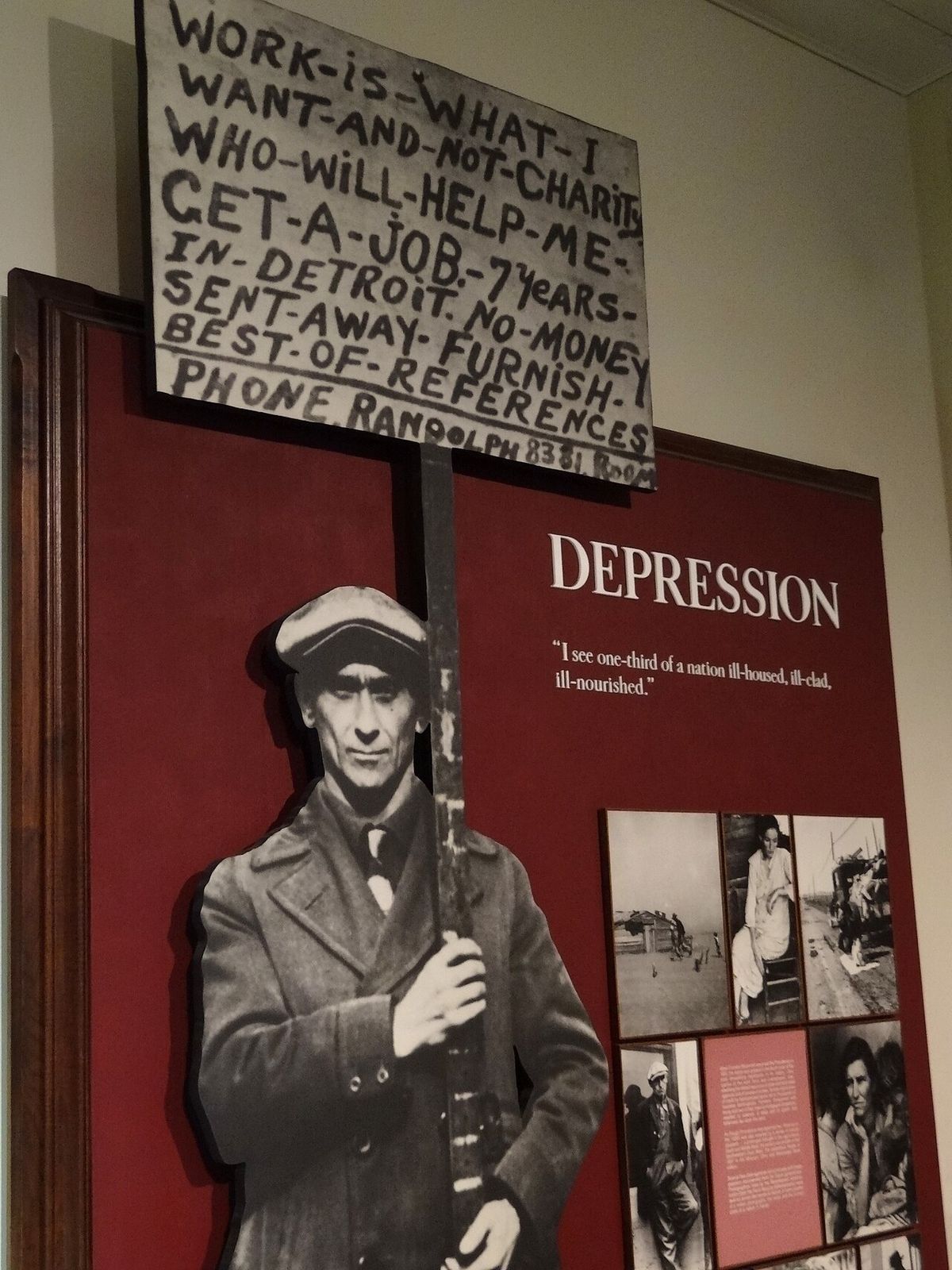
The depression fuelled widespread social discontent and working-class militancy, often organized by the small but influential Communist Party. The federal government established a system of relief camps for single, unemployed men in remote areas starting in 1932, where workers were paid 20 cents per day. Poor conditions in these camps led to the On-to-Ottawa Trek in 1935, where hundreds of relief camp workers travelled east to protest. The trek ended in Regina with a violent police crackdown known as the Regina Riot, leaving one police officer and one protester dead. Other significant clashes included the Estevan Riot in 1931, where RCMP officers killed three striking coal miners in Saskatchewan, and the Battle of Ballantyne Pier during a Vancouver waterfront strike in 1935.
In Vancouver in 1938, protests by the unemployed occupying buildings culminated in Bloody Sunday, when police used tear gas and clubs to clear the post office and art gallery. These conflicts, though diminishing after 1935, had lasting consequences, helping shape the postwar climate for industrial relations and the welfare state. The labour movement began to regain force by the mid-1930s, influenced by militant American unions, notably with the formation of the first Canadian local of the United Automobile Workers in Windsor, Ontario, in 1936.
- Estevan Riot (1931): RCMP killed three striking coal miners in Saskatchewan.
- Battle of Ballantyne Pier (1935): Violent clash during a Vancouver waterfront strike.
- On-to-Ottawa Trek (1935): Protest by relief camp workers ended with the Regina Riot.
- Bloody Sunday in Vancouver (1938): Police cleared occupied buildings.
- Relief Camps: Operated from 1932 to 1936 for single, unemployed men.
- Industrial Standards Act (1935): Ontario legislation to set minimum wages and work standards.
The Experience of Women and Families
For most women, whose primary role was as housewives, the depression meant increased domestic labour under severe financial constraint. Without a steady income, managing food, clothing, and medical care became much harder. Women employed strategies from earlier generations of poverty, using cheap foods like soups, beans, and noodles, and purchasing the cheapest cuts of meat. They sewed and patched clothing, traded with neighbours, and made do with colder homes, postponing new furniture and appliances. Many also contributed to family income by taking in boarders, doing laundry or sewing for cash, or working outside the home where possible.
Women held 25 to 30 per cent of jobs in the cities, typically in light manufacturing, clerical work, teaching, or domestic service. Few were employed in heavy industry, railways, or construction. There was widespread pressure to limit families to one paid job, meaning wives often lost employment if their husband worked. In teaching, married women were frequently not hired on the grounds it was unfair for one family to hold two scarce jobs. Birthrates fell across the country as couples postponed having children, with half of Roman Catholic women using contraception despite Church teachings. The average birthrate for 14 major countries fell 12% from 19.3 births per thousand in 1930 to 17.0 in 1935.
Sectoral Responses and Lasting Changes
Different economic sectors responded to the crisis in varied ways. Large corporations, such as those in the cotton textile industry, invested in automation and new machinery, hiring fewer skilled workers. Smaller firms, like hosiery and knitting operations, lacked capital for such investments and relied on scientific management or piecemeal changes. Power shifted upward to management as the risk of strikes diminished in the early 1930s. The crisis also affected education, as school budgets were cut despite rising enrollments. Districts consolidated schools, increased class sizes, and dropped staff. Teachers saw salaries fall and faced increased competition from men who would have otherwise taken business jobs.
The depression triggered deep and lasting changes in Canadian society and governance. It demonstrated the inadequacy of local and provincial relief efforts, cementing the federal government's future role in social welfare. The political agitation and unrest of the period contributed to the rise of new political movements like the Cooperative Commonwealth Federation and Social Credit. The experience of economic vulnerability also fostered a greater acceptance of government intervention in the economy. The depression finally ended with the advent of the Second World War in 1939, which stimulated industrial production and absorbed the unemployed into the military and wartime manufacturing.
Key Economic Indicators During the Depression
The severity of the Great Depression is starkly illustrated by the dramatic decline in key economic indicators from the peak of the late 1920s to the lowest points of the early 1930s. The following table compares several major metrics, highlighting the depth of the economic collapse. The data shows why this period remains the benchmark for economic hardship in Canadian history. Recovery was only fully achieved with the massive stimulus of the Second World War.
| Indicator | 1929 Level | Worst Point (Year) | Notes |
|---|---|---|---|
| Gross National Expenditure | 100% | 58% (1933) | Declined 42% from 1929. |
| Industrial Production | 100% | 58% (1932) | Second lowest in the world after the U.S. |
| National Income | 100% | 55% (1932) | Worse than any nation other than the U.S. |
| Unemployment Rate | ~3% (est.) | 30% (1933) | One-fifth of population on government assistance. |
| Commodity Prices | High | Fell over 50% | Collapse of export markets. |
| Immigration | 169,000 | <12,000 (1935) | About 25,000 unemployed immigrants deported 1930-31. |
Questions about Great Depression in Canada
When did the Great Depression start and end in Canada?
The Great Depression in Canada began with the global stock market crash in October 1929 and lasted throughout the 1930s. The economic crisis is generally considered to have ended with the advent of the Second World War in 1939. The war stimulated industrial production and created jobs, finally pulling the country out of the prolonged economic downturn.
Why was Canada so severely affected by the Great Depression?
Canada was hit especially hard due to its heavy economic dependence on the export of raw materials and agricultural products like wheat. When global demand and prices for these commodities collapsed, the Canadian economy suffered. The situation was worsened by a severe drought on the Prairies, known as the Dust Bowl, and protective tariffs from key trading partners like the United States.
What was the unemployment rate during the Great Depression?
Unemployment peaked at 30 per cent of the labour force in 1933, meaning nearly one in three Canadian workers was jobless. The rate remained high throughout the decade. In some regions and sectors, like mining and the rural Prairies, the situation was far worse, with two thirds of the rural prairie population on government relief.
What was the On-to-Ottawa Trek?
The On-to-Ottawa Trek was a 1935 protest by hundreds of unemployed men from federal relief camps in Western Canada. They rode freight trains east to Ottawa to protest the poor conditions and low pay of 20 cents per day in the camps. The trek was stopped in Regina, where negotiations failed and a police crackdown led to the Regina Riot, resulting in two deaths.
How did the government respond to the Great Depression?
Initially, governments under Prime Ministers Mackenzie King and R.B. Bennett were reluctant to provide large-scale federal aid. Bennett's government eventually launched make-work programs and expanded relief, but also cut spending. In 1935, Bennett proposed a Canadian New Deal with social programs, but it was largely struck down by the courts. Provincial governments introduced their own reforms, including minimum wage laws.
What were the long-term effects of the Great Depression on Canada?
The Great Depression triggered a fundamental transformation. It led to the birth of the modern social welfare system and fostered a more activist role for government in managing the economy. The period saw the rise of new political movements like the Cooperative Commonwealth Federation and Social Credit, and increased labour activism, shaping the country's political landscape for decades.
Sources and further reading
- Great Depression in Canada (Wikipedia)
- The Great Depression in Canada (thecanadianencyclopedia.ca)
- The Great Depression (canadashistory.ca)
- 1929 to 1939 - The Great Depression Alters B.C.'s Economy (leg.bc.ca)
- Great Depression in Canada: A Detailed Summary (historycrunch.com)
Checked by the Nosy Mag desk. Last updated 2026-10-23.