Uniforms of the Canadian Armed Forces
The uniforms of the Canadian Armed Forces (CAF) are the official dress worn by members of Canada's military while on duty. They are categorized into numbered orders of dress, ranging from formal ceremonial attire to operational combat clothing. Following the unification of the armed forces in 1968, a single rifle-green uniform was adopted, but distinctive environmental uniforms for the Navy, Army, and Air Force were reintroduced in the late 1980s. Today, the CAF is undergoing significant uniform modernization, including new camouflage patterns and combat clothing specifically designed to fit women's bodies.
Historical Evolution and Unification
Prior to the unification of the Canadian Armed Forces in 1968, the uniforms of the Canadian Army, Royal Canadian Air Force (RCAF), and Royal Canadian Navy (RCN) were similar to those of their counterparts in the forces of the United Kingdom and other Commonwealth countries, save for national identifiers and some regimental accoutrements. The unification process led to the adoption of a single, universal uniform known as Canadian Forces rifle green, commonly called "CF greens". This change saw the temporary abandonment of traditional navy blue, khaki, and light blue uniforms, with naval and air force rank names initially replaced by army equivalents, though naval ranks were restored a few years later. For everyday work wear, personnel were issued a Work Dress uniform consisting of rifle-green trousers, a zippered jacket, a lagoon green shirt, and a beret, which remained in use until the late 1980s. The move to a single uniform was intended to symbolize the new integrated force, though it proved unpopular with many personnel who valued their distinct service identities.
The reintroduction of service-specific uniforms began in 1986 with the issuance of Distinctive Environmental Uniforms (DEUs) for the sea, land, and air environments. A fourth DEU pattern was created in 2017 for the Canadian Special Operations Forces Command, establishing an olive green service dress. The DEU system formally encompasses all environmental uniforms, though in common parlance the term often refers specifically to the No. 3 Service Dress, the standard duty uniform. This historical cycle continues with recent announcements, such as the Canadian Army's plan to revert to a British-style khaki service dress, citing discontinued fabric and logistical needs. The evolution of CAF uniforms reflects an ongoing balance between the practical needs of a unified military and the preservation of distinctive service heritage and identity.

The Numbered Orders of Dress
The Canadian Armed Forces categorizes its uniforms into a detailed system of numbered orders of dress, each designated for specific functions ranging from high ceremony to field operations. This structured system ensures clarity and uniformity across all environments and ranks, with variations within each order to accommodate different levels of formality and seasonal conditions. The instructions governing the wear and appearance of these uniforms are detailed in the official Dress Instructions for the Canadian Forces. The formal orders of dress provide a framework for everything from state ceremonies to daily duties in garrison or on operations.
The formal orders of dress are numbered from one to five. Number 1 is Ceremonial Dress, which includes full formal dress uniforms for parades and special occasions. Number 2 is Mess Dress, which is formal evening attire for mess dinners. Number 3 is Service Dress, which is the standard public duty uniform. Number 4 was Base or Garrison Dress, which has been phased out. Number 5 is Operational Dress, designed for wear in combat conditions.
- No. 1 (Ceremonial) Dress: Full formal dress for ceremonial parades and special occasions. It includes several variants: No. 1 (Service Dress with medals and ceremonial accoutrements), No. 1A (Service Dress with medals only), No. 1B (Regimental Full Dress like scarlet tunics), No. 1C (Semi-Ceremonial such as patrol dress or the Navy's white jacket), and No. 1D (No. 1C worn with ribbons instead of medals).
- No. 2 (Mess) Dress: Formal evening attire for mess dinners, which personnel must purchase privately. Regular Force officers are required to own mess dress within six months of being commissioned. Variants include No. 2 (Standard), No. 2A (with summer white jacket), No. 2B (issued DEU with white shirt and bow tie for those without mess kit), No. 2C (Mess Shipboard), and No. 2D (CAF Mess Standard for Air Force members).
- No. 3 (Service) Dress: The standard duty or "walking-out" uniform, equivalent to a business suit. It consists of an environmental pattern jacket, shirt, tie, and trousers. Key variants are No. 3 (standard), No. 3A (jacket removed, worn indoors), No. 3B (short-sleeved shirt without tie for summer), and No. 3C (with a sweater).
- No. 4 (Base) Dress: Originally an informal "work dress" for garrison wear, this order has been phased out. The Army's later "Garrison Dress" variant, featuring a disruptive-pattern jacket and high boots, was unpopular and largely replaced by the operational combat uniform.
- No. 5 (Operational) Dress: Combat uniforms designed for field conditions. For the Navy, this included the Naval Combat Dress (NCD) until it was replaced by the all-black Naval Enhanced Combat Uniform (NECU) starting in 2021. For the Army and Air Force, it is the Canadian Disruptive Pattern (CADPAT) combat uniform.
The phased elimination of the No. 4 Work/Garrison Dress means that operational dress (No. 5) is now routinely worn whenever the more formal service dress is impractical for daily duties on base or in garrison. This change was driven by concerns over the number of uniforms personnel had to carry and the unpopularity of specific garrison dress items.
Distinctive Environmental Uniforms (Service Dress)
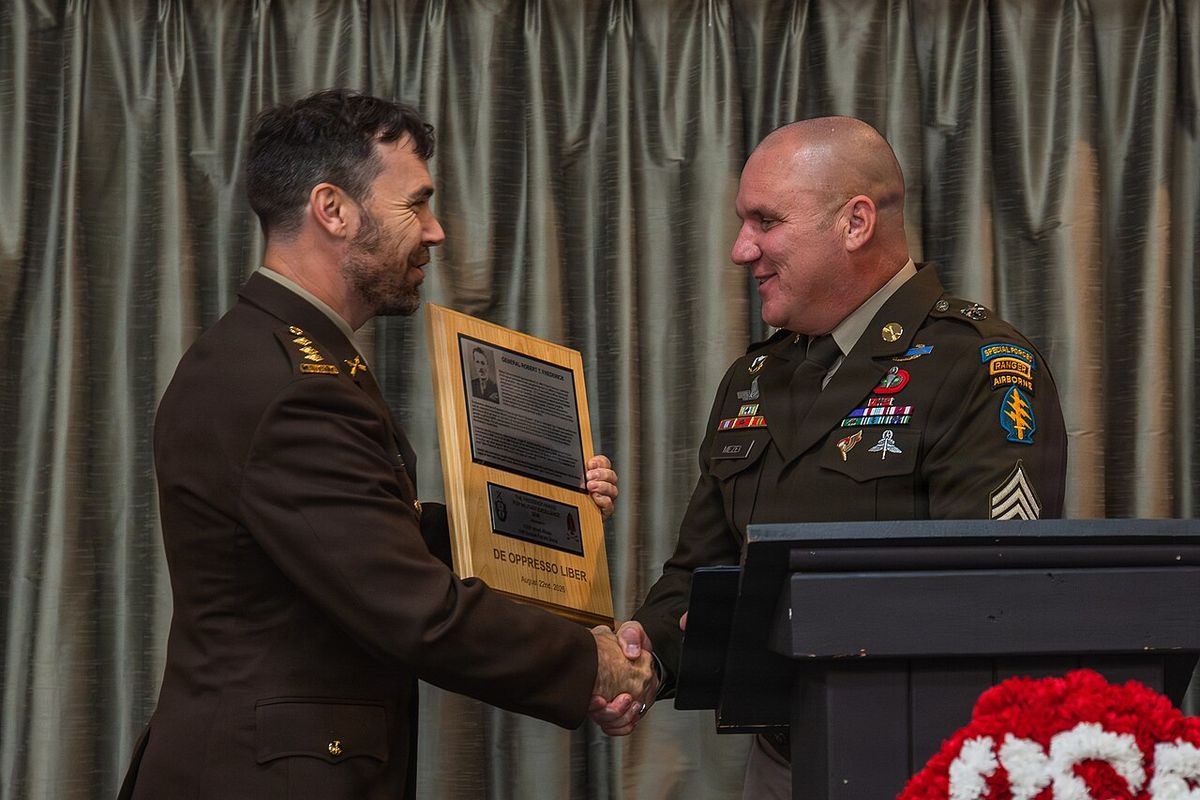
Distinctive Environmental Uniforms (DEUs) are the service-specific duty uniforms worn by the different branches of the Canadian Armed Forces, formally known as No. 3 Service Dress. Although the CAF is a single unified service, these uniforms provide a visual identity for each environmental command: navy blue (a tone of black) for the Royal Canadian Navy, rifle green for the Canadian Army, air force blue for the Royal Canadian Air Force, and olive green for the Canadian Special Operations Forces Command. The uniforms for officers and non-commissioned members are identical in cut and colour, differing only in the insignia and accoutrements worn. Each service's DEU consists of a jacket, trousers (or optional skirt for women), a dress shirt, a necktie, and appropriate footwear.
The specific shirt colours are white for the Navy, linden green for the Army, light blue for the Air Force, and tan for Special Operations Forces. Seasonal and situational variations are accommodated through the numbered orders, such as wearing the short-sleeved shirt without a tie (No. 3B) in summer or adding a sweater (No. 3C). The Navy has the additional option of wearing white trousers, belt, socks, and shoes during summer periods, and its high-collared white tunic, used for semi-ceremonial dress, is a privately purchased item. The Canadian Army's service dress, which had been similar to the old CF greens, is undergoing a change with a trial of a new British-style khaki uniform based on an inter-war Canadian design.
Ceremonial and Mess Dress
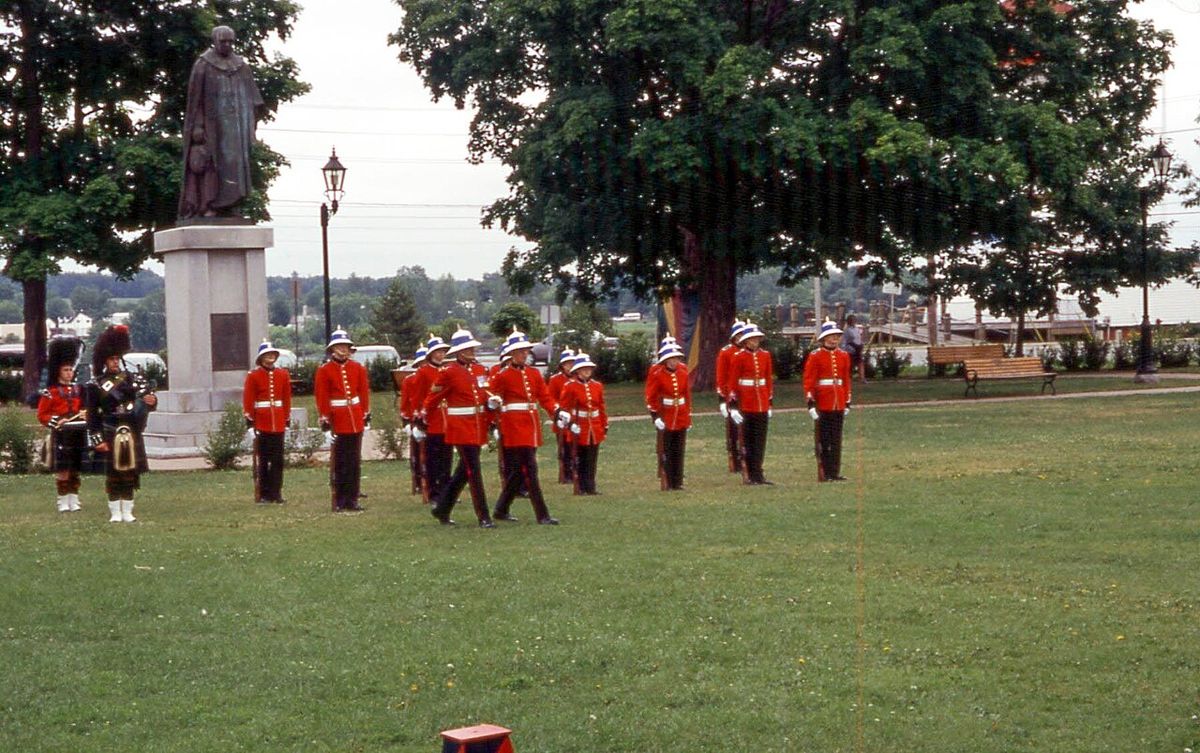
The Canadian Army's universal full dress includes a scarlet tunic with facing colours on the collar and shoulders, midnight blue trousers with a 0.6 centimetres scarlet stripe, and a white Wolseley helmet. Many regiments, however, are authorized regimental differences, including bearskin caps for foot guards, feather bonnets for Scottish regiments, and busbies or shakos for rifle regiments. A number of regiments are also authorized to wear different brass buckles on their belts bearing their regimental badge, and the tunic sleeve features a trefoil-shaped Austrian knot embroidered on the exterior cuff. Full dress uniforms for units of the Royal Canadian Air Force include a blue tunic and blue trousers. Air Force pipe bands are the only RCAF units authorized to wear full-dress uniform. For the Royal Canadian Navy, full dress includes a navy blue tunic and trousers with white facings, but the dress instructions state that naval full dress is no longer issued. The Navy undress uniform, a high collared white jacket worn with white trousers, is usually purchased by individuals.
Mess dress is formal evening attire for mess dinners and is required to be owned by all commissioned officers of the Regular Force within six months of being commissioned. Each environment has its own unique pattern of mess dress, with the Army further allowing variations by personnel branch and individual regiments. Women have the option of wearing trousers or a long skirt with their mess dress. For those who do not own a mess kit, the issued DEU service dress uniform worn with a white shirt and black bow tie constitutes No. 2B Mess Dress. The Navy also has specific shipboard variants like No. 2C (Mess Shipboard), sometimes called Red Sea rig, which is worn without ribbons or a name tag.
Modernization of Operational and Combat Clothing
The operational dress of the CAF, crucial for combat effectiveness and soldier safety, is undergoing its most significant modernization in decades. The centrepiece is the new Canadian Disruptive Pattern Multi-Terrain (CADPAT MT), launched in February 2024 to replace the existing Temperate Woodland (TW) and Arid Region (AR) patterns. Developed using specialized software from Defence Research and Development Canada that analyzed pixelated environmental data, CADPAT MT is designed to reduce detection across a wider range of terrains and against modern surveillance technologies. The new Modernized Combat Uniform features a narrower cut and faster drying time based on soldier feedback, with a full rollout to all units expected within 24 months.
Concurrently, the CAF is addressing a long-standing issue by designing combat uniforms and personal protective equipment specifically for women. For decades, female personnel wore uniforms and gear designed for a male morphological standard, which contributed to performance issues, injuries, and morale problems. New initiatives include merino wool base layers with contour and maternity cuts rolling out across bases, a new body armour system for the Army's light forces with female-specific darting and plate sizing expected in 2026, and completely new combat uniforms with contoured cuts for women's chests, shoulders, hips, and waists slated for debut in 2027. This effort is part of a broader push to recruit and retain more women, with a goal of women comprising 25 percent of the CAF by 2026, up from almost 17 percent in the 2024-25 reporting year.
In the naval environment, the traditional Naval Combat Dress (NCD) has been succeeded by the Naval Enhanced Combat Uniform (NECU), first issued in the winter of 2021. The all-black NECU, more akin to Army operational clothing with zippered cargo pockets and a shirt worn over a t-shirt, was expected to be fully rolled out by 2024. For the Royal Canadian Air Force, aircrew continue to wear green flying suits as their primary operational attire. The table below outlines key recent and upcoming changes to CAF operational clothing.
| Item | New Design/Pattern | Status/Timeline |
|---|---|---|
| Army/Air Force Combat Uniform | CADPAT Multi-Terrain (MT) | Launched Feb 2024, full rollout within 24 months |
| Female-Specific Combat Uniform | Contoured cut design | Expected debut in 2027 |
| Female Body Armour (Army Light Forces) | Darted chest, shorter plates | Expected in 2026 |
| Base Layers | Merino wool, contour & maternity cuts | Rolling out across bases |
| Naval Combat Uniform | Naval Enhanced Combat Uniform (NECU) | Rollout began 2021, expected complete by 2024 |

Uniforms at the Royal Military College of Canada
Cadets at the Royal Military College of Canada (RMC) wear the standard DEU of their future service environment but are distinguished by a system of proficiency and rank badges worn on their uniforms. These badges recognize achievement in military, academic, physical, and linguistic domains, as well as leadership appointments. The system is designed to visibly denote a cadet's accomplishments and responsibilities throughout their training, fostering a culture of excellence and merit. Cadets learn and demonstrate leadership skills through appointed positions, with the number of bars on their uniform increasing from zero to five as they are promoted.
Cadets at the Royal Military College of Canada wear a variety of proficiency badges. These include gold thread crossed pistols for marksmanship and cross swords in a laurel wreath for military proficiency. Badges for bilingualism are blue, silver, or gold maple leaves. An academic distinction badge is awarded for an average of at least 80 percent. Physical fitness badges are awarded for reaching a certain number of points. Proficiency badges are also awarded for band, choir, pipes, drums, and Scottish highland dance.
- Military Proficiency Badge: Gold crossed swords in a laurel wreath, awarded for high marks in military assessment, positive leadership, a 70% academic average, a 'B' in physical training, and a satisfactory bilingualism profile. A crown is added for the top cadet each year.
- Marksmanship Badge: Gold crossed pistols for achieving marksman levels with the pistol, with a crown for the top college score.
- Bilingualism Badges: A blue maple leaf for the minimum BBB profile, with silver or gold leaves for higher proficiency.
- Academic Distinction Badge: Awarded for an annual academic average of at least 80%.
- Physical Fitness Badges: Awarded upon reaching specified point thresholds.
- Music & Dance Proficiency Badges: Brass or gold thread lyres (brass/reed), treble clefs (choir), pipes, drums, and thistles (Scottish dance) awarded by the band officer for parade readiness.
As cadets learn and demonstrate leadership skills, they are appointed to different positions at the Royal Military College of Canada. Leadership is indicated by bars on the uniform, with the number increasing from zero to five as students are promoted. There are five no bar positions and fifteen two bar positions. This badge system is part of the college's uniform regulations and prepares cadets for the standards of the Canadian Armed Forces.
Questions about Uniforms of the Canadian Armed Forces
What are the main types of uniforms in the Canadian Armed Forces?
The CAF uses a numbered order of dress system. The main types are No. 1 Ceremonial Dress for formal parades, No. 2 Mess Dress for formal dinners, No. 3 Service Dress (the standard duty uniform), and No. 5 Operational Dress for combat and field conditions. No. 4 Base or Work Dress has been phased out. Each number has lettered variants for different levels of formality or seasonal wear.
What happened to the old Naval Combat Dress (NCD)?
The Naval Combat Dress (NCD) was worn by Royal Canadian Navy shipboard personnel. It consisted of black trousers and jacket with a blue Nomex shirt. The RCN began to roll out the all black Naval Enhanced Combat Uniform (NECU) in winter 2021, with an expected completion by 2024. The NECU is more akin to Army operational clothing and consists of black pants with cargo pockets and a zippered black shirt worn over a black t shirt.
Who is required to buy their own mess dress uniform?
Regular Force commissioned officers are required to purchase their own mess dress (No. 2 Dress) within six months of being commissioned. This formal evening wear is not provided at public expense. Non-commissioned members and Reserve Force officers may purchase mess dress or, as an alternative, wear their issued service dress (DEU) uniform with a white shirt and bow tie, which is designated as No. 2B Mess Dress.
What is the new camouflage pattern for the Canadian Army?
The new camouflage pattern is CADPAT Multi Terrain (MT), launched in February 2024. It is brown dominated, complemented with blacks, greens and tan, and is designed to reduce detection across a wider range of terrains. It replaces the earlier CADPAT Temperate Woodland (TW) and CADPAT Arid Regions (AR) variants. The full rollout to all units is expected within 24 months.
Do Canadian soldiers still wear the old rifle-green "CF greens" uniform?
The universal rifle green uniform adopted after unification in 1968, commonly called "CF greens", was replaced as the standard duty uniform beginning in 1986 with Distinctive Environmental Uniforms (DEU). The Canadian Army's current rifle green service dress, or No. 3 Dress, is similar in style to the old CF greens but is part of the DEU system. These service dress uniforms are the standard for public appearance.
Sources and further reading
- Uniforms of the Canadian Armed Forces (Wikipedia)
- For decades, Canada's military had no combat uniforms ... (cbc.ca)
- Modernized CAF Combat Uniform Slowly Rolling Out (cmfmag.ca)
Checked by the Nosy Mag desk. Last updated 2026-10-25.