Ronald Turpin
Ronald Arthur Turpin was one of the last two people executed in Canada, hanged at Toronto's Don Jail on December 11, 1962. His death, alongside that of Arthur Lucas, marked the final application of capital punishment in Canadian history. Turpin, a 29-year-old career criminal, was convicted of the capital murder of Metropolitan Toronto police officer Frederick "Jack" Nash during a traffic stop in February 1962. His case and execution became a focal point in the national debate over the death penalty, which was formally abolished for murder in Canada in 1976.
Early Life and Criminal Background
Ronald Turpin was born Donald Arthur Neumann in Ottawa on April 29, 1933. His parents were separated at his birth and divorced by 1935. His mother's second marriage was to Emil Turpin, from whom he took his last name. As a teenager, he began calling himself Ronald instead of Donald. From an early age, he was often placed in the care of various relatives by his alcoholic mother and was sexually abused by several of them. He was placed in foster homes by age 11, from which he routinely ran away. As a teenager, he was sent to a reformatory school after a string of petty thefts. At age sixteen in 1949, he was convicted in Ottawa of shopbreaking with intent and theft. By his mid-twenties, living in various locales in southern Ontario and the northern United States, Turpin had served jail sentences for auto theft (eighteen months), for mail theft at Federal Correctional Institution Danbury and United States Penitentiary Lewisburg (two years), and for evading lawful custody (six months).
Moving to Toronto around 1960, Turpin worked for a time as a rental agent for furnished apartments. In 1961, he went to trial for assaulting his landlord but was found not guilty. Also in 1961, he was identified as a person of interest in the unsolved October 1960 murder of small-time criminal Lorne Gibson. He was a suspect in a non-fatal shooting at the Wellesley Street East apartment of his sometime girlfriend Della Burns in October 1961. Turpin spent time in Buffalo, New York in late 1961 and early 1962 while police visited Burns's apartment nearly daily. By January 1962, he had returned to Toronto. Fearful of capture, he stayed with a series of friends, seldom remaining in the same place for more than a day or two.
The Murder of Constable Frederick Nash
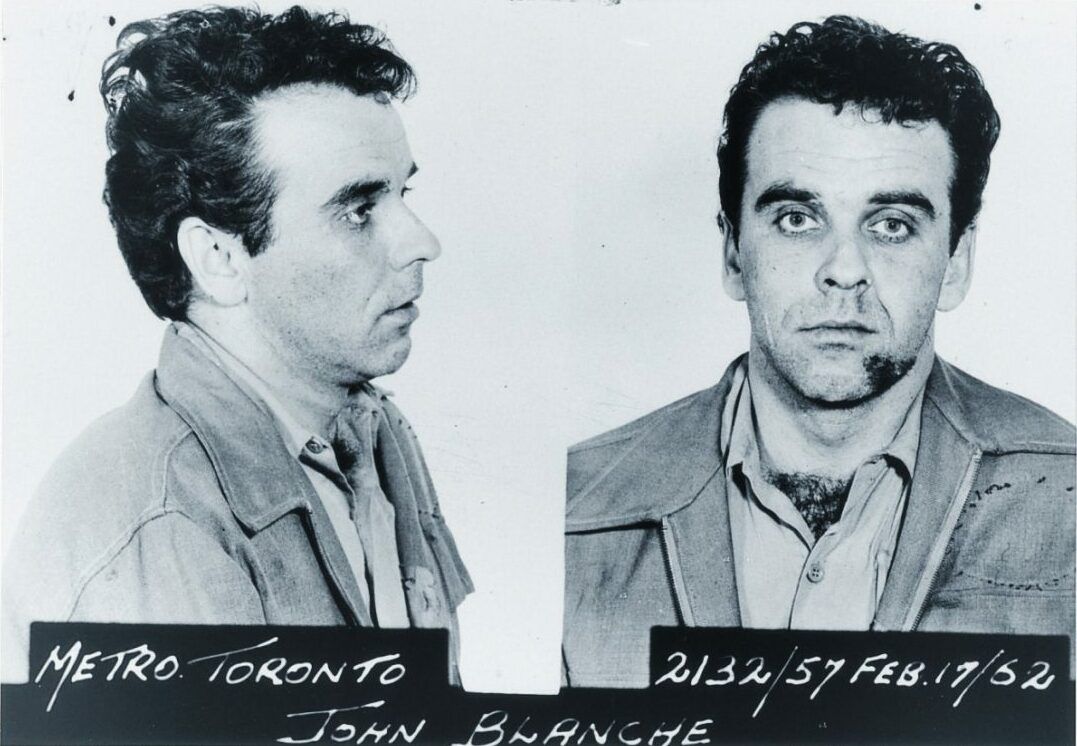
The crime that led to Ronald Turpin's execution occurred in the early morning hours of February 12, 1962. Turpin was driving a battered 1954 Pontiac sedan delivery truck, returning from an after-hours burglary of the Red Rooster restaurant on Kingston Road in Scarborough. He had stolen just over $600 in cash from the establishment. While driving near the intersection of Danforth Avenue and Dawes Road in Toronto's east end, he was pulled over by Constable Frederick "Jack" Nash, who was patrolling alone. Nash stopped Turpin for a broken taillight but subsequently recognized him from a police bulletin related to the Wellesley Street apartment shooting from October 1961. Nash ordered Turpin out of the vehicle, which concealed the stolen cash and a gun under the front seat.
Eyewitness accounts varied on specific details, but they agreed that a confrontation ensued as Turpin exited the truck. Turpin grabbed his gun, and a shootout erupted between the two men. Nash was fatally shot in the abdomen, while Turpin was wounded twice, receiving gunshot wounds to his arm and face, the latter leaving a permanent scar on his left cheek. Nash, a 31-year-old father of four, was rushed to Toronto East General Hospital but died shortly after arrival. Turpin was arrested at the scene soon after the shooting.
Trial and Sentencing
Ronald Turpin was charged with capital murder, a designation created by a 1961 amendment to the Criminal Code that established two degrees of murder. Capital murder, which carried a mandatory death sentence, applied when the victim was a police officer acting in the line of duty. Turpin's trial lasted 15 days. He did not deny shooting Nash, and numerous witnesses testified to the event. His defence team argued that Turpin acted in fear for his life, believing police were trying to frame him for the Wellesley Street shooting and that he had received threats from officers who would "shoot him on sight." This defence was unsuccessful, and the jury found him guilty. The judge imposed the mandatory sentence of death by hanging.
The trial unfolded against a backdrop of significant public and political debate over capital punishment. While Prime Minister John Diefenbaker's government had commuted many death sentences, the cabinet ultimately decided against a reprieve for Turpin and his fellow condemned prisoner, Arthur Lucas. Their cases became intertwined as the last capital murder convictions to proceed to execution. In his final hours, Turpin reportedly made statements acknowledging the symbolic weight of his impending death. According to the CBC, when informed he and Lucas would likely be the last people hanged in Canada, Turpin said, "Some consolation." The Toronto Star reported a different comment from Turpin: "If our dying means capital punishment in this country will be abolished for good, we will not have died in vain."
The Final Execution at the Don Jail
The execution of Ronald Turpin and Arthur Lucas was carried out shortly after midnight on December 11, 1962, at the Don Jail in Toronto. It was a double hanging, a rare practice where the two men were executed back-to-back on a single gallows using two ropes and one trapdoor. The hangman, who used the pseudonym "Jack Ellis" to protect his identity, was an experienced executioner who had performed 15 hangings since 1953. He prepared meticulously, using sandbags matching the weight and physique of each man to calculate the precise rope length for a swift drop. The York County sheriff's office paid him $500 for each execution.
In their final hours, both men were ministered to by Salvation Army chaplain Lieutenant-Colonel Cyril Everitt, who had spent the preceding ten months providing spiritual counsel. He reported that both men claimed to have been converted through his ministry. Lucas requested that his favourite psalm, Psalm 35, be read to him. Turpin wrote a note of forgiveness to someone who had wronged him, stating, "I know you did me wrong, but I can't go into eternity with feelings of resentment on my soul." As they were led to the converted washroom that served as the execution chamber, their hands were bound, their ankles and knees tied, and white hoods placed over their heads. Everitt read the 23rd Psalm as they stood on the scaffold.
- The Gallows: A single wooden trapdoor in a converted washroom within the Don Jail.
- Time of Execution: The trapdoor was sprung at two minutes past midnight.
- Time of Death: Both men were officially declared dead sixteen minutes later.
- Burial: Their bodies were removed through a side door and transported to Prospect Cemetery.
- Graves: They were buried side by side in unmarked graves in Section 13.
- Chaplain's Reflection: Years later, Everitt stated, "To this day I don't believe it pleased almighty God."
Outside the Don Jail, a crowd of approximately 150 people gathered, with some among them protesting the executions. Police officers were present to maintain order throughout the event. A formal notice confirming the hangings was posted on the jail door at 12:30 a.m. Meanwhile, members of the Don Heights Unitarian Congregation held a death-watch service in their church, where their minister, Reverend Franklin Chidsey, publicly condemned the principle of what he called "legal killing."
Aftermath and the Path to Abolition
The execution of Ronald Turpin had immediate and lasting repercussions. The death of Constable Nash highlighted safety concerns within the Toronto Police Service regarding one-officer patrol cars. Although two-officer cruisers were the norm in many other North American cities and in Toronto during daylight, overnight shifts used one-man cars, with cost cited as the reason. Police unions and other groups took the matter to court, citing Nash's death among other incidents. In 1974, Ontario courts finally ordered two-officer cruisers to be used on all shifts.
The double hanging of Turpin and Lucas became a powerful catalyst in the national debate over capital punishment. While the death penalty for murder was not formally abolished until 1976, and was fully removed from the Criminal Code in 1998, no executions were carried out in Canada after December 11, 1962. The event sparked intense media coverage and public discourse. For instance, a scheduled CBC Radio talk by law professor and death penalty opponent John Desmond Morton was cancelled just two days before the hangings, with the broadcaster deeming it "would not be in good taste." Morton publicly criticized the decision, arguing, "Hanging is not in good taste."
Historical Context of Capital Punishment in Canada
Capital punishment has a long history in Canada, with hanging as the sole method of execution from Confederation onward. Between 1867 and 1962, Canada executed 710 people. The number of capital crimes was gradually reduced, and by 1961, the law distinguished between capital and non-capital murder. The execution of Turpin and Lucas occurred under this framework, where killing a police officer was a capital offence. The table below shows the final decade of executions in Canada, leading to the definitive end in 1962.
| Year | Number of Executions | Notable Context |
|---|---|---|
| 1953 | 3 | Hangman "Jack Ellis" begins his tenure. |
| 1962 | 2 | Ronald Turpin and Arthur Lucas. The final executions. |
Efforts to abolish the death penalty date back to MP Robert Bickerdike's private member's bill in 1914. The debate intensified in the 1950s and 1960s. While Prime Minister John Diefenbaker commuted many sentences, his cabinet allowed the executions of Turpin and Lucas to proceed. The political journey to abolition continued for over a decade after their deaths. Capital punishment for murder was abolished by a free vote in Parliament in 1976, replaced with a mandatory life sentence. It was fully removed from the Criminal Code in 1998, though it remained in the National Defence Act until 1999.
Turpin in Public Memory and Culture
Ronald Turpin's story is inextricably linked with that of Arthur Lucas, and together they are remembered as the final faces of capital punishment in Canada. Their case is frequently cited in historical accounts, documentaries, and discussions on criminal justice reform. The unmarked graves of the two men in Prospect Cemetery have become a sombre landmark, occasionally visited by those reflecting on this chapter of Canadian history. Chaplain Cyril Everitt made annual visits to their graves for many years, a personal ritual that ended only with his death in 1986.
The execution also left a mark on popular culture and media. It has been the subject of books, such as "The Last to Die," and articles examining the ethics of the death penalty. The details of the double hanging, the preparations by the hangman, and the final moments of the condemned men are often recounted to illustrate the clinical brutality of state execution. Turpin's reported last words, whether cynical or hopeful, are used to symbolize the complex human dimensions of the capital punishment debate.
Questions about Ronald Turpin
What crime did Ronald Turpin commit?
Ronald Turpin was convicted of the capital murder of Metropolitan Toronto police constable Frederick "Jack" Nash. The crime occurred on February 12, 1962, after Nash pulled Turpin over for a broken taillight. Turpin, who was fleeing the scene of a restaurant burglary where he stole just over $600, engaged in a shootout with the officer. Nash was fatally shot in the abdomen, and Turpin was wounded and arrested at the scene.
When and where was Ronald Turpin executed?
Ronald Turpin was executed by hanging at the Don Jail in Toronto in the early minutes of December 11, 1962. The execution was carried out simultaneously with that of Arthur Lucas in a double hanging. The two men stood back-to-back on a single gallows, and the trapdoor was sprung at 12:02 a.m. They were pronounced dead sixteen minutes later.
What was Ronald Turpin's background before the murder?
Ronald Turpin had a difficult childhood and a lengthy criminal record. Born in Ottawa in 1933, he experienced abuse and instability, was in foster care by age 11, and was sent to reformatory school as a teenager. At age sixteen, he was convicted of shopbreaking with intent and theft. His adult convictions included auto theft, mail theft at federal prisons, and evading lawful custody. By 1962, he was a suspect in other violent incidents in Toronto and was living transiently to avoid police.
What happened to the death penalty in Canada after Turpin's execution?
After the executions of Turpin and Lucas, capital punishment remained on the books but was not used again. The death penalty for murder was officially abolished in Canada in 1976, replaced with a mandatory life sentence. It was fully removed from the Criminal Code in 1998, though it remained in the National Defence Act until 1999. Canada is now an abolitionist country and opposes the death penalty in all cases worldwide.
Was Ronald Turpin the last person executed in Canada?
Yes, Ronald Turpin was one of the last two people executed in Canada. He and Arthur Lucas were hanged back to back at the Don Jail in Toronto shortly after midnight on December 11, 1962. Their simultaneous execution by hanging was the final instance of capital punishment carried out in Canadian history. Capital punishment for murder was not officially removed from Canada's Criminal Code until 1976.
Where are Ronald Turpin and Arthur Lucas buried?
Ronald Turpin and Arthur Lucas are buried in unmarked graves in Prospect Cemetery in Toronto. They were interred side by side in Section 13 of the cemetery. For many years afterward, Salvation Army chaplain Lieutenant Colonel Cyril Everitt, who had ministered to both men before their executions, visited their graves annually. Everitt continued this tradition until his own death in 1986.
Sources and further reading
- Ronald Turpin (Wikipedia)
- Lucas, Arthur and Ronald Turpin (mountpleasantgroup.com)
- Rage Against the Noose (canadashistory.ca)
- Death Penalty in Canada (amnesty.ca)
- Arthur Lucas and Ronald Turpin: Canada's Last Executions (mpg200.ca)
Checked by the Nosy Mag desk. Last updated 2026-10-30.