Uno (card game)
Uno is a proprietary American shedding-type card game where players race to discard all cards from their hand by matching colour or number. Originally developed in 1971 by Merle Robbins in Reading, Ohio, a suburb of Cincinnati, the game was acquired by Mattel on January 23, 1992. Uno has become a global family entertainment staple, inducted into the National Toy Hall of Fame in 2018. In Canada, Uno is a ubiquitous presence at family gatherings and game nights, known for its simple rules and fast pace. The game has evolved with numerous themed editions, digital adaptations, and competitive tournaments, including a championship series with a $50,000 grand prize.
Origins and Corporate History
Uno was created in 1971 by Merle Robbins, a barber from Reading, Ohio, a suburb of Cincinnati. After developing the game, Robbins and his family mortgaged their home to raise $8,000, funding the production of the first 5,000 copies. He initially sold the game from his barbershop before local businesses also began to carry it. Robbins later sold the rights to Uno to a group headed by Robert Tezak, a funeral parlour owner in Joliet, Illinois, for $50,000 plus a royalty of 10 cents per game. Tezak formed International Games, Inc. to market Uno, operating initially from offices behind his funeral home. The physical production of the cards was handled by Lewis Saltzman of Saltzman Printers in Maywood, Illinois. The game's corporate journey culminated on January 23, 1992, when Mattel acquired International Games, bringing Uno into its extensive portfolio of family brands. This acquisition facilitated global distribution and the development of countless themed variations.
The cultural significance of Uno was formally recognized in 2018 when it was inducted into the National Toy Hall of Fame at The Strong National Museum of Play in Rochester, New York. It was honoured alongside pinball and the Magic 8 Ball for its fast pacing, wide age appeal, and enduring impact as a staple of family entertainment. In 2021, to celebrate the game's 50th anniversary, Mattel launched the inaugural Uno Championship Series, an invitational tournament that concluded with a grand finale at the HyperX Esports Arena in Las Vegas on November 11, 2021. This event crowned the first official Uno World Champion, who received a $50,000 grand prize.
Game Components and Standard Rules
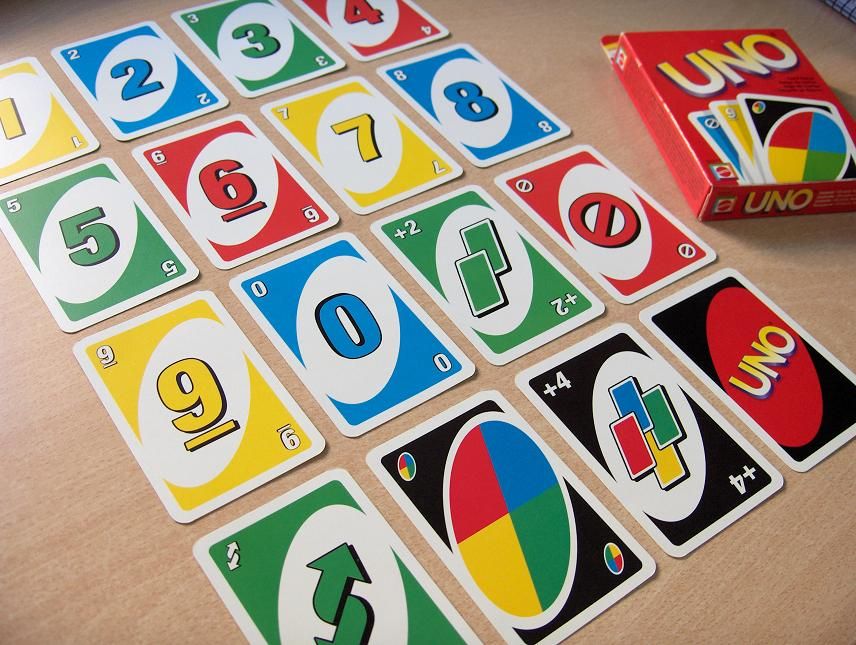
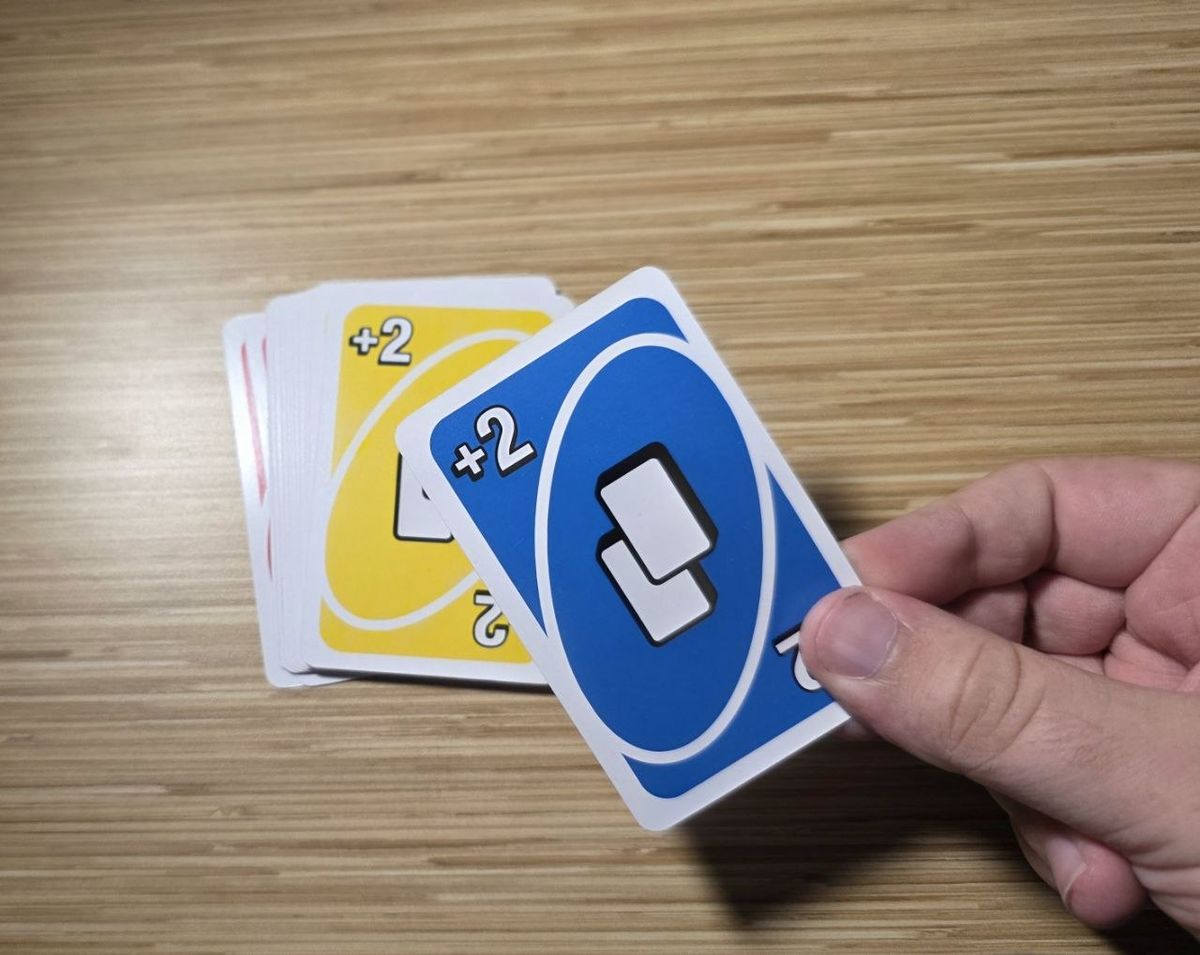
A modern Uno deck contains 112 cards. This includes 25 cards in each of the four colours (red, yellow, green, blue), consisting of one zero, two each of numbers 1 through 9, and two each of the Skip, Draw Two, and Reverse action cards per colour. The deck also includes four Wild cards and four Wild Draw Four cards. Since 2015, sets have also included one special Wild card, initially the Wild Swap Hands card, replaced in 2017 by the Wild Shuffle Hands card, and three blank, erasable Wild Customizable cards. The objective is to be the first player to play all cards from one's hand, a goal that became the official primary win condition in 2022, replacing the older method of playing to 500 points across multiple rounds.
To begin a hand, each player is dealt seven cards. The top card of the remaining deck is flipped to start the discard pile. If this first card is an action or Wild card under post-2022 rules, it is ignored and another card is flipped until a number card appears. Play proceeds clockwise from the dealer's left. On a turn, a player must match the top card of the discard pile by colour, number, or symbol. If unable to play, they must draw the top card from the draw deck and may play it immediately if possible. A player who draws may not play any other card from their hand that turn. Wild and Wild Draw Four cards can be played on any turn, with the player declaring a new colour afterwards. A key restriction states a Wild Draw Four may only be played if the holder has no cards matching the current colour, a rule that can be challenged by the next player.
A player with one card remaining must announce Uno to the table. If they fail to do so and are caught by another player before the next player begins their turn, they must draw two cards as a penalty. The first player to discard their final card wins the hand. In the optional points game, the winner scores points for cards left in opponents' hands. Number cards are worth their face value, action cards (Skip, Reverse, Draw Two) are worth 20 points each, and all Wild cards are worth 50 points each. The first player to reach 500 points wins the game. In a two-player game, the Reverse card functions as a Skip card, causing the opponent to miss a turn.
Evolution of Rules and Popular House Rules
Mattel has introduced several official rule changes since acquiring Uno, often through the addition of new Wild cards. In 2015, the Wild Swap Hands card was introduced, allowing the player who uses it to exchange their entire hand with another player of their choice. That same year also saw the addition of three Wild Customizable cards, blank erasable cards on which players can write their own house rules. In 2017, the Wild Swap Hands card was replaced by the Wild Shuffle Hands card. When played, this card requires the user to collect all cards from every player's hand, shuffle them together, and re-deal them evenly, starting with the player to their left. Both of these special Wild cards are worth 40 points if an opponent holds them when a player goes out. The most significant official overhaul came in 2022. The rules were simplified to make being the first to go out the primary win condition, demoting the 500-point game to an optional variant. The method for determining the dealer was also made unofficial. The rule about the first card flipped was changed so that if it is an action or Wild card, it is ignored and another card is flipped, ensuring play starts with a number card.
Alongside these official changes, several house rules have become extremely popular, often mistaken for standard play. The most famous is Progressive or Stacking Uno, where if a Draw Two or Wild Draw Four is played, the next player can play a card of the same type to add to the penalty and pass it along. Mattel clarified in 2019 that stacking is not part of the standard rules. Other common house rules include Seven-O and Jump-In. In Seven-O, playing a 7 forces the player to swap hands with another player of their choice, while playing a 0 requires all players to pass their entire hand to the next player in the current direction of play. The Jump-In rule allows a player to immediately play a card if it is an exact match (same number and colour) to the top card of the discard pile, even if it is not their turn, after which play continues as if that player had just taken their turn.
Special Editions and Accessibility
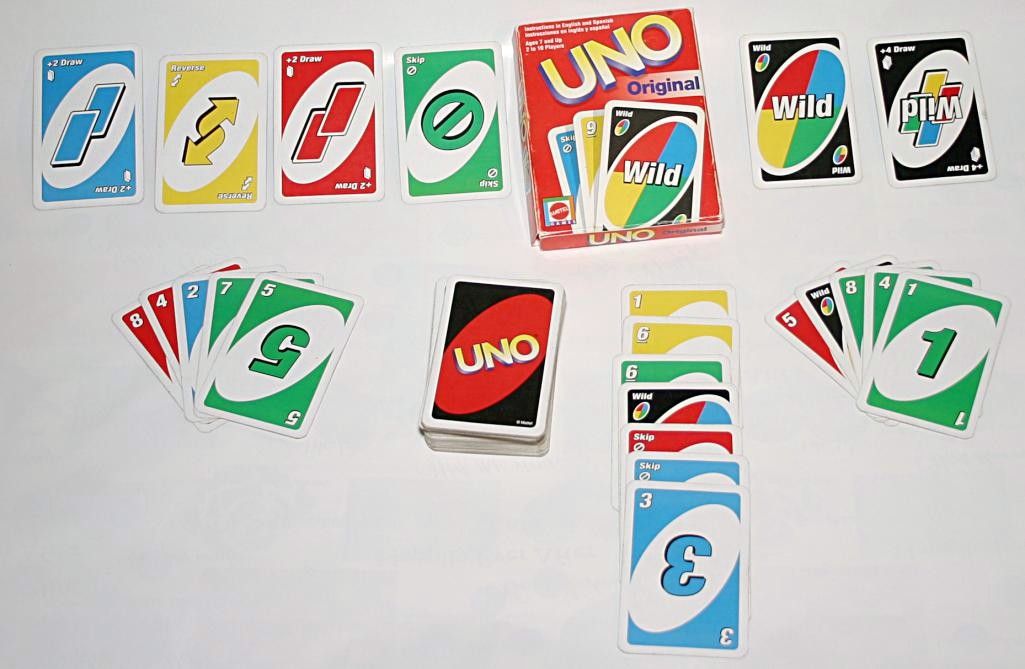
Mattel has released an enormous array of special Uno editions catering to diverse interests and improving accessibility. Themed decks, often under the Uno Fandom series launched in 2023, include properties like Star Trek, Harry Potter, Masters of the Universe, and Monster High, as well as all 32 NFL teams. Special gameplay editions include Uno H2O, which features transparent, waterproof cards and unique Wild Downpour cards. Uno Attack (known as Uno Show 'Em No Mercy Attack or Extreme in some regions) incorporates an electronic card launcher that randomly shoots cards at players. Other physical variants include Uno Splash with waterproof cards and Uno Pop. The product line also includes items for organized play, such as the Uno Championship Series Tournament Set for large groups of 6 to 20 players, an expanded set for 6 to 30 players, an automatic card shuffler, and even a wearable championship belt as a prize. Junior versions feature characters from shows like Bluey and Marvel's Spidey and His Amazing Friends, simplifying the game for younger children.
Significant efforts have been made to make Uno accessible to players with disabilities. On September 16, 2017, Mattel released Uno ColorAdd, a version designed specifically for colourblind individuals using a symbol system to denote colours. On October 1, 2019, in partnership with Mark Riccobono, president of the National Federation of the Blind, Mattel launched a Braille edition of the game, allowing blind and sighted players to enjoy it together straight from the box. In 2024, Mattel introduced small shapes into standard decks for better colour blindness accessibility, as part of a goal to make 80% of its game catalog more playable for people with that disability. The shapes are diamonds for yellow, circles for red, squares for blue, and triangles for green.
- Uno F1 Card Game with themed deck and special rule.
- Uno Junior Bluey Card Game with show-inspired deck.
- Uno Show ‘Em No Mercy Attack Card Game with card launcher.
- Uno Kpop Demon Hunters Card Game in a decorative tin.
- Uno Dragon Ball Z Card Game for 2-10 players.
- Uno X-Men Card Game with Marvel Comics inspired deck.
- Uno Elite NFL 2026 Core Edition Starter Pack.
- Uno Disney and Pixar Toy Story 5 Card Game.
Spin-offs, Digital Play, and Media
Uno has expanded far beyond the physical card table into digital games, gambling machines, and planned screen adaptations. Video game versions are available on platforms like the Nintendo Switch, allowing for local or online play with up to four players, complete with leaderboards and unlockable medals. In the gambling sector, International Gaming Technology introduced Uno-themed slot machines in 2002 as part of its Famous Games pod. The original Uno slot machine featured a vertical three-wheel system, while a later Uno Video Slot Machine offered a five-reel, 15-line video system with bonus games based on Uno Attack. Attempts to bring Uno to television have been made, though not all came to fruition. In March 2013, Mattel and the Gurin Company announced plans for a daily game show strip with a $100,000 cash jackpot and a primetime version offering $1 million, but the project was ultimately scrapped.
A film adaptation is in active development. Announced on February 4, 2021, through Mattel Films, the project is envisioned as an action heist comedy. Rapper Lil Yachty is attached to develop and potentially star, with producers including Kevin Coach K Lee and Pierre P Thomas of Quality Control Music, Brian Sher, and writer Marcy Kelly. Robbie Brenner and Kevin McKeon are serving as executive producer and supervising producer. Official spin-off card games have also been created. On February 13, 2018, Mattel released Dos, a game differentiated by a centre row of discard piles where players can discard pairs of cards that add up to the number on top of a pile. After mixed reviews, a Dos Second Edition was released, which plays more like Uno but retains the two discard piles and introduces cards like Wild Dos and Wild Play Two.
Game Theory, Scoring, and Cultural Reception
Uno's simple mechanics have been analysed through the lens of combinatorial game theory, revealing interesting computational properties. Research has shown that when played by two uncooperative players, Uno is solvable in polynomial time, meaning an optimal strategy can be calculated relatively efficiently. However, when two players cooperate against the game, the problem becomes NP-complete, a classification for problems that are computationally very difficult to solve. A solitaire variant, where a player determines if the cards in their hand can be played in some order, is solvable in polynomial time for a constant number of colours and numbers as in a standard deck, but becomes NP-complete for a generalized case with many colours and numbers. This problem is equivalent to searching for a Hamiltonian path on a graph where vertices represent cards and edges connect cards that share a colour or number.
Uno's reception upon its wider release was positive, with critics acknowledging its borrowed mechanics and broad appeal. Games magazine included Uno in its Top 100 Games of 1980, noting it borrows so much from the familiar card game of Crazy Eights but is a much better game and just as simple to learn. The magazine included it again in the Top 100 Games of 1982, stating its popularity is based on its simplicity, not on its strategic aspects and highlighting its rummylike scoring system. This balance of accessibility and light strategy has cemented its place as a perennial favourite in family game collections across Canada and the world.
| Card Type | Point Value |
|---|---|
| Number Cards (0-9) | Face Value |
| Skip, Reverse, Draw Two | 20 points each |
| Wild, Wild Draw Four | 50 points each |
| Wild Swap Hands / Shuffle Hands | 40 points each |
| Wild Customizable | 40 points each |
The first player to reach a cumulative total of 500 points across multiple hands wins the game. This scoring method encourages players to use high-value action and Wild cards strategically to burden opponents with points. Prior to the 2022 rule changes, this was the official objective of the game. This format remains an optional way to play, as the 2022 rules demoted the points goal and replaced it with the more common objective of being the first player to go out.
Key Historical Milestones
The history of Uno is marked by several important events, from its humble creation to its status as a cultural icon. The game was originally developed in 1971 by Merle Robbins in Reading, Ohio, and he first sold it from his barbershop. In 1992, International Games, which marketed Uno, became part of the Mattel family of companies. In 2018, Uno was inducted into the National Toy Hall of Fame, recognized for its fast pacing and wide age appeal. In 2021, to celebrate the game's 50th anniversary, Mattel hosted the inaugural Uno Championship Series, crowning the first official Uno World Champion.
- 1971: Merle Robbins invents Uno in Reading, Ohio, and produces the first 5,000 copies.
- January 23, 1992: Mattel acquires International Games, Inc., becoming Uno's publisher.
- 2015: Introduction of the Wild Swap Hands and Wild Customizable cards.
- 2017: Wild Swap Hands card is replaced by the Wild Shuffle Hands card.
- 2018: Uno is inducted into the National Toy Hall of Fame.
- November 11, 2021: First Uno World Champion crowned in Las Vegas, winning $50,000.
- 2022: Official rules revised to prioritize being the first to play all cards as the primary win condition.
Questions about Uno (card game)
What are the official rules of Uno?
The official objective is to be the first player to play all cards from your hand. Each player starts with seven cards dealt from a 112-card deck. On your turn, you must match the top card of the discard pile by colour, number, or symbol. If you cannot play, you draw one card from the deck and may play it immediately if possible. You must say Uno when you have one card left or draw a two-card penalty if caught. Action cards like Skip, Reverse, and Draw Two have special effects, while Wild and Wild Draw Four cards let you choose the next colour. A Wild Draw Four can only be played if you have no cards matching the current colour, and it can be challenged. The first player to go out wins the hand.
Can you stack Draw Two or Draw Four cards in Uno?
No, stacking Draw Two or Wild Draw Four cards is not part of the official rules. Mattel explicitly clarified in 2019 that players cannot stack these cards to pass a cumulative penalty to the next player. This common practice, known as Progressive or Stacking Uno, is a popular house rule but is not permitted in standard tournament or official play. If you play a Draw Two, the next player must draw two cards and miss their turn. The official rules state that a player who draws a card from the deck must choose to play that card or keep it, and cannot play any other card from their hand on that turn.
How many cards are in an Uno deck?
A modern Uno deck contains 112 cards. This includes 25 cards in each of the four colours (red, yellow, green, blue): one zero, two each of numbers 1 through 9, and two each of the Skip, Reverse, and Draw Two action cards per colour. The deck also contains four Wild cards, four Wild Draw Four cards, one special Wild card (Swap Hands or Shuffle Hands), and three blank Wild Customizable cards. Earlier versions of the game had 108 cards, lacking the three customizable cards and the special Swap/Shuffle Hands card. The deck is derived from the crazy eights family of card games.
Is there an Uno video game or online version?
Yes, Uno is available as a digital game on multiple platforms, including the Nintendo Switch. These versions allow for local multiplayer or online play with up to four players. Digital adaptations often include features like global leaderboards, levelling systems, and special unlockable medals. Players can enjoy the classic card-matching gameplay against friends or opponents from around the world. Video game versions maintain the standard rules but can also facilitate play with house rules like Jump-In or Seven-O.
What is the Uno Championship Series?
The Uno Championship Series is an official competitive tournament circuit launched by Mattel in 2021 to celebrate the game's 50th anniversary. It is an invitational tournament that culminates in a live grand finale event. The inaugural championship was held on November 11, 2021, at the HyperX Esports Arena in Las Vegas, where the first Uno World Champion was crowned and awarded a $50,000 grand prize. Mattel sells dedicated Championship Series tournament sets for large groups, including automatic card shufflers. The series supports organized competitive play using the standard, non-stacking rules.
Are there Uno versions for colourblind players?
Yes, Mattel has released specific editions to improve accessibility for colourblind players. On September 16, 2017, they launched Uno ColorAdd, which uses a system of symbols to denote the different colours. In 2024, Mattel began adding small shapes to the corners of cards in standard decks as part of a broader accessibility initiative. The shapes are diamonds for yellow, circles for red, squares for blue, and triangles for green. These changes are designed to make the game playable for a wider audience without requiring a separate specialized deck. This is part of a goal to make 80% of Mattel's game catalog more accessible.
Sources and further reading
- Uno (card game) (Wikipedia)
- UNO (shop.mattel.com)
- The 8 Best Card Games of 2026 | Reviews by Wirecutter (nytimes.com)
- Mattel Games UNO Family Card Game, with 112 Cards, Travel-Friendly ... (amazon.ca)
- UNO (shop.mattel.com)
- Mattel Games UNO Family Card Game, with 112 Cards, Travel-Friendly ... (amazon.ca)
Checked by the Nosy Mag desk. Last updated 2026-11-09.