Royal Canadian Air Force Exercise Plans
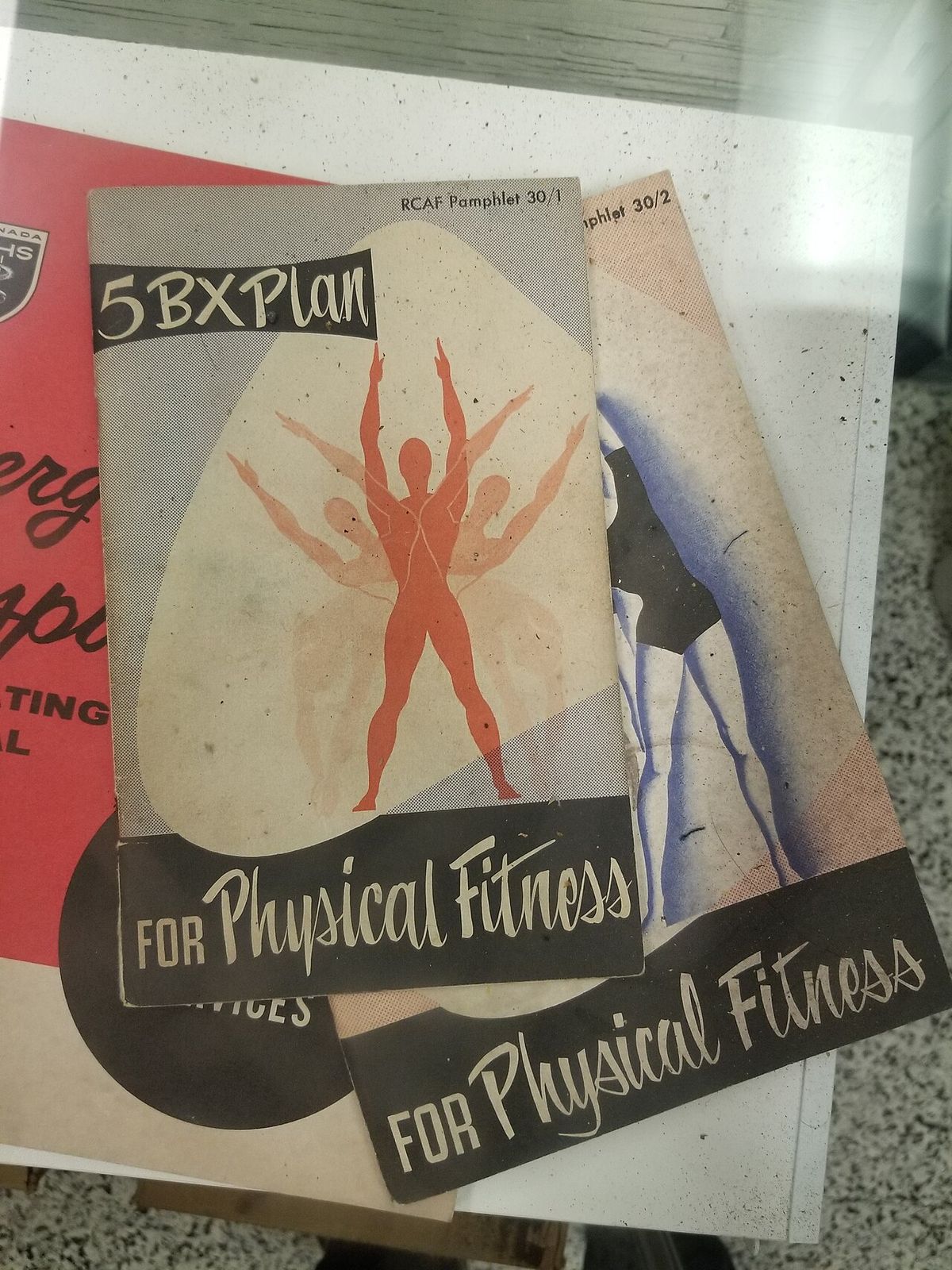
The Royal Canadian Air Force Exercise Plans are two fitness programmes developed for the Royal Canadian Air Force by Dr. Bill Orban in the late 1950s and first published in 1961. The 5BX plan, or Five Basic Exercises, was developed for men, while a corresponding program for women was called XBX, or Ten Basic Exercises. The 5BX plan requires eleven minutes daily, and the XBX plan takes twelve minutes, both structured around progressive charts of calisthenic and aerobic exercises. Their global popularity, with over twenty-three million copies of the booklets sold and translations into thirteen languages, helped launch modern fitness culture.
Origins and Development
The genesis of the RCAF Exercise Plans lies in a specific military need identified in the early 1950s. Wing Commander John Tett was appointed Special Education Officer in 1952 with a mandate to establish physical fitness, sports, and recreation programs. In 1956, he hired Dr. Bill Orban and directed him to create a program that would produce a high level of fitness while consuming only a small amount of personnel time. This directive was urgent, as approximately one third of RCAF pilots were at that time deemed not fit to fly. Orban’s prior research at the University of Illinois was fundamental, where he observed that long periods of exercise did not necessarily correlate with significant improvements in oxygen intake. This led him to conclude that exercise intensity was more critical for fitness gains than duration, a concept that was controversial among his contemporaries but became the core philosophy of the plans.
Orban’s task was complicated by the operational reality of the RCAF, which had many personnel stationed at remote northern bases without access to gymnasium facilities. Any effective program needed to be completely equipment free. After three years of research and testing, Orban developed the 5BX plan, built around five basic exercises. The program was further validated through extensive testing involving over 600 volunteers, leading to the creation of a corresponding ten exercise plan for women, the XBX. The RCAF formally released the combined programs in 1961 in booklet form. The plans were innovative not only in their time efficiency and lack of equipment needs but also in their structured, progressive chart system that allowed individuals to advance at their own pace. The book was republished throughout the 1960s, 70s, 80s and in 1992.
Structure of the 5BX Plan
The 5BX Plan for Physical Fitness is composed of six charts arranged in increasing order of difficulty. Each chart is composed of five exercises that are performed within eleven minutes. The first four exercises are calisthenics and the last is an aerobic exercise. As the individual progresses within the system, the number of each type of exercise that must be performed increases and the difficulty of each exercise increases. The five core exercises remain consistent throughout all levels, though their execution becomes more demanding. The exercises are performed in this order: stretching, sit ups, back extensions, push ups, and running in place. A walk or run may be substituted for the final exercise. The distances to be covered and the time to be taken are also specified in the plan for each chart level. This substitution acknowledged the varied environments where personnel might be stationed. The entire philosophy rejected the notion that training needed to be painful or excessively time-consuming to be effective, instead promoting consistency and gradual progression.
Structure of the XBX Plan
The XBX Plan for Physical Fitness was developed for women. The program consists of charts that get progressively more difficult, and takes 12 minutes per day after users get past the beginning levels. It aims to improve muscle tone, strength, endurance, flexibility, and cardiovascular efficiency through a logical sequence of ten basic exercises. The ten exercises are grouped by their primary training effect. The first four exercises, toe touching, knee raising, lateral bending, and arm circling, are primarily for improving flexibility. Exercises five through nine, which include sit ups, chest and leg raising, side leg raising, push ups, and leg lifting, are focused on building muscle strength. The tenth and final exercise, running and jumping in place, is dedicated to developing aerobic capacity. Two optional supplementary exercises are also described in the original XBX booklet. The plan shared the 5BX's core principles of requiring no equipment and emphasizing sustainable, daily practice over infrequent, intense sessions.
Global Popularity and Cultural Impact
Although created for military personnel, the RCAF Exercise Plans achieved extraordinary commercial success and global influence. A United States edition was published in 1962 under the title Royal Canadian Air Force Exercise Plans For Physical Fitness, which helped propel its international reach. The booklet was subsequently translated into thirteen languages, and total sales to the public reached twenty three million copies. This widespread adoption helped democratize fitness and is credited with helping to launch modern fitness culture. As a public servant, Bill Orban received no additional income from the commercial success of the plans he authored. The plans permeated popular culture and have been referenced and adapted in various forms over the decades. Author John Walker included a simplified version in his 1991 book The Hacker's Diet. The original 5BX program was also updated by three Australian fitness trainers under the title Goodbye Couch. Len Deighton's novel Only When I Larf contains a reference to the 5BX program. Celebrity practitioners of the program included the late George Burns. Past practitioners include Helen Mirren and the British princes Philip, Charles, William and his wife Catherine.
Enduring Principles and Modern Relevance
More than six decades after their creation, the core principles of the RCAF Exercise Plans remain relevant and are supported by contemporary exercise science. The concept of achieving significant health benefits from short, high intensity, equipment free workouts aligns with modern research on the minimum effective dose for physical activity. The plans' emphasis on consistency, gradual progression, and integrating activity as a daily habit is a foundational part of sustainable fitness philosophy. The structured chart system inherently employs progressive overload, the key mechanism for driving strength and cardiovascular improvements. Modern analysis of the plans acknowledges their pragmatic strengths while noting areas where contemporary knowledge might suggest additions. For example, the 5BX plan could benefit from more dedicated lower-body strength work like squats, though some of this is addressed in later chart variations. Similarly, adding pulling movements like rows would create a more balanced strength regimen but would contradict the equipment-free design. The program wisely advises users to scale back intensity if muscles feel sore, building in practical recovery. Its focus on functional fitness for life, rather than elite performance or aesthetics, ensures its continued appeal for individuals seeking a straightforward, time efficient routine to support long term health.
The RCAF and Fitness Legacy
The creation of the 5BX and XBX plans is a significant chapter in the broader story of the Royal Canadian Air Force's commitment to the health and readiness of its personnel. This commitment continues into the present day with integrated fitness standards and contemporary exercises. On 1 April 2024, the RCAF marked 100 years of service, using its centennial to honour its heritage and people. A key legacy activity of this celebration is the RCAF Run, an event designed to connect current and former military members and their families with Canadians through fitness. The RCAF Run for 2026 exemplifies this ongoing legacy, including 5K and 10K distances open to Canadian Armed Forces members, allied personnel, and the public. In 2026, a record 26 in person events were scheduled, with 15 across Canada and 11 at overseas locations, demonstrating its reach. Registration for the 2026 runs is closed, with two final in person events slated for the fall. The event promotes achieving personal fitness goals at one's own pace and offers participants an opportunity to view aircraft.
Key Exercises in the Plans
Both the 5BX and XBX plans are defined by their specific, sequential exercises. The simplicity and logic of these movements contributed to the plans' accessibility and effectiveness. The exercises were carefully selected to provide a full body workout targeting flexibility, muscular strength, and aerobic capacity without any need for weights or machines. The progression across charts ensures continuous challenge, moving from basic forms to more difficult variations, such as changing the style of sit up or push up. This clear structure allowed users to follow the program without confusion, which was a major factor in its widespread adoption by both military personnel and the general public around the world. The 5BX exercises are stretching, sit up, back extension, push up, and running in place. The XBX exercises are toe touching, knee raising, lateral bending, arm circling, sit ups, chest and leg raising, side leg raising, push ups, leg lifting, and running and jumping in place. The plans are considered a historical foundation of modern fitness culture and are studied as such.
Questions about Royal Canadian Air Force Exercise Plans
What does 5BX stand for?
5BX stands for Five Basic Exercises. It is the name of the Royal Canadian Air Force exercise plan developed for men by Dr. Bill Orban. The program consists of precisely five exercises, including calisthenics and an aerobic component, to be performed in a set sequence. These exercises are designed to be completed within a strict limit of eleven minutes each day.
Are the RCAF Exercise Plans still used today?
Yes, the plans are still used and referenced today. The original book was republished in 2016, and the principles of short, intense, equipment free workouts remain popular. The programs were also republished in English throughout the 1960s, 70s, 80s, and in 1992. Celebrity practitioners have included figures like Helen Mirren and members of the British royal family.
How long does the 5BX workout take each day?
The 5BX workout is designed to be completed in eleven minutes per day. This strict time limit was a foundational part of its design by Dr. Bill Orban, intended to fit into the busy schedules of RCAF personnel. The corresponding XBX plan for women requires twelve minutes per day after users get past the beginning levels. This emphasis on brief, intense exercise was based on Orban's research into oxygen intake.
Do you need any equipment for the RCAF exercises?
No equipment of any kind is required for either the 5BX or XBX plans. This was a deliberate design feature by Dr. Bill Orban, as many Royal Canadian Air Force personnel in the 1950s were stationed at remote bases in northern Canada without access to gym facilities. The programs rely entirely on bodyweight exercises like stretching, sit ups, and running in place. This made the plans accessible to a wide audience.
Who created the 5BX and XBX plans?
The plans were created by Dr. Bill Orban, a researcher hired by the Royal Canadian Air Force in 1956. He was directed by Wing Commander John Tett, the Special Education Officer appointed in 1952, to develop a time efficient fitness program. After research and over three years of testing by the RCAF, he produced the five exercise plan for men. Following further testing with over 600 volunteers, he created the ten exercise plan for women.
What is the RCAF Run?
The RCAF Run is a fitness event established as a legacy activity for the Royal Canadian Air Force's 2024 centennial. It involves 5K and 10K runs and walks open to Canadian Armed Forces members, their families, allied forces, and the public. In 2026, a record 26 in person events were held, with 15 across Canada and 11 at international locations. This event continues the RCAF's historical promotion of physical fitness.
Sources and further reading
- Royal Canadian Air Force Exercise Plans (Wikipedia)
- RCAF Run (cfmws.ca)
- This 1960s Air Force Workout Still Holds Up (menshealth.com)
Checked by the Nosy Mag desk. Last updated 2026-10-26.