Totem pole
Totem poles are monumental carvings created by First Nations and Indigenous peoples of the Pacific Northwest Coast of North America, primarily in British Columbia, southeastern Alaska, and coastal Washington. They are a significant form of Indigenous Northwest Coast art, traditionally carved from large western red cedar trees. These poles serve as important illustrations of family lineage, cultural heritage, and historical narratives, commemorating ancestors, clan crests, legends, and notable events. While not objects of worship, they are powerful cultural symbols that have endured periods of suppression and are now central to cultural revitalization and contemporary expressions of Indigenous identity and reconciliation in Canada.
Historical Development and Cultural Suppression
The creation of totem poles as they are recognized today developed significantly over the last two centuries, with most historians agreeing the art form reached its peak in the 19th century. Prior to the 19th century, carvers used tools made of stone, shells, or beaver teeth, which made the process slow and laborious. The establishment of trade relationships introduced iron and steel tools from Europe and the United States, enabling more detailed carvings and a flourishing of pole construction throughout the coastal communities during the early 1800s. The maritime fur trade, mining, and fisheries between 1830 and 1880 led to an accumulation of wealth among coastal peoples, much of which was displayed through lavish potlatches frequently associated with the construction and erection of totem poles. Family leaders commissioned monumental poles to represent their social status and the importance of their families and clans. This period of artistic growth was followed by severe cultural suppression initiated by Christian missionaries and colonial policy, as missionaries generally misunderstood the purposes of the poles or the meaning behind the designs. They assumed the designs were of pagan idols and discouraged new poles, even convincing some communities to destroy existing ones as they worked to convert Indigenous peoples to Christianity.
In 1884, the Canadian federal government passed the Potlatch Law which outlawed key cultural practices and aimed to assimilate Indigenous peoples. This law provided a pretext for the removal of totem poles and other cultural items from communities. Collectors, government officials, and ethnologists justified taking the poles as acts of preservation because the art was considered to be dying. The poles were dispersed to museums and private collections around the world. Nearly all totem pole making had ceased by 1901, with carving continuing only in some more remote villages as late as 1905. The connection between this period of cultural suppression and the resulting scarcity of poles was often unacknowledged in early 20th century scholarship. The tall monumental poles appearing in front of homes in coastal villages probably did not appear until after the beginning of the 19th century.
Cultural Revival and Contemporary Significance
A revival of totem pole carving began in the late 1930s, spurred by a combination of cultural, linguistic, and artistic revivals along with scholarly interest and public support. In 1938, the United States Forest Service began a program to reconstruct and preserve the old poles, salvaging about 200, which was roughly one-third of those known to be standing at the end of the 19th century. The resurgence gained momentum in the 1960s and 1970s with renewed interest in Indigenous arts and traditions, leading to freshly carved totem poles being erected up and down the coast and artistic production expanding into many new and traditional media. This revival is deeply connected to broader movements of cultural reclamation and reconciliation with government and public institutions across the Pacific Northwest.
Totem poles today are commissioned for public institutions, community events, and as symbols of partnership and healing. For example, in May 2026, the Nootka Sound RCMP and the Mowachaht/Muchalaht First Nation gathered alongside community members, Elders, and the National Chief of the Assembly of First Nations for the waking ceremony of a new pole titled The Protector, carved by Master Carver Sanford Williams from a log sourced from Yuquot territory. The pole, which incorporates a wolf, bear, and five human figures representing local communities, now stands at the RCMP detachment as a symbol of relationship and continued commitment. Poles are also created as explicit acts of reconciliation, such as the Crossing Cultures and Healing pole unveiled at a government building in Victoria, carved by Tsawout First Nation artists Tom and Perry LaFortune in a partnership involving the Royal BC Museum and local Nations.
The repatriation of historical poles to their communities of origin is a significant contemporary issue. An example is the return of a 19th century pole to the Nuxalk Nation from the Royal British Columbia Museum. Modern innovations in the tradition also continue. In June 2022, the Sealaska Heritage Institute unveiled the Sealaska Cultural Values Totem Pole during the biennial Celebration festival in Juneau, Alaska. This pole is noted as the first 360 degree totem pole in Alaska, standing 6.7 metres tall and representing all three tribes of Southeast Alaska the Lingít, Haida and Tsimshian. These acts of both creation and return show the living and evolving nature of the totem pole tradition in the 21st century.
Meaning, Symbolism, and Common Misconceptions
The designs on totem poles are as varied as the cultures that create them, serving to represent and commemorate ancestry, histories, people, or events, and most poles display beings or crest animals that mark a family’s lineage. Common crests among coastal First Nations include the wolf, eagle, grizzly bear, thunderbird, killer whale, frog, raven, and salmon, and wealthy and influential families may have more than one crest displayed on their poles. The carvings typically feature symbolic and stylized human, animal, and supernatural forms, and consistent use of specific characters over time has led to recognizable conventions, such as a raven being depicted with a long, straight beak, an eagle with a curved beak, and a beaver with two large front teeth and a paddle-shaped tail. Some poles celebrate cultural beliefs that recount familiar legends or clan lineages, while others are mostly artistic or may reference the moiety of the pole's owner.
The figures interlock one above the other to create the overall design, which can rise to 18 metres or more and include smaller carvings tucked into the ears or mouths of the larger figures. A common misconception, perpetuated by phrases like low man on the totem pole from the 1930s, is that the highest figure is the most important, but Indigenous sources often reject this linear hierarchy. Some cultures place the most significant representations on the bottom, bearing the weight of all the other figures, or at eye-level with the viewer to heighten their significance, and many poles have no vertical arrangement at all, consisting of a lone figure atop an undecorated column. Totem poles are not objects of worship or spiritual practice, contrary to early misunderstandings by missionaries and settlers who assumed the designs were pagan idols obstructing conversion work.
Totem poles are monuments that document stories and histories familiar to community members. They serve as visual representations of kinship and clan membership rather than necessarily telling a single narrative to the uninitiated. The meanings of the designs are embedded in the culture and require specific knowledge to fully interpret. Some designs act as symbolic reminders of quarrels, debts, or other unpleasant events about which communities may prefer to remain silent. The array of different totem pole styles and designs reflects the rich diversity of the First Nations histories and cultures that produced them. The word totem derives from the Algonquian word odoodem meaning kinship group.
Types of Totem Poles
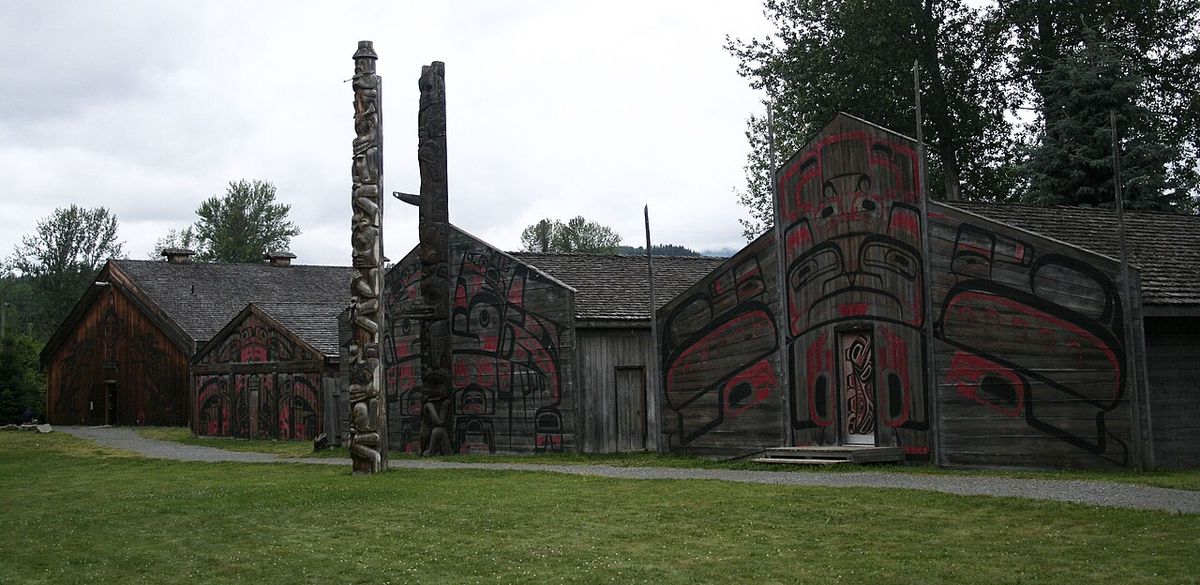
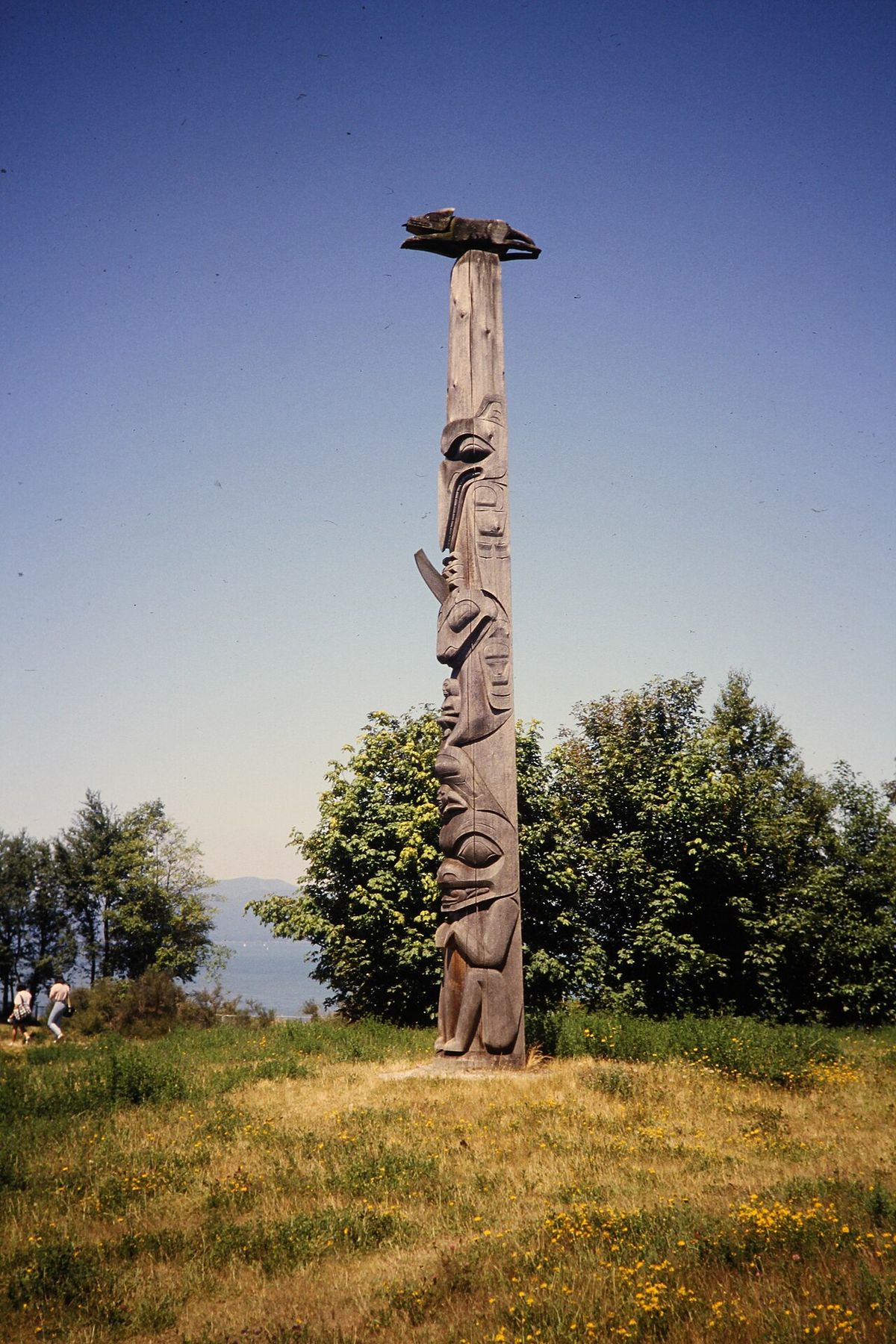
There are several distinct types of upright pole carvings commonly referred to as totem poles, each with a specific function within Indigenous Northwest Coast societies, and not all involve the carving of what might be considered traditional totem figures. The six basic types are house frontal poles, interior house posts, mortuary poles, memorial poles, welcome poles, and shame or ridicule poles, and their purposes range from architectural support to ceremonial honour to social commentary. House frontal poles, usually 6 to 12 metres tall, are the most decorative and are placed outside clan houses to tell the story of the family or village, often with watchman figures at the top or an entrance opening. House posts, typically 2 to 3 metres high, support the roof beams inside a clan house and were more common than free-standing poles among groups like the Coast Salish, with their carvings also helping to tell family history.
- Mortuary Poles: These are among the tallest poles, reaching 15 to 21 metres, and are erected by the Haida and Tlingit at the death of important individuals, incorporating grave boxes that hold ashes or the body in the upper portion of the pole.
- Memorial Poles: Usually erected about a year after a person has died and standing in front of a clan house, these poles honour the deceased and identify the relative who is taking over as his successor, often with one carved figure at the top.
- Welcome Poles: Carved by the Kwakwaka’wakw, Salish and Nuu-chah-nulth people, these poles include large human figures, some up to 12 metres tall, and are placed at the edge of a beach or stream to welcome or possibly intimidate guests to the community.
- Shame or Ridicule Poles: Created to embarrass individuals or groups for unpaid debts or wrongs, these poles are placed in prominent locations and removed after the debt is paid, with the carving representing the person being shamed.
Memorial poles can also commemorate events. For example, several memorial totem poles were erected by the Tlingit in honor of Abraham Lincoln. One such pole was relocated to Saxman, Alaska, in 1938. The Lincoln pole at Saxman commemorates the end of hostilities between two rival Tlingit clans. It symbolizes the hope for peace and prosperity following the American occupation of the Alaskan territory. The story begins in 1868, when the United States government built a customs house and fort on Tongass Island and left the US revenue cutter Lincoln to patrol the area.
Notable Examples of Shame Poles
Shame poles serve as a unique form of social and political commentary by documenting grievances and debts. These poles are carved to represent the person being shamed and are intended to apply public pressure until a wrong is corrected or a debt is repaid. They were more common in the nineteenth century but are still erected today for political grievances. The Seward Pole at Saxman Totem Park in Alaska is a famous example originally carved around 1885. It shamed former U.S. Secretary of State William H. Seward for his lack of recognition of Indigenous peoples and for not reciprocating the generosity of his Tlingit hosts after an 1869 potlatch. The figure's red painted nose and ears may symbolize drunkenness or Seward's stinginess.
- The Three Frogs Pole: Located on Chief Shakes Island in Wrangell, Alaska, this pole was erected by Chief Shakes to shame the Kiks.ádi clan into repaying a debt incurred for the support of three women, and it featured three frogs representing the clan's crest, though it is not known if the debt was ever repaid.
- The Baranof Pole: Commissioned in 1942 by the U.S. Forest Service as a civilian works project and designed by George Benson, this pole depicted Russian governor Alexander Baranof without clothes and originally stood in Totem Square in Sitka, Alaska, but it was not carved by local Tlingits.
- The Exxon Valdez Shame Pole: Erected on March 24, 2007, in Cordova, Alaska, by Tlingit fisherman Mike Webber, this pole includes the inverted and distorted face of former Exxon CEO Lee Raymond and represents the unpaid $5 billion in punitive damages owed for the 1989 Exxon Valdez oil spill.
In the 1940s, a second iteration of the Seward Pole was built by Tlingit men enrolled in the Civilian Conservation Corps. According to the Alaska Historical Society, the United States government was unaware that the pole's intent was to shame Seward until after the completion of the project. A renewed version of the pole was carved in 2017 by Tlingit artist Stephen Jackson. Jackson combined political caricature with Northwest Coast artistic style. This demonstrates the ongoing relevance and adaptation of the shame pole tradition in addressing contemporary issues and historical grievances.
Construction, Materials, and Life Cycle
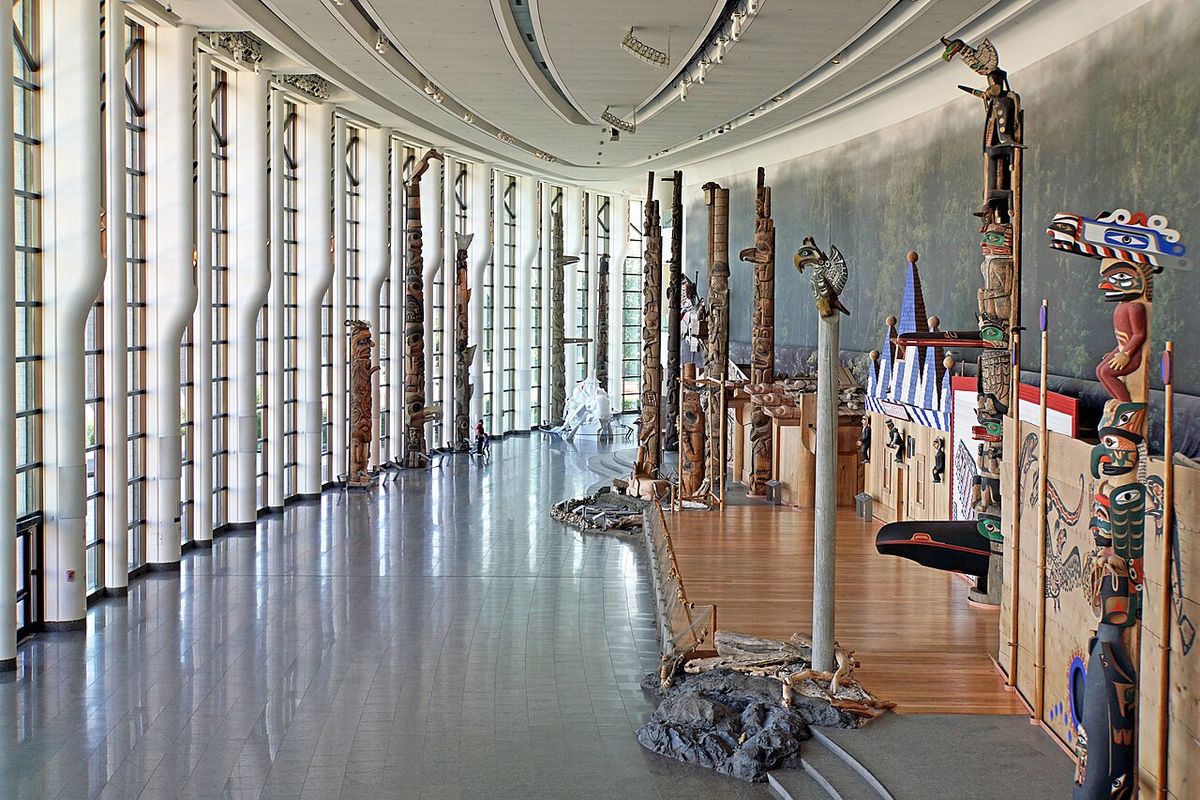
Creating a totem pole requires deep artistic skill, cultural knowledge, and an understanding of forest ecology, and most poles are made from Western red cedar, a rot-resistant tree that is straight-grained and easy to carve. Before a cedar tree is harvested for a totem pole, many coastal First Nations communities will perform a ceremony of gratitude and respect in honour of the tree, and several trees may be inspected before one is chosen for its beauty and character. The process was historically slow and laborious with stone tools, but the late 18th century introduction of metal cutting tools enabled more complex carvings and increased production. Despite the cedar's durability, totem poles have a natural life cycle. They typically last about sixty to eighty years in the moist, rainy climate of the coastal Pacific Northwest before they begin to disintegrate. This decay is recognized as a natural part of a pole's existence. The impermanence of the poles, combined with historical removal and destruction, means few examples carved before 1900 remain today. Noteworthy examples, some dating as far back as 1880, are held in major museums. Notable institutions include the Royal British Columbia Museum in Victoria, the Museum of Anthropology at UBC in Vancouver, the Canadian Museum of History in Gatineau, and the Totem Heritage Center in Ketchikan, Alaska.
The art form has expanded into new media as part of its revival. Related artistic production now ranges from tourist trinkets to masterful works in wood, stone, blown and etched glass, and other traditional and non traditional media. However, the carving of monumental poles from cedar remains the central and most recognizable tradition. This practice continues to embody the cultural values, stories, and artistic excellence of the Pacific Northwest First Nations. It serves both community members and the wider public. Carvers use chain saws to make rough shapes and adzes and chisels for finer details, and paint is added to enhance specific figures.
Removal and Display Outside Original Context
The late 19th and early 20th centuries saw the widespread removal of totem poles from their communities. They were taken for display in distant museums, world's fairs, and private collections. This practice was facilitated by the Potlatch Law and a colonial mindset. That mindset viewed Indigenous cultures as vanishing and in need of preservation by outside institutions. The removal of poles was justified as an act of preserving them because the art was considered to be dying. In 1903, Alaska's district governor John Green Brady collected 15 Tlingit and Haida totem poles from villages in southeastern Alaska. Fourteen of them were initially installed outside the Alaska pavilion at the 1904 Louisiana Purchase Exposition in Saint Louis, Missouri.
Similarly, in the 1880s and 1890s, tourists, collectors, scientists and naturalists interested in Indigenous culture collected and photographed totem poles. Many of these poles were put on display at expositions such as the 1876 Centennial Exposition in Philadelphia, Pennsylvania, and the 1893 World's Columbia Exposition in Chicago, Illinois. This removal severed the poles from their cultural context, stories, and the communities that gave them meaning. It represented a significant loss of cultural patrimony despite the preservation rationale. Today, the repatriation of these poles is a critical aspect of reconciliation. Communities seek to reclaim their heritage and restore the connection between the poles and their places of origin.
The return of a 19th century pole to the Nuxalk Nation from the Royal British Columbia Museum exemplifies this ongoing process. It involves bringing cultural treasures home where they can be understood within their proper social and historical framework. This movement counters the historical dispersal of poles and acknowledges the harm caused by their removal. It aligns with contemporary commitments to reconciliation and Indigenous self determination. The display of poles outside their original context created a complicated history. Today, poles are increasingly celebrated and returned as part of a respectful dialogue about shared history and cultural rights. In the early 1990s, the Haisla First Nation successfully repatriated the Gʼpsgolox totem pole from Sweden's Museum of Ethnography.
Questions about Totem pole
What is the purpose of a totem pole?
Totem poles serve multiple purposes as monuments created by First Nations of the Pacific Northwest. They primarily represent and commemorate ancestry, clan lineages, histories, people, or notable events. Most poles display crest animals or beings that mark a family’s lineage and validate its rights and privileges. They can also serve architectural functions as house posts or frontal poles, ceremonial roles as mortuary or memorial poles, or social functions as welcome poles or shame poles. Contrary to past misconceptions, they are not objects of worship but are significant cultural records and symbols of identity.
Which Indigenous groups carve totem poles?
Totem poles are created by several First Nations and Indigenous peoples of the Pacific Northwest Coast. The key cultural groups include the Haida, Tlingit, and Tsimshian communities of Southeast Alaska and British Columbia. In southern British Columbia, the Kwakwaka’wakw and Nuu-chah-nulth peoples are known carvers. The Coast Salish communities in Washington and British Columbia also create poles, particularly house posts. Other groups such as the Nuxalk also have traditions of pole carving. Each nation has its own distinct styles, stories, and conventions for the art form.
Are the figures on a totem pole worshipped?
No, the figures on totem poles are not worshipped, nor are they idols. This was a common misconception among early Christian missionaries, who incorrectly believed the designs represented pagan deities. Totem poles are cultural monuments that document kinship, history, and social status. They may depict ancestral beings, clan crests, or mythological events, but they are not the subject of spiritual practice or worship. The poles themselves are respected as important cultural property and artistic achievements, but the figures carved on them are symbolic representations rather than objects of veneration.
What does 'low man on the totem pole' mean and is it accurate?
The phrase 'low man on the totem pole,' popularized in the 1930s and 1940s, suggests the figure at the bottom is the least important. This interpretation is culturally inaccurate. Indigenous sources often state that the most important representations may be placed at the bottom, bearing the weight of the others, or at eye level to emphasize their significance. Many poles have no vertical hierarchy at all. The phrase reflects a mainstream cultural misunderstanding of the art form's symbolism and has been criticized for misrepresenting Indigenous cultural practices and perspectives.
What is a shame pole?
A shame pole, or ridicule pole, is a type of totem pole created to publicly embarrass an individual or group for an unpaid debt, a wrongdoing, or a grievance. The pole's carving represents the person being shamed. They are placed in prominent locations and traditionally removed after the debt is paid or the wrong is corrected. Historical examples include the Seward Pole shaming a U.S. Secretary of State and the Three Frogs pole involving a clan debt. Contemporary examples continue this tradition as political protest, such as the 2007 pole in Cordova, Alaska, shaming Exxon's CEO over the unresolved damages from the Exxon Valdez oil spill.
How are totem poles connected to reconciliation today?
Totem poles are powerfully connected to contemporary reconciliation efforts between Indigenous peoples and institutions in Canada. They are commissioned as symbols of partnership, respect, and commitment to rebuilding relationships. For instance, in 2026, the Nootka Sound RCMP and Mowachaht/Muchalaht First Nation raised a pole titled The Protector at a detachment, symbolizing their growing relationship. Governments also commission poles, like the Crossing Cultures and Healing pole in Victoria, to symbolize a commitment to meaningful reconciliation. The repatriation of historical poles from museums back to their communities, such as a pole returning to the Nuxalk Nation, is a crucial act of cultural restoration and reconciliation. Another example is the successful repatriation of the Gʼpsgolox pole by the Haisla First Nation from Sweden in the 1990s.
Sources and further reading
- Totem pole (Wikipedia)
- Totem Poles | indigenousfoundations (indigenousfoundations.arts.ubc.ca)
- New totem pole launches healing journey, BC Gov News (news.gov.bc.ca)
- Canada's Complicated History with First Nation Totem Poles (ictinc.ca)
Checked by the Nosy Mag desk. Last updated 2026-10-25.