Ojibwe language
Ojibwe, also known as Ojibwemowin or Anishinaabemowin, is an Indigenous Algonquian language spoken by the Ojibwe people across a vast region of North America. Its dialects span from southwestern Quebec through Ontario, Manitoba and parts of Saskatchewan in Canada, and from Michigan through Wisconsin and Minnesota in the United States. As the second most commonly spoken First Nations language in Canada and the fourth most widely spoken Native American language in the United States or Canada, Ojibwe is a vital part of the continent's cultural heritage. Despite historical efforts to suppress Indigenous languages, a determined revitalization movement is underway, supported by immersion schools, university programs, and digital resources aiming to ensure its transmission to future generations.
Names and Classification
The most general Indigenous name for the language is Anishinaabemowin, meaning 'speaking the native language', with Ojibwemowin also commonly used. Specific dialects have their own local terms, such as Nishnaabemwin for the Ottawa dialect and Nakawemowin in some Saulteaux communities. In English, the language is known as Ojibwe, with variants Ojibwa and Ojibway, while the term Chippewa is more frequently used in the United States and parts of southwestern Ontario. Ojibwe is a member of the Algonquian language family, which is itself a branch of the larger Algic family. It is frequently grouped geographically with other Central Algonquian languages like Cree, Menominee, and Potawatomi, though this grouping reflects regional contact and shared features rather than a proven genetic subgroup.
Linguists have long noted the particularly close relationship between Ojibwe and Potawatomi, sometimes proposing them as a distinct genetic subgroup within Proto-Algonquian termed 'Ojibwayan'. However, definitive research to confirm this subgrouping has not been completed. The significant similarities could also be the result of extensive historical contact and borrowing between the languages. This diffusion of lexical, phonological, and grammatical features across language boundaries is considered a major factor in giving the languages around the Upper Great Lakes their broadly similar characteristics. The question of whether Ojibwe and Potawatomi form a unique genetic branch remains open pending further detailed study of Potawatomi dialects.
Historical Role as a Lingua Franca
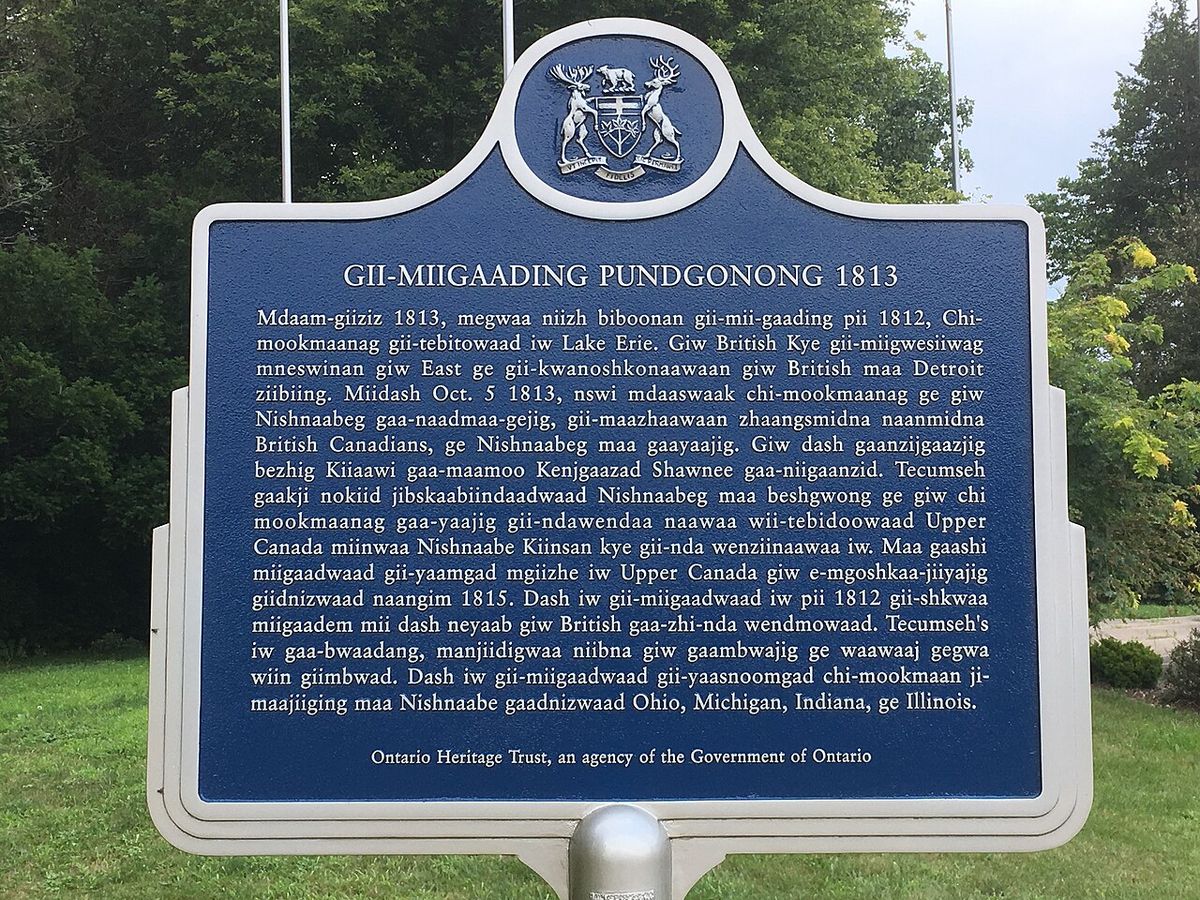
For centuries, various Ojibwe dialects functioned as a crucial trade language and lingua franca across the circum-Great Lakes region. Ojibwe was used from the Gulf of Saint Lawrence to Lake Winnipeg and eventually replaced the Wyandot (Huron) language as the dominant trade language east of the Great Lakes following the political decline of the Hurons in the 18th century. Specific dialects served as trade languages in key areas, with the Ottawa dialect used around the Lower Peninsula of Michigan and the Nipissing dialect east of Georgian Bay. A widespread pattern of asymmetrical bilingualism emerged, where speakers of other Algonquian languages like Potawatomi and Menominee also spoke Ojibwe, but Ojibwe speakers often did not learn the other languages. Reports from traders and government agents in the 18th and early 19th centuries confirm that Ojibwe was used for intertribal communication among the Chippewa, Menominee, Ottawa, Potawatomi, Sac, and Fox tribes. Speakers of unrelated Siouan languages, including the Ho-Chunk (Winnebago), as well as the Iowa and Pawnee farther west, were reported to use Ojibwe as an acquired language when dealing with Europeans and other groups. This historical use shows the language's importance as a medium of commerce and diplomacy across a broad cultural scene.
Assimilation Policies and Language Loss
In the late 19th and early 20th centuries, government policies in both the United States and Canada actively worked to suppress Ojibwe and other Indigenous languages. In the United States, the federal Native American boarding school initiative forcibly removed children from their communities to institutions designed to acculturate them into American society. Students were punished for speaking their native languages, forced to speak English, and made to cut their hair, wear uniforms, and practice Christianity. This systematic effort to sever children's ties to their culture and language caused deep intergenerational trauma and widespread language loss. Many children who grew up in these institutions never had the opportunity to hear or use Ojibwe in a familial or community setting. The Canadian context was similarly damaging with the Indian Residential School system enforcing analogous prohibitions. The fear and trauma experienced in these schools led generations of Indigenous people to not learn their language, putting Ojibwe and many other languages at severe risk of extinction. The legacy of these policies is a primary driver behind contemporary language revitalization efforts across Ojibwe communities today.
Modern Revitalization Movement
The revitalization of Ojibwe involves educators, elders, communities, and institutions working together on many fronts. Ojibwe historian Anton Treuer estimates there are about 1,000 fluent speakers left in the United States, most over the age of 70. According to the 2006 Canadian census, 47,740 people speak varieties of Ojibwe in Canada. Key strategies include collaboration with First Speakers, or knowledge-holding elders, to record stories and vocabulary, such as scholar Anton Treuer's work with elder Eugene Stillday to transcribe oral histories. The movement has gained significant institutional support, including the 2019 passage of Canada's Indigenous Languages Act and the 2021 establishment of the Office of the Commissioner of Indigenous Languages, which champions language reclamation across the country.
Technology plays an increasingly important role in preservation and learning through resources like The Ojibwe People's Dictionary, a collaborative online tool with the University of Minnesota offering searchable entries and voice recordings. In 2022, the Mille Lacs Band of Ojibwe partnered with Rosetta Stone's Endangered Languages Program to create digital learning tools for the Mille Lacs dialect, with three levels available as of 2025. Universities are expanding course offerings. Research also indicates that language revitalization is linked to positive community health outcomes, particularly for psychological and mental well-being, reinforcing the language as a core component of cultural identity and resilience.
- Recording oral histories with elders to preserve language and knowledge.
- Development of the Ojibwe People's Dictionary with audio and visual resources.
- Partnership between Mille Lacs Band of Ojibwe and Rosetta Stone (2022).
- Passage of Canada's Indigenous Languages Act (2019).
- Establishment of the Office of the Commissioner of Indigenous Languages (2021).
- Increase in published children's literature and textbooks in Ojibwe.
- Link between language use and improved psychological health in communities.
Immersion Education and Pedagogy
Language immersion schools are at the forefront of efforts to create new generations of Ojibwe speakers. Inspired by successful models in Hawaii and New Zealand, these schools use Ojibwe as the primary medium of instruction for all subjects. A leading example is the Waadookodaading Ojibwe Language Immersion School on the Lac Courte Oreilles Reservation in Wisconsin, co-developed by educators Lisa LaRonge and Keller Paap. At Waadookodaading, children from English-speaking homes are taught entirely in Ojibwe from preschool through third grade, learning subjects like mathematics, social studies, and music through the language. The pedagogy emphasizes learning by doing and observing, aligning with traditional Indigenous teaching methods.
Educators at Ojibwe immersion schools work with elders to design new ways to say lesser-used words in Ojibwe such as plastic or quotient. Because the Ojibwe language is traditionally oral, it is often difficult for educators to find adequate resources to develop the curriculum. Many of these Ojibwe language immersion schools also consider whether they should include English instruction. Some research suggests that learning to write in one's first language is important prior to learning a second language. The goal is to meet state-mandated standards for curriculum in the native language. Through these school programs, the language is constantly evolving.
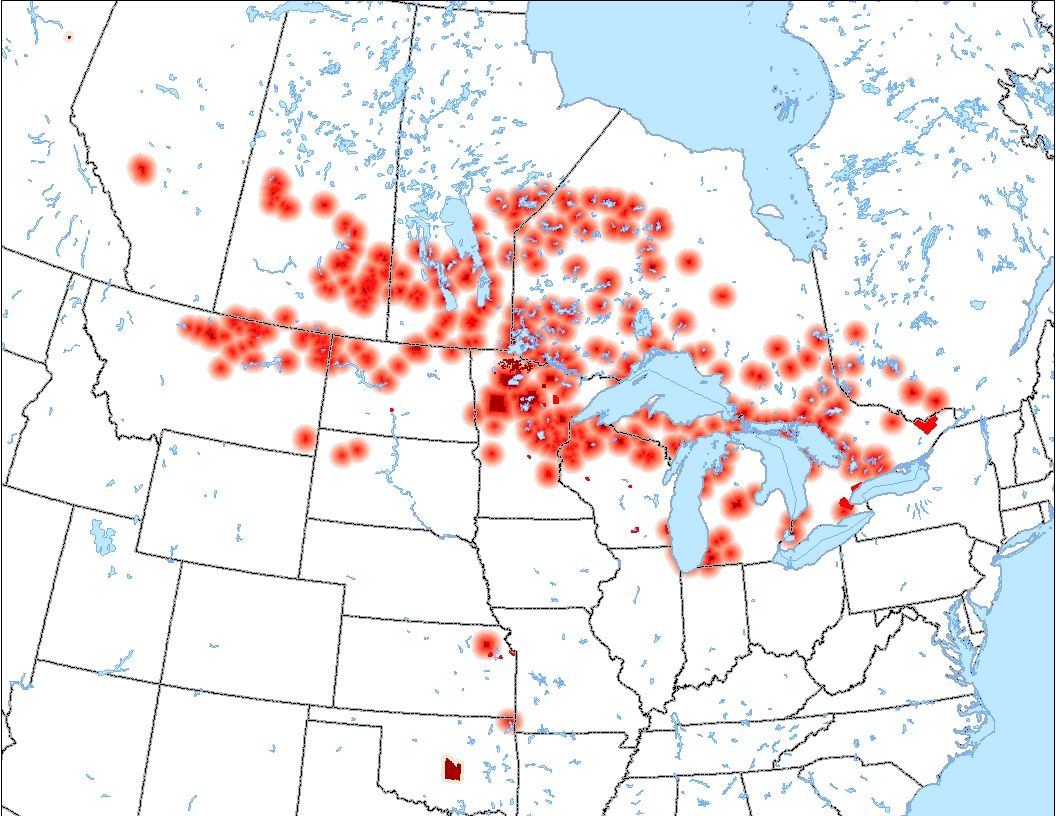
Dialects and Geographic Distribution
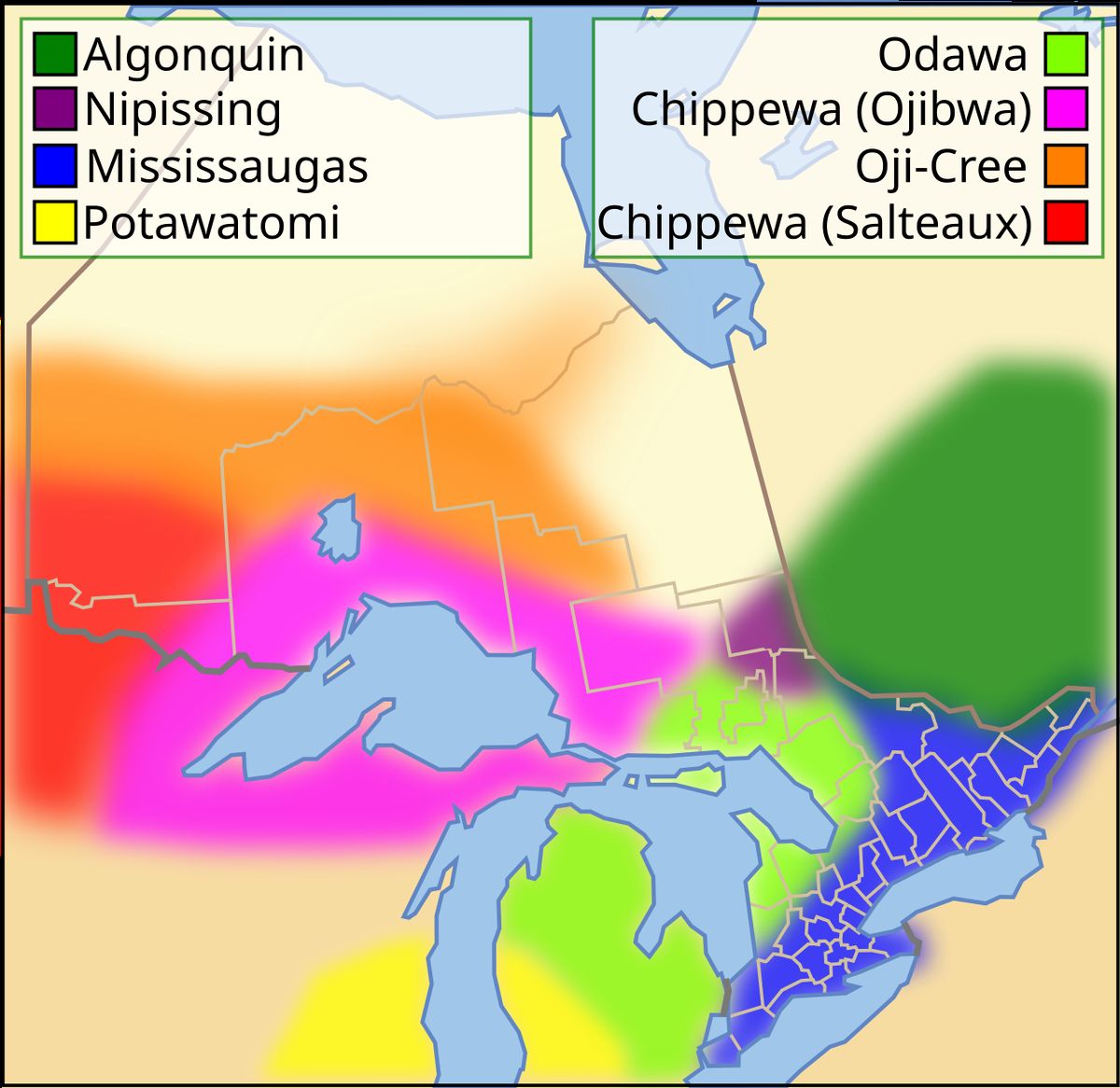
Ojibwe is spoken across a wide geographic range, reflected in a continuum of dialects that are at least partly mutually intelligible. In Canada, communities are found from southwestern Quebec through Ontario, southern Manitoba, and parts of southern Saskatchewan, with outlying communities in Alberta and British Columbia. In the United States, speakers are located from Michigan through Wisconsin and Minnesota, with communities in North Dakota and Montana. Historical migrations of Ottawa dialect speakers also led to communities in Kansas and Oklahoma. The aggregated dialects make Ojibwe the second most commonly spoken First Nations language in Canada, after Cree, and the fourth most widely spoken Native American language in the United States or Canada. While there is some variation in the classification of its dialects, at least the following are recognized, from east to west: Algonquin, Eastern Ojibwe, Ottawa (Odawa), Western Ojibwe (Saulteaux), Oji-Cree (Severn Ojibwe), Northwestern Ojibwe, and Southwestern Ojibwe (Chippewa). Based upon contemporary field research, J. R. Valentine also recognizes several other dialects: Berens Ojibwe in northwestern Ontario, which he distinguishes from Northwestern Ojibwe, North of (Lake) Superior, and Nipissing. The latter two cover approximately the same territory as Central Ojibwa, which he does not recognize.
| Dialect | General Region |
|---|---|
| Algonquin | Southwestern Quebec, adjacent Ontario |
| Eastern Ojibwe | Along the Ottawa River, Ontario |
| Ottawa (Odawa) | Michigan, Ontario, Kansas, Oklahoma |
| Western Ojibwe (Saulteaux) | Southern Manitoba, Saskatchewan |
| Oji-Cree (Severn Ojibwe) | Northern Ontario, Manitoba |
| Northwestern Ojibwe | Northwestern Ontario |
| Southwestern Ojibwe (Chippewa) | Minnesota, Wisconsin, Michigan |
| Berens Ojibwe | Northwestern Ontario |
| North of (Lake) Superior | North shore of Lake Superior |
| Nipissing | Area east of Georgian Bay |
The most general Indigenous designation for the language is Anishinaabemowin, with varying spellings and pronunciations depending upon dialect. Some speakers use the term Ojibwemowin. The general term in Oji-Cree (Severn Ojibwe) is Anihshininiimowin, although Anishinaabemowin is widely recognized by Severn speakers. Some speakers of Saulteaux Ojibwe call their language Nakawemowin. The Ottawa dialect is sometimes called Daawaamwin, but the general designation is Nishnaabemwin. English terms include Ojibwe, with variants including Ojibwa and Ojibway. The related term Chippewa is more commonly employed in the United States and in southwestern Ontario among descendants of Ojibwe migrants from the United States.
Writing Systems and Literary Development
Originally an oral language, Ojibwe has developed several writing systems over the past two centuries. The first written forms using the Latin alphabet were created by Christian missionaries like Frederic Baraga, a Slovenian Roman Catholic priest who authored the 'Dictionary of the Otchipwe Language' in 1853 to aid in missionary work. These early systems are described as folk-phonetic, where spellings could vary from person to person. In 1840, Methodist missionary James Evans, after working with Cree communities, created a system of syllabics that represented combinations of consonants and vowels. This syllabic system spread among some Ojibwe and Cree communities and continues to be used today, particularly for Oji-Cree.
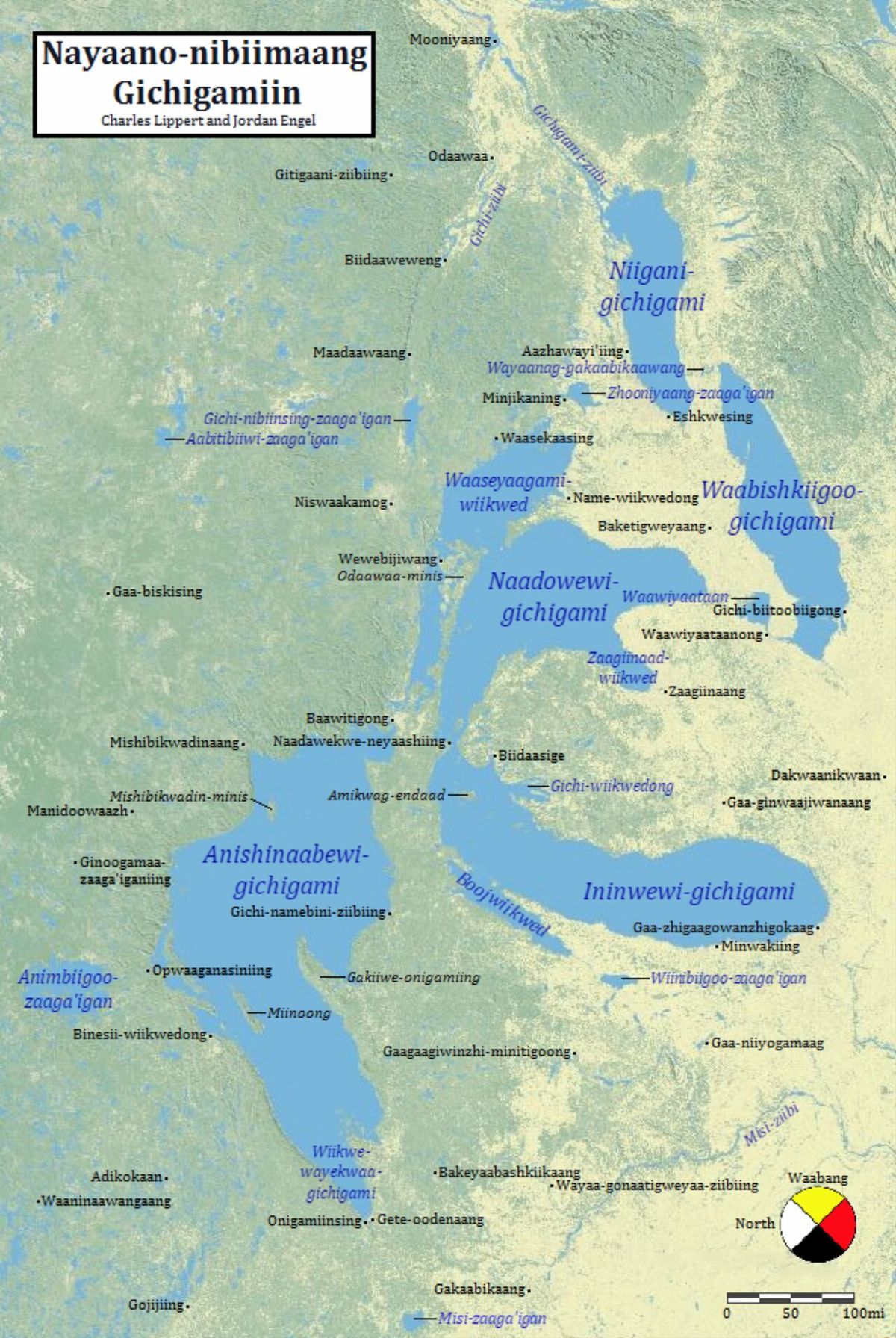
The most influential modern writing system was developed by linguist Charles Fiero in the mid-20th century. Known as the double-vowel system, it uses the Roman orthography but provides a consistent, phonemic spelling that is easier to learn and standardize than the folk-phonetic style. In Fiero's system, vowel length is critical and can change a word's meaning entirely, as in 'zaaga’igan' for lake versus 'zaga’igan' for nail. There has been a significant increase in the publication of Ojibwe language materials, including children's literature, textbooks, and online resources, which is essential for supporting new learners and literacy development and for ensuring the language thrives in all domains of modern life.
Questions about Ojibwe language
How many people speak Ojibwe today?
According to aggregated census data from 2000 and 2006, approximately 56,531 people speak varieties of Ojibwe in Canada and the United States. The 2006 Canadian census specifically lists 47,740 people as speaking Ojibwe languages. In the United States, the 2000 census reports 8,791 speakers. Ojibwe historian Anton Treuer estimates there are about 1,000 fluent speakers left in the U.S., most of whom are over 70 years old and located in places like Minnesota's Red Lake and Mille Lacs regions. These figures highlight both the language's significant speaker base and the urgent need for revitalization.
What is the difference between Anishinaabemowin and Ojibwe?
The terms are often used interchangeably but can have different scopes. Anishinaabemowin broadly means 'speaking the native language' and can refer to the language group shared by the Ojibwe, Odawa, and Potawatomi peoples. Ojibwemowin refers specifically to the language of the Ojibwe nation. 'Anishinaabe' itself is a term that can describe various Indigenous peoples, while 'Ojibwe' typically refers to a specific nation. In common usage, especially in language learning contexts, Anishinaabemowin is frequently used to denote the Ojibwe language.
What are the main dialects of Ojibwe?
Ojibwe comprises a dialect continuum, with several primary dialects recognized from east to west. These include Algonquin, Eastern Ojibwe, Ottawa (Odawa), Western Ojibwe (Saulteaux), Oji-Cree (Severn Ojibwe), Northwestern Ojibwe, and Southwestern Ojibwe (Chippewa). Based on contemporary research by J. R. Valentine, other dialects like Berens Ojibwe, North of (Lake) Superior, and Nipissing are also identified. These dialects are at least partly mutually intelligible with their neighbours.
What is being done to revitalize the Ojibwe language?
Revitalization efforts are diverse and growing. They include language immersion schools like Waadookodaading in Wisconsin, which teaches children entirely in Ojibwe. University courses are expanding. Digital tools are crucial, such as The Ojibwe People's Dictionary online and the Mille Lacs Band's partnership with Rosetta Stone in 2022. Communities are also documenting oral histories with elders and increasing the publication of books and resources in Ojibwe to support learners of all ages. The 2019 Indigenous Languages Act in Canada provides further institutional support.
Was Ojibwe ever used as a common trade language?
Yes, several different Ojibwe dialects have functioned as a lingua franca or trade language in the circum-Great Lakes area. Documentation from the 18th and 19th centuries indicates it was used from the Gulf of Saint Lawrence to Lake Winnipeg. In the 18th century, it replaced Huron as a lingua franca east of the Great Lakes. Reports indicate that speakers of other Algonquian languages like Menominee and Potawatomi, as well as unrelated Siouan languages like Ho-Chunk (Winnebago), Iowa, and Pawnee, used Ojibwe in intertribal communication and trade with Europeans.
How is Ojibwe written?
Ojibwe is written using two main systems. The first is the Latin alphabet, most commonly in the standardized double-vowel orthography developed by linguist Charles Fiero, which clearly indicates vowel length. The second is a syllabic system, originally developed by James Evans for Cree and later adopted by some Ojibwe communities, particularly Oji-Cree speakers. Early missionary writings used a less consistent folk-phonetic style with the Latin alphabet. Today, the double-vowel system is the primary form of written communication in most educational and publishing contexts.
Sources and further reading
- Ojibwe language (Wikipedia)
- Office of the Commissioner of Indigenous Languages: Home (commissionforindigenouslanguages.ca)
- Anishinaabemowin: Ojibwe Language (thecanadianencyclopedia.ca)
- Anishinaabemowin (Ojibwe) Introductory Language Course (outdoorlearning.com)
Checked by the Nosy Mag desk. Last updated 2026-10-20.