MS St. Louis
The MS St. Louis was a German transatlantic ocean liner whose 1939 voyage carrying 937 Jewish refugees from Nazi persecution became a symbol of international indifference. Denied entry in Cuba, the United States, and Canada, the ship was forced to return to Europe, where many of its passengers later perished in the Holocaust. This episode, known as the "Voyage of the Damned," is a chapter in Canadian immigration history. The Canadian government formally apologized for its role in the affair in 2018.
The Ship and Its Early Service
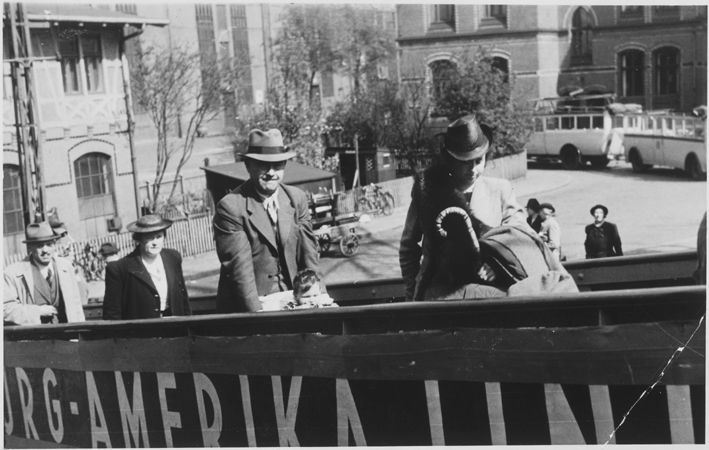
The MS St. Louis was constructed as a diesel-powered ocean liner under construction number 670 at the Bremer Vulkan shipyards in Bremen-Vegesack. Launched on August 2, 1928, the vessel measured 174.90 metres in length and 22.10 metres in width, with a gross register tonnage of 16,732. Its four double-acting six-cylinder two-stroke diesel engines, built under MAN license, each produced 3150 horsepower for a service speed of 16.5 knots. The ship was built for the Hamburg America Line and was named after the city of St. Louis, Missouri, serving as a sister ship to the MS Milwaukee, which was launched on February 20, 1929. St. Louis entered regular transatlantic service with its maiden voyage from Hamburg to New York City on March 28, 1929. Its primary route ran from Hamburg to Halifax, Nova Scotia, and onward to New York. The ship also made cruises of 16 to 17 days to the Canary Islands, Madeira, Spain, and Morocco, especially in autumn and spring. From 1934, the vessel was chartered during summers by the Nazi organization Strength Through Joy, specifically its Office for Travel, Hiking and Holidays, to carry approximately 900 German holidaymakers at a time on trips to Norway. The ship was designed for both liner service and leisure cruises.
The 1939 Refugee Voyage and Captain Schröder's Actions
On May 13, 1939, under the command of Captain Gustav Schröder, the MS St. Louis departed Hamburg for Havana, Cuba, carrying 937 passengers, most of whom were Jewish refugees fleeing Nazi persecution. The passengers included German citizens, some eastern Europeans, and a few Spanish and Cuban nationals. Many were officially stateless, had lost their homes and businesses, or had been released from camps like Dachau and Buchenwald on condition they leave Germany. Captain Schröder made efforts to ensure dignified treatment for his passengers. He provided food subject to rationing in Germany, organized childcare, dances, and concerts. He allowed religious services to be held in the dining room on Friday evenings, and a bust of Hitler on board was covered with a tablecloth. Swimming lessons took place in the pool. The refugees held Cuban landing visas purchased from the Cuban consul in Berlin and anticipated a stopover before seeking permanent asylum in the United States. Upon arrival in Havana Harbour at 04:00 on May 27, the ship was denied permission to dock. The Cuban government, under President Federico Laredo Brú, refused to honour the visas due to Decree 937, enacted on May 5, 1939, which invalidated the landing permits. Only 28 passengers were allowed to disembark in Cuba. These included Jews with valid United States visas, four Spanish citizens, two Cuban nationals, and one medical evacuee, Max Loewe, who attempted suicide and was hospitalized. With 907 refugees still aboard, Captain Schröder sailed the St. Louis towards the coast of Florida. American officials, including Secretary of State Cordell Hull and President Franklin D. Roosevelt, declined to intervene. The United States Coast Guard shadowed the ship to prevent it from running aground. After being turned away, the ship sailed north towards Canada.
Canada's Refusal and the Decision-Making Process
As the St. Louis approached North America, a group of 41 prominent citizens in Toronto, including clergyman and historian George Wrong, petitioned Prime Minister William Lyon Mackenzie King on June 7, 1939, to provide sanctuary. The ship could have reached Halifax, Nova Scotia, within two days from its position off the U.S. coast. The decision rested heavily with the federal bureaucracy, particularly Frederick Blair, the director of Canada's Immigration Branch, who held openly hostile views towards Jewish immigration and had a long record of advocating for exclusionary policies. While Prime Minister King was away on official business, he asked Undersecretary of State for External Affairs Oscar Skelton to consult on the matter with Minister of Justice Ernest Lapointe and Frederick Blair. Historical records indicate Lapointe was emphatically opposed to admitting the refugees, and Blair successfully persuaded the government not to intervene, with the formal refusal communicated on June 9, 1939. This refusal occurred within a broader context of Canadian immigration policy from Confederation until after the Second World War, which was animated by personal and institutional antisemitism. The 2018 Canadian government apology explicitly stated that the St. Louis story was not an isolated incident but part of a prolonged history of governmental indifference to Jewish suffering.
Return to Europe and Dispersal of Refugees
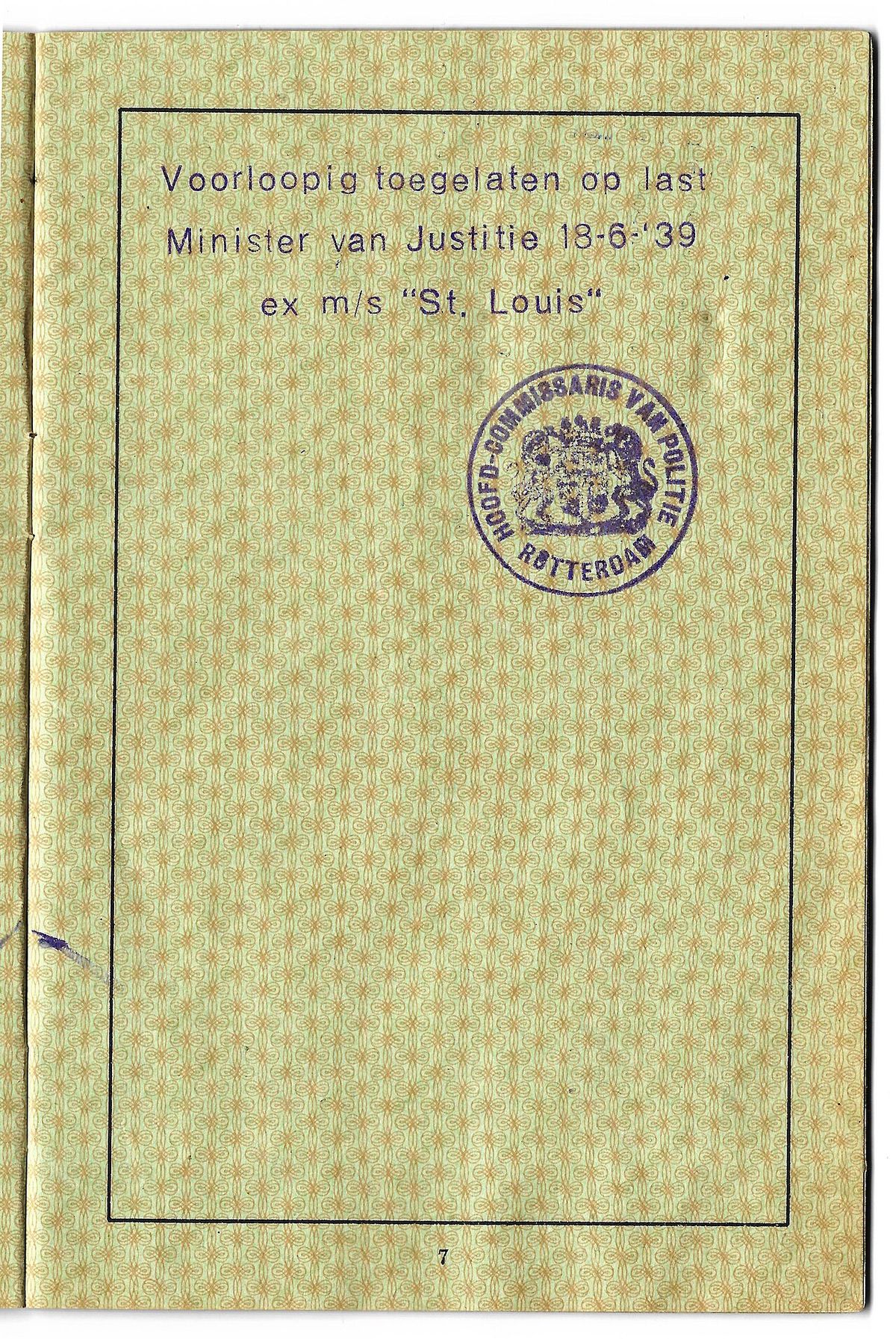
With no haven in North America, Captain Schröder negotiated with European governments while steadfastly refusing to sail back to Germany. The St. Louis docked at the Port of Antwerp, Belgium, on June 17, 1939, with the 907 passengers. An international agreement was reached to disperse the refugees. The British Prime Minister Neville Chamberlain agreed to take 288 passengers, who disembarked and travelled to the UK via other steamers. After much negotiation by Schröder, the remaining 619 passengers were also allowed to disembark at Antwerp. France accepted 224 refugees, Belgium accepted 214 refugees, and the Netherlands accepted 181 refugees. The distribution percentages were 32 percent to the United Kingdom, 25 percent to France, 23.59 percent to Belgium, and 20 percent to the Netherlands. The MS St. Louis then returned to Hamburg without any passengers. The following year, after the Battle of France and the Nazi occupations of Belgium, France, and the Netherlands in May 1940, all the Jews in those countries were subject to high risk, including the recent refugees.
Fate of the Passengers and Holocaust Mortality
The dispersal of the refugees across Europe had devastating consequences following the German occupation of France, Belgium, and the Netherlands. Historians from institutions like the United States Holocaust Memorial Museum have meticulously traced the fate of each passenger. Of the 620 passengers who returned to continental Europe, 87 managed to emigrate to safety before the Nazi invasion of Western Europe on May 10, 1940. Research has determined that 254 of these passengers were murdered during the Holocaust. Most were killed in the killing centres at Auschwitz and Sobibór, while others died in internment camps, in hiding, or while attempting to evade capture. This figure of 254 deaths represents 41.1 percent of those returned to the continent. In contrast, the vast majority of the 288 passengers sent to Britain survived the war. Overall, of the original 937 refugees, approximately 709 survived the war and 227 died, including one who died during the voyage itself. Based on survival rates for Jews in various countries, historians estimate that 180 of the St. Louis refugees in France, 152 of those in Belgium, and 60 of those in the Netherlands survived the Holocaust.
| Country of Disembarkation | Number Accepted | Estimated Survivors |
|---|---|---|
| United Kingdom | 288 | Vast majority |
| France | 224 | 180 |
| Belgium | 214 | 152 |
| Netherlands | 181 | 60 |
Post-War Commemoration and Official Apologies
The story of the MS St. Louis has been commemorated internationally as a cautionary tale in refugee policy. After the war, Captain Gustav Schröder was awarded the Order of Merit by the Federal Republic of Germany. In 1993, he was posthumously named Righteous Among the Nations by Yad Vashem, Israel's Holocaust memorial. Museums around the world feature exhibits on the voyage, including a permanent display at the United States Holocaust Memorial Museum in Washington, D.C., and a display with video at the Hamburg Museum in Germany. In Canada, the Maritime Museum of the Atlantic in Halifax hosted a special exhibit titled Ship of Fate in 2009, which later became a traveling exhibit shown across the country. A significant Canadian memorial, the Wheel of Conscience, was unveiled in 2011. Produced by the Canadian Jewish Congress and designed by architect Daniel Libeskind with graphic design by David Berman and Trevor Johnston, this polished stainless steel sculpture features four interlocking gears labelled with the words antisemitism, xenophobia, racism, and hatred. The back of the memorial is inscribed with the full passenger list. It was first exhibited at the Canadian Museum of Immigration at Pier 21 in Halifax before being shipped to fabricators in Toronto for repair. Formal apologies have been issued by the governments that turned the ship away. The United States Department of State offered an apology in a 2012 ceremony attended by Deputy Secretary William J. Burns and 14 survivors, who presented a proclamation of gratitude to European countries. The U.S. Senate had previously recognized June 6, 2009, as the 70th anniversary of the incident. On November 7, 2018, Prime Minister Justin Trudeau delivered a formal apology in the House of Commons for Canada's role in denying the refugees sanctuary. He acknowledged the country's history of indifference to Jewish suffering, stating the government went to great lengths to ensure their appeals went nowhere.
Later Wartime Service and Scrapping
Following its infamous voyage, the MS St. Louis was requisitioned for service by the German navy during the Second World War. From 1940 to 1944, it served not as an active warship but as a naval accommodation ship, providing housing for personnel. On August 30, 1944, the vessel was caught in an Allied bombing raid on the port of Kiel and sustained heavy damage. After the war, the damaged hull was repaired enough to be used briefly as a stationary hotel ship in Hamburg in 1946, serving a practical function in a city facing a severe housing shortage. Its seafaring career ended permanently when it was sold for demolition. The MS St. Louis was broken up for scrap at the port of Bremerhaven in 1952, ending the physical existence of the vessel.
Cultural and Artistic Representations
The dramatic and tragic story of the MS St. Louis has inspired a wide array of works across various media. These representations often explore themes of bureaucracy, indifference, survival, and moral courage. Key literary works include Gordon Thomas and Max Morgan-Witts's detailed nonfiction account Voyage of the Damned (1974) and Julian Barnes's novel A History of the World in 10½ Chapters (1989) which recounts the trials in the chapter "Three Simple Stories." Other novels include Bodie and Brock Thoene's Munich Signature (1991), Armando Lucas Correa's The German Girl (2016), and Alan Gratz's young adult novel Refugee (2017). Survivor accounts include Philip S. Freund's Denied Entry: A Survivor's Story (2011) and Kathy Kacer's young adult nonfiction To Hope and Back (2011). In film and television, Stuart Rosenberg directed the 1976 all-star film Voyage of the Damned, adapted from the Thomas and Morgan-Witts book, and a German television film, Die Ungewollten, Die Irrfahrt der St. Louis, was produced in 2019. Theatrical and operatic works range from Jan de Hartog's Schipper naast God (1942), translated as Skipper next to God and adapted into a film in 1951, to more recent plays like Nilo Cruz's Sotto Voce (2014), Daniel Kehlmann's Die Reise der Verlorenen (2018), and Philip Boehm's The Good Ship St. Louis (2022). Composer Chiel Meijering created an opera, St. Louis Blues, in 1994. Other media include Art Spiegelman's graphic narrative The St. Louis Refugee Ship Blues and Leonardo Padura's novel Herejes (2013) which centres on the incident.
Notable Passengers and Their Legacies
Among the hundreds of refugees aboard the St. Louis, several individuals later achieved prominence in their fields or left poignant records of their experience. Their stories personalize the broader tragedy of the voyage and its aftermath. Arno Motulsky (1923 to 2018) was a passenger who later emigrated to the United States and became a pioneering medical geneticist, founding the field of pharmacogenetics. Frederick Reif (1927 to 2019) was a refugee who grew up to be a noted physicist and author of standard textbooks, holding professorships at the University of California, Berkeley and Carnegie Mellon University. Erich Dublon (1890 to 1942) was a passenger whose writings about his experience on the ship were published, providing a first-hand account, but he was murdered in the Holocaust in 1942. The passenger list also included many families and individuals whose names are recorded on memorials like the Wheel of Conscience.
Historical Context and Parallel Cases
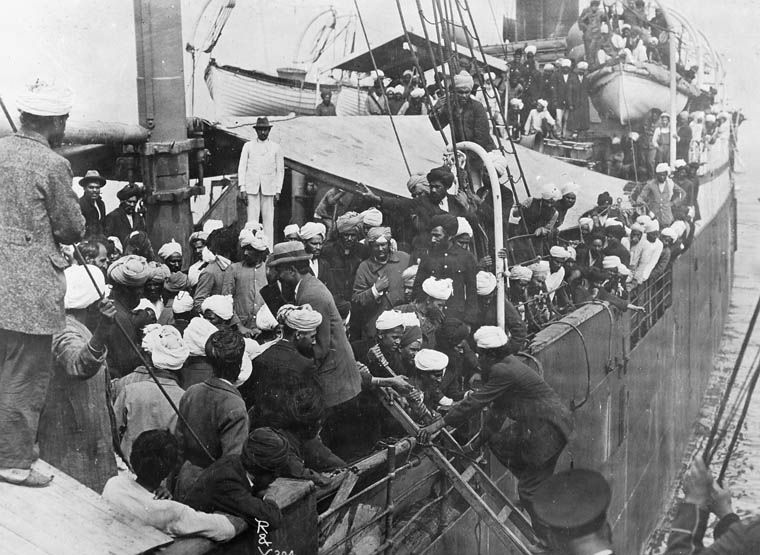
The voyage of the MS St. Louis was not a unique event in the history of refugee ships being denied sanctuary during the Nazi era. Other contemporaneous cases highlight a pattern of desperation and international refusal. The SS Navemar, a cargo ship designed for 28 passengers, carried 1,120 Jewish refugees in extremely cramped conditions to New York in 1941. The MV Struma, a schooner chartered to carry Jewish refugees from Romania, was torpedoed and sunk by a Soviet submarine on February 5, 1942, with only one survivor. Similarly, the MV Mefküre was torpedoed and sunk by a Soviet submarine on August 5, 1944, while carrying Jewish refugees. Within Canadian history, the St. Louis incident is often discussed alongside the 1914 Komagata Maru incident, in which a merchant ship carrying migrants from British India was denied entry to Vancouver under exclusionary immigration laws. Another case is the SS Quanza, which carried over 300 refugees, including at least 100 Jews, to America and Mexico in 1940 and faced similar entry disputes. These cases collectively show the recurring challenges faced by refugees and the deep consequences of immigration policies shaped by discrimination.
Questions about MS St. Louis
Why is the MS St. Louis important to Canadian history?
The MS St. Louis is a critical episode in Canadian history because it exemplifies the country's exclusionary and antisemitic immigration policies in the pre-World War II era. In June 1939, Canada refused entry to the ship's 907 Jewish refugees, a decision directly influenced by hostile officials like Immigration Branch director Frederick Blair. This refusal, followed by the deaths of many passengers in the Holocaust, became a powerful symbol of Canada's failure to provide sanctuary. The Canadian government formally apologized for this action in 2018, making it a lasting lesson on the human cost of xenophobia.
How many passengers on the MS St. Louis died in the Holocaust?
Of the 937 original passengers, one man died during the voyage itself. After the ship returned to Europe, 254 of the refugees who were forced to disembark in Belgium, France, and the Netherlands were murdered during the Holocaust. This represents 41.1 percent of the 620 passengers who returned to continental Europe. Most were killed in the killing centres at Auschwitz and Sobibór. In total, approximately 227 St. Louis passengers perished, while about 709 survived the war. The vast majority of the 288 passengers accepted by the United Kingdom survived.
What was Canada's official apology for the MS St. Louis?
On November 7, 2018, Prime Minister Justin Trudeau delivered a formal apology in Canada's House of Commons for the country's role in the MS St. Louis affair. The apology acknowledged the government's refusal to grant sanctuary to the ship's 907 Jewish refugees in June 1939. Trudeau stated that this refusal was part of a longer history of discriminatory immigration policy. He also recognized that these refugees would have strengthened the country and that officials had worked to ensure their appeals were denied.
What is the Wheel of Conscience memorial?
The Wheel of Conscience is a Canadian memorial created to remember the MS St. Louis and its passengers. Produced in 2011 by the Canadian Jewish Congress, it was designed by architect Daniel Libeskind with graphic design by David Berman and Trevor Johnston. The memorial is a polished stainless steel wheel featuring four intermeshing gears, each engraved with a word representing a factor that led to the refugees' exclusion: antisemitism, xenophobia, racism, and hatred. The back of the sculpture is inscribed with the passenger list. It was first exhibited at the Canadian Museum of Immigration at Pier 21 in Halifax.
Who was Captain Gustav Schröder and how did he help the passengers?
Captain Gustav Schröder was the German commander of the MS St. Louis during its 1939 voyage. He demonstrated compassion and courage in his efforts to protect his Jewish refugee passengers. Aboard ship, he ensured they were treated with dignity, providing food subject to rationing, organizing childcare, dances, concerts, and allowing religious services while covering a bust of Hitler. When Cuba, the United States, and Canada refused entry, Schröder refused orders to return directly to Germany, instead negotiating to find safe havens in Europe. His persistence led to the agreement that dispersed the refugees to the United Kingdom, Belgium, France, and the Netherlands. For his actions, he was later awarded the Order of Merit and recognized as Righteous Among the Nations.
Are there any museums in Canada that feature the MS St. Louis story?
Yes, several Canadian museums have featured exhibits on the MS St. Louis. The most prominent is the Canadian Museum of Immigration at Pier 21 in Halifax, which is Canada's national immigration museum. It hosted the Wheel of Conscience memorial and continues to tell the story. In 2009, the Maritime Museum of the Atlantic, also in Halifax, presented a special exhibit titled Ship of Fate, which explored the Canadian connection to the voyage. This exhibit later became a traveling display shown across Canada.
Sources and further reading
- MS St. Louis (Wikipedia)
- Watch it Now | Commemorating the MS St. Louis (hiaspa.org)
- MS St. Louis in Canadian Context (pier21.ca)
- MS St. Louis (thecanadianencyclopedia.ca)
- St. Louis Adult Learning and Continuing Education: Welcome (stlouis.wcdsb.ca)
Checked by the Nosy Mag desk. Last updated 2026-10-25.