Cotroni crime family
The Cotroni crime family was an Italian Canadian criminal organization based in Montreal, Quebec, that dominated the city's underworld for much of the mid-20th century. Founded by Calabrian immigrant Vincenzo "Vic" Cotroni in the 1940s, the family served as the Canadian branch of the Bonanno crime family of New York City. Its operations spanned illegal gambling, drug trafficking, loan sharking, extortion, and political corruption across southern Quebec and Ontario. The family's decline was precipitated by a violent internal war between its Calabrian and Sicilian factions in the 1970s, which ultimately allowed the rival Rizzuto family to ascend as Montreal's preeminent Mafia power.
Founding and Early Political Connections
Vincenzo Cotroni immigrated to Montreal in 1924 with his two sisters, Marguerita and Palmina, and his brother Giuseppe. His younger brothers Frank and Michel were later born in the city. In the late 1920s, Cotroni attended a wrestling school where his teacher, French Canadian professional wrestler Armand Courville, became a lifelong associate and member of the family. Cotroni and Courville gained early notoriety for their roles in the "baseball bat elections" of the 1930s, working as enforcers for the Quebec Liberal Party and using baseball bats to threaten or assault voters opposed to the Liberals. When the Union Nationale won the 1936 election, they switched their loyalties to the new governing party. These forged political connections provided the Cotroni organization with a degree of immunity from prosecution for decades, establishing a pattern of combining street-level violence with high-level political corruption.
Expansion and Bonanno Alliance
In the 1950s, the Cotroni family solidified a crucial alliance with the New York-based Bonanno crime family, which was seeking to control Montreal's lucrative drug trade. In 1953, influential Bonanno member Carmine "Lilo" Galante arrived in Montreal to work directly with Vic Cotroni, planning to make the city a central hub for importing heroin from overseas for distribution in New York and across the United States via the French Connection network. Police estimated that Galante was also collecting gambling profits in Montreal worth approximately $50 million per year. His aggressive extortion tactics eventually led the Canadian government to deport him back to the United States in April 1956. This partnership cemented the Cotroni family's status as a formal branch of the Bonanno family, granting it significant authority and access to international narcotics pipelines. The family's structure followed Mafia norms with the elite status of "made men" reserved for those of Italian descent while associates could be of any background.
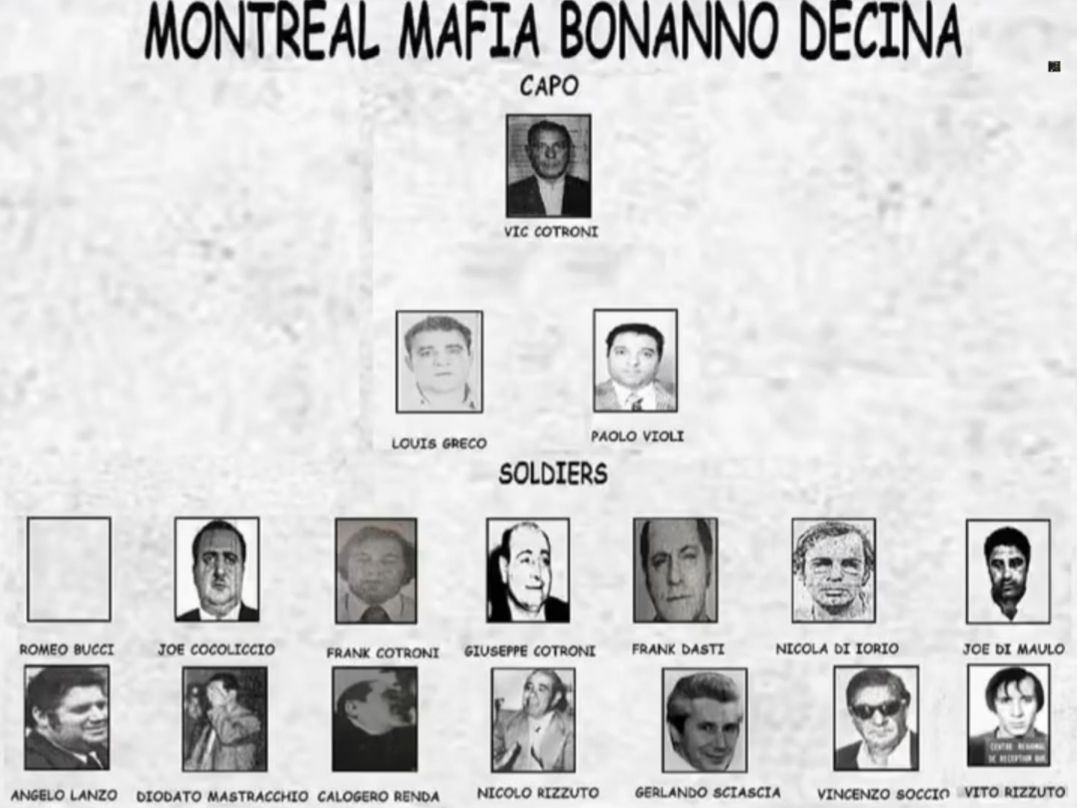
Unusually for the era, the Cotroni family included both Calabrian and Sicilian members in its ranks. In 1975, Dr. Alberto Sabatino of the Italian Polizia di Stato testified as an expert witness that the Cotroni family was exceptional in having Sicilians and Calabrians working together, stating such a mixture did not occur in Italy. At the height of their power in the 1960s and 1970s, the family was divided along geographical lines, with each capo running a particular district of Montreal. The key district leaders during this period included Sicilian Luigi Greco in the west end, Frank Cotroni in the Saint-Laurent district, Canadian-born Nicola Di Iorio running the Sorrento Gang, and Calabrian Paolo Violi serving as Vincenzo Cotroni's deputy. The two most important non-Italian members of the family were Armand Courville and William Obront. Courville was a French-Canadian professional wrestler who became a political fixer for the family. Obront, known as the Canadian Meyer Lansky, performed a role similar to a chief financial officer for the family, in charge of money laundering and stock fraud.
- Luigi Greco (Sicilian): Ran operations in the west end of Montreal.
- Frank Cotroni: Ran the family's operations in the Saint-Laurent district.
- Nicola Di Iorio: Led the Canadian-born Sorrento Gang.
- Paolo Violi (Calabrian): Served as Vic Cotroni's deputy and later acting boss.
Key Associates and Criminal Operations
Beyond its Italian core, the Cotroni family integrated powerful non-Italian associates who were critical to its financial and operational success. Armand Courville remained a key political fixer and enforcer from the family's earliest days. William Obront served as the family's chief financial officer, overseeing complex money laundering schemes and stock fraud. Obront also supervised a bookmaking network in the Ottawa-Hull area that handled around $50,000 in bets per day, with 25 percent going to Paolo Violi. For Montreal's Expo 67, Obront helped the Cotroni family land the meat and vending machine supply contract, most of which was tainted meat. Obront's financial crimes eventually caught up with him in 1973 when he was convicted of tax fraud, sentenced to 20 months in jail, and ordered to pay $683,046 in back taxes.
Another significant non-Italian associate was Joe Di Maulo, a trusted enforcer for the family. In the late 1960s, the Cotronis engaged in a violent feud with French-Canadian mobster Richard Blass, with Di Maulo doing much of the enforcing. On May 7, 1968, Blass and Robert Allard attempted an ambush of Frank Cotroni outside his home, killing two bodyguards but Frank escaped. In October 1968, Di Maulo twice shot Blass, who survived his wounds. The Montreal underworld was extremely violent during this period, with 110 gangland murders between 1963 and 1969, including 70 murders in 1968 and 1969. A provincial commission in 1969 blamed the murders on a struggle for control between the Bonanno family in New York City and the Magaddino family in Buffalo, but in reality much of the violence was caused by an upstart French-Canadian gang led by Blass.
- Drug trafficking: Heroin importation and distribution via the French Connection.
- Illegal gambling: Extensive bookmaking networks across Quebec and Ontario.
- Loan sharking: Providing high-interest loans to individuals and businesses.
- Extortion: Shaking down legitimate businesses for protection money.
- Corruption: Influencing public officials and rigging political processes.
- Fraud: Stock fraud and other white-collar financial crimes.
- Money laundering: Cleaning the proceeds of illegal activities through legitimate fronts.
Violence and Political Intrigue
The family's deep political connections were most evident through associates Nicola Di Iorio and Frank D'Asti, who were very close to the Quebec Liberal Party and donated heavily to Pierre Laporte's unsuccessful 1969 leadership bid and again during the 1970 provincial election, delivering briefcases full of cash to Laporte's aides René Gagnon and Jean-Jacques Coté. After Robert Bourassa became premier following the 1970 provincial election, Di Iorio and D'Asti were recorded expressing hope that Pierre Laporte would become the Quebec Attorney General. They were disappointed when he failed to secure that portfolio but considered his appointment as Minister of Labour a consolation prize. Coté promised them that the new Attorney General, Jérôme Choquette, would be friendly towards the Cotroni family.
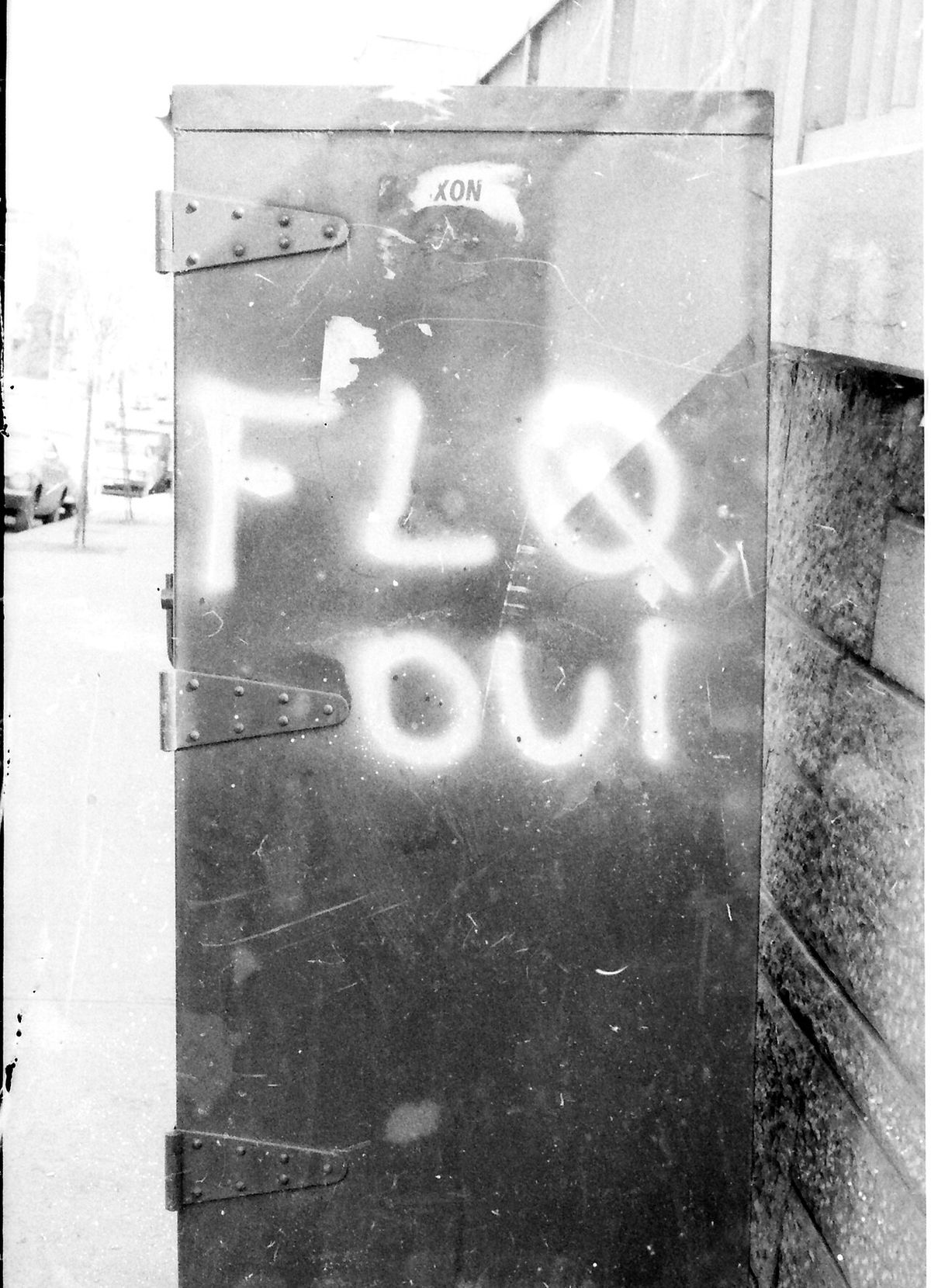
During the October Crisis of 1970, the Front de libération du Québec mentioned Cotroni in its manifestos, accusing him of rigging elections for the Liberals. After Laporte was kidnapped by the FLQ, D'Asti approached Laporte's aide offering to have the Cotroni family help police find the minister. The offer was accepted, but Laporte was not rescued and was found murdered. In December 1970, policeman Robert Ménard successfully bugged the Reggio Bar, Paolo Violi's base of operations. The recordings revealed much about Mafia operations in Canada, the United States, and Italy.
The Internal War and Rise of the Rizzutos
The cohesion between Calabrian and Sicilian factions began to fracture following the death of Sicilian capo Luigi Greco in 1972. In 1973, a violent power struggle broke out between the factions, notably involving aspiring Sicilian mob boss Nicolò Rizzuto. Following Vincenzo Cotroni's imprisonment for contempt in September 1974 after giving evasive testimony to the Commission d'Enquête sur le Crime Organisé, day-to-day control passed to his deputy, Paolo Violi. On January 9, 1975, Violi sent Pietro Sciarra to New York to ask Bonanno leader Philip Rastelli to appoint him the new boss. The conflict was exacerbated in 1976 when six years of police wiretap recordings from Violi's base were played publicly at the commission, devastating his reputation. The Bonanno family then shifted its support from Violi to Rizzuto, whom they felt was a more competent criminal.
The internal war resulted in a series of murders that decimated the Calabrian leadership and allowed the Sicilian faction to seize control. During the war in Montreal, Paolo Violi and his brothers Francesco and Rocco Violi were murdered through the mid-1970s to the early 1980s. As crime correspondent Peter Edwards noted, Vincenzo Cotroni was not one to buck New York, and any hit on Violi had to be sanctioned from the United States. By the mid-1980s, the Rizzuto crime family emerged as Montreal's preeminent crime family after the turf war, supplanting the Cotronis. Vincenzo Cotroni died of cancer on September 16, 1984, marking the symbolic end of his family's dominance. The Calabrian faction continued under Frank Cotroni, who had been imprisoned from 1975 to 1979, but it was a weakened entity operating in the shadow of the ascendant Rizzutos.
- Paolo Violi: The acting captain murdered in the late 1970s.
- Francesco Violi: Paolo's brother, also killed during the war.
- Rocco Violi: Another brother murdered in the early 1980s.
Frank Cotroni's Leadership and Final Downfall
Following his brother Vic's death, Frank Cotroni assumed leadership of the diminished Calabrian faction and developed connections with French Canadian hitman Réal Simard, who became his driver and enforcer. In 1986, after his arrest, Simard turned informant, confessing to five murders and his involvement with Cotroni. Based on this testimony, Frank Cotroni was sentenced to eight years in prison for manslaughter in 1987. After Simard's defection, Frank's replacement was boxer Eddie Melo, who took the lead in forging a national criminal alliance in the early 1990s with the Commisso 'ndrina of Toronto and the East End chapter of the Hells Angels in Vancouver, frequently meeting with their leaders. The family's final downfall was triggered by Operation Caviar, a major RCMP investigation. On April 18, 1996, Frank Cotroni and his son Francesco "Frank" Cotroni Jr. were among 30 people arrested as part of this three-year probe into an international drug network involving the Mafia and the West End Gang.
On April 4, 1997, Frank Cotroni was sentenced to seven years in prison after pleading guilty to plotting to import 180 kilograms of cocaine from Colombia as part of Operation Caviar. On August 23, 1998, his son Paolo "Paul" Cotroni was shot and killed by hitmen Gérald Gallant and Gérard Hubert under contract from the Rock Machine biker gang, due to his association with the Hells Angels during the Quebec Biker War. Frank Cotroni died of brain cancer on August 17, 2004. On November 4, 2012, longtime ally Joe Di Maulo was murdered outside his Montreal home, which police believe was part of an ongoing power struggle between the Sicilians and their rivals.
- April 4, 1997: Frank Cotroni sentenced to seven years in prison after pleading guilty to plotting to import 180 kilograms of cocaine from Colombia.
- August 23, 1998: Frank's son Paolo "Paul" Cotroni shot and killed in Repentigny by Rock Machine hitmen Gérald Gallant and Gérard Hubert.
- August 17, 2004: Frank Cotroni died of brain cancer at his daughter's home in Montreal.
- November 4, 2012: Longtime ally Joe Di Maulo murdered outside his Montreal home.
Aftermath and Modern Context
In the spring of 2026, the Canadian government launched a sweeping assault on the Rizzuto crime family, resulting in the Project Alliance indictment, the largest Mafia prosecution in the country's history, which charged nearly the entire leadership with gangsterism, murder, and money laundering. As the Rizzutos were weakened by legal pressure, rival street gangs like Arab Power and the Rap Pack Mob, connected to international drug cartels, moved aggressively to exploit the power vacuum, firebombing Rizzuto-owned businesses and demanding protection money, carrying these attacks into 2026. Many of the arrested Rizzuto leaders, including boss Leonardo Rizzuto, street boss David Barberio, and underbosses Stefano Sollecito and Pietro D'Adamo, were declared flight risks and held in jail awaiting trial scheduled for September 2026, where they face life sentences if convicted. This modern turmoil shows how the destabilization that began with the Cotroni-Rizzuto war in the 1970s created a cycle of violence and succession. In 2025, alleged Rizzuto leaders maintained day-to-day control via smuggled iPhones from prison and were linked to ordering murders of rivals. This included a prison killing of a high-ranking Arab Power Gang member in June 2025. These events demonstrate that the patterns of violence and adaptation established in the Cotroni era persist in Montreal's underworld.
Questions about Cotroni crime family
What caused the downfall of the Cotroni family?
The family's downfall was primarily caused by a violent internal war in the 1970s between its Calabrian faction, led by Paolo Violi, and its Sicilian faction, led by Nicolò Rizzuto. The Bonanno family in New York withdrew support from Violi after police wiretaps ruined his reputation, backing Rizzuto instead. The murders of Paolo, Francesco, and Rocco Violi crippled the Calabrian leadership, allowing the Rizzutos to take over. Subsequent police investigations like Operation Caviar and the deaths of Vincenzo Cotroni in 1984 and Frank Cotroni in 2004 ended the family's power.
How did the Cotroni family influence Quebec politics?
The family had deep and corrupt ties to Quebec politics, particularly the Liberal Party. Starting in the 1930s, Vic Cotroni and associate Armand Courville acted as enforcers in "baseball bat elections. Later, associates like Nicola Di Iorio and Frank D'Asti delivered large cash donations to Liberal figures like Pierre Laporte. These connections were intended to secure influence and immunity from prosecution. During the 1970 October Crisis, the FLQ mentioned Cotroni in its manifestos, accusing him of rigging elections for the Liberals.
Who founded the Cotroni crime family?
The Cotroni crime family was founded in the 1940s by Vincenzo Cotroni, a Calabrian immigrant from Mammola who settled in Montreal, Quebec. He immigrated to Canada in 1924 with his two sisters Marguerita and Palmina and his brother Giuseppe. Cotroni built the organization's early power base through political connections, famously working as an enforcer for the Quebec Liberal Party during the 'baseball bat elections' of the 1930s. His partnership with wrestler Armand Courville forged political ties that ensured immunity from prosecution for decades.
What was the family's relationship with the Bonanno crime family?
The United States Federal Bureau of Investigation considered the Cotroni family a branch of the Bonanno crime family of New York City. This strong connection formed in the 1950s when Bonanno captain Carmine Galante arrived in Montreal to work with Vic Cotroni. Galante planned to make the city a key hub for importing heroin via the French Connection for distribution in the United States. The Bonanno family held ultimate authority over the Cotroni family, and in the late 1970s, they shifted their support from the Cotroni faction to the Sicilian Rizzuto faction during the internal war.
What illegal activities were the Cotronis involved in?
The Cotroni family was involved in illegal gambling, loan sharking, drug trafficking, extortion, and political corruption. Specific operations included a major heroin importation network linked to the French Connection. The family ran a bookmaking network in the Ottawa-Hull area handling about $50,000 in bets daily. Through associate William Obront, they laundered money and committed stock fraud. They also controlled legitimate business fronts, securing the meat and vending machine supply contract for Expo 67, which involved tainted meat.
Sources and further reading
- Cotroni crime family (Wikipedia)
- Organized Crime in Canada (thecanadianencyclopedia.ca)
- Embattled Montreal Mafia clings to underworld power amid ... (themobmuseum.org)
- Reputed Montreal crime boss Cotroni dead (cbc.ca)
Checked by the Nosy Mag desk. Last updated 2026-10-26.