Stud poker
Stud poker is a family of poker variants where players receive a mix of face-down and face-up cards over multiple betting rounds, distinguishing it from community card games like Texas Hold'em. In Canada, popular forms include the classic Seven Card Stud, the proprietary casino table game Mississippi Stud, and the uniquely Canadian variant known as Soko or Canadian Stud Poker. These games are fixtures in both home games and licensed casinos across provinces, offering a blend of skill, strategy, and chance.
Origins and Core Concepts of Stud Poker
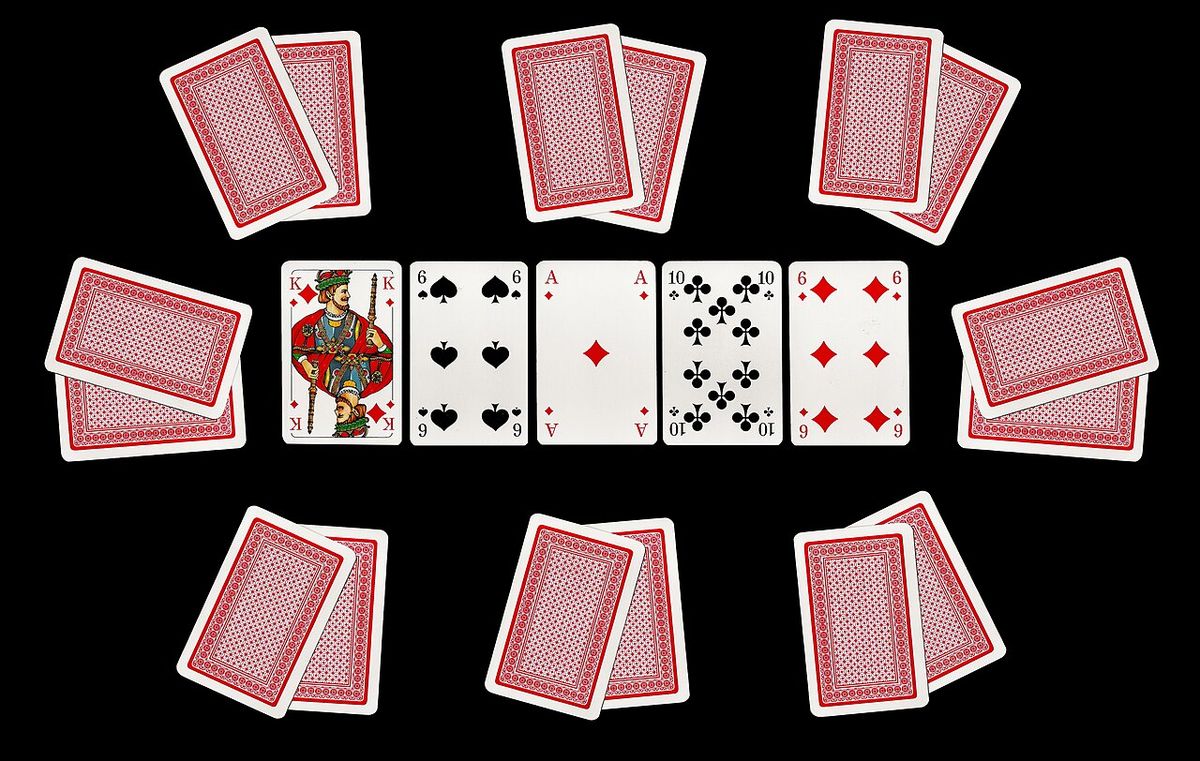
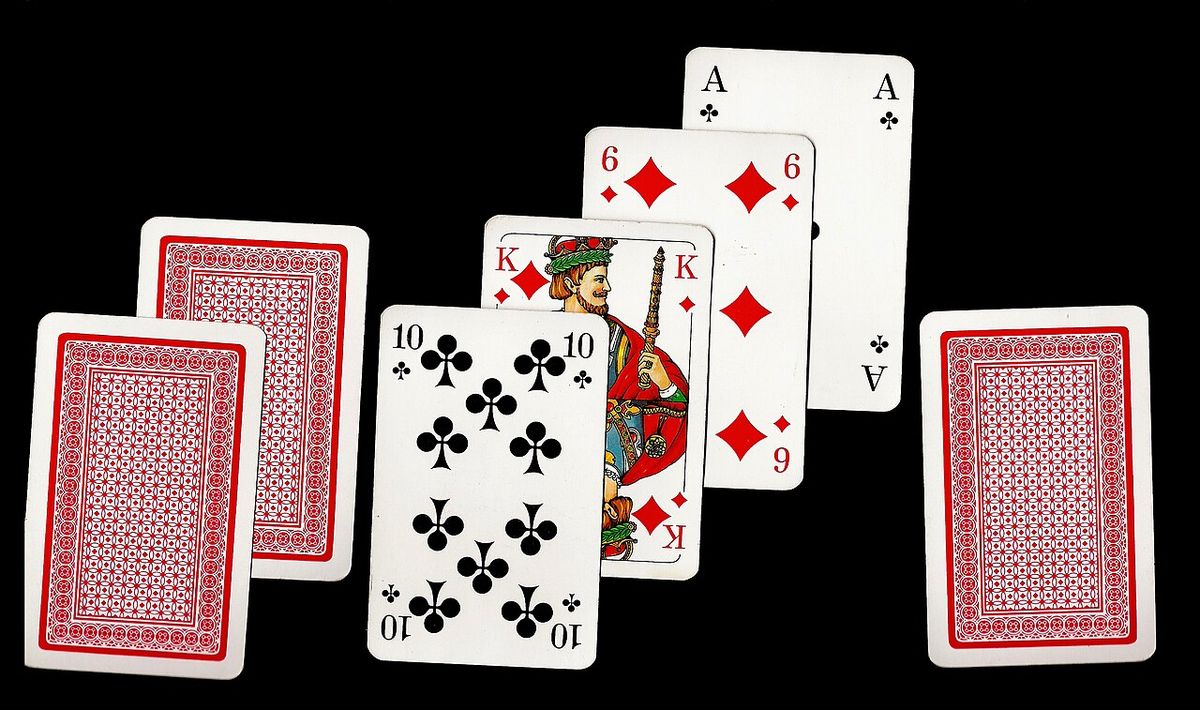
The core mechanical concept that defines all stud poker games is the deal of a combination of face-down and face-up cards to each player. Face-down cards, known as hole cards, are private and seen only by the player who holds them. Face-up cards, often called door cards or upcards, are visible to all players at the table, providing public information that influences betting strategy. This structure creates a game of partial information, where players must deduce opponents' hidden strength from their visible cards and betting patterns. The most traditional forms are Five-Card Stud and Seven Card Stud, which serve as the foundation for numerous modern casino and home game variants. Five-card stud first appeared during the American Civil War and became very popular. Seven-card stud later became more common in casinos and home games.
Traditional Stud Poker: Five-Card and Seven-Card
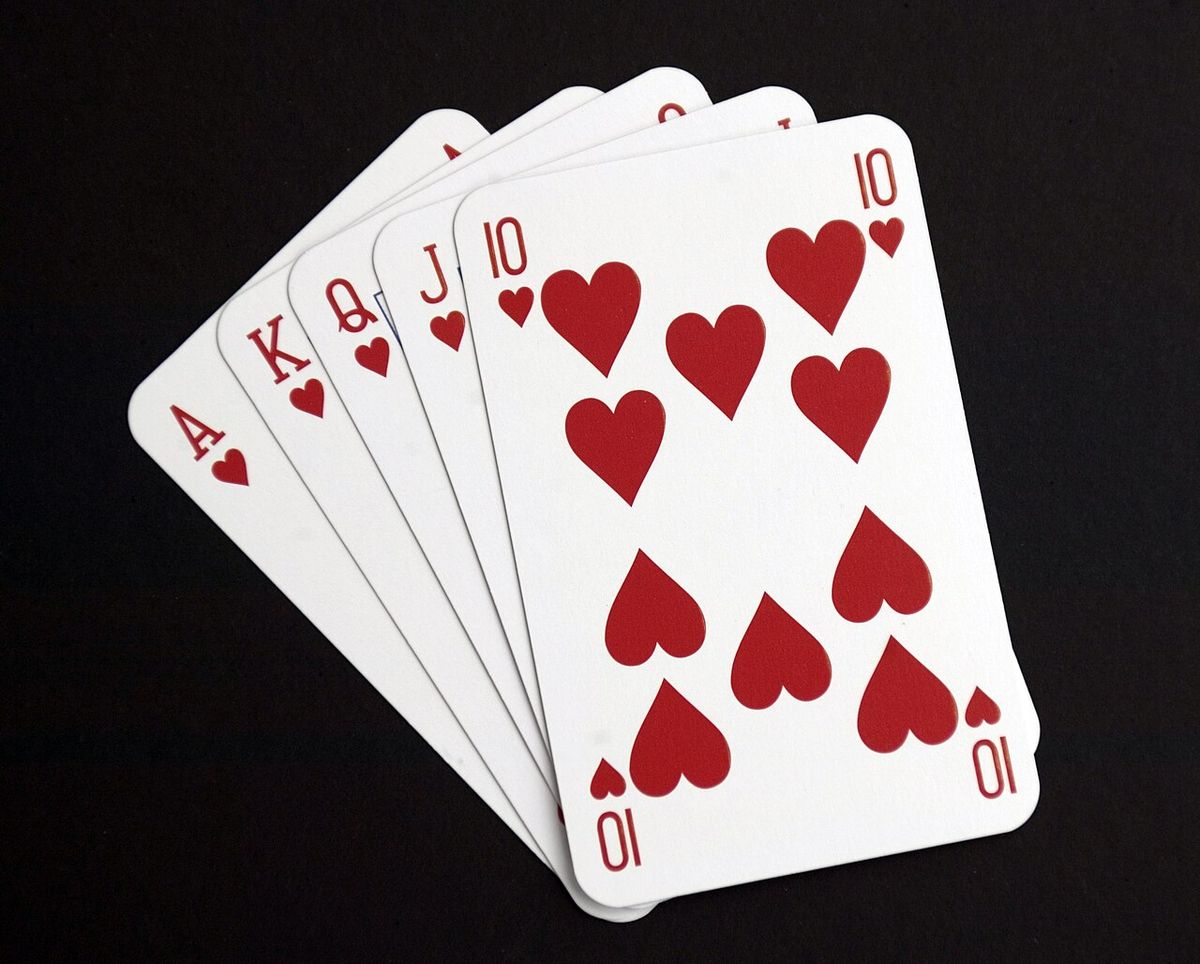
Five-Card Stud is historically one of the simplest forms, often serving as a beginner's introduction to poker. In a standard game, each player receives one card face down and one card face up after posting an ante. A betting round follows, and then three more face-up cards are dealt one at a time, with a betting round after each. By the end, each active player has one hole card and four upcards, from which they make their best five-card hand. Seven Card Stud is a more complex and enduringly popular variant, especially in home games and some tournament formats. Each player begins with two cards face down and one card face up, followed by a betting round. Players then receive three more face-up cards and a final seventh card face down, with a betting round after each new card. For the showdown, players select their best five-card hand from their total of seven cards. The hand rankings follow traditional poker hierarchy, from a Royal Flush down to High Card. Betting rounds in stud poker are named after the number of cards each player holds, such as third street and fifth street.
Canadian Stud Poker: The Soko Variant
Soko, also known as Canadian Stud Poker, is a distinctive Five-Card Stud variant that originated in and remains popular in Finland, despite its Canadian namesake. It follows the standard Five-Card Stud deal structure with one hole card and four subsequent upcards. The key differentiator of Soko is the addition of two special hands to the standard poker hand ranking. A Canadian straight, or four straight, is four cards in sequence with one unrelated card. A Canadian flush, or four flush, is four cards of the same suit with one off-suit card. In the Soko hand hierarchy, a Canadian straight outranks one pair but is outranked by two pair. A Canadian flush outranks a Canadian straight. The full ranking from highest to lowest is: Five of a Kind (with wild cards), Straight Flush, Four of a Kind, Full House, Flush, Straight, Three of a Kind, Two Pair, Canadian Flush, Canadian Straight, One Pair, High Card. Betting in Soko typically involves an ante and a bring-in bet from the player showing the lowest upcard, with limits often doubling if a pair is visible among the upcards. The game is also called Scandinavian stud.
Casino Table Games: Mississippi Stud and Caribbean Stud
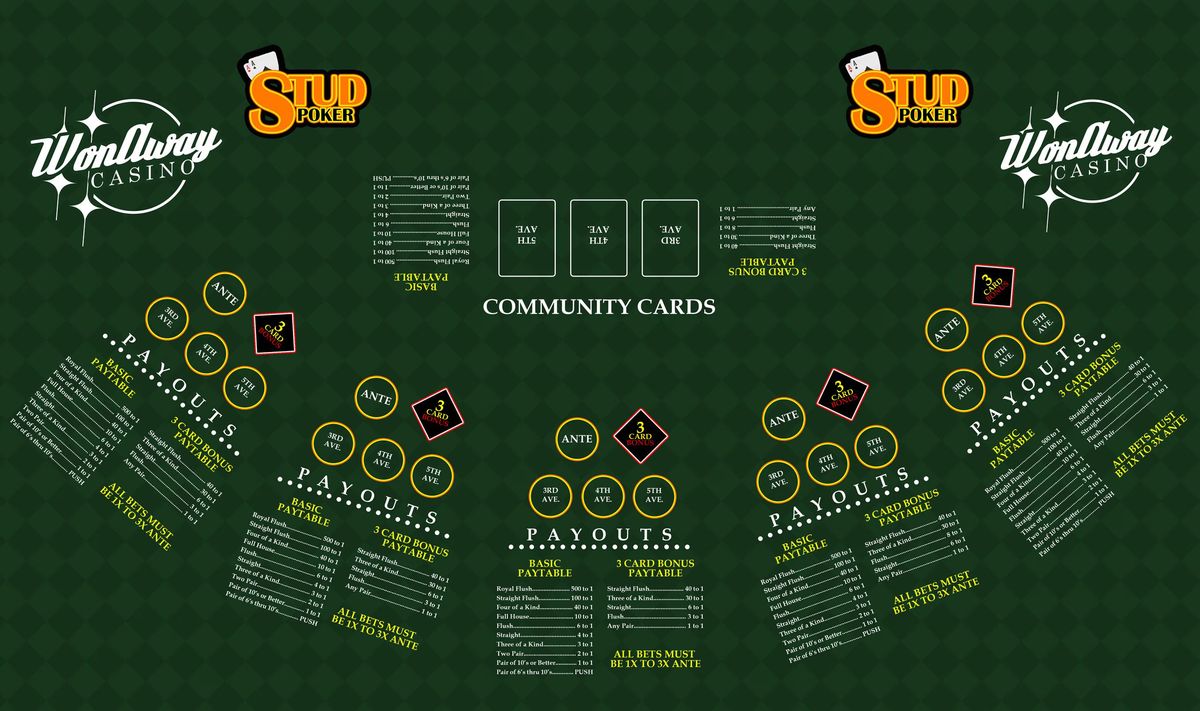
In Canadian casinos, stud poker is often encountered as proprietary, house-banked table games where players compete against a paytable or dealer, not directly against each other. Mississippi Stud is a widespread example, easily identified by its blue playing surface. Players start by placing an ante bet and receive two hole cards. The dealer places three community cards face down. After seeing their hole cards, players must decide to fold or raise by betting one to three times their ante. This decision point repeats after the dealer reveals the first and second community cards. After the final community card is revealed, players make their best five-card hand using their two hole cards and the three community cards. Wins are determined by a paytable, with a pair of Jacks or better required to win. Hands of a pair of 6s through 10s result in a push, and lower hands lose. Caribbean Stud Poker is another popular casino variant based on Five-Card Stud. Players make an ante bet and receive five cards face down, while the dealer receives five cards with one face up. Players then decide to fold or raise by placing a bet double their ante. The dealer qualifies to play only with a hand containing an Ace and a King or better. If the dealer does not qualify, players win even money on their ante only. If the dealer qualifies, players win payouts on both ante and raise bets if their hand beats the dealer's, according to a fixed paytable. Caribbean Stud Poker was originally invented by David Sklansky and first introduced in Aruba in the 1980s.
| Hand (Mississippi Stud) | Payout | Hand (Caribbean Stud) | Payout (on Raise Bet) |
|---|---|---|---|
| Royal Flush | 500 to 1 | Royal Straight Flush | 100 to 1 |
| Straight Flush | 100 to 1 | Straight Flush | 50 to 1 |
| Four of a Kind | 40 to 1 | Four of a Kind | 20 to 1 |
| Full House | 10 to 1 | Full House | 7 to 1 |
| Flush | 6 to 1 | Flush | 5 to 1 |
| Straight | 4 to 1 | Straight | 4 to 1 |
| Three of a Kind | 3 to 1 | Three of a Kind | 3 to 1 |
| Two Pair | 2 to 1 | Two Pair | 2 to 1 |
| Pair of Jacks or Better | 1 to 1 | One Pair | 1 to 1 |
Gameplay and Betting Procedures
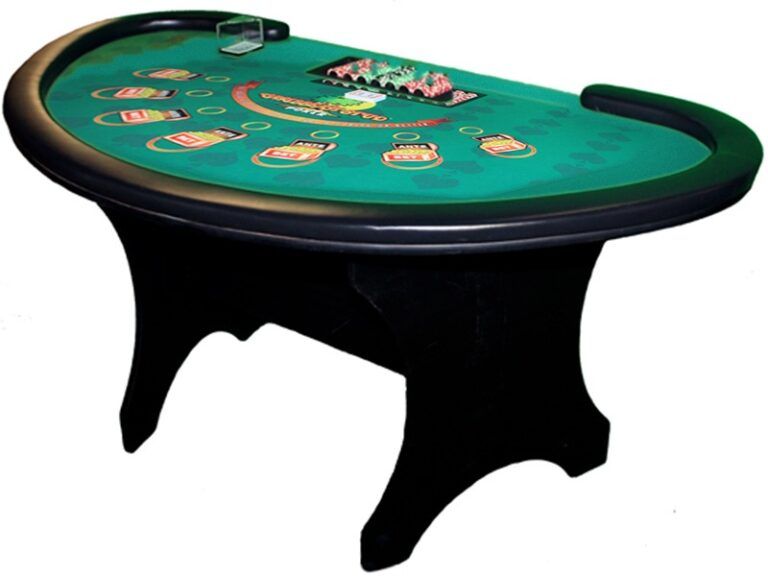
Playing stud poker in a casino environment involves specific procedures to ensure game integrity. To join a table, a player must place cash on the table layout, not hand it directly to the dealer, and will receive chips in exchange. Bets are placed in designated betting spots on the table before any cards are dealt. For games like Mississippi Stud, the betting process is structured across three decision points called 3rd Street, 4th Street, and 5th Street, corresponding to the revelation of each community card. At each point, a player may fold and forfeit all bets already in play, or raise by adding a bet of one to three times their original ante. In Caribbean Stud, the decision is a single choice to fold or raise after seeing the initial five-card hand. Players are universally prohibited from showing or discussing their hole cards with others at the table. All games use a standard 52-card deck with card rankings from Ace high down to Two, with the Ace also able to serve as a low card to form a straight of Ace-2-3-4-5. In fixed limit games, later betting rounds often have higher limits, such as a $5/$10 Seven-card Stud game allowing $5 bets for the first two rounds and $10 bets for subsequent rounds.
- Step 1: Player places an ante bet on the table.
- Step 2: Dealer deals two hole cards face down to the player and three community cards face down.
- Step 3: Player examines hole cards and decides to fold or make a 3rd Street bet (1x-3x ante).
- Step 4: Dealer reveals first community card. Player decides to fold or make a 4th Street bet (1x-3x ante).
- Step 5: Dealer reveals second community card. Player decides to fold or make a 5th Street bet (1x-3x ante).
- Step 6: Dealer reveals final community card and player makes best five-card hand.
- Step 7: Wagers are resolved against the paytable. A pair of Jacks or better wins.
Common Variations and Rule Modifications
Beyond the standard variants, stud poker games often incorporate rule modifications in home and casino settings. High/Low split games are a popular addition, where the pot is divided between the player with the best traditional hand and the player with the lowest qualifying hand, encouraging more players to stay in the game. Wild cards are sometimes introduced, but almost always with stipulations to maintain balance, such as declaring a specific rank wild only if it is dealt face-down as a hole card. Another variation is the inclusion of a progressive jackpot side bet, commonly offered in casino versions like Caribbean Stud and Mississippi Stud. For an additional wager, often $1 or $5, players become eligible for a large cumulative jackpot, which can exceed $1,000,000, typically awarded for very rare hands like a Royal Flush. Some local Canadian home game rules create unique hybrids, such as a rule where a four flush beats an outside straight, blending concepts from games like New York Stud. Specific variants include Razz, where the lowest hand wins, and Mexican stud, which uses a stripped deck and wild cards.
- Number of Cards: Games are typically structured around five or seven cards per player.
- Betting Structure: Can be limit, pot-limit, or no-limit, often with antes and bring-ins.
- House-Banked vs. Player-Banked: Casino games pit players against the house, while home games are player-versus-player.
- Qualifying Hands: In games like Caribbean Stud, the dealer must have a minimum hand (Ace-King or better) to qualify.
- Side Bets: Optional wagers like progressive jackpots are common in casino formats.
Access and Responsible Play in Canada
Stud poker games are available to adults across Canada in various formats. Traditional Seven Card Stud and Five-Card Stud can be found in home games, private tournaments, and occasionally in poker rooms at casinos. Proprietary table games like Mississippi Stud and Caribbean Stud Poker are widely available on the floors of licensed casinos in provinces such as Ontario, Quebec, and British Columbia. These games are also accessible online through regulated casino sites and via mobile apps that offer free-to-play practice versions. Casinos and gaming websites provide resources for responsible gambling, and players are encouraged to set limits, understand the rules completely, and view the activity as entertainment. The house edge for games like Caribbean Stud Poker is approximately 5.2 percent, meaning the casino retains a statistical advantage over time. Players should be aware of provincial help lines and play only with funds they can afford to lose, treating the games as a form of leisure rather than a source of income. Stud poker variants using four cards were popular as of the American Revolutionary War.
Questions about Stud poker
What is Mississippi Stud poker?
Mississippi Stud is a popular casino table game based on five-card poker. Players make an ante bet and receive two hole cards, while the dealer places three community cards face down. Players then have three opportunities to fold or raise their bet as each community card is revealed. The final five-card hand, made from the two hole cards and three community cards, is paid according to a fixed paytable. A pair of Jacks or better is required to win, with top payouts reaching 500 to 1 for a Royal Flush. It is a house-banked game where players compete against the paytable, not other players or a dealer's hand.
How do you play Caribbean Stud poker?
In Caribbean Stud Poker, each player places an ante bet and receives five cards face down. The dealer also receives five cards, with one revealed face up. After viewing their cards, players must decide to fold (forfeiting the ante) or raise by placing a bet equal to double their ante. The dealer then reveals their remaining cards. The dealer must qualify with a hand of Ace-King or better to play. If the dealer does not qualify, players win even money on their ante only. If the dealer qualifies and the player's hand is better, the player wins even money on the ante and a payout on the raise bet according to a paytable, with a Royal Flush paying 100 to 1. The game was originally invented by David Sklansky.
What are the rules for Five Card Stud poker?
In a standard Five Card Stud game, each player posts an ante. Each player is then dealt one card face down (the hole card) and one card face up. A betting round occurs, started by the player with the lowest upcard who may be forced to make a 'bring-in' bet. Three more cards are then dealt face up to each active player, one at a time, with a betting round following each new card. By the end, each player has one hole card and four upcards. Players use these five cards to make their best poker hand. The player with the highest-ranking traditional poker hand wins the pot. Betting can be structured as fixed-limit, and the game typically accommodates two to eight players. Five-card stud first appeared during the American Civil War.
What is Seven Card Stud poker?
Seven Card Stud is a classic poker variant where each player is ultimately dealt seven cards to make their best five-card hand. The game begins with each player receiving two cards face down and one card face up, followed by a betting round. Three subsequent face-up cards are then dealt individually, with a betting round after each. A final seventh card is dealt face down, followed by a final betting round. In the showdown, active players select their best five-card hand from their seven total cards. The game requires careful attention to opponents' upcards to deduce possible hands. It is often played as a high-only game or as a High/Low split variant, and it remains a staple in home games and some poker tournaments. Betting rounds are named after the number of cards, such as third street and fifth street.
Can you play Mississippi Stud poker online for free?
Yes, free-to-play online versions of Mississippi Stud poker are available through various mobile apps and casino websites. These platforms allow players to practice the game using virtual chips without wagering real money. The apps typically replicate the standard casino rules, dealing two hole cards and three community cards, and offering the same fold/raise decision points. They often include features like multiple table levels, daily bonus chips, and paytables matching the real game. These free versions are useful for learning basic strategy and understanding the betting flow before playing for real money at a licensed online casino or physical casino in Canada.
What is Soko or Canadian Stud Poker?
Soko, also known as Canadian Stud Poker, is a variation of Five-Card Stud that adds two unique hands to the standard poker hierarchy. The game is most popular in Finland but carries a Canadian namesake. The special hands are the Canadian straight (four cards in sequence with one unrelated card) and the Canadian flush (four cards of the same suit with one off-suit card). In the hand ranking, a Canadian straight outranks one pair but is outranked by two pair, while a Canadian flush outranks a Canadian straight. The game follows standard Five-Card Stud deal and betting procedures, often with a bring-in bet and doubled limits when a pair is visible. It is a player-versus-player game common in home settings. The game is also called Scandinavian stud.
Sources and further reading
- Soko (Canadian Stud) (denexa.com)
- Stud Poker Games (poker.com)
- Mississippi Stud Poker | Casinos et Salons de jeux (casinos.lotoquebec.com)
- Seven Card Stud Poker (bicyclecards.com)
- How to Play Mississippi Stud | Seneca Niagara (senecaniagaracasino.com)
- Mississippi Stud Poker | Casinos et Salons de jeux (casinos.lotoquebec.com)
Checked by the Nosy Mag desk. Last updated 2026-11-13.