Yukon
Yukon is a solitaire card game played with a standard 52-card deck, sharing its foundational goal and visual layout with the classic Klondike. The game is distinguished by two key rule changes: there is no stock or waste pile to draw from, and players can move groups of cards between tableau columns with greater flexibility. Named after Canada's Yukon Territory, it occupies a strategic middle ground between the luck-dependent Klondike and more complex games like Spider, attracting players who prefer a puzzle that rewards careful planning over chance.
Rules and Setup
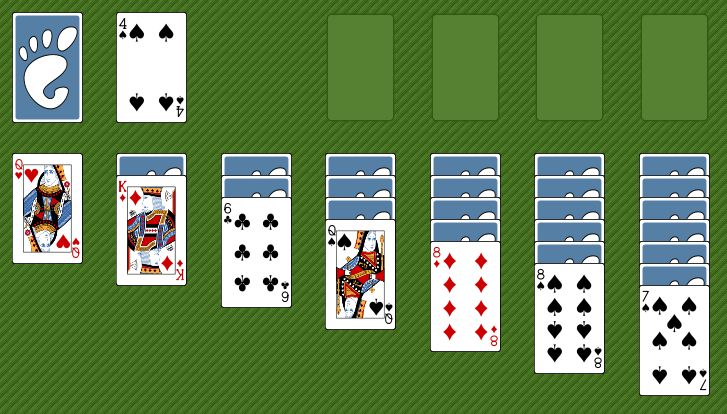
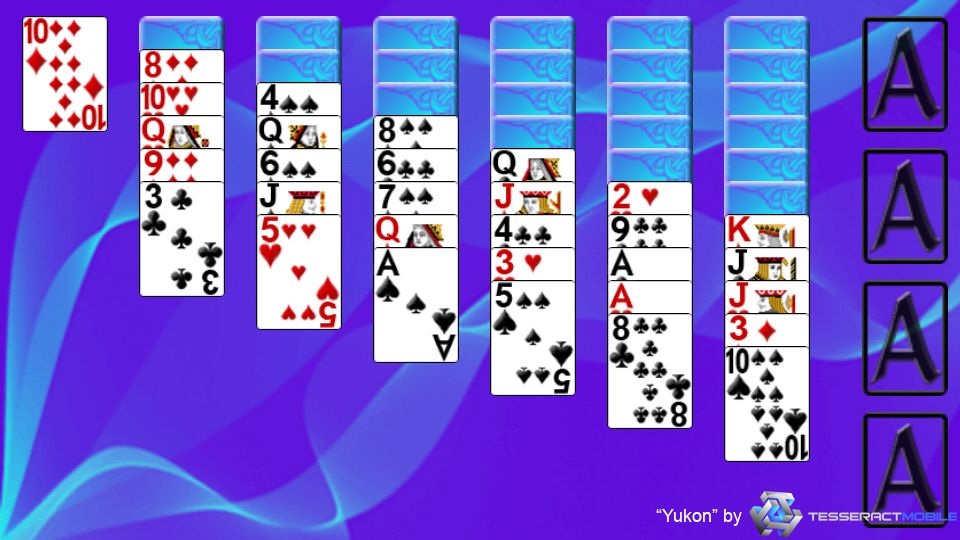
The objective of Yukon is identical to Klondike: to build four foundation piles in ascending order from Ace to King, each pile consisting of a single suit. The game begins by dealing all 52 cards into seven tableau columns in a specific pyramidal arrangement. The first column contains one face-up card. Columns two through seven each contain a number of face-down cards equal to their column number minus one, topped with five face-up cards. For example, column two has one face-down card under five face-up cards, while column seven has six face-down cards under its five face-up cards. This initial deal uses the entire deck, leaving no cards remaining for a stock or waste pile.
Play revolves around moving cards between the tableau columns and onto the foundations. A face-up card, or any group of face-up cards sitting on top of a face-up card, can be moved to another tableau column. The move is valid if the bottom card of the moving group is one rank lower than the top card of the destination column and of the opposite colour. Crucially, the cards within the moving group do not need to be in a perfect descending sequence. This relaxed movement rule is a major departure from Klondike. When a face-down card is uncovered by moving all the cards above it, it is turned face-up and becomes available for play.
Empty tableau columns, created when all cards are moved from a pile, can only be filled by a King or by a group of cards headed by a King. Foundations are built by suit in ascending order, starting with the Aces. Any available Ace can be moved to a foundation pile as soon as it is uncovered and is the top card of its column. Subsequent cards of that suit can then be placed on the foundation in sequence. The game is won when all 52 cards are successfully moved to the four foundation piles. The game ends in a loss when no further legal moves are possible.
Strategy and Difficulty
Successful play in Yukon requires a different strategic approach than Klondike, focusing on long-term tableau management over short-term draws. The primary goal is to expose face-down cards as quickly as possible to increase mobility and access to Aces and other key cards. Moving Aces to the foundations early is considered critical, as it clears space in the tableau and defines the target sequences for the remaining cards. However, players must balance this against the need to maintain movable sequences and avoid creating blocked configurations where high-value cards trap lower ones. The absence of a stock pile means every move is permanent and must be considered carefully.
This increases the importance of planning several moves ahead. The flexible group movement rule is a powerful tool but can also lead to tangled, disorganized columns if used indiscriminately. Skilled players use it to consolidate sequences by suit and colour, and to carefully open up empty columns for King placement. Analysis of large datasets from online play indicates a win rate of approximately 13.69%, though other sources suggest it can reach 25% with optimal play. The decisive nature of losses in Yukon is often noted by players, as a losing position typically results from a clear strategic misstep rather than an unlucky draw.
Comparison to Klondike Solitaire
Yukon is most directly compared to Klondike, the ubiquitous solitaire game pre-installed on computers for decades. Both games use a single deck, seven tableau columns, and four foundation piles built by suit from Ace to King. The visual setup is nearly identical, leading many players to initially confuse the two. The core differences, however, fundamentally alter the gameplay experience and strategic depth. The most significant change is the complete elimination of the stock and waste piles in Yukon. In Klondike, these piles introduce a major element of luck, as players cycle through unseen cards hoping for useful draws. Yukon removes this randomness, presenting all challenges and solutions within the initial tableau.
The second major difference is the rule for moving cards between columns. In Klondike, only cards that form a perfect descending sequence of alternating colours can be moved as a group. In Yukon, any face-up card and all cards stacked on top of it can be moved together, regardless of their internal order, as long as the bottom card of the group matches correctly with the destination card. This gives Yukon players far greater ability to reorganize the tableau, but it also increases the complexity of decision-making. These changes shift Yukon from a game of patience and chance to one of logic and foresight.

Variants and Related Games
Several solitaire games are closely related to Yukon, offering variations in difficulty and rules. The most notable variant is Russian Solitaire, which uses an identical layout but imposes a stricter building rule in the tableau: cards can only be moved onto the next higher card of the same suit, rather than alternating colours. This makes the game significantly more difficult. It should not be confused with other historical games also called Russian Solitaire, such as Nidgi Novgorod or Russian Patience. Other popular variants adjust the rules to increase or decrease the challenge. Common recommendations for players seeking a different type of challenge include FreeCell, with its 99% win rate and all cards face-up, and Spider Solitaire, with its two-deck complexity.
- Russian Solitaire: The strict suit-building variant that is considerably harder than standard Yukon.
- Alaska: A closely related game that shares Yukon's core mechanics.
- Australian Patience: Another relative within the same family of solitaire games.
- Queenie: Listed among favourite Yukon variants in player communities.
- Scorpion Solitaire: A variant mentioned as a favourite, known for its own unique set of challenging rules.
Some Yukon variants remove the usual restriction that only Kings be placed in empty tableau spaces. This modification generally makes the game easier to win. The existence of these variants demonstrates the game's flexibility. The game serves as a foundation for a broader family of patience games, such as Alaska and Australian Patience.
Digital Play and Online Availability
The digital era significantly boosted Yukon's popularity, as it became a standard inclusion in computer solitaire software packages and online gaming portals. Its appeal to players seeking a skill-based alternative to Klondike ensured its place alongside classics like Spider and FreeCell. Numerous websites offer free browser-based versions of Yukon Solitaire with no download or registration required. These platforms often feature innovative gameplay aids like unlimited undo functions, auto-complete for guaranteed wins, and keyboard shortcuts for efficient play. Common digital features include card-highlighting tools activated by keyboard keys to locate specific ranks or suits, and 'super move' functions that automatically shift intervening cards to execute a complex move with a single click or drag.
- Green Felt: A site offering Yukon with a friendly, competitive community and innovative features.
- Solitaire Bliss: A platform providing free online play, often featuring games like Yukon and Russian Solitaire.
- Solitaire Network: A site where Yukon is listed among the top games, playable instantly.
- World of Solitaire: A website hosting a version of Yukon with tutorial support.
- CardGames.io: A multi-game portal that has included Yukon in its offerings.
- Amazon Appstore: A source for downloadable Yukon Solitaire apps for mobile devices.
Many online Yukon Solitaire sites track player statistics and offer daily challenges. These platforms maintain leaderboards for a competitive community. The game is available to play online for free in web browsers with no download required. The ongoing development of these platforms indicates its sustained relevance.

Historical Context and Naming
Yukon takes its name from Canada's Yukon Territory, sharing a geographical inspiration with Klondike, which references the Klondike region of the same territory during the gold rush era. This naming convention places both games within a thematic context of the remote and rugged Canadian north. The game appears in card game reference books from the mid-20th century, positioned as a variant designed to address common criticisms of Klondike's reliance on luck. By dealing all cards at the start and removing the stock pile, game designers created a version that emphasized skill and analytical thinking. References to Yukon and its variants can be found in authoritative solitaire compendiums such as The Complete Book of Solitaire & Patience Games by Morehead and Mott-Smith, and David Parlett's The Penguin Book of Patience.
Yukon appears in card game collections from the mid-20th century. Its inclusion in these collections helped standardize its rules. The game's evolution to a digital staple allowed for the collection of vast gameplay data. This data has been used by researchers to study sequential decision-making under full information. The game's design prioritizes player agency over random draws. This philosophy attracts a devoted following who treat solitaire as a serious logic puzzle.
Win Rate Statistics
Analysing win rates in solitaire provides insight into a game's inherent difficulty and the balance between skill and luck. For Yukon, statistics drawn from large online samples offer a concrete measure of its challenge level. One analysis of 626,953 randomly played online games recorded 85,856 wins, resulting in a win rate of 13.69%. Other sources suggest that with skilled play, the win rate can be higher, potentially reaching 20% to 25%. This variability depends on the player's strategic ability and whether the digital implementation allows moves like returning cards from foundations to the tableau. These figures position Yukon as a moderately difficult solitaire game.
| Game | Win Rate | Key Feature |
|---|---|---|
| Yukon Solitaire | 13.69%, 25% | No stock pile, flexible group moves |
| Klondike Solitaire | ~82% (optimal play) | Includes stock and waste piles |
| FreeCell | ~99% | All cards face-up, free cells for storage |
| Spider Solitaire | Varies (lower than Yukon) | Uses two decks, more complex tableau |
Questions about Yukon
What is the main difference between Yukon and Klondike solitaire?
The two main differences are the absence of a stock or waste pile in Yukon and a more flexible card-moving rule. In Yukon, all cards are dealt at the start with no deck to draw from. You can move a group of face-up cards even if they are not in a perfect sequence, as long as the bottom card of the group matches correctly with the destination card. This contrasts with Klondike, where you draw from a stock and can only move sequences that are perfectly ordered by rank and alternating colour.
Can you play Yukon solitaire for free online?
Yes, numerous websites offer free online versions of Yukon Solitaire that require no download or registration. Platforms like Green Felt, Solitaire Bliss, and Solitaire Network host the game directly in a web browser. These sites typically provide features like unlimited undos, hints, auto-complete functions, and daily challenges. The game is also available as a downloadable app for mobile devices and computers through various app stores.
What is Russian Solitaire, and how is it related to Yukon?
Russian Solitaire is a direct variant of Yukon that uses an identical card layout and the rule of no stock pile. The critical difference is in tableau building: in Russian Solitaire, you can only move a card onto the next higher card of the same suit, rather than onto a card of the opposite colour. This stricter building rule makes the game considerably more difficult than standard Yukon. It is a distinct game from other historical solitaires also called Russian Solitaire, such as Nidgi Novgorod.
What is a key strategy tip for winning at Yukon?
A fundamental strategy is to prioritize uncovering face-down cards as quickly as possible to expand your options. This often involves making moves that may not directly build foundations but that open up hidden cards. Moving Aces to the foundations early is also critical, as it creates clear targets for subsequent cards and frees up space in the tableau. Careful planning of group moves is essential. While the rules allow moving disordered piles, doing so without a plan can create tangled columns that are hard to unravel. Always consider the consequences of creating an empty column, as it can only be filled by a King.
How do you set up a game of Yukon solitaire?
To set up Yukon, shuffle a standard 52-card deck and deal all cards into seven tableau columns. The first column gets one face-up card. For columns two through seven, deal a number of face-down cards equal to the column number minus one. Then, on top of these face-down cards in columns two through seven, deal five face-up cards. This uses the entire deck, leaving no cards for a stock pile. The lengths of the seven tableau stacks from left to right are 1, 6, 7, 8, 9, 10, and 11 cards.
What is the win rate for Yukon solitaire?
The win rate for Yukon solitaire is approximately 13.69% according to an analysis of 626,953 random online games. With skilled play, win rates are estimated to hover between 20% and 25%. This moderate challenge level positions Yukon as more difficult than Klondike but often less punishing than games like Spider Solitaire. The absence of a stock pile increases the skill component, making consistent wins dependent on careful strategy and analysis of the initial deal.
Sources and further reading
- Yukon (Wikipedia)
- Yukon Solitaire (greenfelt.net)
- Yukon Solitaire, Play Online & 100% Free (solitaired.com)
- Yukon Solitaire: Rules, Strategy & Free Play (2026) (solitaireassociation.com)
- Yukon (denexa.com)
- Yukon Solitaire | Play it online (cardgames.io)
- Yukon Solitaire, Play Online & 100% Free (solitaired.com)
Checked by the Nosy Mag desk. Last updated 2026-11-11.