Egyptian Ratscrew
Egyptian Ratscrew, often abbreviated as ERS and also known as Egyptian War, Bloodystump, Ratslap or Slap, is a fast-paced American matching card game popular for its blend of chance, reflexes, and simple strategy. The game is played with a standard 52-card deck where the objective is to win all the cards by correctly slapping specific combinations or by successfully challenging opponents with face cards and aces. Its appeal in Canada lies in its accessibility and energetic gameplay, making it a common feature at summer camps, family gatherings, and university residences. The game's reliance on quick reactions and simple rules has secured its place as a beloved casual pastime across generations.
Gameplay Fundamentals and Setup
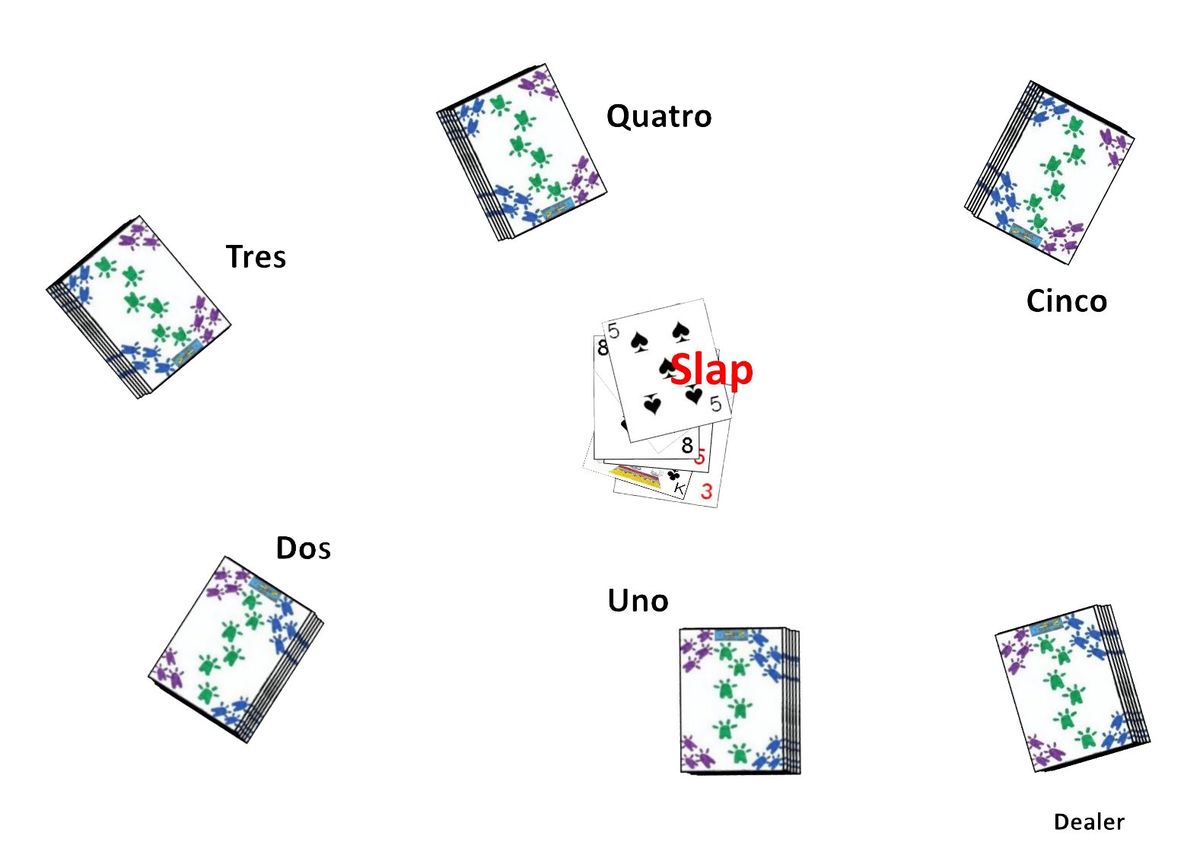
A standard 52-card deck is used for Egyptian Ratscrew, and groups may opt to include Jokers or shuffle multiple decks together for larger numbers of players. The dealer distributes the entire deck as evenly as possible, creating a personal, face-down draw pile for each participant. Players are strictly prohibited from looking at their own cards at any point during the game, and they must square their pile neatly in front of them. Play begins with the person to the dealer's left, who takes the top card from their pile and places it face-up in the centre of the table to start the communal discard pile. Each subsequent player in clockwise order does the same, flipping their card away from themselves to ensure all players see it simultaneously, with penalties potentially incurred for revealing a card toward oneself first. The game continues in this manner until a player reveals a face card (Jack, Queen, King) or an Ace, which triggers a special challenge sequence that interrupts the normal rotation. Jokers, when included, can also reverse the direction of play depending on the house rules established before the game begins.
The Face Card and Ace Challenge
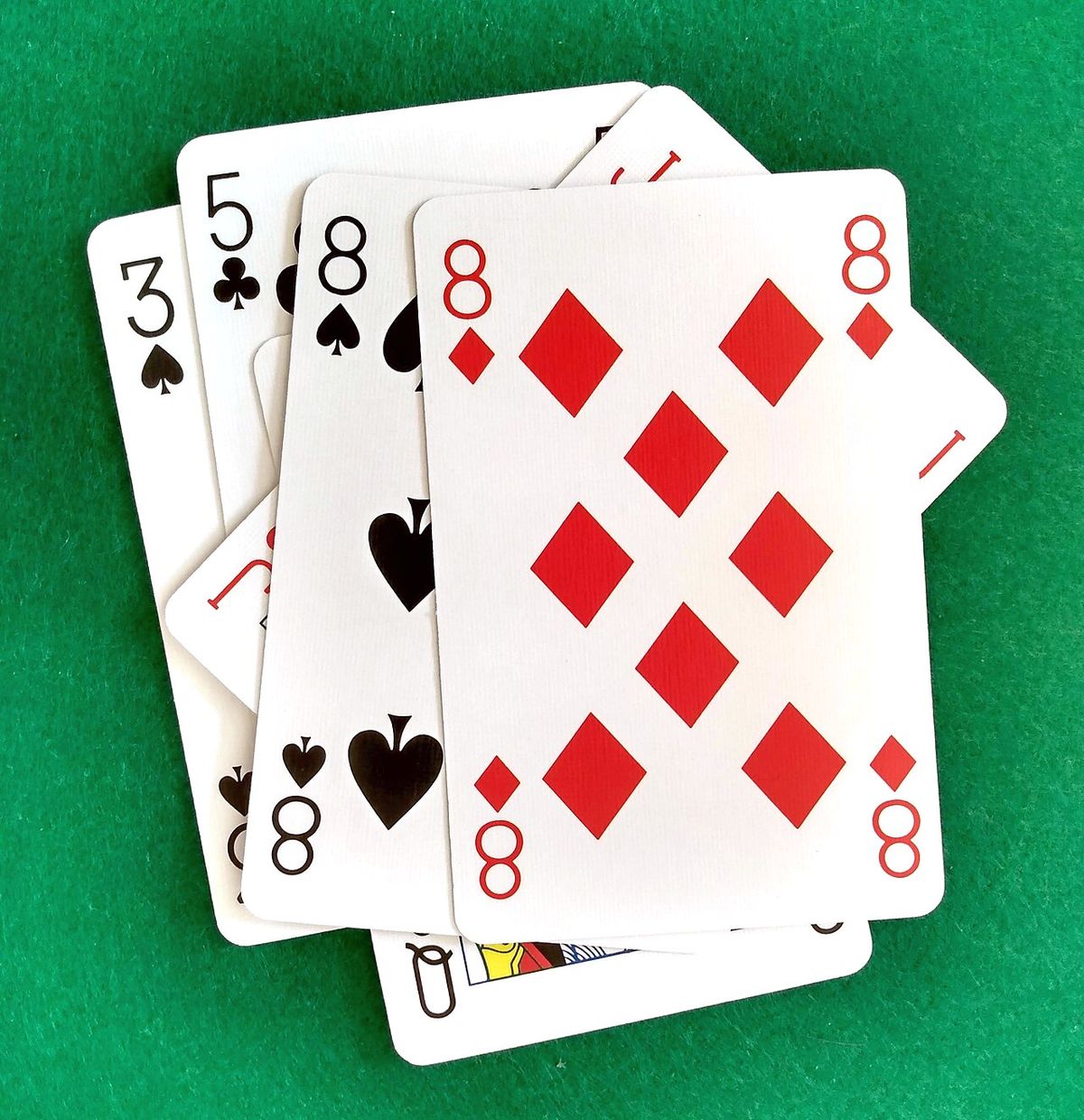
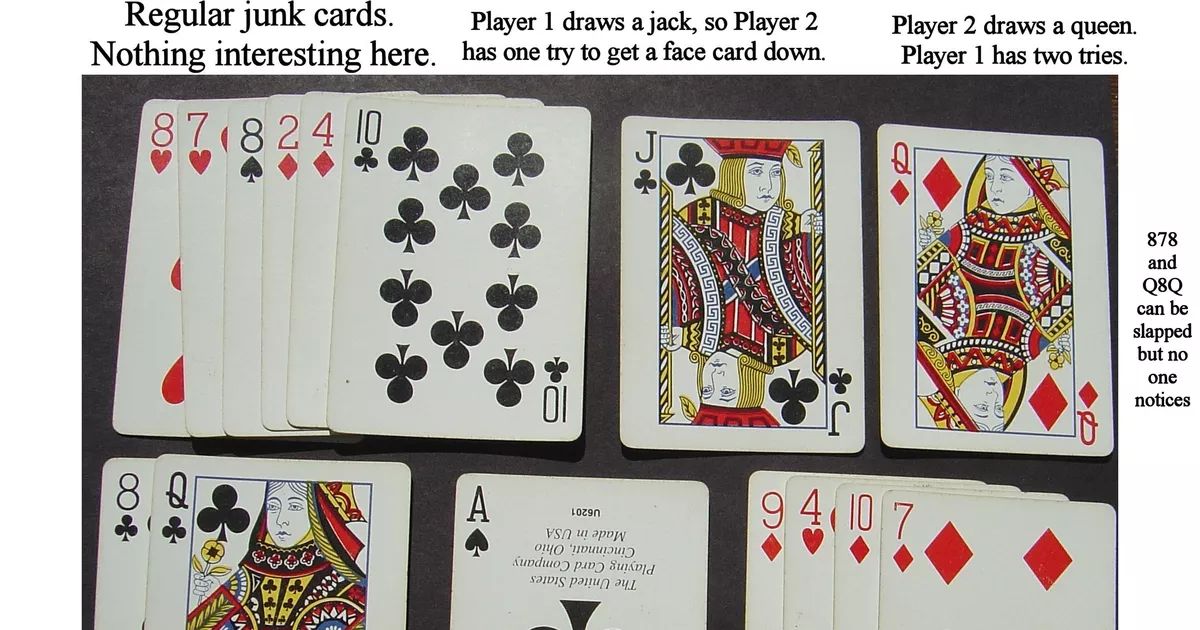
When a player lays down a Jack, Queen, King, or Ace, they become the challenger and the normal flow of play is suspended. The next player in sequence, known as the challenged player, is given a limited number of chances to play another face card or Ace to continue the challenge. The number of chances corresponds to the rank of the initial card: an Ace grants four chances, a King grants three, a Queen grants two, and a Jack grants only one chance. In some variations, this order is reversed for Kings and Jacks, so players must agree on the specific counts beforehand. The challenged player must flip cards from their pile one at a time onto the central pile. If they successfully play a qualifying face card or Ace within their allotted chances, the challenge passes to the next player, who must then respond to the new face card. If the challenged player exhausts their chances without playing a qualifying card, the original challenger wins the entire central pile. The winner of the pile places these cards face-down at the bottom of their personal deck, without shuffling, and then starts the next round by playing a new card to the centre. If a player runs out of cards while attempting to counter a face card, the next player may continue with the remaining chances, or the play ends and the pile is claimed by the challenger.
Slap Combinations and Rules
The defining and most chaotic element of Egyptian Ratscrew is the ability for any player to slap the central pile to claim it when certain card combinations appear. These slapping opportunities override the face card challenge rules entirely, and players must agree on which combinations are valid before the game begins. The first player to correctly slap a valid combination wins the pile, and if a tie occurs, the player whose hand is under all of the others or has the most contact with the cards typically wins. To prevent unfair play, hands must be entirely withdrawn from the pile area before a slap is attempted, and hovering one's hand too close is generally considered poor sportsmanship. The simplest and most common combination is the Double, but many others are widely recognized.
- Double: Two consecutive cards of equal rank (e.g., 7, 7).
- Sandwich: Two cards of equal rank with one card of a different rank between them (e.g., 5, 9, 5).
- Hoagie: A double with two cards of a different rank between the two.
- Four in a Row: Four or more consecutive cards in ascending or descending order (e.g., 7, 6, 5, 4 or 10, Jack, Queen, King).
- Flush: Three or more cards of the same suit.
- Tens: Two cards whose ranks add up to ten, with an Ace counting as one.
- Top Bottom: The card played matches the very first card played in the round.
- Ratscrew: A 6 and a 9.
- Marriage: A King and Queen played consecutively in either order.
- Divorce: A King and Queen with one card of a different rank between them.
- Joker: If Jokers are in play, slapping is usually allowed whenever one appears. Some rules differentiate between red and black Jokers.
Additional house rules can create combinations based on suit or colour. For example, a condition can be added for three or four cards of the same suit in a row. Another condition is when the card's position matches its value, like the second card played being a two. To maintain fairness, some groups implement optional rules known as Redneck Rules. These rules require players to bring their hands to their foreheads before slapping. Another optional rule penalizes slapping with the hand not used to play a card. For even more complexity, jokers can be differentiated with specific rules. For example, a red joker can be an instant slap, but a black joker might initiate a challenge with thirteen chances for the next player.
Penalties, Player Elimination, and Re-entry
Incorrectly slapping the pile when no valid combination is present incurs a penalty, which is a core mechanic for maintaining game balance. The standard penalty requires the offending player to take one or more cards from the top of their own deck and place them at the bottom of the central pile. If a player runs out of cards, they are eliminated from the game. However, eliminated players can 'slap in' by being the first to slap a valid combination, thereby claiming the pile and re-entering play as long as at least two other players still have cards. A player who slaps incorrectly after having no cards may receive strikes, and after three strikes they can lose slapping privileges for the remainder of the game. In another variation, offenders must 'burn their hands' by placing them at the bottom of the pile until it is awarded or another player slaps. If the final active player fails to counter a face card and exhausts their deck, the pile goes to the challenger, and that player must then play three more cards, offering eliminated opponents one last chance to slap back into the game. Other infractions, like playing a card out of turn, result in that card becoming a 'dead card' that does not create slapping opportunities and can lead to further penalties. An element of bluffing is introduced through contesting slaps. If a play is contested as illegal but is actually legal, the contesters must give their top card to the slapped player, whereas if the slap was indeed illegal, the contested player gives a card to each challenger. This rule discourages both incorrect slaps and frivolous contesting, helping to maintain the game's quick pace.
Advanced Strategies and Dominant Play
While Egyptian Ratscrew rewards reflexes, strategic considerations can significantly improve a player's odds of winning the entire deck. Memorizing cards that have already been played can help anticipate when a Sandwich or Double might appear, as a Double that is slapped early may later reappear as a Sandwich when the same rank cards are drawn again. Players often consider the composition of their deck, as a high concentration of face cards increases the likelihood of successfully issuing or countering a challenge, while an abundance of non-face 'filler' cards can dilute a deck's potency. A tactic known as 'risk slapping' involves slapping the card played immediately after any face card. This means slapping the first card after a Jack, the second after a Queen, the third after a King, and the fourth after an Ace, regardless of its value. The rationale is that the potential reward of winning the pile outweighs the consistent penalty for an incorrect slap. Players may also employ bluffing tactics, such as feigning a slap to induce opponents to slap incorrectly, or intentionally slapping wrong to discard undesirable cards from the top of their deck in preparation for a remembered face card. A counter-strategy to risk slapping involves quickly moving a card toward the pile without dropping it to provoke an incorrect slap from an opponent, which can be particularly effective if the next card is actually a face card.
Variations, History, and Cultural Presence
Egyptian Ratscrew has numerous regional and house rule variations that affect its pace, complexity, and even its name across different communities. The game closely resembles the 19th-century British card game Beggar-my-neighbour but incorporates the slapping mechanic likely borrowed from Slapjack. Its creation is attributed to modern American origins, with one source noting it was 'originally created at Interlochen Arts Academy, circa the mid nineties.' The number of chances granted for each face card can be reversed, with a Jack granting three chances and a King granting one. Some groups play with 'instant slap' cards beyond Jokers, or add slaps for conditions like three or four cards of the same suit in a row. The 'Ratscrew' combination, specifically a 6 and a 9, is a named but less common variant. The game's popularity in North America, including Canada, is often attributed to its spread in youth settings like summer camps and schools, and it is frequently played in casual social circles. The game has also transitioned to digital formats, with mobile app versions available that simulate the fast-paced slapping action. Despite its simple equipment requirements, the game sustains engagement through its unpredictable blend of luck, speed, and light strategy, ensuring its continued presence as a lively group activity.
Comparative Game Data and Rule Clarifications
The face card challenge sequence is a core structured mechanic of Egyptian Ratscrew. When a face card or Ace is played, that player becomes the challenger. The next player, who is challenged, is given a set number of chances to play another face card or Ace. The number of chances depends on the original card. For an Ace, the challenged player gets four chances. For a King, they get three chances. For a Queen, they get two chances. For a Jack, they get one chance. These rules are consistent across most standard interpretations of the game. However, in some variations, the chance counts for Kings and Jacks are sometimes swapped.
| Card Played (Challenger) | Standard Chances for Next Player | Alternative Chance Rule | Required Response |
|---|---|---|---|
| Ace | 4 chances | 4 chances | Must play an Ace or face card within 4 flips |
| King | 3 chances | 1 chance (variation) | Must play a King or face card/Ace within allotted flips |
| Queen | 2 chances | 2 chances | Must play a Queen or face card/Ace within 2 flips |
| Jack | 1 chance | 3 chances (variation) | Must play a Jack or face card/Ace on the very next flip |
Beyond the challenge rules, several other specific procedures and penalties are essential for smooth gameplay. Players are prohibited from viewing their cards, even when playing from their hand. Cards must be flipped away from the player to reveal the card to everyone at the same time. If a player slaps the pile without a valid combination, they must discard one or more cards to the bottom of the pile. Players who run out of cards are eliminated but can slap in on a valid combination to rejoin the game. It is crucial for players to confirm all rule variations before starting a game to avoid disputes.
- Cards must be flipped away from the player to reveal them to all participants simultaneously.
- Won piles are added face-down to the bottom of the winner's deck and are not shuffled in.
- A player slapping without a valid combination must add one or more cards to the bottom of the pile as a penalty.
- Cards played out of turn are considered 'dead cards' and do not create slapping opportunities.
- If a slap is contested, the outcome determines card transfers between the slapped player and the challengers.
- Victory is achieved only when a single player collects all the cards in play.
Questions about Egyptian Ratscrew
How many people can play Egyptian Ratscrew?
Egyptian Ratscrew can be played by two or more people, with the practical limit being how many players can physically reach the central card pile. The game scales easily by using multiple standard 52-card decks shuffled together for larger groups. There is no official maximum player count, making it suitable for lively parties or large gatherings where quick reactions are prized. The number of players is limited only by each participant's ability to reach the central pile to slap it effectively, and Jokers may be introduced to ensure an even deal.
What is the most important rule in Egyptian Ratscrew?
The most critical rule is that players must never look at their own cards or the cards in other players' hands. All cards are played blind from the top of each player's personal face-down pile. This rule ensures the game remains one of chance and reaction rather than deep calculation. The second most important rule is the slap mechanism, which allows any player to claim the pile by being the first to slap it when a pre-agreed combination appears, overriding even the face card challenge sequence.
What happens if you slap at the wrong time?
Slapping the pile when no valid combination is present results in a penalty. The standard penalty requires the player to take one or more cards from the top of their own deck and place them at the bottom of the central pile. This penalty adds cards to the pot, making it more valuable, but also depletes the slapper's resources. In some variations, players without cards who slap incorrectly receive strikes and may eventually lose the privilege to slap, or they must 'burn their hands' by placing them under the pile.
Can you get back in the game after losing all your cards?
Yes, player elimination is not always permanent in Egyptian Ratscrew. A player who has lost all their cards remains in the game and can 'slap in' by being the first to correctly slap a valid card combination on the central pile. Upon doing so, they claim the entire pile and re-enter play. This rule keeps all participants engaged until a single player finally collects every card, and it applies as long as there are at least two other active players still in the game with cards.
What is a 'risk slap' and is it a good strategy?
A risk slap is the tactic of slapping the card played immediately after any face card. This means slapping the first card after a Jack, the second after a Queen, the third after a King, and the fourth after an Ace, regardless of its value. This is often profitable as the potential reward of winning the pile outweighs the risk of burning a card. Players with a strong lead in cards may use this strategy, sacrificing one card in hopes of gaining the pile. A counter-strategy involves quickly moving a card towards the pile without dropping it to provoke a risk slap from an opponent.
Is Egyptian Ratscrew the same as Slapjack?
No, Egyptian Ratscrew and Slapjack are distinct games. While both involve slapping a central pile, Slapjack is simpler, with players only slapping when a Jack appears. Egyptian Ratscrew incorporates the complex face card challenge rules and a wider variety of slappable combinations like Doubles, Sandwiches, and Tens. ERS is considered a more advanced and strategic evolution of the basic slapping card game concept, with deeper gameplay stemming from its challenge mechanics and greater variety of slappable conditions.
Sources and further reading
- Egyptian Ratscrew (Wikipedia)
- Egyptian Rat Screw (bicyclecards.com)
- Dominant Strategies in Egyptian Ratscrew, Cornell Blogs Service (blogs.cornell.edu)
- Egyptian Rat Screw (bicyclecards.com)
Checked by the Nosy Mag desk. Last updated 2026-11-10.