Trans Mountain pipeline
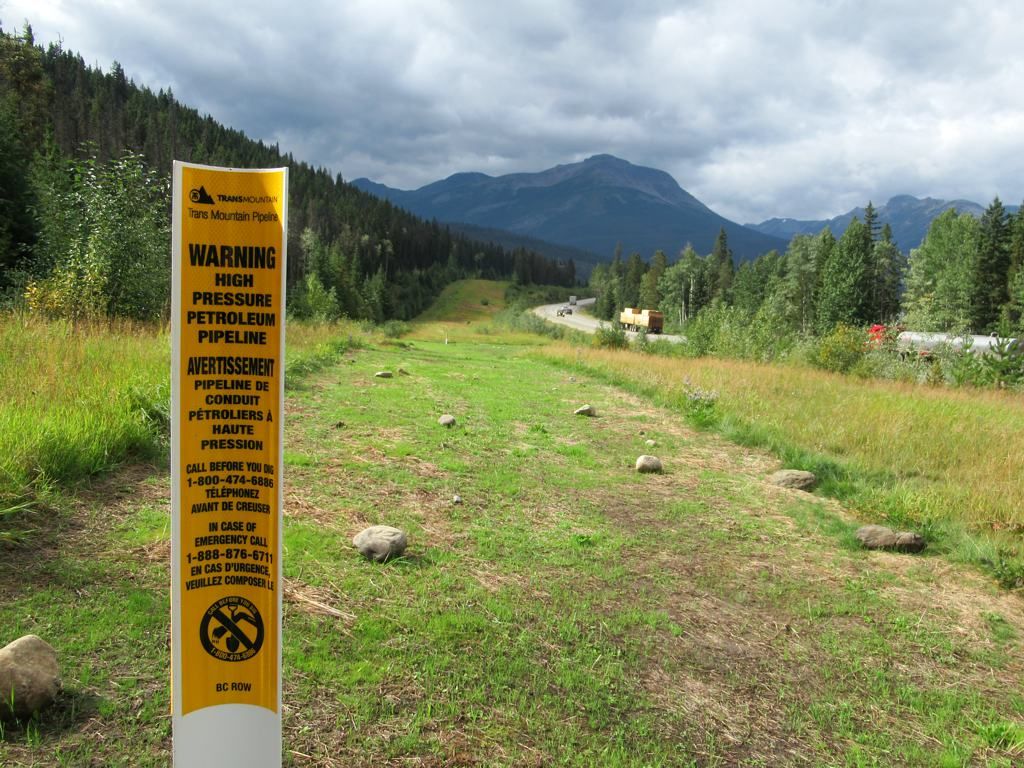
The Trans Mountain Pipeline System is a federally owned, multiple-product pipeline transporting crude oil and refined petroleum products from Edmonton, Alberta, to the coast of British Columbia. The corporation was created in 1951, construction began in 1952, and operations commenced in 1953. The project has been one of Canada's most contentious energy infrastructure developments, facing sustained opposition from environmental groups and some First Nations over spill risks and inadequate consultation, while receiving support from others for its economic benefits. A central and evolving aspect of the project is Indigenous economic participation, with the federal government offering a collective ownership stake to First Nations along the route. The expansion project, which began operations on May 1, 2024, increased the system's capacity from 300,000 to 890,000 barrels per day.
Origins and Early Operations
The discovery of major oil deposits at Leduc, Alberta in 1947 spurred the vision for a pipeline to the Pacific coast, driven by growing demand in Asia and on the west coasts of Canada and the United States. The Trans Mountain Pipeline Company was created by a special act of Parliament on 21 March 1951, with its proposal immediately submitted and approved by the Board of Transport Commissioners. Construction began in February 1952. The 1,150-kilometre pipeline was built rapidly by Canadian Bechtel Ltd., partly due to strategic defence concerns related to the Korean War. The final weld was completed near Aldergrove, British Columbia on 17 October 1952. The first crude oil began flowing from Edmonton to Vancouver-area refineries and the northwestern United States in August 1953 at a total cost of $93 million, as stated by BC Premier W. A. C. Bennett at the opening ceremony. For its first three decades, the pipeline carried only crude oil to supply refineries in Vancouver and the state of Washington. It remains the only pipeline running between Alberta and the BC coast. Ownership of the original company was split between Canadian Bechtel Ltd. and Standard Oil.
Technical Evolution to a Multi-Product System
Beginning in 1983, Trans Mountain began experiments to shift from a single-product to a multiple-product pipeline to increase efficiency. By 1985, TMPL regularly carried refined products 820 kilometres from Edmonton to Kamloops. This service extended all the way to Vancouver by 1993. A 1993 report noted it was the only major system in the world simultaneously transporting both crude oil and refined petroleum products in a single pipeline. By 1998, regular shipments to Vancouver included jet fuel, gasoline (unleaded and premium unleaded), diesel (regular sulphur, low sulphur, and low temperature), methyl tertiary butyl ether (MTBE), and crude oil (light sweet, light sour, and heavy). In 2004, Kinder Morgan added a second pipeline running parallel to the first between Hinton, Alberta, and Hargreaves, British Columbia. This required building two new pumping stations: the Wolf Pump Station near Niton Junction, Alberta, and the Chappel Pump Station near Pyramid Creek Falls Provincial Park, British Columbia. Capacity was increased by 40,000 barrels per day, from 260,000 to 300,000 barrels per day.
Impact on Refineries and Spill History
The pipeline's capacity to carry refined products contributed to changes in the refinery landscape. Shell, Petro-Canada, and Imperial closed refineries in British Columbia in the 1990s and expanded their operations in the Edmonton area. This resulted in the conversion of existing refineries along the TMPL route into storage and distribution facilities. The Kamloops Royalite Refinery shut down in 1983. Shell's refinery in North Burnaby and Petro-Canada's in Port Moody closed in 1993. Imperial Oil closed its Port Moody refinery in 1995. After the expansion opened in 2024, oil refineries complained about poor oil quality. The pipeline has a history of spills. As of 2017, it had reported approximately 84 spills to the National Energy Board since 1961. A majority occurred at contained zones like pumping stations and were below the mandatory reporting threshold of 1.5 cubic metres. Significant incidents include a 2005 rupture in Abbotsford that dumped 210 cubic metres of crude oil. A 2007 contractor error in Burnaby caused a spill of 224 to 234 cubic metres, with some oil flowing into Burrard Inlet. A 2009 incident at the Burnaby Terminal released 305 cubic metres from a tank. A 2012 leak in Sumas released 90 cubic metres. A 2020 leak in Sumas released 190 cubic metres of light crude from a small pipe connected to the mainline.
The Expansion Project: Proposal and Escalating Costs
Kinder Morgan filed an application for the Trans Mountain Expansion Project (TMX) with the National Energy Board on 18 June 2013 to build a second pipeline to transport diluted bitumen. The project proposed 980 kilometres of new pipe, increasing system capacity from 300,000 to 890,000 barrels per day and requiring 12 new pumping stations. The initial 2013 cost estimate was $6.8 billion. The company had support from several large petroleum industry customers including BP Canada, Canadian Natural Resources, Cenovus, Imperial Oil, Suncor, and Total. The federal cabinet approved the project in November 2016 subject to 157 binding conditions. BC Premier Christy Clark announced provincial support in January 2017 after a revenue-sharing agreement worth up to $1 billion. In 2018, facing legal uncertainty, Kinder Morgan suspended non-essential work. The federal government announced on 29 May 2018 that it would purchase the pipeline and expansion project for $4.5 billion. The purchase was finalized on 31 August 2018 for $4.7 billion, transferring the asset to the Crown corporation Trans Mountain Corporation. Project costs ballooned repeatedly.
- February 2020: Cost estimate rose to $12.6 billion due to rising costs of labour, steel, and land.
- February 2022: Costs increased by 70% to $21.4 billion. Finance Minister Chrystia Freeland stated this funding was not part of the federal COVID-19 commitment.
- March 2023: Announced cost increased to $30.9 billion.
- May 2024: Final project cost reported at $34 billion upon commencement of operations.
The project was 98% complete as of 23 January 2024. By January 2023, more than 700 kilometres of pipe was in place. Construction reached the halfway mark by April 2022. The expanded pipeline began operations on 1 May 2024, nearly tripling oil pipeline capacity from Alberta to the Pacific coast.
Legal, Political, and Interprovincial Controversy
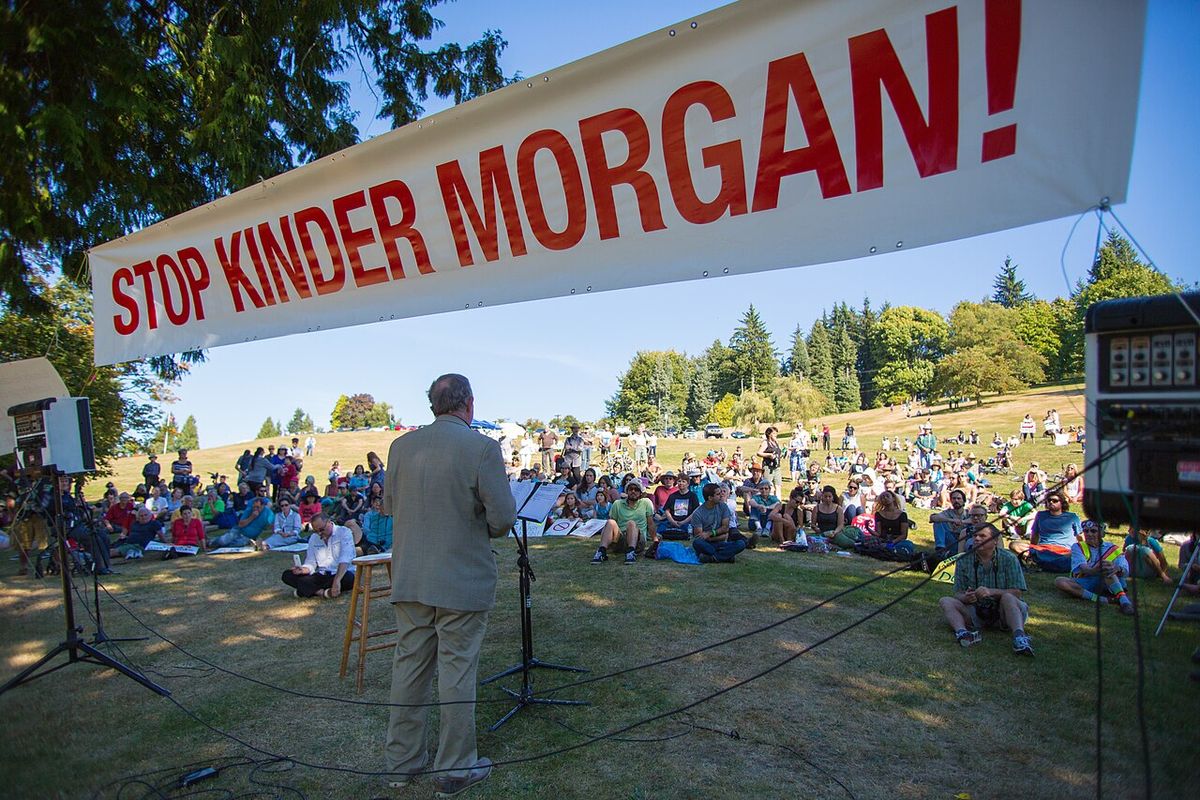
The expansion faced intense opposition from environmental groups, municipalities, and several First Nations, primarily over increased tanker traffic and spill risks in the Salish Sea. Environmental group Stand.earth warned the expansion would obstruct 30% of Burrard Inlet and cause a seven-fold increase in tanker traffic. Proponents argued it created jobs and was safer than rail transport. A 2014 Simon Fraser University study claimed Kinder Morgan overestimated the economic benefits. From 2008 through 2018, Western Canadian Select sold at an average discount of US$17 against West Texas Intermediate. A major legal setback occurred on 30 August 2018 when the Federal Court of Appeal overturned the project's approval, citing inadequate consultation with First Nations and a lack of environmental assessment for increased tanker traffic's impact on orcas. Prime Minister Justin Trudeau reaffirmed federal commitment. Alberta Premier Rachel Notley announced Alberta would pull out of the national carbon price. The federal government recommenced Phase III consultations, overseen by Justice Frank Iacobucci. The National Energy Board held hearings with 117 Indigenous groups in late 2018. On 2 July 2020, the Supreme Court of Canada declined to hear appeals, ending the legal challenge. The project also sparked a trade dispute. In January 2018, B.C. proposed restrictions on increased bitumen imports. Alberta Premier Rachel Notley retaliated with a ban on B.C. wine imports from 6 to 22 February 2018 and introduced the Preserving Canada's Economic Prosperity Act. B.C. Attorney General David Eby threatened a lawsuit over the act's constitutionality.
Protests and Secwépemc Opposition
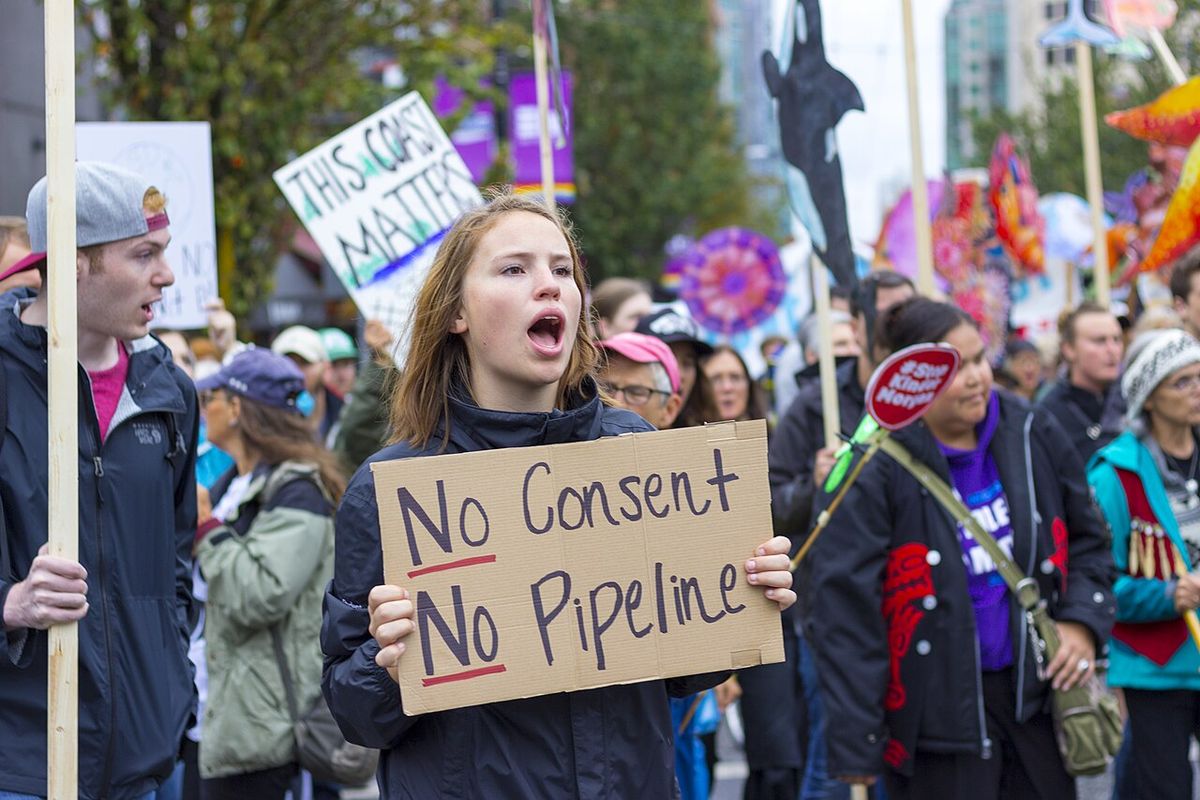
The expansion project faced sustained protests. In November 2014, over 100 opponents were arrested camping on Burnaby Mountain to block construction. Members of the Squamish and Tsleil-Waututh Nations paddled canoes to Kinder Morgan's Burnaby Terminal in protest. In July 2018 activists blocked an oil tanker from the Ironworkers' Memorial Bridge in Vancouver. The RCMP contained protests on Burnaby Mountain and dismantled a treetop camp in the Brunette River Conservation Area in September 2021. Significant opposition came from the Secwépemc people, whose territory the expansion crosses for 518 kilometres. Beginning in 2013, Secwépemc community members defended their traditional land, Secwepemcul’ecw, asserting approval was granted without sufficient consultation. They were concerned about damage to land and water, disruption of salmon, and violation of traditional Secwépemc law. In July 2018, a Secwépemc protest camp known as the Tiny House Warriors was established near Blue River, British Columbia. This led Chiefs Rosanne Casimir of Tk’emlúps te Secwépemc and Shelly Loring of Simpcw First Nation to issue a joint statement asking the Warriors to stand down. In early September 2020, protester Loralie Dick chained herself to a TMX worksite in Kamloops before being arrested. In October 2020, a protest camp was set up along the Thompson River, leading to RCMP arrests after the Secwépemc delivered a cease and desist notice to TMX.
Indigenous Engagement, Opposition, and the 2026 Equity Offer
Indigenous consultation has been a central issue. The federal government committed to exploring economic participation with the 129 Indigenous communities potentially affected. Key opposing nations included the Tsleil-Waututh, Squamish, Kwantlen, and Coldwater First Nations, who filed Federal Court challenges. The Tsleil-Waututh Nation's assessment found a 79-87% likelihood of a spill in Burrard Inlet over 50 years. In 2026, the government formalized an offer for a collective equity stake in the Trans Mountain system. The offer includes a government-provided, low-cost loan, a $2.5 million payment to each participating group for lost prior revenue, up to $100,000 per group for participation costs, and covered independent advisory fees. The government planned in-person meetings in late October 2026 to share details. The offer has received mixed reactions. Stephen Buffalo, CEO of the Indian Resource Council, called the stake insulting. Dale Swampy of the National Coalition of Chiefs supported the concept but questioned the payment size. The Union of British Columbia Indian Chiefs, under President Stewart Phillip, expressed being shocked and appalled at Canada's investment. Other Indigenous groups, including the Kehewin Cree Nation, T'Sou-ke Nation, and Frog Lake First Nation, formed the Western Indigenous Pipeline Group (WIPG) and have sanctioned the project for ownership stakes.
Spectrum of Indigenous Support and Economic Agreements
Indigenous perspectives on the pipeline expansion are diverse and not monolithic. Proponents cite support or non-opposition from 120 of the 129 Indigenous groups potentially affected. By 2026, 59 benefit agreements had been signed with Indigenous groups in British Columbia (45) and Alberta (14). These represent over $500 million in benefits and opportunities. Since 2021, Indigenous communities have acquired ownership interests in over 5,000 kilometres of operating pipelines across Canada, a number expected to grow. These investments are often structured through consortia or limited partnerships, allowing multiple nations to share risks and benefits while respecting each nation's independence. This growing ownership creates economic opportunities and gives communities a greater voice and access to project-related information within their territories. This contrasts with the outright opposition from nations who view the project as a violation of their rights and title. This stance was supported by the UN Committee on the Elimination of Racial Discrimination which called on Canada to suspend the project in December 2019. Indigenous ownership in energy infrastructure typically involves lower-risk investments in operating assets that generate steady revenue, often facilitated by government loan guarantees. Involvement in projects like Cedar LNG often occurs during the development phase, reflecting different investment strategies across the energy sector.
Operational Challenges and Future Implications
With the expansion operational since May 2024, the Trans Mountain system now delivers 890,000 barrels per day. Oil refineries have complained about poor oil quality. The project faced challenges during construction including the COVID-19 pandemic, slumping oil demand, and protests. By 2020, three insurance companies including Zurich Insurance Group had withdrawn their support, though the company stated it still had adequate coverage. The pipeline's future ownership structure remains in flux as the federal government seeks Indigenous partners. The stake is intended to be held collectively through a special-purpose vehicle giving participants governance rights and a share of cash flow. The government does not intend to be the permanent owner and initially sought outside investors who would be indemnified for delays, but could not find a buyer. The project's legacy is intertwined with climate policy, Indigenous sovereignty, and Canada's energy export strategy. It has set precedents for federal intervention and for models of Indigenous economic participation. The ongoing negotiations over the stake will be a critical test of the government's economic reconciliation agenda. The corporation's status changed to a non-agent Crown corporation on 29 April 2022, allowing it to access financing from third-party lenders. The federal government's 2019 re-approval stated the project was in the national interest, adding tens of billions in government revenue and sustaining thousands of jobs, while acknowledging potential environmental damage.
Questions about Trans Mountain pipeline
When did the Trans Mountain expansion start operating?
The Trans Mountain Expansion Project officially began commercial operations on 1 May 2024. The project was first proposed in 2013. It was declared 98 per cent complete in January 2024. The final step of line fill occurred in early 2024 before the system became operational.
How much did the Trans Mountain expansion cost?
The final cost was C$34 billion, a massive escalation from the original 2013 estimate of $6.8 billion. Major cost revisions were in February 2020 ($12.6 billion), February 2022 ($21.4 billion), and March 2023 ($30.9 billion). The February 2022 increase of 70% was not part of federal COVID-19 funding. The total includes the $4.7 billion purchase price from Kinder Morgan.
What is the Indigenous equity offer for Trans Mountain?
In 2026, the federal government offered Indigenous groups a collective equity stake. The offer includes a low-cost government loan, a $2.5 million payment per group for lost revenue, and up to $100,000 for participation costs. The government consulted 129 potentially affected First Nations. Finance documents in 2024 indicated plans to provide access to capital for this stake.
Who owns the Trans Mountain pipeline?
The Trans Mountain Corporation, a Crown corporation and subsidiary of the Canada Development Investment Corporation, owns the pipeline. The Government of Canada purchased it for $4.7 billion from Kinder Morgan on August 31, 2018. The federal government has offered Indigenous groups a collective ownership stake. The purchase was made through the creation of the Trans Mountain Corporation to keep the expansion project alive.
Why is the Trans Mountain pipeline controversial?
The expansion was controversial due to environmental impact and legal challenges. Opposition cited inadequate consultation with First Nations and heightened spill risk from increased tanker traffic. The Federal Court of Appeal overturned approval in 2018. Critics argued the federal government's purchase was a taxpayer-funded bailout. The project also sparked an interprovincial trade dispute between Alberta and British Columbia.
How has Indigenous ownership in energy infrastructure grown in Canada?
Indigenous communities are increasingly becoming owners. Since 2021, they have acquired interests in over 5,000 kilometres of operating pipelines. Investments are often through consortia allowing multiple nations to share risks. The Trans Mountain offer is part of this trend. Other examples include the Western Indigenous Pipeline Group formed by several First Nations to seek ownership stakes in TMX.
Sources and further reading
- Trans Mountain pipeline (Wikipedia)
- Feds open up Trans Mountain equity stake to Indigenous ... (cbc.ca)
- Growing Indigenous ownership in Canadian pipelines and ... (cer-rec.gc.ca)
- The First Nations' movement against the Trans Mountain ... (waconservationaction.org)
- 15+ Quotes: Indigenous Support for Trans Mountain ... (canadaaction.ca)
Checked by the Nosy Mag desk. Last updated 2026-10-24.