Haida language
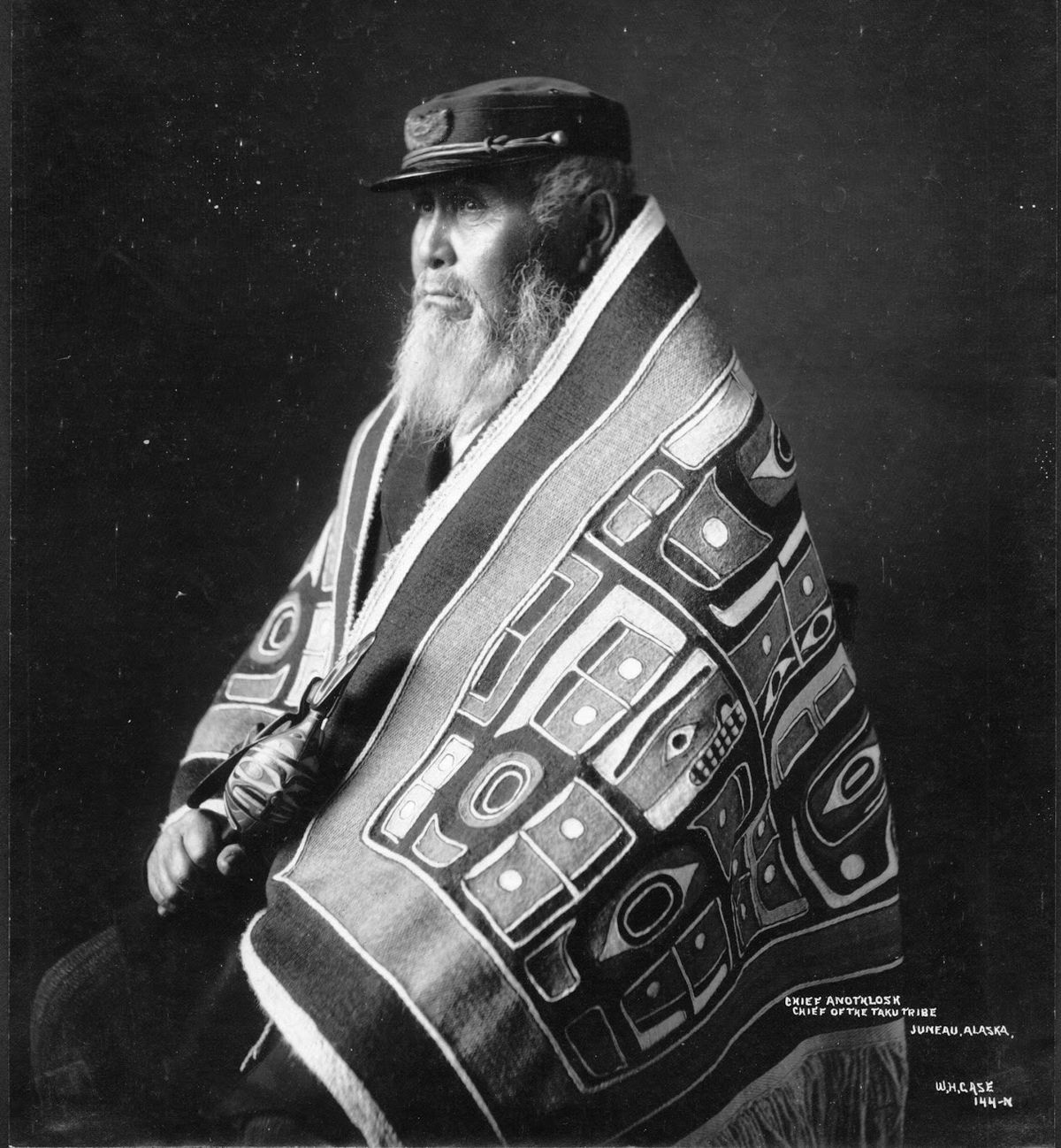
The Haida language, known to its speakers as X̱aat Kíl, X̱aadas Kíl, or Xaad kil, is the critically endangered language of the Haida Nation, an Indigenous people whose traditional territory encompasses Haida Gwaii in British Columbia and parts of southern Alaska. With only 24 remaining native speakers, the language is a central focus of cultural revitalization efforts for the Haida people, who numbered approximately 4,260 individuals claiming Haida ancestry in the 2021 Canadian census. Historically, the language was spoken by an estimated 15,000 people prior to European contact, but epidemics and colonial policies, including residential schools, led to a severe decline. The language is recognized for its linguistic complexity, including ejective consonants and phonemic tone, and its status as a language isolate, meaning it has no proven genetic relationship to any other language family.
Historical Context and Decline
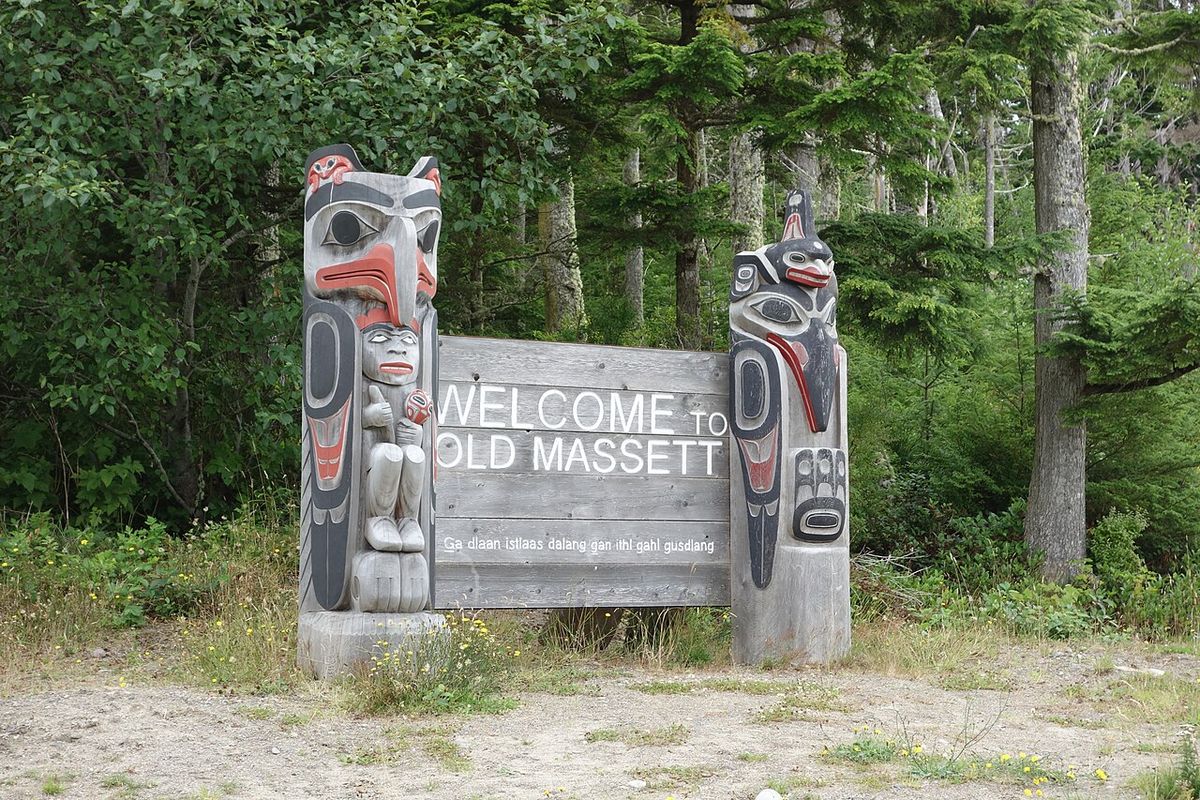
The first documented European contact with the Haida people occurred in 1772 with Spanish explorer Juan Pérez. Prior to this contact, the Haida population is estimated to have been around 15,000 people living in numerous villages across Haida Gwaii, Dall Island, and Prince of Wales Island. The arrival of Europeans triggered a demographic catastrophe, primarily through introduced diseases. A smallpox epidemic soon after initial contact reduced the population to about 10,000, and a more devastating epidemic in 1862 caused it to plummet to 1,658. Venereal disease and tuberculosis further reduced the Haida population to 588 people by 1915. This dramatic decline forced the consolidation of the Haida population into three primary villages: Masset (merged 1876), Skidegate (merged 1879) on Haida Gwaii, and Hydaburg (merged 1911) in Alaska.
In the 1830s, a pidgin known as Haida Jargon was used in the islands by speakers of English, Haida, Coast Tsimshian, and Heiltsuk. Later, during the Fraser Canyon Gold Rush and the subsequent boom in Victoria, Southern Haida traveling to the city often used Chinook Jargon for trade. Negative attitudes towards the language began to spread among Haida communities themselves, influenced by the model community of Metlakatla and a growing belief that abandoning tradition would lead to a better life. By the turn of the 20th century, the Canadian and American governments began forcibly removing Haida children to attend residential schools. These institutions strictly enforced a ban on speaking Indigenous languages, playing a major role in the decimation of Haida and other Northwest Coast languages. The practice of families using English at home to prepare children for school became widespread in Skidegate and later in Masset during the 1930s, leading to a generation where few children were raised with Haida as a primary language.
Current Status and Revitalization
The Haida language is listed as critically endangered by UNESCO, with nearly all of its two dozen fluent speakers being elderly. As of 2003, most speakers were between 70 and 80 years old and often used a simplified form of the language. Comprehension is largely limited to individuals over the age of 50, and the language is rarely used in daily communication even among those who retain knowledge. The 2021 Canadian census reported that 220 people claimed knowledge of the Haida language, though this figure does not distinguish between fluency and basic understanding. The Council of the Haida Nation recognizes that there are fewer than a dozen fluent speakers of the Northern dialect, X̱aad Kíl, and that approximately half of all fluent speakers of the Southern dialect, X̱aayda Kil, are Elders.
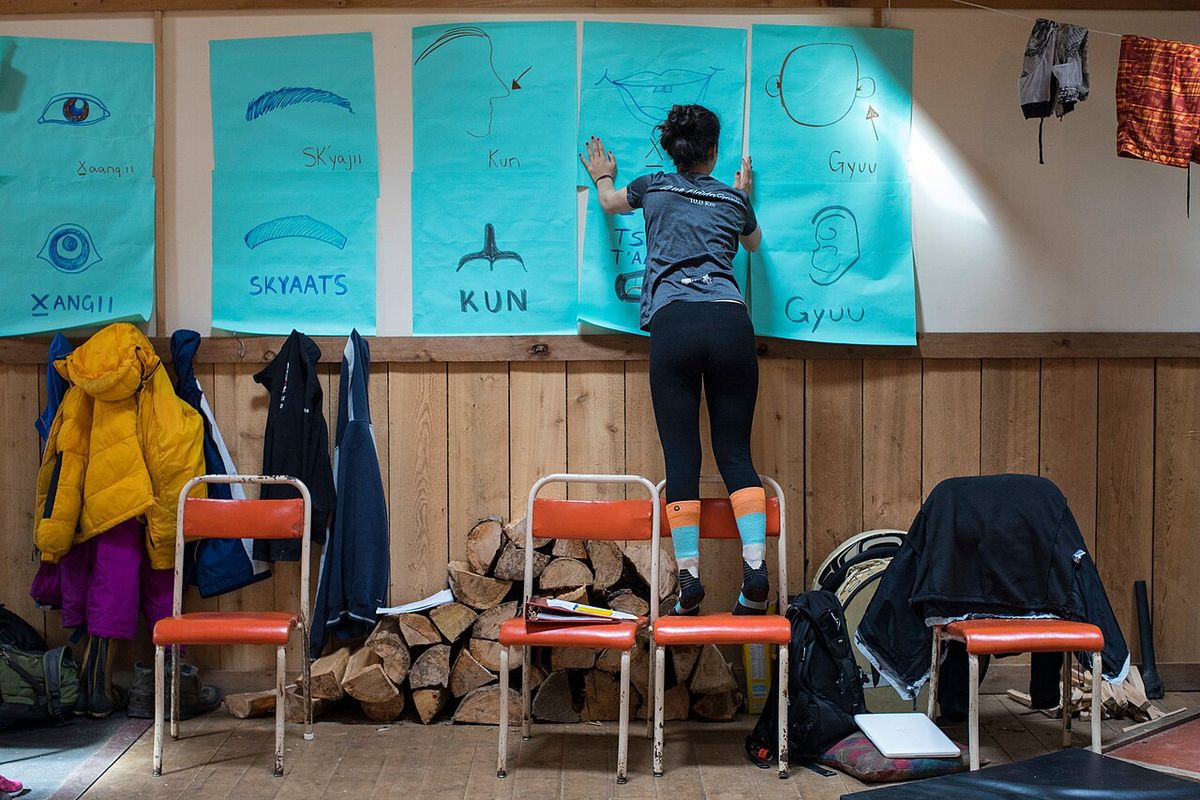
Despite this dire situation, significant revitalization efforts are underway, driven by a renewed cultural pride within the Haida Nation. Language programs are funded in schools across the three Haida communities, and classes are available at the University of Alaska Southeast in Juneau, Ketchikan, and Hydaburg. Key initiatives dedicated to language preservation include:
- The X̱aad Kíl Née Language Office and the Skidegate Haida Immersion Program (SHIP), which develop learning resources and immersion experiences.
- A Skidegate Haida language app for iPhone, built from a bilingual dictionary and phrase archive hosted on the FirstVoices.com database.
- Haida Rediscovery camps, such as the T'aalan Stl'ang program supported for 2026, which aim to foster the next generation of land and language caretakers.
- The creation of the first feature film acted entirely in Haida, SGaawaay K’uuna (Edge of the Knife), which premiered at the Toronto International Film Festival in 2018 and required actors to be trained in pronunciation.
Linguistic Classification and Dialects
The genetic classification of Haida has been a subject of longstanding controversy among linguists. In 1915, Edward Sapir included it in the proposed Na-Dené language family, a hypothesis first suggested by Franz Boas in 1894. This classification links Haida to languages like Tlingit and the Athabaskan languages. Other linguists argue that Haida is a language isolate, with any perceived similarities to Na-Dené languages being the result of ancient loanwords or errors in early data collection. The more recent and contentious Dene-Yeniseian hypothesis, which proposes a link between Na-Dené and languages in Siberia, typically treats Haida as separate. Today, many linguistic authorities consider Haida to be an isolate, though the debate is not fully settled.
Haida has a major dialectal split between Northern and Southern varieties. The Northern Haida dialects are Masset (or North Graham Island) Haida and Alaskan (or Kaigani) Haida, spoken in Hydaburg and on Prince of Wales Island. The Southern dialect is Skidegate Haida. A sub-dialect, Ninstints Haida, is now extinct and poorly documented. The dialects are grammatically very similar but differ in phonology and some vocabulary. A notable feature of Northern Haida is the development of pharyngeal consonants, rare sounds also found in some neighbouring Salishan and Wakashan languages. These are believed to be a relatively recent areal development rather than an inherited trait.
Phonology and Sound System
The Haida sound system is complex and includes several typologically distinctive features. It has a series of ejective consonants (like k’, t’), glottalized sonorants, and contrastive vowel length, meaning vowel duration can change a word's meaning. All dialects also feature phonemic tone, though its nature varies. In the Canadian dialects (Skidegate and Masset), tone has a relatively low functional load, with pitch often predictable by syllable structure. In Alaskan Haida, the system operates more like a pitch accent, where typically one high-tone syllable occurs per word. Syllabic laterals appear in all dialects but are only phonemic in Skidegate Haida.
Northern Haida dialects are distinguished by their pharyngeal consonants, which developed from historical uvular fricatives. In Northern Haida, the consonants /χ ɢ̥/ historically developed into the pharyngeal consonants /ħ ʕ/. The actual realization of these pharyngeal consonants varies with dialect. In Masset Haida they are pharyngeal fricatives, [ħ, ʕ]. In the variety of Alaskan Haida spoken in Hydaburg they have been described as an epiglottal trill [ʜ] and a trilled epiglottal affricate [ʡʢ] or an epiglottal stop [ʡ]. Pharyngeal consonants are an areal feature of some languages in a small portion of Northwest America, found in the Salishan and Wakashan languages as well as Haida.
| Consonant Type | Labial | Alveolar | Post-alveolar | Velar | Uvular | Glottal |
|---|---|---|---|---|---|---|
| Stops (plain) | p | t | k | q | ʔ | |
| Stops (aspirated) | pʰ | tʰ | kʰ | qʰ | ||
| Stops (ejective) | pʼ | tʼ | kʼ | qʼ | ||
| Affricates | t͡s | t͡ʃ | ||||
| Fricatives | s | ʃ | x | χ | h | |
| Nasals | m | n | ŋ |
The vowel system of Haida typically includes the vowels /i/, /e/, /a/, /o/, /u/, and a schwa (/ə/), all of which have contrasting long and short versions. Phonotactic rules govern syllable structure, which can include complex consonant clusters at the beginning of a syllable. The vowels /ɯ/, /ɜ/, /æ/, and a short /o/ occur specifically in nonsense syllables within traditional Haida songs. This indicates a specialized linguistic domain reserved for artistic expression in the language's musical traditions.
Grammar and Structure
Haida grammar presents several features that differ markedly from Indo-European languages like English. While nouns and verbs are clear word classes, adjectives form a subclass of verbs. For example, the concept 'good' is expressed by the verb 'láa, meaning 'to be good'. The language has very few prepositions. Instead, spatial relationships are expressed using relational nouns, akin to saying 'the box's top' instead of 'on the box'. Haida verbs are richly inflected for tense, aspect, mood, and evidentiality (indicating the source of the speaker's information). Person is not marked directly on the verb but by pronouns that cliticize, or attach, to it.
Two particularly notable grammatical features are its classifiers and its alignment system. Haida employs hundreds of classifiers, which are morphemes that categorize nouns based on shape, animacy, or other properties and are used with numerals and demonstratives. Haida uses a rare direct-inverse verbal alignment system. Instead of using cases like nominative or accusative to mark subject and object, verb forms change depending on a hierarchy between persons and noun classes. If the subject outranks the object on this hierarchy, a direct form is used. If the object outranks the subject, an inverse form is used. Haida also exhibits obligatory possession for certain types of nouns, meaning they cannot stand alone and must always appear with a possessor, similar to words like 'hand' in phrases like 'my hand'.
Morphology in Haida is predominantly suffixing. Prefixation is limited and is primarily used to form complex verbs by combining a nominal classifier or an instrumental prefix with a bound root. For instance, different prefixes can be added to a root meaning 'pick up' to specify whether one is picking up a stick-like object or several small objects with tongs. This structure allows for precise and nuanced verb creation tied closely to the physical world.

Writing Systems and Orthography
Several orthographies, all based on the Latin alphabet, have been developed for writing Haida, reflecting its dialects and the history of documentation. The Haida Gospel of Matthew was published in 1891, followed by Luke and John in 1899, and the book of Acts in the 1890s. John Henry Keen also used this system for his translation of the Book of Common Prayer in 1899. Modern orthographies have since been developed to better represent the language's sounds. Linguist John Enrico created a system for Skidegate and Masset Haida that uses symbols like ⟨7⟩ for the glottal stop and ⟨@⟩ for certain instances of the vowel /a/, and it does not use capital letters. For Alaskan (Kaigani) Haida, the Alaska Native Language Center (ANLC) devised an orthography in 1972 based on conventions used for Tlingit, and it was updated in 2010 by Jordan Lachler. Author Robert Bringhurst developed a minimalist orthography for his publications on Haida literature, using few punctuation marks. The Skidegate Haida Immersion Program (SHIP) created another orthography that is now commonly used in the Skidegate community.
These systems represent Haida's unique sounds in different ways. For example, the uvular stop /q/ is written as ⟨q⟩ in the ANLC system, ⟨r⟩ in Enrico's Skidegate orthography, and ⟨ǥ⟩ in the SHIP system. The pharyngeal consonants of Northern Haida are written with special symbols like ⟨ħ⟩ and ⟨ʕ⟩ in linguistic notation. The variation in writing systems, while a challenge for standardization, also reflects the active and community-driven efforts to document and revitalize the language.
The Haida Nation and Political Context
The Haida language is inextricably linked to the Haida Nation, its people, and their territory. The Council of the Haida Nation (CHN) states its purpose as stewarding the lands and waters of Haida Territories and perpetuating Haida culture and language. The Haida have inhabited Haida Gwaii since time immemorial, with archaeological evidence confirming habitation for at least 6,000 to 8,000 years. Their society is traditionally organized into two matrilineal moieties, Eagle and Raven, with complex systems of crests displayed on totem poles, canoes, and other artworks. Potlatches were central to social, economic, and political life, reinforcing relationships and the management of lineage property, which included rights to salmon streams, cedar stands, and stretches of coastline.
The journey toward reconciliation and recognition of Haida sovereignty has been a long one. Building on earlier agreements, the Haida Nation and the Province of British Columbia signed the landmark Gaayhllxid • Gíihlagalgang “Rising Tide” Haida Title Lands Agreement in April 2024. This led to the introduction of the Haida Nation Recognition Amendment Act, 2024, the first legislation in Canadian history to recognize Aboriginal title. The act, supported by 95% of Haida citizens in a special assembly, recognizes Haida title throughout Haida Gwaii while protecting private property rights and existing public services. It establishes a framework for a staged transition to Haida jurisdiction, guided by the principle of yahguudang (respect).
Questions about Haida language
What are the main dialects of Haida?
Haida has a major division between Northern and Southern dialects. The Northern Haida dialects are Masset Haida (spoken on the north part of Graham Island in Haida Gwaii) and Alaskan or Kaigani Haida (spoken in Hydaburg and on Prince of Wales Island in Alaska). The Southern dialect is Skidegate Haida, spoken on the south-east coast of Haida Gwaii. A sub-dialect called Ninstints Haida is now extinct. These dialects are grammatically very similar but differ in their sound systems, particularly in phonology. Northern Haida is notable for having developed pharyngeal consonants, which are rare sounds not found in the Southern variety.
Is the Haida language related to any other languages?
The classification of Haida is a matter of ongoing debate among linguists. Some, following a hypothesis proposed by Edward Sapir in 1915, place it in the Na-Dené language family, which includes Tlingit and the Athabaskan languages. Others argue that Haida is a language isolate, meaning it has no proven genetic relationship to any other language family, and that similarities to Na-Dené are due to ancient contact and loanwords. The more recent Dene-Yeniseian proposal, which links Na-Dené to languages in Siberia, typically treats Haida as separate. Currently, many linguistic authorities consider it an isolate, though research continues.
What is being done to revitalize the Haida language?
Multiple community-driven initiatives are working to revitalize the Haida language. These include the X̱aad Kíl Née Language Office and the Skidegate Haida Immersion Program (SHIP), which develop resources and offer immersion learning. Haida language classes are available in community schools and at the University of Alaska Southeast in Juneau, Ketchikan, and Hydaburg. A Skidegate Haida language app is available for iPhone, drawing from the FirstVoices.com archive. Cultural programs like Haida Rediscovery camps integrate language learning with land stewardship. A significant cultural milestone was the 2018 feature film SGaawaay K’uuna (Edge of the Knife), the first film acted entirely in Haida, which helped raise the language's profile.
What was the impact of residential schools on the Haida language?
Residential schools played a devastating role in the decline of the Haida language. Beginning at the turn of the 20th century, Haida children were sent to these institutions, which strictly enforced a ban on speaking Indigenous languages. This policy severed intergenerational transmission, as children were punished for using Haida. The practice led families, hoping to ease their children's schooling, to begin using English at home, a trend that started in Skidegate and spread to Masset in the 1930s. As a result, few children from that era onward were raised with Haida as a primary language, creating a gap that today's revitalization efforts are striving to bridge.
What is the significance of the 2024 Haida title agreement?
The Gaayhllxid • Gíihlagalgang “Rising Tide” Haida Title Lands Agreement and the accompanying Haida Nation Recognition Amendment Act, 2024, represent a historic first in Canada. This legislation is the first to formally recognize Aboriginal title in provincial law, acknowledging the Haida Nation's title throughout Haida Gwaii. Voted on and supported by 95% of Haida citizens, the agreement provides a staged framework for implementing Haida jurisdiction while protecting private property and public services. It marks a major step in reconciliation, moving the Haida Nation and British Columbia from conflict toward coexistence based on yahguudang (respect), and enables the Haida to pursue an economy and future aligned with their cultural values.
Sources and further reading
- Haida language (Wikipedia)
- Council of the Haida Nation (haidanation.ca)
- Haida Nation (coastfunds.ca)
- Haida (thecanadianencyclopedia.ca)
- Historic B.C. legislation introduced recognizing Haida ... (news.gov.bc.ca)
Checked by the Nosy Mag desk. Last updated 2026-10-24.