Roulette odds and payouts
Roulette is a classic casino game of chance where players wager on which numbered pocket a small ball will land in after a spinning wheel comes to a stop. The game is a staple in Canadian casinos, from the private rooms of Fallsview Casino Resort to provincial gaming establishments operated by entities like Loto-Québec and BCLC. Its enduring appeal lies in its simple premise, social atmosphere, and the wide range of betting options with varying odds and payouts. Understanding the layout of the roulette wheel and table, the different bet types, and their corresponding house edges is fundamental for any adult player considering the game.
The Roulette Wheel and Table Layout
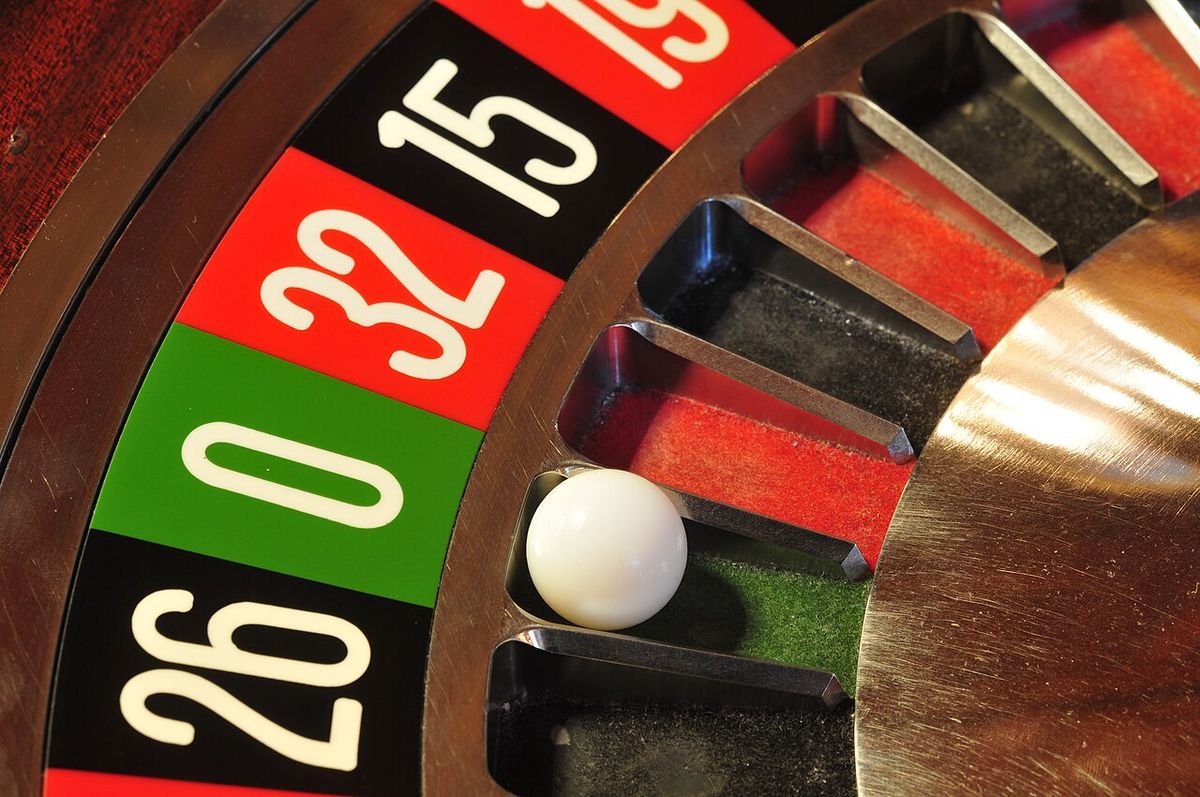
The roulette experience is defined by two central components: the wheel and the betting layout. The wheel is a large, circular dish with numbered and coloured pockets around its circumference. In Canada, players will encounter two primary wheel types. The American roulette wheel features 38 pockets: numbers 1 through 36, which alternate between red and black, plus two green pockets marked 0 and 00. The European roulette wheel, more common internationally but also available in Canadian casinos, has 37 pockets with a single green zero. The numbers on the wheel are not arranged sequentially but are distributed to create a balanced mix of high and low, and odd and even numbers around the circumference.
The roulette table is a large felt surface marked with a grid that mirrors the betting possibilities. The heart of the layout is a three-column grid displaying numbers 1 through 36 in consecutive order. Above this grid is an area for the zero (and double zero on American tables). Surrounding the number grid are boxes for outside bets, which cover larger groups of numbers. The entire table is typically bordered in green, and each betting position is clearly labelled. Canadian retailers like GameRoomDepot and Straight Poker Supplies manufacture and sell professional-grade tables for home use, built with Canadian lumber and custom cloth.
At a live casino table, players do not use standard casino chips. Instead, they purchase unique roulette chips of a specific colour from the dealer, assigning a value to them at the buy-in. This system allows the dealer to easily distinguish each player's bets on the shared layout. These coloured chips have no value elsewhere in the casino and must be cashed in at the same roulette table before the player leaves. Tables typically accommodate up to 10 players, and minimum and maximum bet amounts are posted clearly on a sign.
Inside Bets: Types, Odds and Payouts
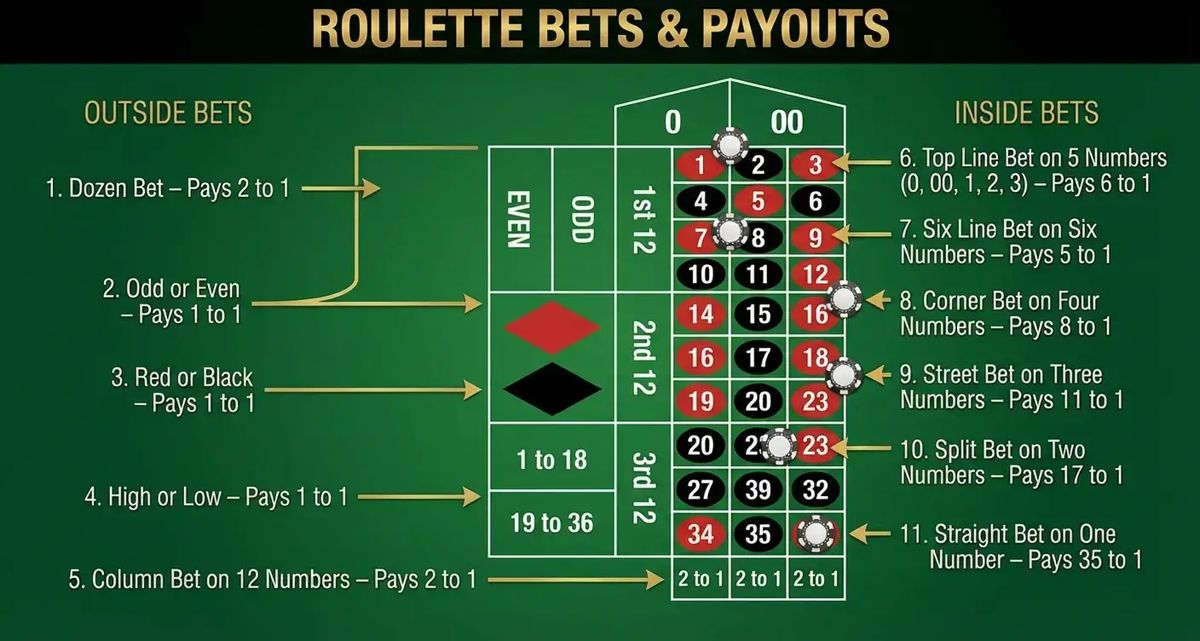
Inside bets are wagers placed directly on the numbered grid or on the lines between numbers. These bets cover fewer numbers, offering higher potential payouts but lower probability of winning. The exact placement of a chip determines the type of inside bet being made. All inside bet payouts are expressed as a ratio to 1, meaning a winning bet returns the original wager plus the stated multiple. For example, a 35 to 1 payout on a $1 bet returns $35 in winnings plus the original $1, for a total of $36. The specific inside bets, their placement, and their standard payouts are consistent across both American and European roulette, though the presence of the double zero affects the underlying odds.
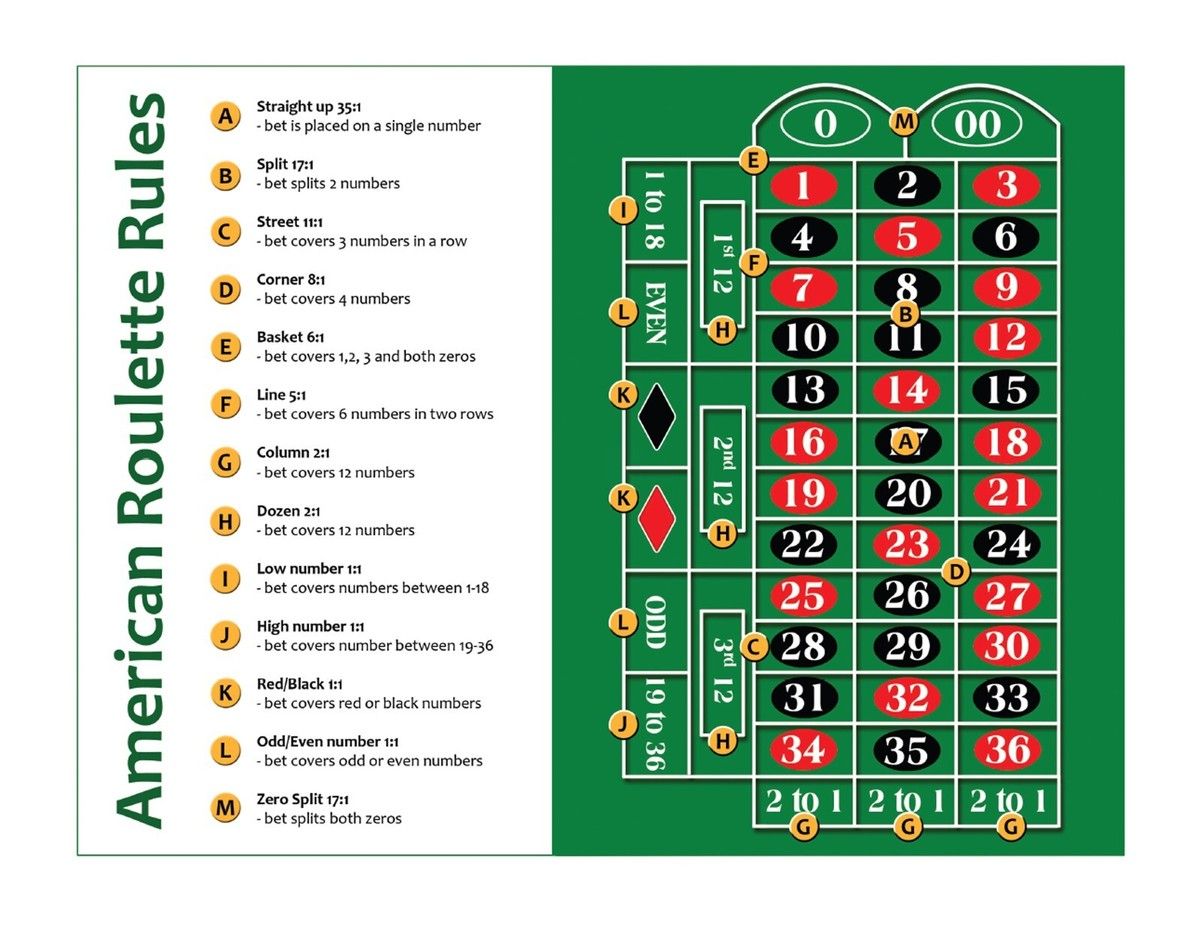
The primary inside bet options on a standard roulette table include bets on one, two, three, four, five, or six numbers. A straight up bet on a single number pays 35 to 1. A split bet on two connecting numbers pays 17 to 1. A street bet on three connecting numbers pays 11 to 1. A corner bet on four connecting numbers pays 8 to 1. A line bet on six connecting numbers pays 5 to 1. In American roulette, a top line bet on the numbers 0, 00, 1, 2, and 3 pays 6 to 1.
- Straight Up: A bet on a single number, including 0 or 00. The chip is placed directly in the centre of a number square. Payout: 35 to 1.
- Split: A bet on two adjacent numbers. The chip is placed on the line separating the two numbers on the layout. Payout: 17 to 1.
- Street: A bet on three consecutive numbers in a horizontal row (e.g., 1, 2, 3). The chip is placed on the outer edge of the row. Payout: 11 to 1.
- Corner (or Square): A bet on four numbers that meet at a corner (e.g., 1, 2, 4, 5). The chip is placed at the intersection of the four numbers. Payout: 8 to 1.
- Line Bet: A bet on six numbers comprising two adjacent rows (e.g., 1-6). The chip is placed on the outer edge where the two rows meet. Payout: 5 to 1.
A unique inside bet found only on American roulette tables is the Top Line or Basket bet. This is a wager on five numbers: 0, 00, 1, 2, and 3. The chip is placed at the corner where the 0 and 1 lines meet, or on some layouts, on a specific '00-0-1-2-3' box. This bet pays 6 to 1, which offers worse true odds than any other standard bet, contributing to a higher house edge on that specific wager. The house edge on this five-number bet is 7.29%, significantly above the American game's average of 5.26%.
Outside Bets: Types, Odds and Payouts
Outside bets are placed on the designated areas surrounding the number grid. These bets cover large groups of numbers, either 12 or 18, resulting in a much higher probability of winning but with lower payouts. They are often recommended for beginners due to their nearly even odds. Like inside bets, payouts are a ratio to the original wager. A 1 to 1 payout, known as 'even money,' returns an amount equal to the bet. The following outside bets are standard on both American and European roulette layouts. All even-money outside bets lose if the ball lands on zero or double zero.
- Red or Black: A bet that the winning number will be of the chosen colour. Payout: 1 to 1.
- Odd or Even: A bet that the winning number will be odd or even (zeros are neither). Payout: 1 to 1.
- High or Low: A bet that the winning number will be in the range 1-18 (Low) or 19-36 (High). Payout: 1 to 1.
- Dozen Bet: A bet on one of three groups of 12 numbers: 1-12 (1st dozen), 13-24 (2nd dozen), or 25-36 (3rd dozen). Payout: 2 to 1.
- Column Bet: A bet on one of the three vertical columns of 12 numbers on the main grid. The bet is placed in the '2 to 1' box at the bottom of the chosen column. Payout: 2 to 1.
On some electronic or advanced layouts, players may also encounter 'racetrack' betting for announced or neighbour bets, which are inside bets placed based on the wheel's physical sequence rather than the table layout. However, the core outside bets listed above are universally available. The minimum bet for outside wagers is typically applied per individual bet spot, meaning a player must wager at least the table minimum on a single Red square or a single Dozen box. This differs from inside bet minimums, which usually apply to the total amount wagered across all inside numbers.
Calculating Odds and House Edge
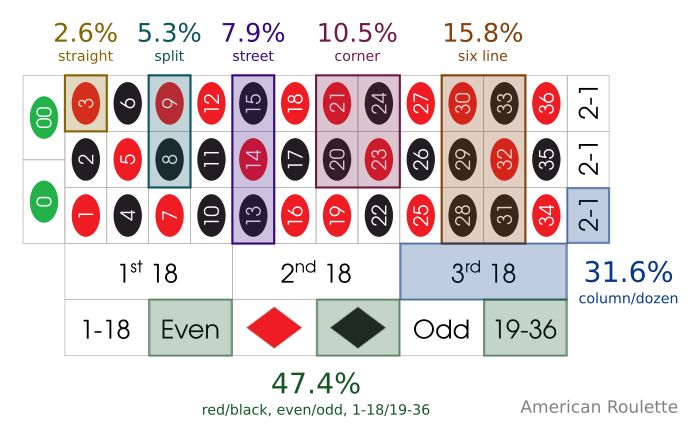
The odds of winning a particular roulette bet are determined by the number of possible winning outcomes versus the total number of pockets on the wheel. The payout offered by the casino is slightly less than the true odds, which creates the house edge, the casino's mathematical advantage over time. This edge is expressed as a percentage of the player's original bet that the casino expects to retain. The formula for calculating the payout for any bet is (36 / S) - 1, where S is the number of spaces the bet covers. The key difference between American and European roulette is the number of pockets, which directly impacts the house edge.
On a European wheel with 37 pockets, the probability of winning a straight-up bet is 1 in 37. The casino pays 35 to 1, while the true odds are 36 to 1. This discrepancy results in a house edge of 2.70%. The American wheel, with 38 pockets, has a probability of 1 in 38 for a single number. The same 35 to 1 payout against true odds of 37 to 1 creates a house edge of 5.26%, nearly double that of European roulette. The house edge varies slightly for different bets, though it averages to the figures above. The worst odds on a standard layout are for the American five-number Top Line bet.
On an American roulette wheel, the house edge is 5.26 percent, which is nearly double the 2.70 percent house edge on a European wheel. Common bets include a single number bet paying 35 to 1, a double number bet paying 17 to 1, and a three number bet paying 11 to 1. Other common bets are a four number bet paying 8 to 1, a dozen bet paying 2 to 1, and an odd or even bet paying 1 to 1. Red or black bets also pay 1 to 1.
| Bet Type | Numbers Covered | Probability of Win | Payout |
|---|---|---|---|
| Split | 2 | 5.26% (2/38) | 17 to 1 |
| Red/Black | 18 | 47.37% (18/38) | 1 to 1 |
French roulette is played on a European wheel with 37 pockets numbered 0 to 36. It introduces special rules for even money bets when the ball lands on zero. The 'La Partage' rule returns half of the player's even money wager to them. The 'En Prison' rule holds the player's even money bet for the next spin instead of losing it. This makes French roulette the most player favourable version of the game.
Gameplay Procedure in a Canadian Casino
Playing roulette at a Canadian casino like Fallsview or a Loto-Québec establishment follows a standardized procedure. A player first selects a table with a minimum bet that suits their budget. They exchange cash for uniquely coloured roulette chips from the dealer, specifying the value per chip. Players then place their chips on the desired betting areas on the layout. All bets must be placed before the dealer announces 'No more bets' or 'Rien ne va plus'. The dealer spins the wheel in one direction and launches the ball in the opposite direction.
Once the ball loses momentum and drops into a numbered pocket, the dealer announces the winning number, its colour, and whether it is odd or even. They place a marker, or 'dolly', on the winning number on the table layout. The dealer then collects all losing chips from the table and proceeds to pay out winning bets according to the posted odds. Winning roulette chips remain on the table for the next round unless the player chooses to remove or change them. Players are responsible for the correct placement of their bets, even if assisted by the dealer.
It is crucial for players to cash in their special roulette chips at the table before leaving. These coloured chips have no value at other tables or the cashier. Responsible gambling resources are promoted within Canadian casinos. For instance, BCLC directs players to GameSense.com for information, and the PlaySmart website is a resource for Ontario players. Provincial helplines, such as 1-888-795-6111 in British Columbia, are available for those concerned about their gambling. The legal age to play is 19+ in most provinces, and 18+ in Alberta, Manitoba, and Quebec.
Roulette Variants and Modern Formats
Beyond the standard American and European versions, several roulette variants and electronic formats are available to Canadian players. French roulette, as noted, uses a European wheel but with special rules for even-money bets when zero hits, lowering the house edge. Casinos also offer modern electronic versions that change the gameplay dynamic. Fallsview Casino Resort, for example, features electronic roulette tables. Rapid Roulette is a common format where players place bets on individual video terminals linked to a central, automated wheel, speeding up the game with scheduled spins.
Some game developers have created innovative variants that alter payouts or add bonus features. Games like Lightning Roulette or Roulette Xtra randomly multiply the payouts on certain straight-up numbers after betting closes, offering potential wins of up to 200 to 1 or more. Another exclusive variant mentioned in industry notes is Venetian Roulette, which incorporates a third zero space marked with a logo, further increasing the house edge. These games maintain the core roulette mechanics while adding layers of novelty.
For home entertainment, a substantial market exists in Canada for roulette equipment. Companies like Straight Poker Supplies in Toronto build custom professional-series tables with Canadian lumber, foam padding, and dye-sublimated cloth. Retailers such as MRC Poker Store and GameRoomDepot sell roulette wheels, felt layouts, and complete sets for home casino nights, offering Canada-wide shipping. These products allow adults to experience the game in a private, non-gambling setting, with options ranging from basic 16-inch wheel sets to full-size 8-foot tables built to order. Fallsview Casino Resort has 4 roulette tables in its Privé area and 9 on the main floor.
Questions about Roulette odds and payouts
What is the difference between American and European roulette wheels?
The primary difference is the number of pockets on the wheel. An American roulette wheel has 38 pockets: numbers 1 through 36, a single zero (0), and a double zero (00). A European roulette wheel has 37 pockets, featuring the same 1-36 numbers but only a single zero. The extra double zero on the American wheel increases the house edge from 2.70% to 5.26%. The sequence of numbers around the wheel's circumference also differs between the two types.
What is the best bet in roulette?
However, these pay only 1 to 1. No bet offers a player advantage, as all have a built-in house edge. The 'best' bet depends on a player's goal: outside bets for more frequent, smaller wins, or inside bets for a lower chance of a larger payout. The five-number Top Line bet on American roulette has the worst odds for the player.
How do roulette chip values work?
In live roulette, players do not use standard casino chips. Instead, they buy in with cash and receive a set of chips in a colour unique to them at that specific table. The player decides the value of each chip with the dealer when purchasing them, for example, $1 or $5 per chip. These coloured chips have no marked denomination and can only be used at that roulette table. Before leaving, players must exchange them back for regular value chips or cash at the same table.
What does a 35 to 1 payout mean?
A payout of 35 to 1 means that for every 1 unit wagered, the player wins 35 units in profit, plus the return of their original wager. If you bet $1 on a single number and win, you would receive $35 in winnings plus your original $1 back, for a total of $36. This payout is for a 'Straight Up' bet. All roulette payouts are expressed as a ratio to 1, indicating the multiple of the original bet that is paid as profit.
Can you play roulette online in Canada?
Yes, many licensed online casinos offer roulette to Canadian players. These digital platforms typically feature both American and European roulette variants, along with modern versions like Lightning Roulette. Online play uses a random number generator to determine outcomes. The rules, odds, and payouts are generally the same as the live game, with interfaces that replicate the wheel and table layout. Players must be of legal age in their province, which is 19+ in most jurisdictions and 18+ in Alberta, Manitoba, and Quebec.
What is the house edge in roulette?
The house edge is the mathematical advantage the casino holds over the player, expressed as a percentage of each bet. In European roulette (single zero), the house edge is 2.70%. This means for every $100 wagered, the casino expects to retain $2.70 on average over time. In American roulette (double zero), the house edge is nearly double, at 5.26%. This higher edge is solely due to the extra 00 pocket, as the payouts for individual bets are the same on both wheels.
Sources and further reading
- How to Play Roulette (venetianlasvegas.com)
- Roulette Odds Explained | Bet Types & Payouts (playsmart.ca)
- How To Play Roulette (casinosbc.com)
- Roulette Payout Calculator (omnicalculator.com)
- Roulette Wheel Numbers, Layout & Sequence (partycasino.com)
- How to Play Roulette (playsmart.ca)
Checked by the Nosy Mag desk. Last updated 2026-11-11.