Tri Peaks
Tri Peaks, also known as Three Peaks or Tri Towers, is a single-deck solitaire card game created in 1989 by Robert Hogue. Its distinctive layout of three overlapping pyramids of cards and its fast-paced, strategic gameplay have made it a popular digital pastime. The objective is to clear all cards from the three peaks by moving them to a waste pile, matching cards that are exactly one rank higher or lower than the current top card, regardless of suit.
Gameplay and Rules
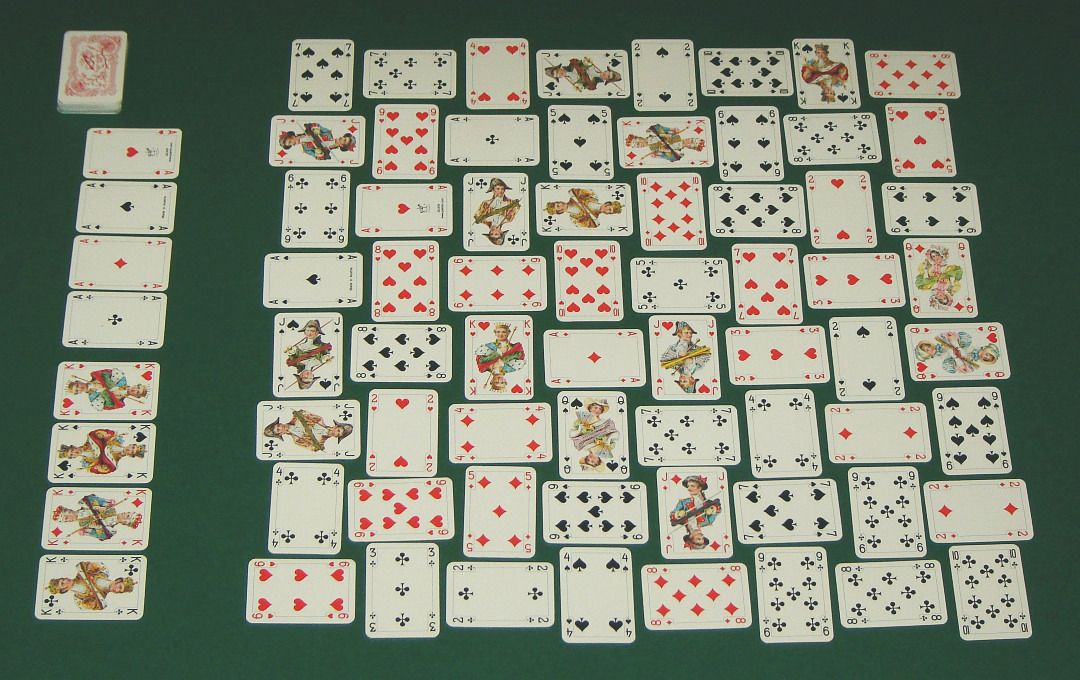
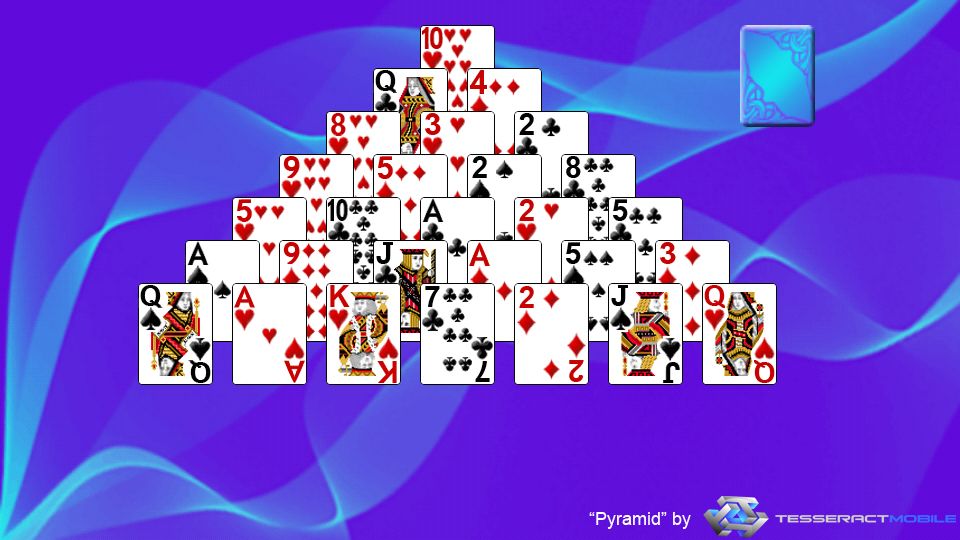
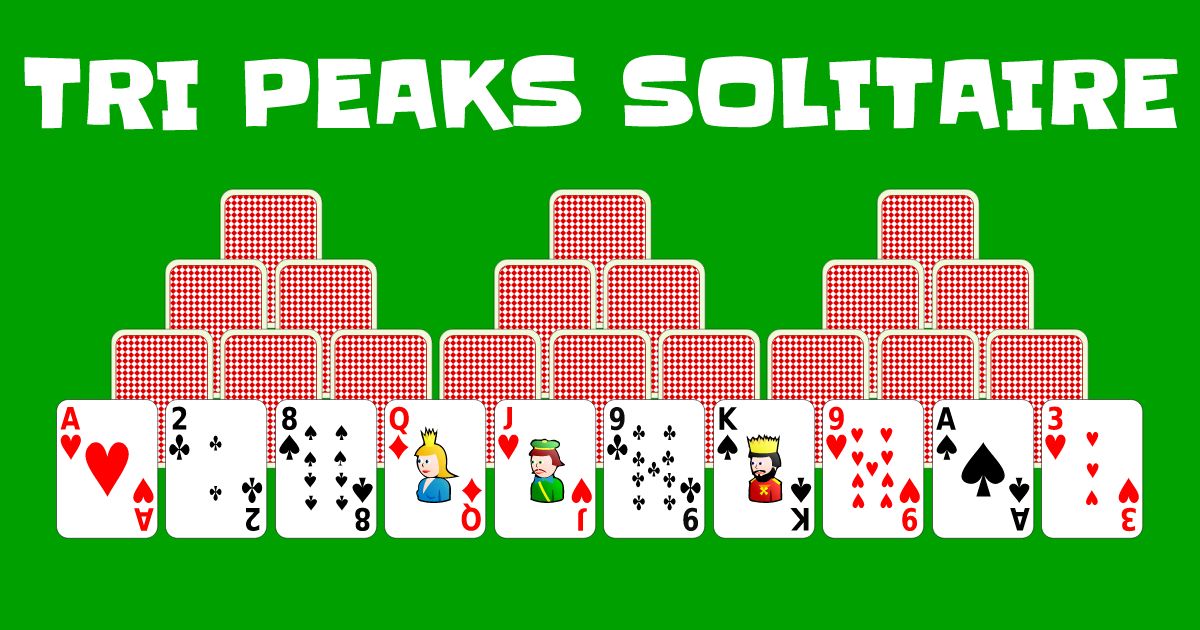
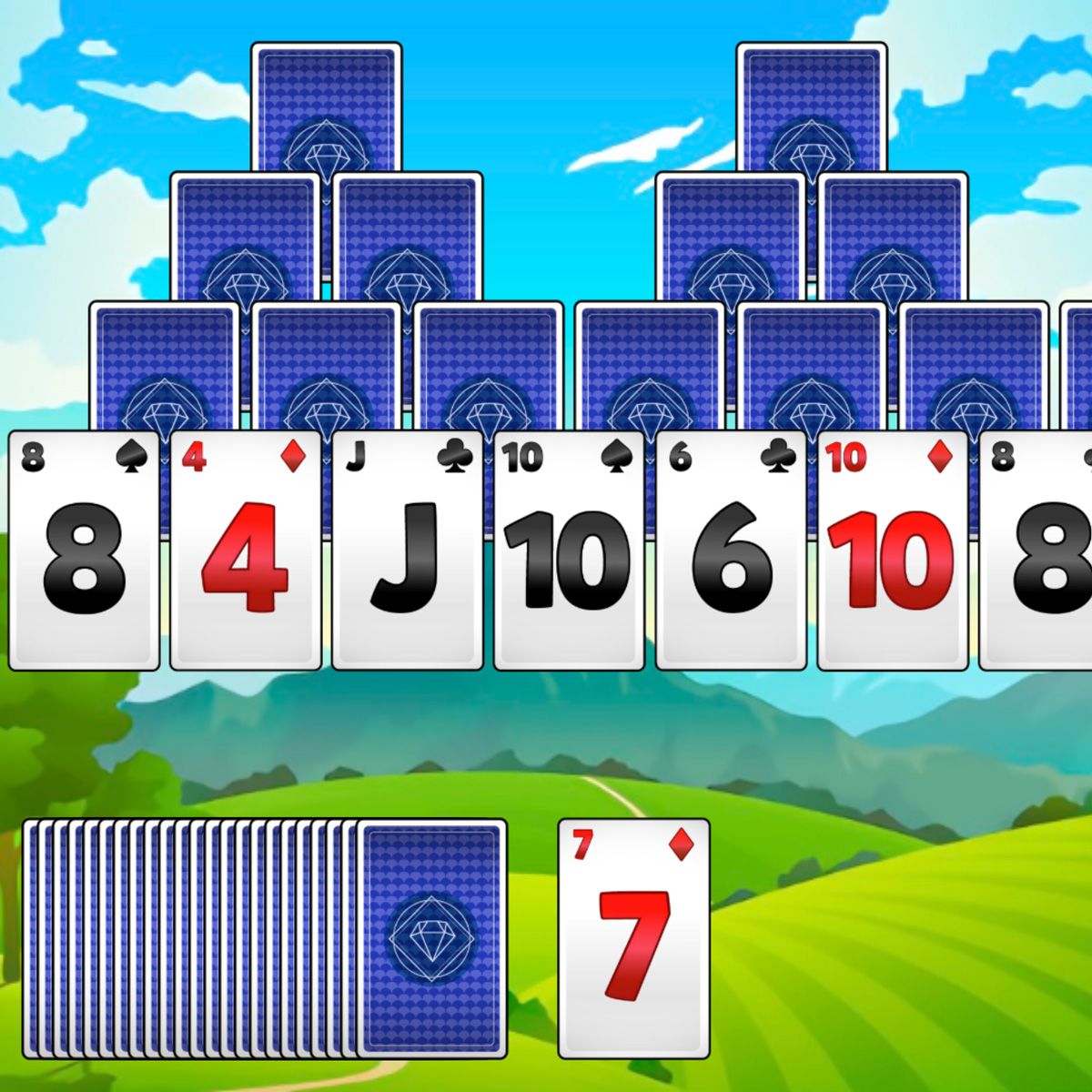
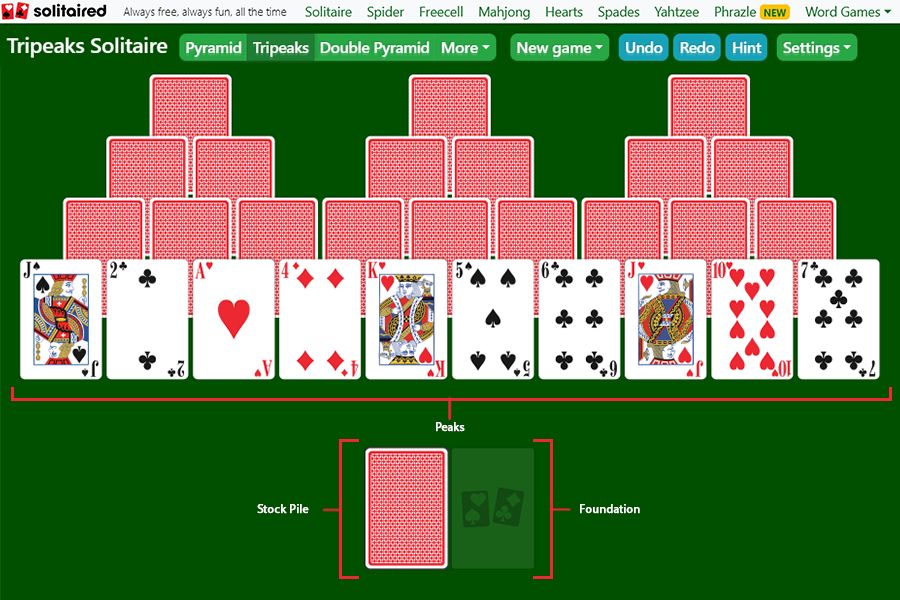
The game begins with a specific tableau layout built from a standard 52-card deck. First, ten cards are dealt face-up in a horizontal row. Above this, nine cards are dealt face-down, offset to the right, followed by a row of six face-down cards, and finally three face-down cards to cap the three peaks. This creates a tableau of 28 cards, with only the bottom row initially visible. The remaining 24 cards form the stock pile. The first card from the stock is turned face-up to start the waste pile, which is also called the foundation or discard pile. The core rule of play is that a card from the tableau can be moved to the waste pile only if it is exactly one rank higher or one rank lower than the current top card on the waste. Suits and colours are irrelevant for matching. For example, if the top waste card is a 7, you may play any 6 or 8 from the exposed tableau cards. When a card is removed from the tableau, any face-down cards it was covering are turned face-up and become available to play. This process of building sequences continues as long as possible. When no legal move exists from the tableau, a new card is drawn from the stock and placed on the waste pile, potentially starting a new sequence. The game is won when all 28 cards from the three peaks are cleared and moved to the waste pile. The game is lost if the stock is exhausted and no further moves are possible from the remaining tableau cards.
A key strategic element involves managing the sequence of moves to maximize the number of consecutive plays without drawing from the stock. Each time you draw a card from the stock, it represents a lost opportunity for a streak bonus in scoring versions of the game. Players must carefully survey the tableau before drawing, as overlooking a single playable card can break a valuable sequence. The initial layout means many cards are hidden, so a primary goal is to strategically remove cards from the peaks to reveal the face-down cards beneath them, thereby expanding future options. The game does not allow rank wrapping in its standard form, meaning an ace cannot be placed on a king, nor a king on an ace, as aces are considered low. A common beginner-friendly variant, sometimes called Easy Tri Peaks, does allow this wrapping of ranks to make the game more accessible. The game can also be played with a wild card or with all cards in the peaks face-up, which changes the strategic depth.
History and Development
Tri Peaks was invented in 1989 by Robert Hogue. The game was designed not just as a static solitaire variant but as a flexible system that could accommodate different card layouts, with the three-peak formation being the original and most popular. Hogue performed extensive computer statistical analysis on his creation, revealing that over 90% of all possible game deals are theoretically solvable. His analysis of the original scoring system indicated that a perfect theoretical average score of 60 points per game was possible, suggesting the scoring was balanced so that the cost of using the stock pile could be offset by points earned from creating long streaks during play. In practice, however, achieving a perfect score is extremely difficult because only a portion of the cards are known at the start of a deal. The average score for most players is around 12 points, while skilled players employing better strategies can average over 17 points per game.
The game first reached a wide audience as part of the Windows Entertainment Pack 3, a collection of casual games for early versions of the Microsoft Windows operating system. Its popularity was cemented when it was later included as a standard game within the Microsoft Solitaire Collection, which is bundled with Windows. This inclusion introduced the game to millions of users globally. Hogue's intention for others to create new layouts and balanced scoring rules has led to the game being extensively modified and featured in many different digital card game collections and standalone applications over the decades.
Scoring and Strategy
While Tri Peaks can be played simply to clear the peaks, many digital implementations feature a scoring system that adds a competitive layer and influences strategy. In a typical scoring model, each card successfully moved from the tableau to the waste pile earns a base number of points, often 5 or 10. The real score multiplier comes from creating streaks, which are consecutive moves made without drawing a new card from the stock. Each subsequent move in a streak increases a multiplier, dramatically boosting the points earned per card. For instance, the first card might be worth 5 points, the second 10, the third 15, and so on. Clearing all three peaks usually awards a substantial completion bonus, often 100 points. Conversely, leftover cards in the stock pile at the end of the game may result in point deductions, penalizing inefficient play that required too many draws.
Effective strategy in Tri Peaks revolves around maximizing these streaks and carefully managing the stock. The primary goal is to reveal face-down cards as quickly as possible to open up more options. This often means prioritizing the removal of cards that are blocking multiple hidden cards beneath them in the pyramid structure. Before drawing a new card, players should meticulously scan the entire tableau to ensure no playable card has been missed. When multiple moves are available, the optimal choice is usually the one that uncovers the most new cards or preserves the broadest range of future sequences, rather than simply extending the current streak by one card. Understanding that the game is over 90% solvable in theory encourages persistence and thoughtful planning, even when the path to victory is not immediately obvious. In the original scoring, winning was less about clearing the peaks and more about making the best choices to create better winnings and limit losses, possibly by quitting early.
- Prioritize uncovering face-down cards to expand your options.
- Build long streaks to maximize your score multiplier.
- Survey the entire tableau before drawing from the stock.
- Choose moves that open the most future possibilities, not just the current streak.
- Manage your stock draws efficiently, as each draw resets your streak multiplier.
Digital Availability and Platforms
Tri Peaks is widely available across numerous digital platforms, catering to both casual and dedicated players. The most accessible versions are free-to-play browser-based games on websites like Solitaire Bliss, Pogo, and CardGames.io, which require no download or registration. These sites often feature clean interfaces, optional hints, and undo functions. For a more polished offline experience, dedicated applications are available for Windows PCs, with one notable release dated for October 8, 2026, offering features like live statistics, streaks, and hints. The game has also found a home on gaming consoles, with Summer Tri-Peaks Solitaire available for purchase on the Nintendo Switch for CAD $8.99, featuring beautiful animations, daily challenges, and a left-handed mode.
The game's presence in the Microsoft Solitaire Collection ensures it remains a staple on Windows computers. Many digital versions introduce variations to adjust difficulty, such as the aforementioned Easy Tri Peaks with rank wrapping, or the use of a wild card to facilitate clearing the peaks. Some platforms also offer themed versions, like Santa Tripeaks or Holiday Tripeaks, and progressive level-based challenges that gradually increase in complexity. The availability of daily challenges and global leaderboards on some platforms adds a social and competitive element, encouraging repeat play and skill improvement.
Game Statistics and Winnability
The perceived and actual difficulty of Tri Peaks varies depending on the rule set and the source of analysis. Robert Hogue's original computer analysis concluded that over 90% of deals are solvable, indicating a very high potential win rate with perfect play. However, in practice, the win rate for human players is significantly lower due to hidden information and suboptimal decisions. Different online platforms report varying statistics. Conversely, other sources cite a win rate as low as 16% for the standard game, classifying it as relatively difficult to beat. This discrepancy likely stems from differences in scoring rules, whether rank wrapping is allowed, and the skill level of the player base being measured.
| Game Variation | Reported Win Rate | Notes |
|---|---|---|
| Standard Tri Peaks | 16% | Considered relatively difficult. No rank wrapping. |
| Theoretical Solvability | Over 90% | Computer analysis by inventor Robert Hogue. |
| Easy Tri Peaks (with wrap) | Higher than standard | Described as a good introduction for beginners. |
| Golf Solitaire (similar game) | 16.27% | Provided for comparison in one analysis. |
Related Solitaire Games
Tri Peaks belongs to a family of solitaire games that emphasize sequencing and clearing a tableau through rank-based matching, rather than building suits in foundation piles. Its closest relatives are Golf Solitaire and Black Hole. Golf Solitaire shares the fundamental rule of moving cards from a tableau to a waste pile if they are one rank higher or lower, though its tableau layout is different. Black Hole is another single-deck game where all cards are eventually played to a single foundation pile. Tri Peaks also shares conceptual similarities with Pyramid Solitaire, which involves pairing cards to equal a specific total to remove them from a pyramid layout. The strategic focus on uncovering hidden cards and managing sequences makes Tri Peaks a distinct and engaging member of this group.
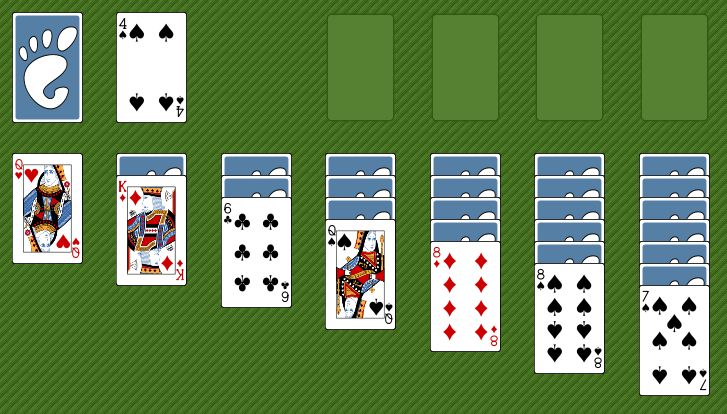
- Golf Solitaire: Features a tableau of seven columns. The core matching rule is identical to Tri Peaks.
- Black Hole: All cards are eventually played to a single foundation, with different placement rules.
- Tower Solitaire: A listed variant often grouped with Tri Peaks and Golf games online.
- Scottish Solitaire: Another game frequently categorized alongside Tri Peaks on gaming portals.
- Microsoft Solitaire Collection: The software bundle that popularized Tri Peaks.
- Glossary of solitaire terms: A reference for game terminology.
Questions about Tri Peaks
How do you play Tri Peaks Solitaire?
You play Tri Peaks using one standard deck. The goal is to move all 28 cards from the three pyramid-shaped peaks onto a single waste pile. You can only move a card from the peak if it is one rank higher or one rank lower than the current top card on the waste pile. Suit does not matter. When you remove a card, any face-down cards it was covering are turned face-up. If you have no moves, you draw a new card from the stock pile onto the waste to try to start a new sequence. You win by clearing all cards from the peaks. The game can also be played with a wild card or with all cards face-up for variation.
Is Tri Peaks Solitaire free to play online?
Yes, numerous websites offer Tri Peaks Solitaire completely free to play directly in your web browser with no download or registration required. Popular sites include Solitaire Bliss, Pogo, and CardGames.io. These browser-based versions provide the full game with features like undo and hints. There are also free downloadable apps for various devices, as well as premium versions like the one for Nintendo Switch, which costs CAD $8.99.
What is the win rate for Tri Peaks Solitaire?
Reported win rates vary. The game's inventor, Robert Hogue, determined through computer analysis that over 90% of deals are theoretically solvable with perfect play. Other sources cite a win rate as low as 16% for the standard game, classifying it as relatively difficult. The easier 'Easy Tri Peaks' variant, which allows rank wrapping, has a higher win rate and is recommended for beginners.
What are the best strategies for Tri Peaks?
Key strategies include focusing on uncovering face-down cards to increase your options, as this is essential for solving the game. Try to build long sequences of consecutive moves without drawing from the stock to earn higher scores in point-based versions. Always scan the entire tableau carefully before drawing a new card. When you have multiple moves available, choose the one that reveals the most new cards or keeps the most pathways open for future plays, rather than just making the easiest immediate move. In the original scoring, strategy also involved managing risk and potentially quitting a hand early to limit losses.
Who invented Tri Peaks Solitaire and when?
Tri Peaks was invented in 1989 by Robert Hogue. He designed the game to allow for various card layouts, with the three-peak formation being the original. Hogue performed statistical analysis on the game, revealing its high solvability and that an average score of 60 was theoretically possible under the original scoring system. It first gained widespread distribution as part of Windows Entertainment Pack 3.
What is the difference between Tri Peaks and Golf Solitaire?
Both games use the same core rule: moving cards from a tableau to a waste pile if they are one rank higher or lower. The main difference is in the tableau layout. Tri Peaks uses three overlapping pyramids of cards, while Golf Solitaire typically uses a layout of seven columns of five overlapping cards each. The strategic feel differs due to the layout. Tri Peaks often involves more focus on uncovering specific blocked cards within the pyramid structure. Both are part of the Microsoft Solitaire Collection.
Sources and further reading
- Tri Peaks (Wikipedia)
- Tripeaks Solitaire (games.aarp.org)
- Tripeaks Solitaire and Golf Solitaire Games, One higher or one lower (cardgame.com)
- Play TriPeaks Solitaire Free Online (thesolitaire.com)
- Tri Peaks Solitaire, Play Online for Free (solitairebliss.com)
- Tri Peaks Solitaire | Play it online (cardgames.io)
- Tripeaks Solitaire (games.aarp.org)
Checked by the Nosy Mag desk. Last updated 2026-11-10.