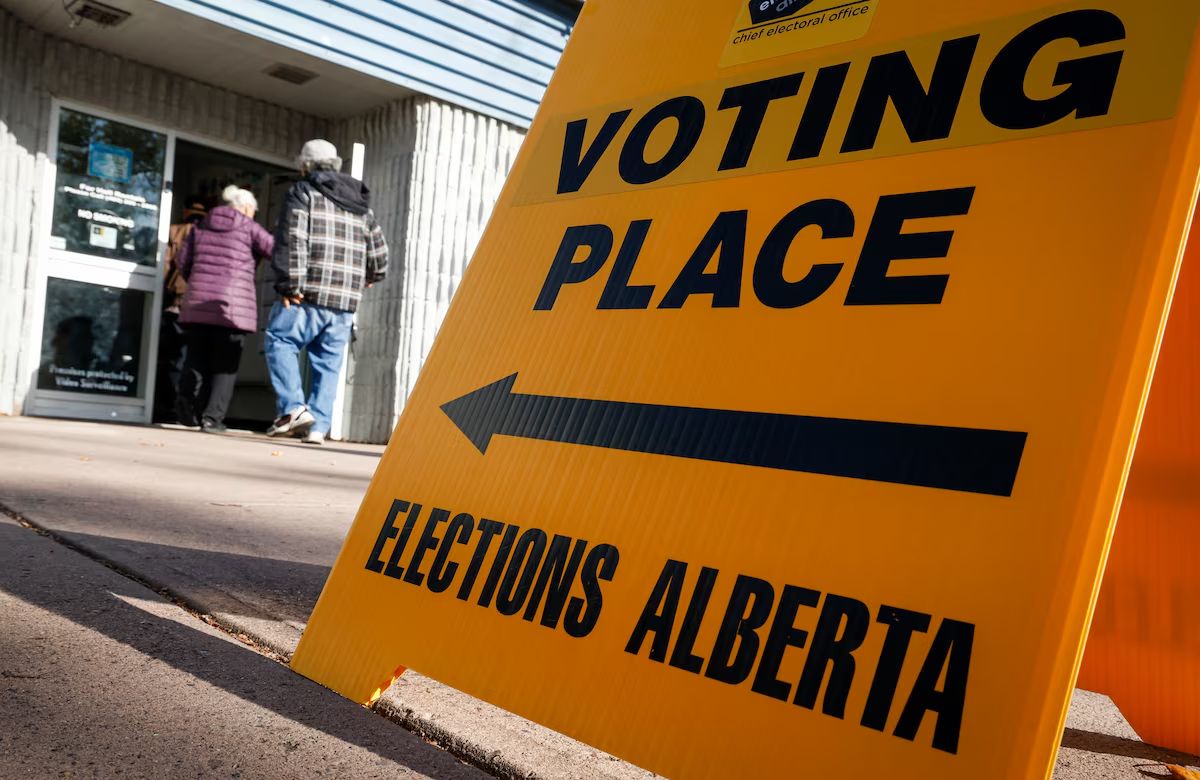
Albertans vote to stay in Canada, endorse changes to immigration and constitution
While rejecting a future independence vote, Albertans voted yes to nine other questions on immigration restrictions and constitutional reform.
EDMONTON — Albertans have voted decisively to remain in Canada, with unofficial referendum results showing a majority rejecting a future binding vote on independence.
As of early Tuesday morning, with more than 71 per cent of polling stations reporting, more than 1.3 million votes had been cast for Alberta to remain a province of Canada, while just over 414,000 votes went towards the option of holding a binding referendum on separation.
“Albertans made a clear choice,” Prime Minister Mark Carney said in a social media post shortly after results began rolling in. “They chose unity, to build together, and to take care of each other.”
READ MORE: Alberta Premier Danielle Smith votes to stay in Canada in separation referendum
READ MORE: Carney and Smith rally for Canadian unity as Alberta referendum nears
Alberta Premier Danielle Smith said she was pleased with the result. “I’m very pleased to see the initial results from Elections Alberta show widespread support for remaining in Canada,” she said in a social media post. “Albertans have voted for a stronger Alberta in a united Canada.”
However, the nine other questions on the ballot, which focused on immigration and constitutional issues, were backed by majorities favouring change.
Question 1, on taking increased control over immigration to decrease numbers to “more sustainable levels,” saw 58.6 per cent support. Questions 2, 3 and 4, which proposed restricting access to social programs and charging fees for health care and education for some immigrants, also passed with between 56.9 and 58.2 per cent support.
Question 5, requiring proof of citizenship to vote in provincial elections, passed with 62.7 per cent support.
Constitutional questions also saw majority support. Question 6, on provinces selecting their own judges, passed with 50.7 per cent. Question 7, to abolish the Senate, passed with 52.9 per cent. Question 9, to give provincial laws priority over federal ones in conflicts, passed with 52.1 per cent.
Question 8, on allowing provinces to opt out of federal programs without losing funding, was narrowly defeated with 50.8 per cent voting no.
In the British Columbia border community of Sparwood, residents expressed relief at the separation result but concern about the other questions. “I think it’s a little bit ridiculous,” said resident Serena Baran of the referendum, questioning the logic of separation when it could result in people needing passports to go to work.
“I think we really need to stick together and be united,” she said. “It’s terrible that we’re at this point.”
Tony Wheeler, who has lived in Sparwood for 40 years, said he thinks people in favour of separation haven’t fully thought through the implications for border communities. “It sounds easy, just separate, but it’s not,” he said.
The Business Council of Alberta has stood against separation, saying it would bring with it “profound uncertainty and risks.”
Voting was delayed on Monday, with some polling stations staying open past the scheduled 8 p.m. close. Results only began to be released to the public once all polling stations closed, which occurred around 11 p.m.
Prior to Monday’s vote, a large number of electors had already cast their vote early. In all, 837,791 ballots were cast in advance voting and Elections Alberta had received and processed 519,082 mail-in or special ballots.
The other results provide a more troubling glimpse into voters’ satisfaction levels within the Canadian federation, with each of the nine questions backed by majorities that favour a change to the status quo.
In a podcast interview last week, Prime Minister Carney said he “(got) the point about an unelected Senate,” and admitted that “the Constitution is not unamendable.” “But it requires building a real consensus around what’s necessary to change and why it (should) change and which elements you are going to change,” he told host Ryan Jespersen.
Alberta Premier Danielle Smith will deliver an address to the province at 6:45 p.m. Tuesday to discuss the referendum results and what the next steps for the province will be.
With files from CityNews, CBC News and Calgary Herald