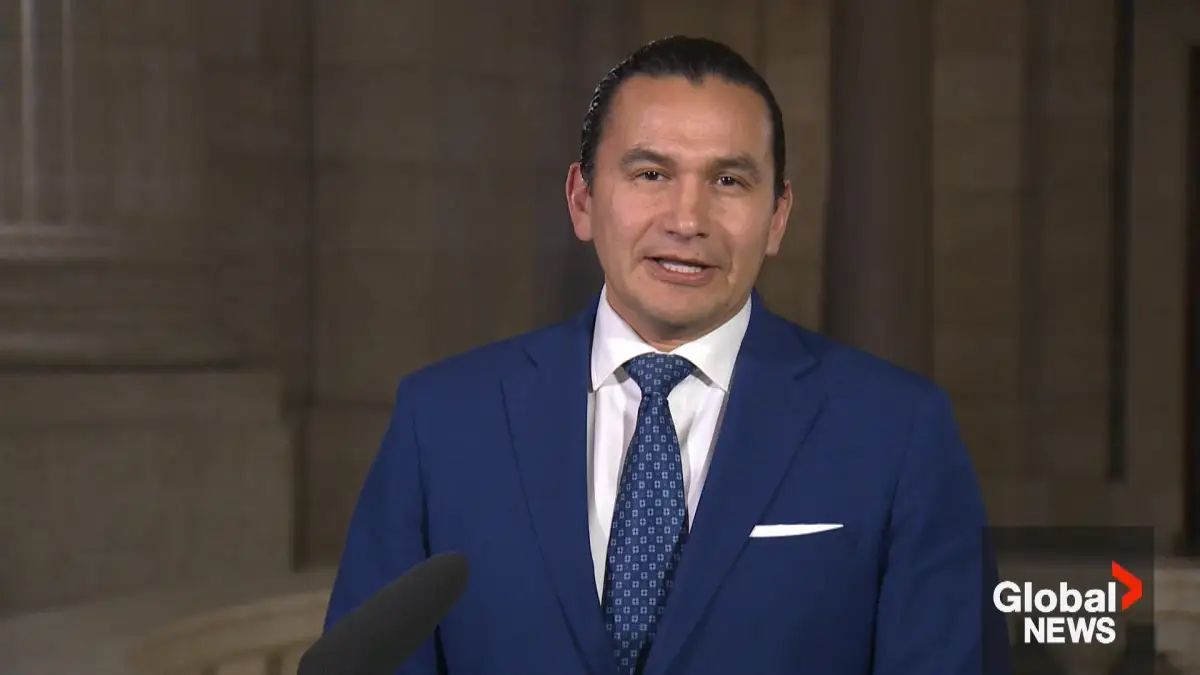
Manitoba premier opposes criminalizing residential school denialism
Premier Wab Kinew says education, not criminal law, is the way to combat misinformation about residential schools.
Manitoba Premier Wab Kinew says residential school denialism is detestable but should not be made a crime, putting him at odds with a federal MP's proposed legislation.
"I have a lot of respect for MP Gazan, but I don't think we can criminalize this. I think we have to just do the continued work of educating people and trying to combat misinformation," Kinew told CBC Manitoba Up to Speed host Marcy Markusa on Friday.
He was referring to Bill C-254, a private member's bill from Manitoba NDP MP Leah Gazan that seeks to amend the Criminal Code.
READ MORE: Truth and Reconciliation Day events confront residential school denialism
READ MORE: Manitoba and Brandon buy campground holding residential school graves
The bill would make it illegal for anyone to condone, deny, justify or minimize the Indian residential school system in Canada through any statements beyond a private conversation.
Gazan first introduced the bill in October 2024, but it died when the spring 2025 election was called. She reintroduced it in October 2025.
"If the government is serious about reconciliation, then they need to protect survivors and their families from hate," Gazan said when she first introduced it.
"The residential school system was a genocide designed to wipe out Indigenous cultures, languages, families and heritage. To downplay, deny or justify it is cruel, harmful and hateful."
The bill has had its first reading but has yet to reach a second reading. All bills must go through three readings, committee reviews and final debates before becoming law.
Kinew spoke about the importance of education while reflecting on recent events for the National Day for Truth and Reconciliation.
On Sept. 30, he announced the province partnered with the City of Brandon to buy a popular campground property that was once part of the Brandon Residential School, which ran from 1895 until 1972.
The site included a former school cemetery, used from 1895 to 1912, and still contains the remains of children, the province said.
Sioux Valley Dakota Nation, which owns the land where the school once stood, will guide decisions around the former cemetery and is working with university researchers to identify the more than 50 children it believes are buried there.
Kinew, who dedicated a memorial at the site on Sept. 30, said such events help educate the public.
"It's very well-documented. It's very historic. So let's make sure that we keep that history alive in our living memory as a province," he said.
Rev. Stan McKay, a survivor of the Fisher River and Birtle residential schools, called the purchase of the cemetery land a “very important piece” of reconciliation.
His maternal grandparents were forced to attend the Brandon Residential School for a good part of their life and never talked about it, he said.
"It was not a good place," McKay said the day of the province's announcement.
McKay would like to see more education in Manitoba schools around the residential school experience, localized to stories about the 18 schools that operated in the province.
Kinew agreed that would be a good idea and said much more is being done in schools now than in previous decades.
"How much did we learn about residential school in K-12 versus what a kid today learns? It's night and day in terms of being so much more," he said.
He said there is also a need to educate adults no longer in school.
"As we were preparing for Brandon … I was talking to some of my staff that I work with very closely, very smart people, and I pulled out the volume of the Truth and Reconciliation Commission that documents the child deaths. People were shocked. They didn't know [the number of deaths]," Kinew said.
"So for sure there's more needs to be done in the K-12 system, but I think there's also a lot in the workplace, in churches, in sports, all the venues where we gather as Manitobans, where we need to keep this thing alive."
He added, "The thing that we don't want to happen is for this to fade from our living memory, and then we forget, and then maybe some of the the negative lessons we should have learned start to re-emerge."
For a period of more than 150 years, from the 1830s until 1997, First Nations, Inuit and Métis children were taken from their families and communities to residential schools, often far from their homes.
Most were government-funded and run by Christian religious organizations. The schools were designed to assimilate Indigenous children into Euro-Canadian culture.
An estimated 150,000 children across Canada attended the schools and the National Centre for Truth and Reconciliation has documented more than 4,000 who died while attending them.
With files from CBC News